What Is Fetal Station? The 3 Pelvic Levels Explained

Fetal station helps us understand how high or low baby is in the pelvis! Depending on what station baby is will determine what type of movement patterns we should do to help create more space to facilitate labor progress!
Diaphragmatic Breathing Breakdown: Inhales are NOT Relaxation

A common phrase you may hear is that we inhale to relax, and exhale to contract. However, this notion is not accurate. Inhalations are a lengthening down and out, which increases pressure. If I stretched a rubber band, I would not consider that a state of relaxation: that would be a state of tension!
Prenatal Workout: Leg Day

Exercising Throughout Pregnancy Benefits Improves your comfort throughout pregnancy Decreases the risk of occurrence of a prenatal complication Decreases labor time and interventions Improves baby’s resiliency and strength at birth And so much more! Here is a leg day workout that we offer in our 40-week prenatal programming, and the rationale behind our approach! Our […]
Diastasis Recti (DRA): Approaching Core Exercises to Enhance Healing

Diastasis Recti Abdominis (DRA) Diastasis Recti Abdominis (DRA) is the normal separation of the six-pack abs at the Linea alba (connective tissue that connects the six-pack abs) during pregnancy. This separation is a normal adaptation to pregnancy and required to allow baby’s growth to not be impeded. With DRA, the tissues and muscles of the […]
Breastfeeding Positions: 5 Helpful Holds for You and Baby

Table of Contents Breastfeeding Positions There are so many options on how we choose to feed our babies. If you choose breastfeeding, this blog post will be breaking down a few common breastfeeding positions to help you better understand which techniques may be beneficial for you! Initial Latch Position: Cross Cradle The cross cradle position […]
5 Prenatal Core Exercises: Beyond the Sit Up and Crunch to Protect Your Prenatal Core!

We can, and should, still strengthen our core throughout pregnancy! We need a strong core to stabilize our spine, and to support our functional movement, as our belly grows and our body adapts to pregnancy. A strong abdominal wall can also support your baby’s position! But, remember, strong doesn’t mean tight! Strong means best able to respond to demand and changes in the environment!
This blog will share five of our favorite prenatal core exercises.
Pelvic Girdle Pain in Pregnancy: 5 Tips for an Easier Labor

Laboring with pelvic girdle pain, such as pubic symphysis dysfunction or SPD, can make certain laboring positions painful. Movement helps to facilitate the labor process; the more we move the more we can wiggle and rock baby through the pelvis, and increase the space in the various pelvic levels! Learn how to approach labor with pelvic girdle pain, and find relief during pregnancy!
5 Ways Your Partner Can Support Pushing During Birth!

Your partner can help support pushing with a few tips! They can be your best advocate for how you want to push and guiding you to meet your baby.
Cardinal Movements of Labor: 2 Positions to Help Baby
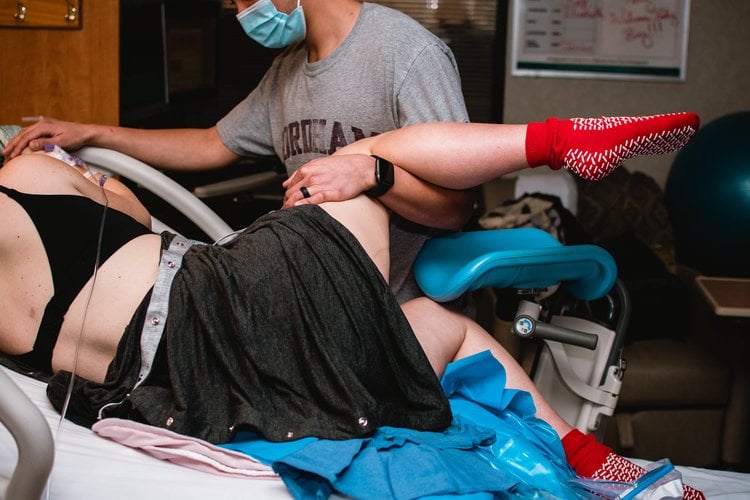
One of the things you may hear while pushing, especially if you have been pushing for a while, is that “baby is rocking back and forth to get under the pubic bone.” But, what does this mean, and is there a way to facilitate this happening faster? There are positions we can emphasize to help create more space in the lower midpelvis to facilitate the final rotation for baby during birth!