



Movement is important to help baby rotate through the pelvis. Movement creates space in the different layers of the pelvis (inlet, midpelvis, and outlet) and is a necessary part of the labor process. Most moms will report they feel that they are in more pain when they are restrained in the bed compared to when they can move with their contractions; so movement can even be a source of pain relief!
But what happens when you get an epidural? How can you still have movement when you cannot get out of the bed?
With some help from your birth partner, doula, nurses, and a **peanut ball.
**Almost all hospitals should have a peanut ball, but it may be a good idea to confirm on your labor and delivery tour.
Why did you get an epidural?? Exhaustion Considerations
There are a number of ways to facilitate movement when you are somewhat immobile with an epidural.
First, we should consider why you got an epidural in the first place. Did you get an epidural because you were exhausted and needed to rest? Priority should be resting before we start doing any serious movement.
But we can consider where we last understood baby to be in your pelvis (inlet, midpelvis, outlet) so that we can position the peanut ball appropriately.
Learn more about epidural labor positions in our childbirth education course! We break down pelvic biomechanics so that you can better understand what positions may be more optimal for labor progress.
Learn the science of pregnancy and birth to take the mystery of labor away! Understand why you are feeling what you feel, and learn strategies to confidently move through pregnancy and birth!
- 9 hours of on-demand video
- Lifetime Access of E-Course
- Watch on Mobile Device
Where is Baby??
When positioning the peanut ball to create space in the pelvis, we want to consider where is baby?
We want to open the pelvic level that baby is currently trying to navigate through!
If baby is still trying to engage or enter the top of the pelvis, then we want to open the inlet.
If baby is trying to rotate through the pelvis, then we want to open the middle of the pelvis.
And if baby is trying to finish their rotation and extend under the pubic bone, we want to open the bottom of the pelvis.
We break down fetal stations and labor biomechanics in our labor biomechanics webinar offered every other month.
This webinar will be recorded and is available for download, and on our learning platform to view at any time.
This course includes our 90-minute labor biomechanics webinar recording plus our 24-page labor biomechanics quick reference guide.
- 90-min webinar
- 24-Page E-Book
- Upcoming Live Webinar & Q&A
- Watch on Mobile Device
1. Open the Top of the Pelvis Movement
Fetal Station -2 or Higher: Inlet Openers
If your baby was still high (-2 or higher) when you got an epidural, we want to focus on inlet opening. Inlet opening happens with external rotation of the femurs (wide knees) and a posterior pelvic tilt (butt tucked under or hips fully extended/locked out). We can achieve this with the flying cowgirl position.
Place the peanut ball between the knees, ankles together. Then push the hips forward until they lock out. Lay in the position for about 20-30 minutes maybe a little longer if you are getting a good amount of rest, and then switch sides. Remember, priority is rest here!


If baby is still high (-2 or higher), the modified walchers position may be a good idea here. Place the hips at the edge of the middle portion of the bed with the feet together on the lower portion of the bed. Let the knees hang open, and then lower the bottom portion of the bed. Ensure that the hips are fully extended
2. Open the Middle of the Pelvis Movement
Fetal Station -1 to +1: Midpelvis Openers
If baby is in the midpelvis (-1 to +1 station), we want to focus on opening the midpelvis. This occurs with uneven, diagonal, or sideways movement. We can achieve this with a side lunge supported position. Place the peanut ball under the entire shin, both knee and ankle. Then roll the peanut ball sideways till the belly is facing down (or as much as it can comfortably). The focus is for the hip to be in a side lunge position, where the top leg is externally rotated and the down leg is either internally or neutral. When you do want to add movement, your birth team can shift your top leg forward and backwards
during contractions (or whenever you feel like it).

3. Open the Bottom of the Pelvis
Laboring Down: Waiting to Push, Fetal Station +2 or Lower
If baby is in the outlet (+2 station), you are probably getting ready to push or already pushing! We want to open the outlet by having the knees together and ankles apart, which prompts internal rotation of the femurs. Place the peanut ball between the ankles, and a pillow between the knees for some extra support. You can also make sure the knee is on the middle portion of the bed, and the ankle is on the lower portion of the bed. Then lower the bottom portion of the bed, so that the ankle sits lower than the knee (internal rotation!)

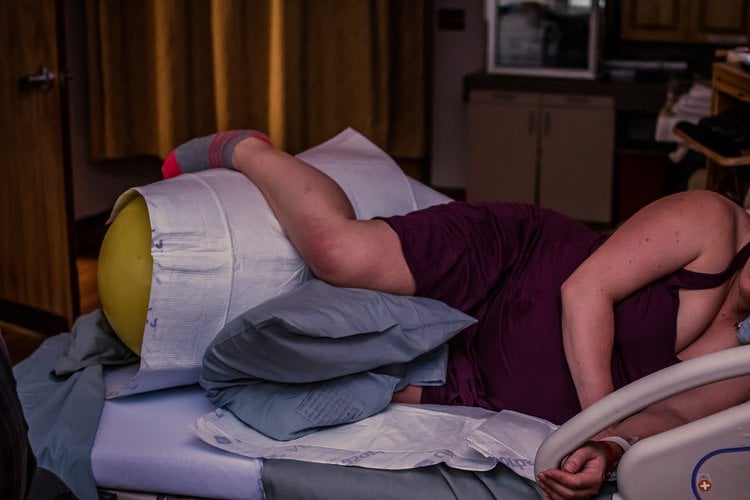
You can also add a pillow between the knees to decrease the intensity of the internal rotation! Sometimes the knees touching is just too much.
This position can also be great for resting between pushes.
What is baby isn't +2 or under the pubic bone yet??
If baby hasn’t finished their final rotation from the lower midpelvis to the outlet, then we may want to focus more on asymmetrical movements to create more space in the lower midpelvis as opposed to outlet openers.
This would be more of a concern if you have been pushing for a while, and baby is still rocking back and forth to get under the pubic bone.
Some of my favorite ways to facilitate this final rotation is with a half lunge position or side lying with knee press.
See our Instagram reel for some more info!
Now for Movement!
Now, if you got the epidural and you have rested or did not feel exhausted when you received it, we can focus on moving all over with the rollover technique.
We want to start on the left side in the side lunge peanut supported position. Then after 20-30 minutes, “roll” with assistance to all fours. Even if you can’t feel your legs, your muscle memory will help you stay in the all fours position.
I like to place a peanut ball under mom’s chest here, because it keeps her from rolling side to side (aka off the bed). After 20-30 minutes, “roll” with assistance to the right side in the side lunge position. Then roll onto the back.

When you reach the back, it will be important to understand where baby is in the pelvis. If baby is midpelvis (-1 to +2), then I like to use an uneven hip movement with the peanut ball between the thighs. Both legs fall towards the right or left, which prompts an external rotation of the bottom leg and internal rotation of the top leg (uneven hips). After 20-30 minutes, switch sides, and then repeat the roll over.
Considerations
When moving with an epidural, more upright positions can be available! We don’t need to just stay on our side or backs.
BUT!!! If you cannot get into a position without assistance, such as your partner or nurse need to physically move you to get you in an upright position, it is likely not a safe position for you.