



Baby’s position during labor can really influence how well they can navigate through the pelvis. We may experience a labor stall, where labor progress seems to stop for a period of time, and one of the potential causes is baby’s position!
Think of baby has a square peg trying to navigate through the pelvis, a square hole. They are meant for each other, but if we don’t align the square peg to the square hole, it will seem to not fit!
Let’s explore ways we can adjust baby’s position if they are occiput posterior, also known as posterior, OP, or sunny side up, to a more optimal position so that we can see labor progress again!
Understanding Baby's Positions! What is OP?
If baby is head down, there are several positions they can be in based on how they are oriented within the pelvis.
The reference points that we use are the back of baby’s head, the occiput, and where the occiput is in relation to the maternal pelvis.
If the back of baby’s head is towards the back of the pelvis, then they are occiput posterior, more commonly referred to as OP, posterior, or even sunny side up!

* Fetal Compass Rose: Understanding Baby’s Position During Pregnancy + Labor *
But why does baby’s position even matter?
For an OP baby position, typically, the sacral promontory pushes your baby forward, so their forehead rests on the pubic bone, making it difficult for your baby to enter the pelvis.
Usually, OP babies will have a line across their forehead after birth from when they were pushing into the pubic bone for the duration of labor.
This can be problematic since your baby needs to usually be more oriented OT, or occiput transverse with the back of the head towards usually the left hip, but sometimes the right hip, to enter into the pelvis.
Learn more about your baby’s position and movement through the pelvis, plus tips on how to address labor stalls in our childbirth education course!

3 Ways to Fix an OP Baby's Position
So, what can you do? You’re pregnant, and you find out your baby is OP, or you’re in labor, and you realize your baby is OP. What can you even do to influence their position?
Fortunately, we do have some control over supporting their position! Not complete, but some!
Things we can focus on:
- Invert: This brings baby to a higher pelvic level so they can adjust a bit more easily with more space.
- Forward Leaning Positions: This can encourage your baby to rotate towards the side or front, depending on the pelvic level.
- Open the Pelvic Level Baby is In, Usually the Inlet
We want to focus on creating the space for your baby so they have the opportunity to move and adjust, as opposed to forcing them into a position.
Our providers do have the ability to apply more force based on their expertise, so discussing with your provider if they can manually adjust your baby is also an option!
Signs of an OP Baby Position
Usual signs that baby’s position is causing a stall could include:
- Irregular contraction pattern, or a start-stop contraction pattern. This could include doubling or several contractions back to back, then long rest periods. This is my biggest sign that your baby’s position needs to be adjusted.
- Back Labor: this is not always a sign of an OP baby position but can be a sign if back pain is not common during your periods outside of pregnancy. Usually, my clients who have more back pain during their periods will also have more back pain during their labors which is unrelated to their baby’s position.
This course includes our 90-minute labor biomechanics webinar recording plus our 24-page labor biomechanics quick reference guide.
- 90-min webinar
- 24-Page E-Book
- Upcoming Live Webinar & Q&A
- Watch on Mobile Device
1. Inversions: Fix an OP Baby's Position
Inversions involve bringing the head lower than the hips. This uses gravity to shift your baby slightly upwards, which may feel counterintuitive, so they reach a pelvic level or space with more room to adjust around.
Inversions can be done throughout pregnancy, and even during labor with an epidural!
If pregnant, we want to invert for 3 full breaths, so roughly 20-30 seconds. Then rest for at least 10-15 minutes. You can do this several times a day.

If in labor, we want to invert for three contractions. You can come up in between each contraction if the inversion is too intense to hold for the full three, as it can be several minutes. And there are several variations that you can do based on your physical conditioning, whether you have an epidural or not, and your general level of fatigue!
We would not recommend doing this step if you have high blood pressure or another contraindication for inversions.
2. Forward Leaning Postures: Rotate an OP Baby's Position
After doing inversions, we can focus on forward-leaning postures, leaning forward from the hips with the belly towards the floor.
This can either be done from an all-fours or standing position! During labor, a common position is to lean against the bed or birth ball.
Depending on your comfort level, you can usually stay in this position for 20-30 minutes.
The goal is to help your baby rotate towards the side or front of the belly!

3. Open the Pelvic Level: Create Space for an OP Baby's Position to Change
After we have hopefully encouraged baby to align better to the pelvic level we can focus on creating more space in that pelvic level to allow your baby to descend and rotate!
Usually, your baby is in the inlet trying to engage with an OP position, so we want to focus on opening the top of the pelvis.
Inlet opening movement patterns include:
- External Rotation of the Femurs (Wide Knees)
- Posterior Pelvic Tilt
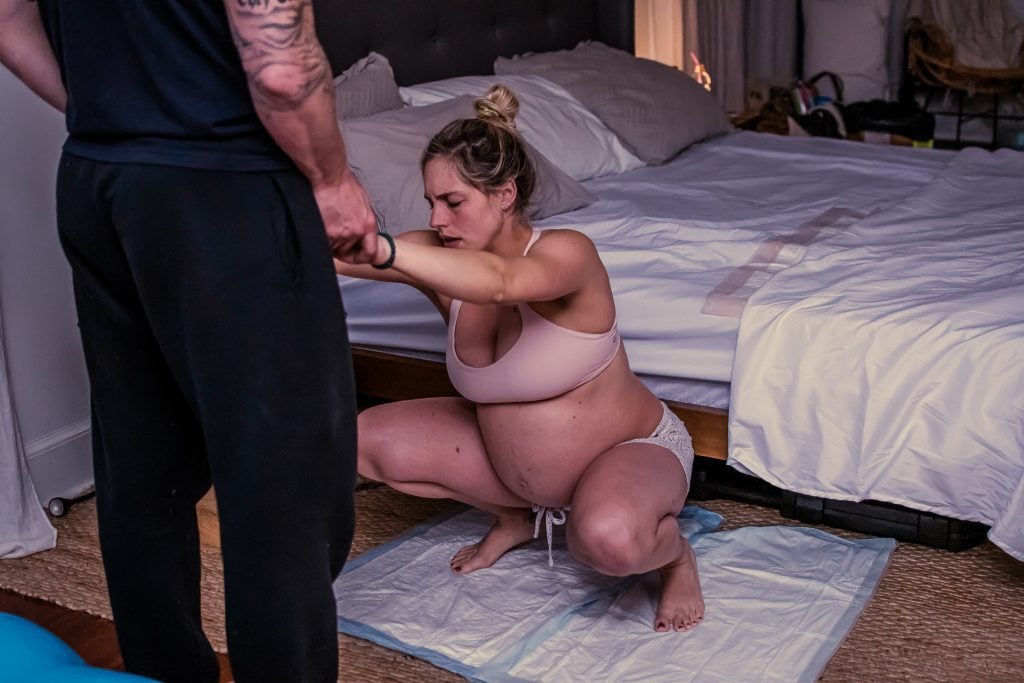
During a contraction, find a labor position that includes both movement patterns! This could include deep squats, sitting on a birth ball, and rounding in the back as you spread the knees apart.
We break down labor positions that open each pelvic level in our childbirth education courses and our labor biomechanics webinar.
Your Baby's Position Matters!
Your baby’s position matters during birth! We want baby to align to the pelvic level (and their optimal position will adjust as they navigate through the pelvis due to the different shapes of each level), so if baby is not properly aligned we may see a labor stall!
The OP Baby Position tends to cause baby’s forehead to push into the pubic bone, inhibiting their descent into the pelvis. This is problematic as it can cause a labor stall, prolonged labor, or eventually head towards a cesarean birth (which is not a bad way to give birth, but usually not our initial birth plan).
Fortunately, we can do movement to help provide your baby the opportunity to adjust their position, and our providers can also attempt manual techniques should the situation support that it is an optimal option!