
During labor, your baby enters then rotates through the pelvis as you move and shift your pelvis to create different amount of space. The lower midpelvis is the bottom of the bony structure that baby is rotating through. Your baby will finish their rotation through the lower midpelvis to align with the pelvic outlet, after which they will extend their head to begin crowning so we can finally meet them!
Let’s explore how to open the lower midpelvis during labor and the exercises you can do during pregnancy to prepare for birth!
Open the Lower Midpelvis: Creating Space for Baby to Finish Their Rotation
The lower midpelvis is the bottom of the bony structure that your baby rotates through in their path for birth.
The lower midpelvis is similar to the upper midpelvis in which asymmetrical labor positions and movement patterns create space diagonally through this pelvic level.
When we open the lower midpelvis, the opposite upper midpelvis has more space, and vice versa.
Ways to open the lower midpelvis include a combination of:
- Posterior pelvic tilt
- Internal Rotation
- Adduction
You can also think about it as a closed hip position (belly to thigh), or driving the knee back into the hip socket.
When we open the lower midpelvis, we are opening it only on one side! So, if we drive the left hip crease backward, we are opening the lower-left midpelvis and upper-right midpelvis. But, we are closing the opposite halves!
When approaching opening the midpelvis, in general, as long as we shift weight from side to side in our labor positions, we will help your baby rock through the pelvis for birth.
Lower Midpelvis Laboring Positions
As discussed before, shifting weight from leg to leg will open the midpelvis as a whole, alternating between an open or close of the lower halves of the midpelvis. This shifting will help rock baby through, but sometimes we need to take a more directed approach to help baby finish their rotation!
Two labor positions I typically will see when my clients’ babies are in the lower midpelvis are movements where they shift their weight into one leg over and over again, usually the left leg.
When they do this, they are finding internal rotation and opening the lower midpelvis on the stance leg side.
Laboring positions could include a standing position, where they come upon the tippy toes of the opposite leg to shift into the stance leg more, or all fours where they rock into one hip over and over again.
We break down labor biomechanics and labor positions in our childbirth education courses. We offer our courses online, completely self-paced + maintain lifetime access of the course, in-person at our facility in Aberdeen NC, and virtually via zoom.
Learn the science of pregnancy and birth to take the mystery of labor away! Understand why you are feeling what you feel, and learn strategies to confidently move through pregnancy and birth!
- 9 hours of on-demand video
- Lifetime Access of E-Course
- Watch on Mobile Device
1) Standing Stance Shift with Tippy Toes
In this labor position, you will shift your weight into one leg. This becomes your stance leg and usually shifts into an internal rotation with a closed hip and adduction emphasis. This will open the lower midpelvis on that leg.
One way we can emphasize this is by doing a tippy-toe position with the opposite leg!

2) Half Kneeling Lunge with Hip Shift
Another labor position that can open the lower midpelvis, and is one of my favorites to put my clients in, especially if they have some movement capability with an epidural, is the half kneeling lunge with hip shift.
In this position, you can grab something in front of you with one or both hands. Then shift your weight into the forward leg’s hip. This will prompt an internal rotation.
Your partner can then push into your knee to drive it back into the femur to emphasize this even more!

The good news is that most of us will have intuitive movement patterns during labor, where we will naturally go into labor positions that open the pelvic level that our baby is moving through.
But, understanding how each level opens and helpful positions can allow us to enhance those intuitive movement patterns. Plus, if we get an epidural, we may need more support in what positions to do!
This isn’t just a childbirth course. It’s a pregnancy and birth course. I’ve learned so much about the anatomy and physiology of pregnancy and childbirth.
I have gained tools to help mitigate aches and pains and understand possibly why they’re happening. I have learned so much about the birth process that I can look back on my first experience and say “OH! So that’s what was going on!” Prior courses taught me the what, but this course has also taught the how and why.
I am impressed by the level of detail, and feel like I am so much more prepared to navigate the uncertainties around birth."
Prepare to Open the Midpelvis
Lower Midpelvis: Finish Baby's Rotation
When preparing for birth, we want to ensure that we have the movement capability to get into these labor positions! If we cannot find internal rotation on one side, or internal rotation bilaterally, we may experience a labor stall as we approach pushing!
Fortunately, there are quite a few exercises we can do throughout pregnancy to prepare to open the pelvis for birth!
One of the main focuses of our prenatal fitness programming is to ensure that the movement capability exists in your body to support labor positions during birth!
Our 40-week Prenatal Strength Program is synced to your current week of pregnancy, so you can start it at any time! If you’re 20 weeks, you’ll start at week 20 of our program.
I have personally done our program through two pregnancies, and we have had countless prenatal clients use our programs both online and in-person in our fitness facility to prepare physically for their births.
The one aspect of many that make our programming so unique is that we have developed our programs as both fitness professionals and birth professionals to support prenatal comfort and strength, but also labor preparation.
Since we train clients in person and focus exclusively on prenatal and postnatal clientele, our programs are tested and refined based on feedback with in-person clients.
Exercises and Mobility Drills
As we prepare for birth, we can incorporate movements into our workout routine that ensure we have movement capability in the pelvis.
When preparing to open the lower midpelvis, we want to focus on movements that emphasize internal rotation to one side, and also release tension in the glutes, our external rotators!
Two of our favorite exercises to incorporate into our prenatal programming are the staggered stance RDL and step-ups with an internal rotation emphasis.
Finding internal rotation with single leg movements can also support overall glute sterngheing, and it bring sthe glute into a larger range of motion!
Mobility exercises can focus on releasing tension in the glutes, which may inhibit internal rotation, and also working on shifting weight from side to side. Breathing drills are some of my favorite ways to find shifting in the hips and focus on one-sided open and cl0soed hip positining.
1) Staggered Stance RDL with Internal Rotation Emphasis
In the staggered stance RDL, we are focusing on increasing strength in the glute and hamstring of one side. This movement also incorporates lat strengthening by holding the weight.
In this movement, you will step one foot forward. This leg is our work leg.
Holding a weight in the opposite hand, you will inhale to lower the weight towards the opposite foot. Think to bring the belly towards the forward leg thigh, or drive the hip crease back.
Sometimes reaching up towards the ceiling with the free hand can help to emphasize this internal rotation.

Want more?? Join our prenatal and postnatal fitness programs! MamasteFit is unique in that we are one of the ONLY prenatal/postnatal training facilities in the United States. We develop our workout programs from our experience of working with in-person pre/postnatal fitness clients and work closely with physical therapists to refine our programming. In addition, we are birth workers, so we combine our experience as perinatal fitness trainers and birth professionals to ensure that our programs actually support your birth preparation and recovery!
Our prenatal and postnatal fitness programs are offered in two formats:
- Teambuildr App: list of exercises with demo videos with options to track your weights and progress within the app!
- On-Demand Videos: full length workout videos you follow as you workout at the same time
I think this helped so much in the “marathon” that is labor! After I had my baby I really didn’t know how to safely and effectively get back into fitness and her return to fitness program has been amazing!
As someone who felt fit before pregnancy- I was always challenging by the programming and it has helped so much! I recommend her classes and programs to all my friends!"
2) Step Ups with Internal Rotation
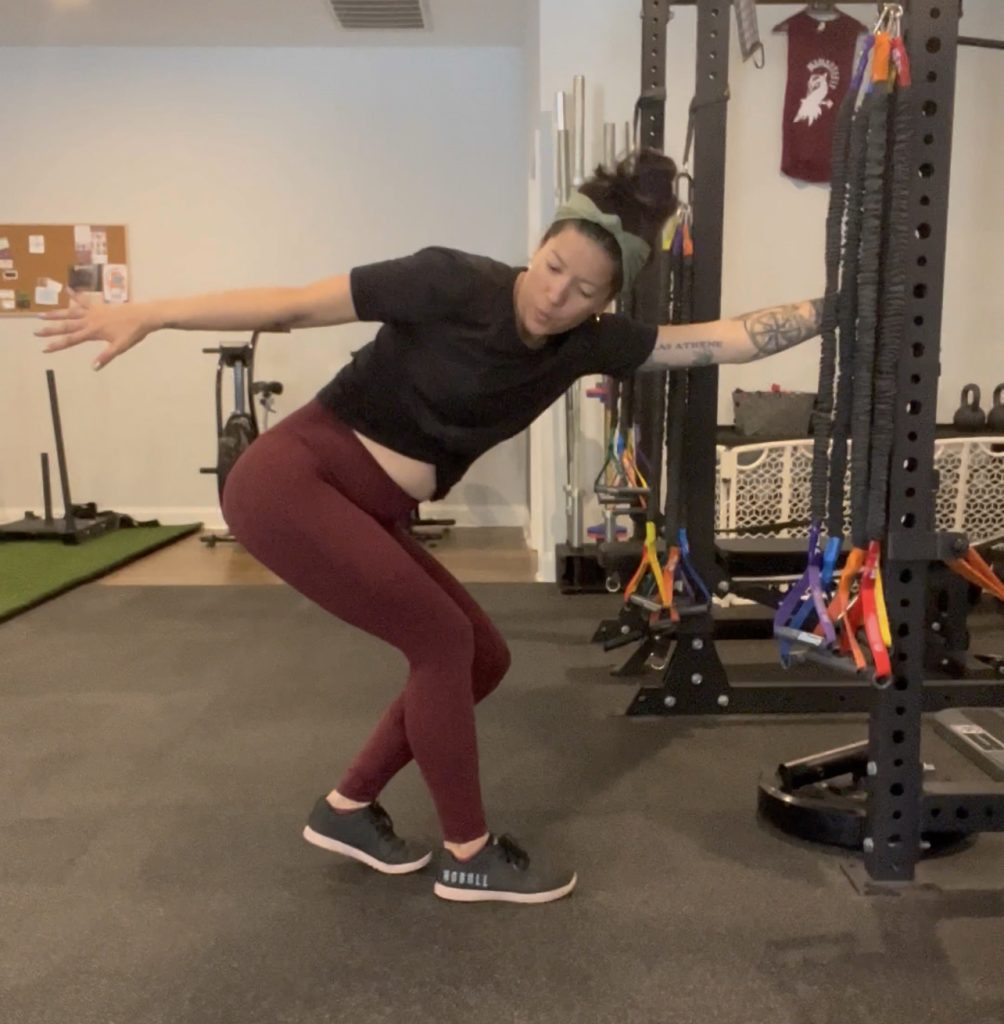
The step up is a single leg movement that we can find more internal rotation in! The step up tends to be the easiest way for me to teach internal rotation to my clients.
Place one foot on an elevated surface, then rotate the belly towards that lifted leg thigh. Feel the glute stretch, as you shift your weight into that foot.
It can be helpful to reach forward with the opposite hand, as it can bring you into that internal rotation. Then exhale to step up onto the box to face forward. Do this in reverse to step down.

3) Standing Breathing Drill
A mobility focused exercise we can do to learn how to shift weight from side to side and feel the pelvic floor and glute stretch is the standing breathing drill.
In the standing breathing drill, we can do both legs in internal rotation to feel the entire posterior outlet open more, or we can emphasize it towards one side.
During labor, that can also be a great position to move into if you feel that you need to release some tension in the glutes and pelvic floor!
Open the Lower Midpelvis: Create Space for Your Baby to Finish their Rotation for Birth
Each level of the pelvis opens with different labor positions and movement patterns. The top of the pelvis opens differently than the lower half.
As baby finishes their rotation trhough the pelvis, opening the lower midpelvis can help baby rotate to get under the pubic bone so they can crown during pushing!
You may intuitively find lower midpelvis opening when laboring, or it may need to be a deliberate effort!
Learn more about labor biomechanics in our online childbirth education courses, fitness programs, and webinars!
Prepare for Birth Courses

- 5 Workouts/Week
- Gym Workouts
- Self-Paced

Instructor
GINA
Workout on-demand with our prenatal fitness workout videos! Each workout is 30-40 minutes to follow along as you exercise at the same time!
- Birth Prep
- All Trimesters
- Mobility Work