Frequently Asked Questions
What is the best position to push with an epidural?
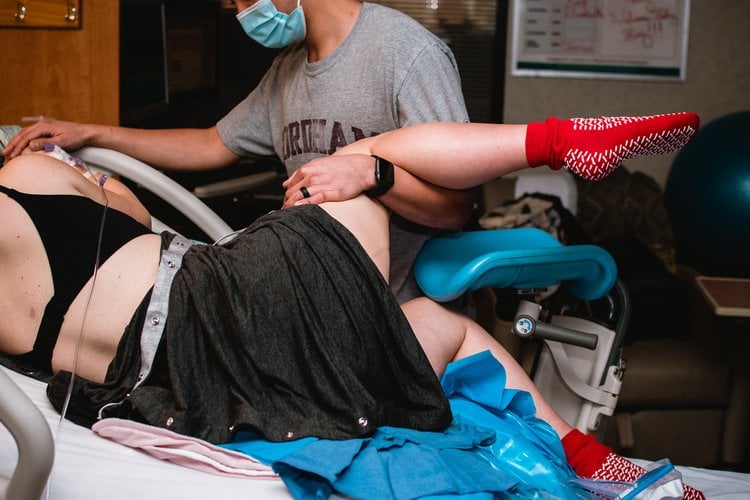
There isn't one "best" position — it depends on how much you can move and what helps baby descend. With an epidural, sidelying is often the most accessible position and tends to have the lowest risk of tearing, since your legs stay closer together and more relaxed. Pushing on your back (supine) is the most common, and you can use pillows or the bed's cutout to create space for your sacrum. If you can move with little assistance, upright options like throne or a supported squat can also help move baby down.
How to push if you have an epidural?
With an epidural you'll usually be pushing in the bed, but the labor bed adjusts into many positions to support you — your nurse can show you how. How much you move depends on the strength of your epidural: if you can shift with little assistance, you can try all fours, throne, or a supported squat, and if you need more support, bed-based positions like supine or sidelying work beautifully. Props like a peanut ball or pillows help create space, and a tug of war can add power to your pushes. The goal is to find what's comfortable and helps baby navigate down.
How long should you push with an epidural?
There's no single "right" length — the pushing phase varies a lot from birth to birth. With an epidural the urge to push can be muted, so many providers use laboring down, where you give the uterus extra time (sometimes one to two hours) to bring baby lower before active pushing begins, which can shorten the active pushing phase. How long you push depends on baby's position, your epidural, and how labor is progressing, so it's worth talking through with your provider. Learn more in
our breakdown of pushing timing and techniques.
Can you push before 10 cm?
Active pushing usually begins once you've reached 10 centimeters, or full dilation, since the cervix needs to be fully open for baby to pass through. With an epidural you may not feel a strong urge to push, which is where laboring down can help: even at 10 cm, you can let the uterus passively bring baby down before you start actively pushing. Your provider may also do a "practice push" during a cervical exam to see how baby is descending. See
why waiting to push can help during labor for more.
Can I tear even if I push correctly?
Yes — and if you do tear, it is not your fault. Tearing can't be completely avoided, because things like baby's position, or a birth emergency that calls for a pushing intervention, can play a big role no matter how you push. Some positions, like sidelying, tend to carry a lower risk, but tears can still happen. You can learn about
the different types of vaginal birth tears and how they heal to feel more prepared.
How to speed up labor while on epidural?
Movement is one of the best tools for helping labor progress, and an epidural doesn't have to take that away. Even when you can't get out of bed, you can keep baby rotating and descending through the pelvis with help from your birth partner, nurse, and a peanut ball — most hospitals have one. Changing positions regularly creates space in the pelvis so baby can navigate down. Here are
three ways to find movement during labor with an epidural.
Does it hurt to push even with an epidural?
It really varies from person to person, depending on the strength of your epidural. Some people feel quite a bit of pressure or sensation while pushing, while others feel very little — both are normal. You may still feel enough to know when and how to push, and your provider and nurse can help guide you through each contraction.
How many cm dilated is best for epidural?
There isn't a magic number of centimeters — the best time is really when you want one, though it helps to plan ahead. You'll likely work through a few contractions first, and there can be a wait depending on whether anesthesia is available and what else is happening on the labor floor, so allot for at least an hour. You'll also need an IV with some fluids started before the epidural can be placed. You can read about
the reasons to consider an epidural as a labor tool to help decide what's right for you.
Can you push a baby out after an epidural?
Absolutely — an epidural doesn't take away your ability to push your baby out. You still have options and can push in several positions other than just on your back, using the bed and props to support you. Even with an epidural, you get to make decisions about your birth and find the position that works best for you and baby.