
Table of Contents
If you’re preparing for birth, it’s time to think beyond the standard squats and Kegels. In this blog, I’m sharing the unconventional exercises to prepare for labor that I used during my last pregnancy to support my baby’s position, create more space in my pelvis, and relax my pelvic floor. The result? My fastest and most comfortable labor yet—proof that these unique movements can make a big difference.
Why We Choose These Birth Prep Exercises (and Skip Deep Squats, Butterfly Pose, and Endless Kegels)
Before we dive into the exercises, it’s important to understand why we prefer these movements over more traditional “birth prep” staples like deep squats, butterfly pose, or Kegels.
The first concept to grasp is our common postural tendency—and how it often becomes exaggerated during pregnancy.
Most of us naturally favor putting more weight in our right leg, a pattern known as right stance. This happens because the organs on the right side of the body are denser, and the right side of the diaphragm is slightly larger, giving us a stronger sense of stability on that side. While this natural asymmetry isn’t inherently bad, it does influence how our pelvis functions—and it’s worth considering when choosing exercises for birth preparation.
When we live in a right stance pattern, the right half of the pelvis becomes more active than the left. Over time, this overactivity can pull the sacrum forward and cause the posterior pelvis to compress. This can limit space in the pelvis and restrict mobility—two things we don’t want when preparing for labor and birth.
Our unconventional exercises are designed to balance pelvic activity, improve mobility, and create more space so your baby can move more freely into an optimal position.

It’s important to remember that your pelvic floor isn’t just one flat sheet of muscle—it’s a complex group of muscles with multiple attachments to the pelvis. The position of your pelvis, hips, and spine can all change the amount of tension in different parts of your pelvic floor.
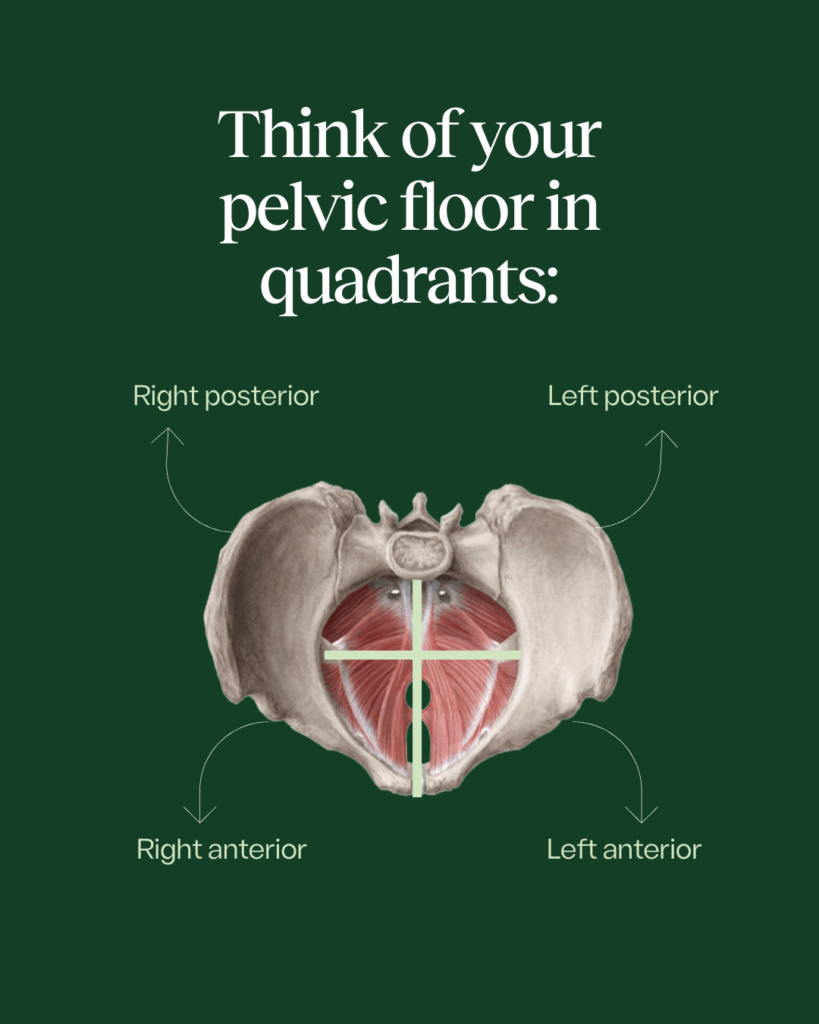
One way to visualize this is to think of your pelvic floor in quadrants:
- Left Anterior (front, left side)
- Right Anterior (front, right side)
- Left Posterior (back, left side)
- Right Posterior (back, right side)
When we move into certain positions—like a wide-leg squat or deep butterfly stretch—we may be lengthening one quadrant while compressing another. Over time, these patterns can create imbalances, leaving some areas of the pelvic floor overlengthened and others tight and restricted.
The unconventional birth prep exercises I’m sharing are designed to help you balance these quadrants, so your pelvic floor can work as a coordinated unit during labor—able to relax for dilation and stretching, and able to engage effectively when it’s time to push.
During pregnancy, many of us naturally spend more time in positions that stretch the front (anterior) portion of the pelvic floor—think wide legs, toes turned out, and an arched lower back. From a biomechanics perspective, this means we’re living in a lot of external hip rotation, abduction, and lumbar extension.
While these positions might feel natural or even comfortable, they keep the anterior pelvic floor in a constantly overlengthened state. When we add more of the same movements—like deep squats or butterfly pose—we’re reinforcing this imbalance instead of correcting it.
On the other hand, the posterior portion of the pelvic floor is lengthened more when we move into internal hip rotation and a posterior pelvic tilt (rounding the lower back). These positions help decompress the back side of the pelvis and create more space in the posterior outlet—something that can be incredibly helpful during pushing.
We can take it a step further and think about the pelvic floor in quadrants: one-sided “open” hip positions stretch the anterior portion on that side, while “closed” hip positions stretch the posterior portion. Understanding these patterns helps us choose exercises that bring balance to all four quadrants—a concept we’ll break down even more throughout this blog.
My Top 6 Unconventional Exercises to Prepare for Labor: Balance the Pelvis for Birth
These are the exact exercises I used during my own pregnancy to help balance my pelvic floor and align my pelvis. Each movement was chosen to address common asymmetries, create more space in the posterior pelvis, and support my baby in finding an optimal position for birth.
The result? My fastest labor yet. Maybe it was luck—but I truly believe that opening my pelvis, releasing tension, and supporting my baby’s position played a big role in how smoothly things went.
If you want to encourage better fetal engagement, improve pelvic mobility, and prepare your body for a more efficient labor, these unconventional exercises can be a game-changer.
If you want to take this even further, join our upcoming Birth Prep Workout Series—now 50% off. You’ll get four birth prep workouts each month (including pelvic floor relaxation techniques), plus two live Q&A calls with Roxanne and me where we’ll answer your questions and dive deeper into positioning strategies for labor.
Our next series starts Monday, September 1st—Labor Day (how perfect is that?). Each new series begins on the first Monday of the month, so you can jump in whenever you’re ready to start preparing your body for an easier, more confident birth.
This series is also a great compliment to our Prenatal Fitness Programs if you want the structure of a full fitness plan with the added motivation and community connection as you prepare for birth.
1) 90/90 Side Body Opener with Adductor Release
We’ll start with a more restorative release to open up the hips, side body, and pelvic floor. This position helps lengthen the side of the rib cage, release tension through the adductors (inner thighs), and create more space in the pelvis—especially helpful if you tend to favor that right stance we talked about earlier.
How to do it:
- Sit in a 90/90 position with your right leg forward and your left leg behind you in internal rotation.
- Place a pillow under your left thigh for support.
- Gently drop your right side body toward the floor, feeling a stretch along the right side of your torso.
- Press both knees down into the floor evenly, keeping your weight balanced.
- Hold this position and breathe deeply, focusing on expanding your rib cage and relaxing your pelvic floor with each exhale.
Why it helps:
This exercise balances tension between the anterior and posterior pelvic floor quadrants, encourages mobility in the hips, and releases asymmetries that can restrict pelvic space during labor.

2) Open Hip Half Lunge
This variation takes the adductor/groin release into a more upright position, giving you a deeper stretch through the inner thigh while also opening space in the pelvis.
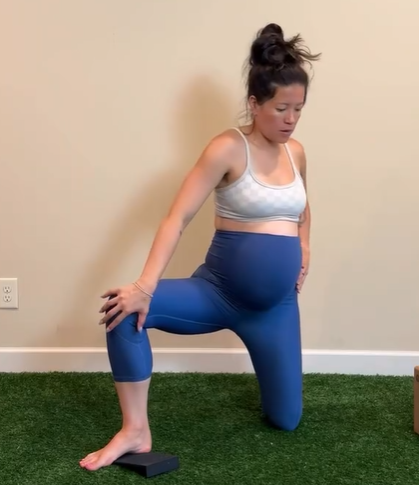
How to do it:
- Start in a half lunge position with your right leg forward and your left knee on the floor.
- Open your right hip slightly outward so your front leg is in an “open” position rather than straight ahead.
- Rotate your belly button toward your left leg—you should feel an increased stretch in your right groin/adductor.
- Keep your right big toe pressed into the floor to maintain proper alignment.
- Gently rock forward and back to explore the stretch, breathing deeply as you move.
Why it helps:
This position lengthens the anterior pelvic floor on one side while encouraging hip mobility and adductor release—key for balancing the pelvic quadrants. It also mimics some of the “open” hip positions you might find yourself in during labor, helping your body feel more comfortable in them.
3) All Fours Hip Shift – Knees Level
This variation of the all fours hip shift keeps both knees on the ground, which helps target the anterior pelvic floor more than the elevated-knee version.

How to do it:
- Start on all fours with both knees on the floor.
- Shift your weight toward your left leg, pressing both knees firmly into the floor.
- You should feel a stretch through the right groin and the left posterior hip pocket.
- Add gentle pelvic tilts in this position:
- When your back is more arched (anterior tilt), you’ll feel it more in the groin.
- When your back is more rounded (posterior tilt), you’ll feel it more in the left glute.
- For a deeper focus on the posterior pelvic floor, try the variation where your left knee is slightly elevated off the floor.
Why it helps:
This exercise encourages mobility and balanced length-tension across the pelvic floor quadrants. It’s especially useful for opening the anterior pelvic floor while also teaching your body to move fluidly between pelvic positions—something that can be incredibly helpful during labor.
4) Deep Squat with Back Expansion
I know I said deep squats weren’t included—but this variation is! The difference here is that we’re pairing the squat with back expansion to decompress the lower spine and open the posterior pelvis, rather than just hanging out in an arched, anterior-tilted position.
How to do it:
- Start in a deep squat position with your feet about shoulder-width apart (or slightly wider if needed for comfort).
- Shift your weight into your heels to help you round through your lower back instead of arching.
- Take slow, deep breaths, focusing on expanding your back and rib cage with each inhale.
- On your exhale, gently pull your belly toward your spine without tensing your pelvic floor.
- Spend time exploring this position so it becomes comfortable—because in labor, you can’t expect to find (or relax into) a deep squat if it’s completely unfamiliar to your body.
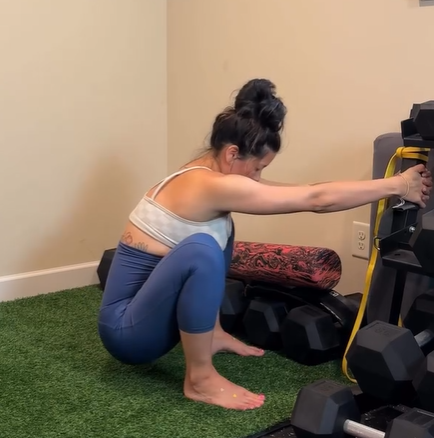
Why it helps:
This variation targets the posterior pelvic floor and helps you learn to relax in a deep squat without overlengthening the anterior portion. It also conditions your body to be more comfortable in this position for labor, where pelvic outlet space is key for birth.
5) Lateral Hip Shifts
This upright movement connects upper body and lower body coordination while targeting different quadrants of the pelvic floor. It’s a great way to balance pelvic tension and improve mobility in standing.
How to do it:
- Stand with your feet slightly wider than hip-width and parallel.
- Shift your weight toward your left leg, bending into the left knee while keeping the right leg straight.
- As you shift left, you’ll feel a stretch in the posterior left pelvic floor and glute, while the straight right leg will create a groin/adductor stretch on that side.
- Keep both big toes pressed into the floor for stability and proper pelvic alignment.
- Hold on one side, then optionally shift side-to-side to explore both directions.

Why it helps:
This exercise stretches and strengthens different pelvic floor quadrants at the same time—lengthening the posterior pelvic floor on one side and the anterior on the other. Learning to hip shift is also incredibly helpful for labor! Being able to find a hip shift creates space in the lower pelvis for baby to finish their rotation under the pubic bone and can help you relax your pelvic floor during labor!
6) Squat to Hip-Shifted Row
This final movement puts it all together—integrating hip mobility, pelvic floor balance, and upper/lower body coordination. It’s a functional movement that mirrors how your body works during daily life and can prepare you for dynamic positions in labor.
How to do it:
- Anchor a resistance band at chest height and hold it in your left hand.
- Inhale as you lower into a squat—going as deep as feels comfortable while keeping your feet flat and knees tracking over your toes.
- Exhale to stand, shifting your weight toward your left leg as you row the band back with your left arm.
- At the top, you should feel a strong lateral hip shift to the left, with your glutes and core engaged.
- Reset and repeat, maintaining smooth breath coordination and alignment.

Why it helps:
This exercise integrates all the concepts—posterior and anterior pelvic floor mobility, lateral hip shifting, and rib cage expansion. It strengthens your hips, core, and back while reinforcing the movement patterns that help your pelvic floor function well during birth.
Final Thoughts
Preparing for birth goes beyond a few stretches or the occasional deep squat. By addressing pelvic imbalances, improving mobility in all directions, and training your body to coordinate breath with movement, you’re setting yourself up for a smoother, more confident labor.
These unconventional birth prep exercises are a great place to start—but if you want a structured, trimester-by-trimester plan that includes strength training, pelvic floor work, mobility drills, and ongoing modifications as your pregnancy progresses, our Prenatal Fitness Programs are designed for exactly that.
You’ll get:
- Guided workouts for every stage of pregnancy
- Pelvic floor & mobility training to support baby’s position
- Lifetime access so you can use the program now and in future pregnancies
- The option to add our Birth Prep Workout Series for extra community support and live coaching calls as you get closer to labor