Ever wonder what the best position is for labor? There is no one best position! We want to create more space in the pelvis based on where baby is within the pelvis. The more optimal position will actually change as labor progresses and baby descends through the pelvis! Read this blog to learn what type of movement patterns will open each pelvic level!
Ever wonder what the best position is for labor? There is no one best position! We want to create more space in the pelvis based on where baby is within the pelvis. The more optimal position will actually change as labor progresses and baby descends through the pelvis! Read this blog to learn what type of movement patterns will open each pelvic level!
Best Laboring Positions
What is the best laboring position to do during labor?? Depends on where your baby is within the pelvis! There is no ONE best position for all of labor, as no one position opens the entire pelvis. So, we want to create more space at the level of the pelvis that baby is trying to navigate.
Fetal Station
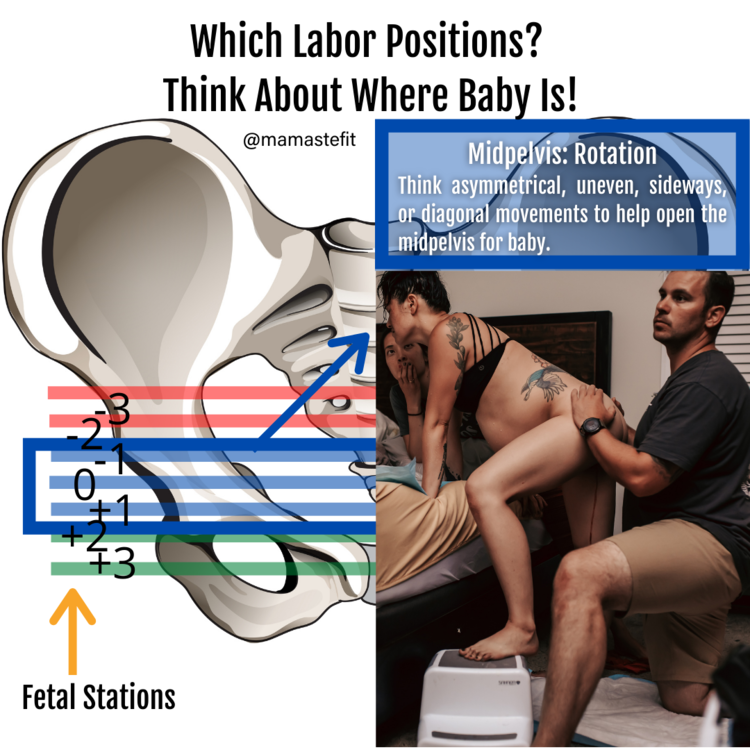
We can understand where your baby is in the pelvis based on their fetal station, or what pelvic level your baby is currently at. Fetal station is where the presenting portion of your baby (usually the head) is in relation to the ischial spine (bony protrusion on the back of the pelvis). If your baby’s presenting portion is higher than the ischial spine, the baby is a minus station (-1, -2, etc). If your baby’s presenting portion is lower than the ischial spine, the baby is at a plus station (+1, +2, etc).
Each of these fetal stations tends to correspond to a different pelvic level: inlet, midpelvis, or outlet.
Pelvic Levels
There are three main pelvic levels: inlet, or top of the pelvis; midpelvis, or middle of the pelvis; and outlet, or bottom of the pelvis. Each pelvic level tends to be associated with certain fetal stations.
Inlet: -2 station or higher (-2, -3, etc). Baby is usually considered “high” or not yet engaged.
Midpelvis: -1, 0, and +1 station. Baby is usually considered engaged. The midpelvis can be broken down into smaller levels: upper and lower, but understanding how to open each level in depth is usually not necessary during labor. It can end up being more confusing than helpful.
Outlet: +2 station and lower (+2, +3, etc). Usually you are pushing, and baby is about to be born.
Opening the Pelvis
How can we create more space in the pelvis to facilitate your baby’s descent and rotation?? Movement!
Inlet: If your baby is trying to enter into the top of the pelvis, then we want to create more space at the top so your baby can more easily fit! Usually, this can be done with wide knee movements or external rotation of the femurs. Examples could include deep squats or rock forward and backward.
Midpelvis: If your baby is in the pelvis and trying to rotate through, then we want to create more space in the middle of the pelvis. Usually, we can do this with uneven, asymmetrical movement patterns. Examples could include: swaying side to side, elevated lunges, or walking up and down stairs sideways.
Outlet: If you are pushing, and your baby is trying to extend under the pubic bone, then we want to create more space at the bottom of the pelvis. Usually, we can do this with knees in, ankles out, or internal rotation of the femurs. Examples could include bringing the knees closer together and having the ankles out further in a number of pushing positions, such as all fours, standing, or even sidelying with partner support.
The good news is that you tend to intuitively create more space without thinking about it! You just tend to move in a way that creates more space. The less we interrupt this process, the better. But, if you want some extra guidance, or want to emphasize your intuitive movements, apply these principles to your movement patterns during labor.