



Table of Contents
Prolapse is a scary diagnosis! If your provider or physical therapist casually mentioned you have pelvic organ prolapse, you likely didn’t receive much guidance on what to do with this new information. Or maybe they told you that you’ll never lift weights or run again (yikes). Then maybe you did a google search and if you weren’t already scared, you definitely are now.
Well, I’m glad you found this blog if you were googling “what do I do now?” because I am going to break down prolapse exercises you can do to help find relief from your symptoms and return to an active life again!
If you want more of a step-by-step approach to finding relief from pelvic floor issues (or wanting to keep your pelvic floor feeling good), check out our online prenatal and postpartum fitness programs. Our fitness programs incorporate daily pelvic floor exercises (no Kegels involved) to keep your pelvic floor feeling good throughout your entire motherhood journey.
But, let’s break down how you can feel good with these simple exercises!
What Is Prolapse—and Why It Doesn’t Have to Ruin Your Life
If you have pelvic organ prolapse, I want to start by saying: you will be okay (or you already are totally fine). I like to think about prolapse like looser skin–our bodies are different after we give birth, but it doesn’t mean they are less functional. Now, there are times where you may feel more symptoms of prolapse, such as:
- Heaviness or a bulging feeling
- Bladder issues
- Constipation
- Lower back pain
But, these symptoms are not necessarily your organ falling out (there is actually a lot of tissue between where your organ actually is and the opening of your vagina, so if you see a bulge, it’s not the actual organ). Rather, these symptoms are likely related to pelvic floor tension.
If you are feeling heaviness, let’s start with some exercises to help you release some tension before we move onto the strengthening exercises.
Gentle Prolapse Exercises to Relax and Support Your Pelvic Floor
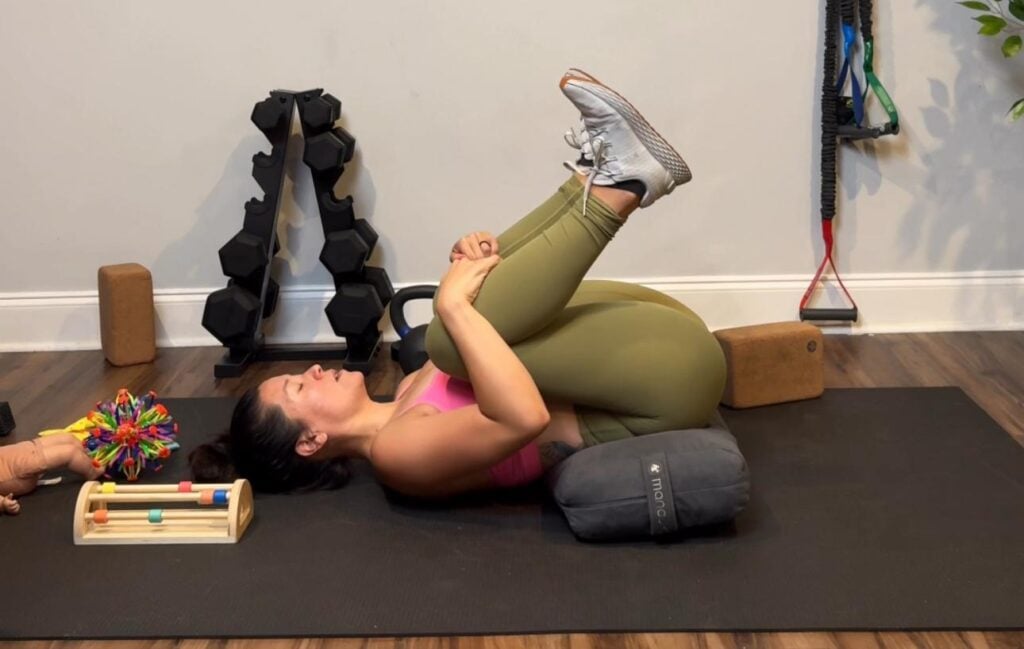
1) Offload the Pelvic Floor with Anti-Gravity
If you are feeling heaviness, you can start with hips and legs elevated to offload the pelvic floor and help it stop clenching. You can try lifting your legs up a wall with a pillow under your hips, lay your legs on a birth ball (it still is helpful even postpartum), or elevate your hips on pillow and curl up to offload.

2) Rib Cage Mobility to Improve Pelvic Position
Next, you are going to think outside the pelvis (aka outside the box, pun intended) and focus on rib cage mobility. Our body is a connected unit–so movement in one area impacts movement (or lack of movement) in another area.
Throughout pregnancy and motherhood, we tend to favor a more arched back position in an attempt to stabilize. Our belly grows forward, shifting our center of gravity up and out and then that belly is replaced by a cute baby after birth. We love to be extended!
But! With this extension, it can result in restriction in our rib cage mobility keeping us stuck in this extended position which impacts the pelvis too! When we are more arched, our pelvis also tips forward (anterior pelvic tilt) which lengthens the front portion of our pelvic floor (where we have less physical structure to support our pelvic organs). This increase in pressure to the front of the pelvic floor can cause a feeling of heaviness as the back of the pelvic floor clenches.
The solution? Let’s add in some back expansion, side body opening, and rotational exercises in the upper body! And this trend continues in the following section too!


 Bundle · lifetime access
MamasteFit Bundles
Combine courses and programs for lifetime access and save up to 15% — grouped for birth preparation, the third trimester, or the whole pre and postnatal journey.
Learn more
Bundle · lifetime access
MamasteFit Bundles
Combine courses and programs for lifetime access and save up to 15% — grouped for birth preparation, the third trimester, or the whole pre and postnatal journey.
Learn more
 On-demand video · 30 workouts
Core, Pelvic Floor & Pelvic Stability
Thirty follow-along workouts across beginner, novice, and advanced levels, ten per level — core and pelvic floor strength for pain relief in pregnancy or postpartum.
Learn more
On-demand video · 30 workouts
Core, Pelvic Floor & Pelvic Stability
Thirty follow-along workouts across beginner, novice, and advanced levels, ten per level — core and pelvic floor strength for pain relief in pregnancy or postpartum.
Learn more
 Video course · 7 modules
Prepare Your Pelvic Floor For Birth
Seven modules on releasing the pelvic floor rather than only strengthening it — breathing drills, thoracic and pelvic mobility, and how to relax it during labor.
Learn more
Video course · 7 modules
Prepare Your Pelvic Floor For Birth
Seven modules on releasing the pelvic floor rather than only strengthening it — breathing drills, thoracic and pelvic mobility, and how to relax it during labor.
Learn more
How to Exercise with Prolapse: Full-Body Movements for Daily Life
Now, let’s put it all together. Our body works as one connected system—so when there’s restriction in one area, it impacts everything else. If your rib cage can’t move well, your pelvis can’t move well either… and your pelvic floor is part of that system.
When you learn how to coordinate your upper and lower body, you’ll likely notice your prolapse symptoms start to improve—because everything is working together.
In this full YouTube video, I walk you through six upright exercises to help relieve (or even prevent) prolapse symptoms. We’re getting off our backs and onto our feet—because that’s how we move through real life!
In this workout, I walk you through six exercises:
- Diaphragmatic Breathing with Back Expansion
- Side Seated Side Body Opener
- Side Plank Reach
- Star Plank Reach
- Standing Hip Shift
- Lateral Hip Shift
1) Diaphragmatic Breathing with Back Expansion
Whenever I am feeling prolapse symptoms, it is usually because I have been on my feet all day and I have been favoring a more extended spine position (arching in my back). This could be from just standing all day, babywearing, or just not thinking too much about my positioning.
The first thing I will do to find relief is some sort of back expansion exercise. In a back expanded position, you will think round in your back as you push your chest backwards. Inhale to feel the back of your ribs expand, then exhale to pull belly to spine to round a little more.
You can do this in a standing position, all fours, seated, or even holding onto a structure and leaning back into your hips (my personal favorite). I like to breathe for 10-20 breaths to just decompress my lower back. After this, my symptoms are usually completely resolved!
2) Side Seated Side Body Opener
Next, this is another rib cage mobility exercise but a commonly neglected part of thoracic mobility: lateral mobility. The rib cage can move in three directions:
- Front to Back
- Side to Side
- Rotationally
But, most of us think cat/cows with the front to back movements and rotational exercises when we think thoracic mobility. So, adding in the lateral mobility can be a game changer for your pelvic floor!
In this side seated position, you will drop the rib cage toward the floor to feel a stretch in your side body. Then, think about pushing your chest back to round in the upper back. This will intensify the stretch. You may notice that the right side feels more restricted than the left, which is common! Spend more time on the side that feels like you need it more.

3) Side Plank Reach
Next, we can add in that thoracic rotation that we all love when it comes to rib cage mobility but in a way that also includes the shoulder! In this side plank position, you will be rotating on the shoulder girdle as you reach forward to bring your chest towards the floor and then shift backwards to come back to the starting position.
In this exercise, we are improving shoulder mobility and stability of the shoulder blade and thoracic rotation!
4) Star Plank Reach
Next, you can expand on the side plank reach with a star reach. This exercise has the same shoulder mobility with rotation, but you are adding in hip/pelvic rotation, as well! In this movement, you will reach forward to rotate your chest towards the floor (same pivot point in the shoulder), while extending the top leg backwards. This extension will internally rotate your pelvis toward the bottom leg.
This is your first integration of both the upper and lower body!
5) Standing Hip Shift
After our floor based exercises, let’s get onto our feet with a hip shift. This hip shift targets the lower body and pelvic mobility. Many of us tend to hold more tension and tightness to the back of our pelvis. The hip shift targets the posterior pelvic floor near the sacrum, so when you come into this position, you will feel more of a stretch in the back hip pocket (where your jeans pockets would be).
Key things to remember:
- Keep weight in your big toe of the target leg.
- Think rotate the knee inward of the target leg.
- Bring your belly more toward the thigh of the target leg–think zipper your pants closer together from your pant leg and the front of your pants.
- Add a slight round to your lower back to target the posterior pelvic floor more.

6) Lateral Hip Shift
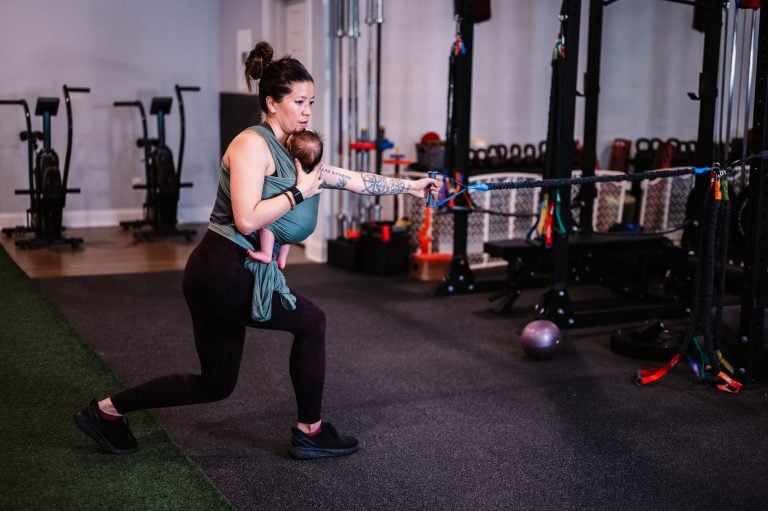
And then we finish up with the lateral hip shift. This exercise integrates the upper and lower body with thoracic rotation AND pelvic rotation. You can add a weight to sink deeper or stick to body weight to slow down.

You Deserve to Feel Strong—Even with Prolapse
Prolapse doesn’t mean your active life is over—and it definitely doesn’t mean you have to live in fear of movement. With the right approach, you can find real relief, rebuild strength, and feel confident in your body again.
Our prenatal and postpartum fitness programs are designed with prolapse support in mind. Whether you’re newly diagnosed or just want to prevent symptoms from developing, our programs will guide you through safe, effective workouts that actually make a difference.
Ready to feel strong, supported, and empowered in your body again? Join our fitness programs today and take the next step in your prolapse recovery journey—with expert guidance every step of the way.
 App program
Train for a Marathon After Baby
Progressive run workouts and strength training from 5K to the marathon finish — long runs, tempo work, easy miles, and a weekly pelvic stability session.
Learn more
App program
Train for a Marathon After Baby
Progressive run workouts and strength training from 5K to the marathon finish — long runs, tempo work, easy miles, and a weekly pelvic stability session.
Learn more
 App program · 16 weeks
Postpartum Return to Fitness
Sixteen weeks of rebuilding, four strength sessions a week, with a vaginal or cesarean recovery track and follow-along videos for the first six weeks.
Learn more
App program · 16 weeks
Postpartum Return to Fitness
Sixteen weeks of rebuilding, four strength sessions a week, with a vaginal or cesarean recovery track and follow-along videos for the first six weeks.
Learn more
 App program · 64 days
Postpartum Return to Running
Sixty-four training days, four sessions a week, with plyometrics and running programming beginning at week seven — a structured way back to your first run.
Learn more
App program · 64 days
Postpartum Return to Running
Sixty-four training days, four sessions a week, with plyometrics and running programming beginning at week seven — a structured way back to your first run.
Learn more