



If you’ve ever been told to “just do Kegels,” you’re not alone—but that advice is incomplete. Kegels train only a single action (squeeze), while a healthy pelvic floor needs to lengthen, yield, and lift through different hip and spine positions, and it needs to do that dynamically as you move, lift, walk, and—eventually—give birth. Your pelvic floor isn’t one big switch; it’s a sling made of four quadrants—left/right anterior (front) and left/right posterior (back)—and each quadrant responds differently to how your hips and pelvis are positioned as you move through the day.
The problem with “just do your Kegels” is that it does not take into account the pelvic position and how that position impacts pelvic floor function. If your pelvis is not in an optimal position, the pelvic floor will have a harder time working. So, if you did a pelvic floor strength test without any consideration of pelvic position, how valid are those results? If you “failed” or scored low—aka your pelvic floor was called weak—but your back was arched off the table, I wonder: what if you rounded your back slightly? Would your results have been different?
Think about this with a part of your body you can see more easily: your arm. If you’re trying to carry something heavy, is it easier with your arm bent and close to your body, or straight out to the side? The muscle itself isn’t suddenly “weak” when your arm is straight—it’s just in a position where it can’t produce force as effectively. Your pelvic floor is the same: the position of your pelvis shapes how well your muscles can contract, relax, and support you.
In my book Training for Two, I teach this four-quadrant lens and why it matters for both birth prep and postpartum recovery. The punchline: there isn’t one “best” position; what matters is your ability to change positions—to access length where you’re short, and support where you’re lax.
How Pelvic Position Shapes Pelvic Floor Function
Hip rotation and pelvic tilt shift which quadrants of the pelvic floor are long versus short:
- External rotation + abduction (ER + APT) → knees wide, ankles in, such as deep squats or butterfly. This lengthens the anterior pelvic floor and shortens the posterior. Anterior pelvic tilt (APT) pushes the pelvis forward, exaggerating the low-back arch and opening the front.
- Internal rotation + adduction (IR + PPT) → knees closer, ankles out, like hero pose or “knees-in” hinges. This lengthens the posterior pelvic floor and shortens the anterior. Posterior pelvic tilt (PPT) tucks the pelvis under, rounding the back and opening the back of the sling.
- Asymmetrical combos → one hip in ER + APT, the other in IR + PPT (like a hip shift or 90/90). These create diagonal length, stretching a front quadrant on one side to the opposite back quadrant on the other. This is exactly how we move step-to-step—and how the pelvis opens dynamically in birth.
Just like the bent-arm analogy, your pelvic floor isn’t inherently “weak” in one shape; it’s simply more or less effective depending on position.
Why Posterior Release (IR + PPT + Back Expansion) is the Missing Piece
Most birth prep and pelvic floor-focused exercises already load the ER + APT side: deep squats, butterfly stretches, open-hip work. Those are great for the anterior floor, but they don’t solve the other half of the puzzle.
Pregnancy exaggerates lumbar extension (arched low back, anterior tilt). That means the posterior pelvic floor is often short and tight—and a tight muscle isn’t strong, it’s restricted. Common symptoms like urgency, leaking, constipation, and painful sex often trace back to this imbalance.
This is why back expansion and posterior-biased drills matter. They restore movement options, balance the sling, and often bring the fastest symptom relief.
If you’re wanting a more comfortable pregnancy and to feel GOOD in your body again after birth, check out our online prenatal and postpartum fitness programs. It is realistic to move through pregnancy without constant pelvic floor issues—and to return to running, lifting, and chasing your kids with confidence. We’d love to support you on that journey.
Breath is your first “release” (and your best strength tool)
Your diaphragm and pelvic floor move together: on inhale, the diaphragm descends and the pelvic floor lengthens; on exhale, the diaphragm rises and the pelvic floor recoils/lifts. This is the foundation for both release work and load-bearing strength in pregnancy and postpartum.
If your lower back feels chronically tight or you live in an arched posture (hello, pregnancy!), your pelvic floor often struggles to move. Start with all-fours back-expansion breathing: gently round the back, inhale into the back ribs, exhale to feel a subtle front-of-pelvic-floor lift. This is the reset I use before almost every mobility or strength block.
Your breath is your anchor. On every inhale, the diaphragm drops and the pelvic floor lengthens; on every exhale, the diaphragm rises and the pelvic floor recoils. This simple rhythm gives you a built-in way to both release and strengthen your pelvic floor without overthinking.
In addition to the back expansion breathing, you can visualize your breath as a way to stretch and shorten specific portions of the pelvic floor:
- Inhale: expand into your back ribs and feel the back of your pelvic floor lengthen.
- Exhale: gently draw the belly in and feel the front of your pelvic floor lift and shorten.
This circular breathing pattern is powerful: with every breath cycle, you’re encouraging the posterior pelvic floor to release while simultaneously teaching the anterior pelvic floor to activate and support. When layered into movement—like hinges, bridges, or squats—this breath-to-movement connection transforms basic exercises into pelvic floor training.
The Plan: Release + Strength for Each Quadrant
Below is the pelvic floor training concept I use with our in-person fitness clients and inside our online programs. For each quadrant, I’ll share a release exercise (to create space and mobility) and a strengthening exercise (to build control through that new, lengthened range).
The goal is not to force ourselves into one “perfect” posture, but to improve how well we can change positions. Because your best posture isn’t the one you hold—it’s the next one you can move into.
1) Anterior Pelvic Floor (often too long—needs control at length)
The anterior pelvic floor tends to already have a lot of length thanks to our preference for an anterior pelvic tilt and external rotation (especially during pregnancy). Common pelvic floor stretches tend to involve exercises that continue to target an already lengthened area of our pelvic floor, such as deep squats and butterfly pose, or other wide-legged positions.
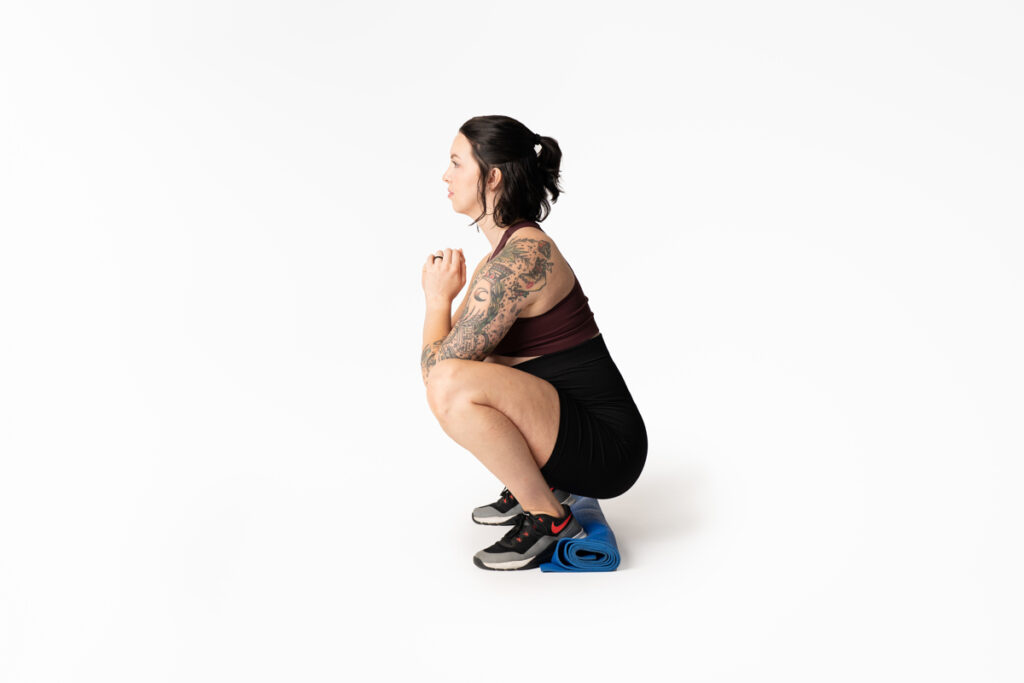
Now, including wide-legged positions is not bad, but you want to ensure that you aren’t feeling heaviness in the releases. If you are doing a deep squat hold, check on your mobility and support. You can add a yoga block under your hips or a rolled-up yoga mat under your heels for support. Or hold onto a supportive structure to allow you to shift your weight into your heels and round in your back.
In the anterior portion of the pelvic floor, we can focus on open hip shifts to offload the right side, which tends to be more overactive. Start in an all-fours position with your knees level. Gently shift your weight toward the left until you feel a stretch through the right groin and adductor. If the stretch feels faint, imagine reaching your right hip toward your left knee to rotate the pelvis and intensify the sensation. Once you’ve shifted, add a slight arch through your back to deepen the stretch into the right hip and front of the pelvis.
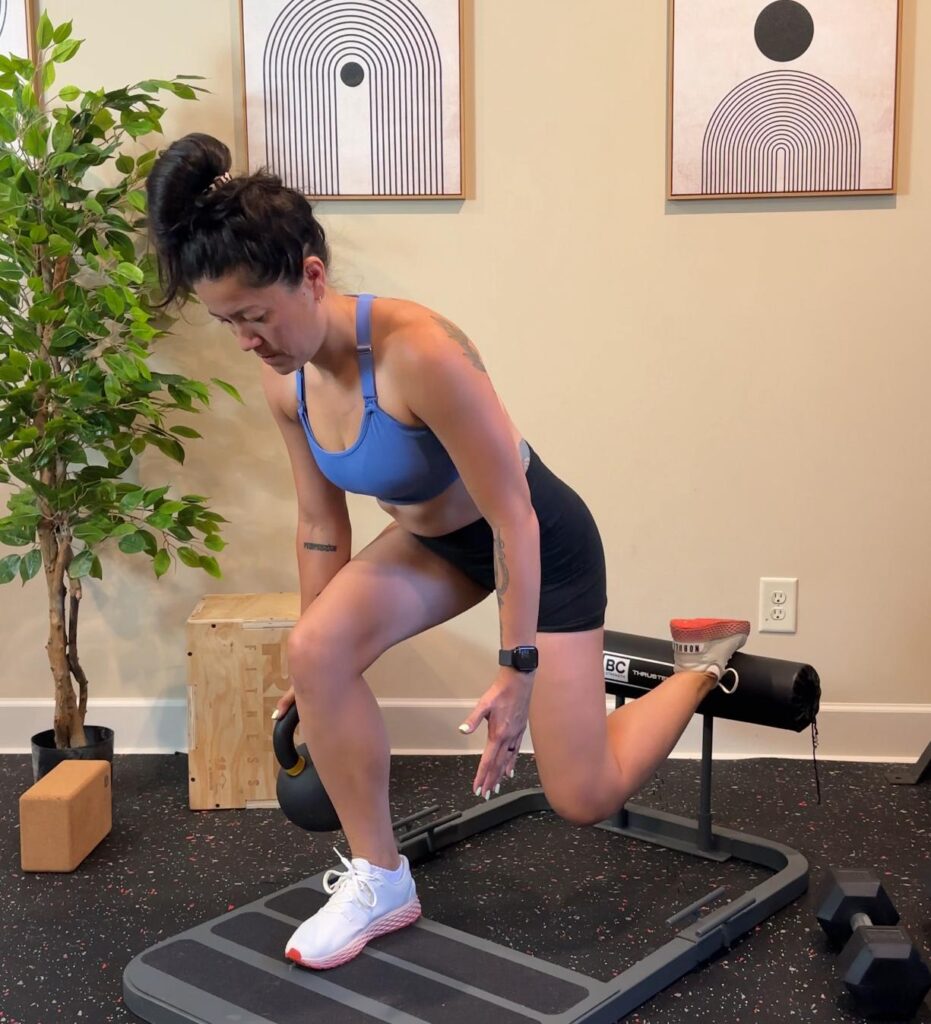
Next, we can bias this pelvic floor positioning to improve pelvic floor strength in our single-leg exercises. When targeting the right leg, hold the weight in your right hand to bias the right quad and glute more, and keep the hip in a more neutral or open hip position.
If you’re reading this thinking, “This all makes sense, but I need someone to show me exactly what to do,” that’s exactly what our programs were built for. With our prenatal and postpartum fitness programs, you’ll get weekly workouts, step-by-step videos, and coaching cues that take all the guesswork out of training your pelvic floor.
2) Posterior Pelvic Floor (often short—needs length and rib-cage movement)
The posterior portion of the pelvic floor often becomes shortened, which can compress space in the back of the pelvis. To counter this, focus on movements that emphasize internal hip rotation (knees in) with adduction, as these positions help stretch and release the posterior pelvic floor. A great starting point is the hero’s pose rock back, where you gently shift your hips toward your heels while keeping the knees closer together. Remember, adding a posterior pelvic tilt—rounding through your back—further targets the back of the pelvic floor, giving you a deeper release.
In addition to general posterior pelvic floor release, there’s often an asymmetry: the left posterior quadrant tends to be tighter and more restricted. Hip shifts are my go-to exercise to target this area, and there are plenty of variations to choose from. You can begin with a leaning hip shift, which provides a supported way to explore the stretch, and then progress to a standing hip shift for more intensity. In either version, focus on adding a slight rounding through your back—this helps specifically target the posterior pelvic floor and encourages greater release on the left side.
If you want to stop guessing at which hip shift, hinge, or row to do (and how often to do it), our prenatal and postpartum fitness programs give you the exact framework. You’ll know which exercises to pair together, how to progress them, and how to adjust based on symptoms.
Once you’ve worked on releasing the posterior pelvic floor, you can layer in strengthening exercises to build control and support. Hinges are one of the best ways to do this. Similar to how we bias the right anterior quadrant, we can bias the left posterior pelvic floor by incorporating more internal rotation with adduction. A staggered-stance Romanian deadlift (RDL) is especially effective: the hamstrings help pull the pelvis into internal rotation, while adding a band for resistance increases inner thigh activation, further reinforcing adduction and IR. To deepen the effect, hold the weight in the opposite hand—this subtle shift also encourages the pelvis into internal rotation, directly targeting the left posterior quadrant.
Conclusion: Training a Pelvic Floor That Can Move
When we step back, the theme is clear: the pelvic floor isn’t just about strength or squeezing—it’s about mobility, adaptability, and the ability to change positions. Pregnancy often exaggerates patterns like anterior tilt and external rotation, leaving the posterior pelvic floor shortened and overactive. Postpartum, these imbalances can linger, showing up as urgency, leaking, constipation, or pain.
By working through release drills (like back expansion, hip shifts, and rock backs) and pairing them with strength work (like staggered-stance hinges or single-leg exercises), you restore balance across all four quadrants. Layer in the breath cycle—inhaling to lengthen the back, exhaling to lift the front—and suddenly every rep becomes pelvic floor training.
Your best posture isn’t one you hold. Your best posture is your next one.
Ready to Take the Next Step?
If you found these strategies helpful, imagine having a step-by-step program that builds them into your workouts week after week. That’s exactly what our Prenatal and Postpartum Fitness Programs are designed to do.
- In pregnancy, you’ll learn how to balance pelvic floor release and strength, while also preparing your body for labor and birth.
- In postpartum, you’ll rebuild a foundation of breath, core, and pelvic floor support so you can return to strength, running, or whatever movement you love.
These are the same programs I used in my own pregnancies and recoveries, and the same progressions we teach our in-person clients every day. They’ve helped thousands of women feel strong, supported, and confident again.
👉 Explore our Fitness Programs and start training your pelvic floor beyond Kegels.