



Every birth has something to teach us.
For Brooke, the birth of her first baby wasn’t traumatic—but it wasn’t the experience she hoped for either. After a long 48-hour labor that ended with Pitocin, an epidural, and feeling disconnected from the birth process, she knew she wanted to approach her next pregnancy differently.
Instead of simply hoping for a different experience, she decided to prepare for one.
In this episode of the MamasteFit Birth Story Podcast, Brooke shares how education, intentional preparation, and staying flexible helped her achieve the unmedicated birth she had envisioned. Her story is a powerful reminder that while birth rarely follows the exact plan we imagine, preparation gives us the confidence to adapt when things change.
Learning From Her First Birth
Brooke describes her first labor as long, exhausting, and emotionally distant.
After laboring at home for nearly 36 hours, she arrived at the hospital only 3 centimeters dilated. She agreed to Pitocin augmentation, which quickly intensified her contractions and led her to request an epidural. While everything medically went well and her son was born healthy, she left feeling like birth had happened to her instead of something she actively participated in.
There was nothing “wrong” with her first birth.
But it showed her what she wanted to do differently next time.
For her second pregnancy, Brooke’s goal wasn’t simply to avoid an epidural—it was to feel present, connected, and actively involved throughout labor.
Preparing for Birth Started on Day One
As soon as Brooke found out she was pregnant, she began preparing.
Being a physical therapist, she already appreciated how much the body can accomplish without relying solely on medication. That mindset naturally carried over into pregnancy.
She immersed herself in birth education by:
- Reading positive and realistic birth stories
- Learning multiple comfort techniques
- Listening to birth podcasts
- Taking a childbirth education course
- Practicing breathing exercises
- Staying active throughout pregnancy
- Learning about labor positions and movement
- Researching pelvic floor relaxation
One of the biggest mindset shifts came from hearing dozens of different birth stories.
Rather than searching for the “perfect” labor, Brooke realized every birth unfolds differently—and every story had valuable lessons.
Instead of trying to memorize one ideal birth plan, she built a toolbox of strategies she could draw from when labor actually began.
Why Having Multiple Coping Tools Matters
During pregnancy, Brooke became convinced that hypnobirthing would be her secret weapon.
She practiced breathing exercises every week.
She memorized the breathing patterns.
She visualized herself calmly breathing through every contraction.
Then labor started.
And she hated it.
Within a few hours, she realized the technique she had spent months preparing wasn’t helping at all.
Instead of feeling discouraged, she simply switched gears.
This is one of the biggest takeaways from her story.
The techniques you love during pregnancy may not be the ones your body naturally chooses during labor.
And that’s completely okay.
Because Brooke had prepared multiple coping strategies—not just one—she was able to pivot without feeling like she had failed.
The Unexpected Comfort Measures That Worked
As contractions intensified, Brooke noticed something surprising.
Her body naturally wanted to move.
Instead of lying down, she found herself:
- Swaying through contractions
- Shifting all of her weight onto her right leg
- Walking between contractions
- Standing almost the entire labor
These weren’t movements she had carefully planned.
They simply felt right in the moment.
Eventually she also discovered another tool she hadn’t expected to love:
Low vocalizations.
Instead of focusing on breathing counts, she began making deep, low moaning sounds with every contraction.
The difference was immediate.
She describes vocalization as the turning point in her labor. It helped her relax, cope with contractions, and gave her husband a clear signal that another contraction was beginning.
Sometimes the simplest tools end up being the most effective.
Labor Doesn't Always Follow the Textbook
Brooke’s labor began with inconsistent contractions that came and went for nearly two days.
After experiencing a long first labor, she worried she was headed down the same road.
Instead, active labor arrived overnight.
She focused on resting whenever possible, sleeping between contractions early on and conserving her energy—a strategy that likely made a huge difference later.
By morning, contractions had become stronger and closer together.
After trying a birth ball and deciding it wasn’t for her, she continued laboring at home until it was time to head to the hospital.
The car ride?
Her least favorite part of labor.
Without being able to move freely, contractions felt significantly more intense.
It’s a common experience many birthing families report—and another reason why staying home during early labor can often feel more comfortable than spending unnecessary hours in the hospital.
A Surprise at the Hospital
After arriving at the hospital, Brooke worried she wasn’t very far along.
Her first birth had conditioned her to expect disappointment.
Instead, her midwife smiled and said:
“There is no cervix here.”
She was fully dilated.
Within minutes, everyone shifted into birth mode.
Rather than immediately climbing into bed, Brooke continued standing because it was where she felt strongest and most comfortable.
Her care team supported her movement instead of forcing her into one position.
That flexibility allowed Brooke to continue following what her body naturally wanted to do.
Following Her Body During Pushing
One of the most fascinating parts of Brooke’s story is how instinctively her body guided her through pushing.
She began in a tall kneeling position while leaning on her husband’s shoulders.
As labor progressed, someone suggested lifting one leg into a half-kneeling position.
That small adjustment created more room within her pelvis.
Within just a couple of pushes, her baby began crowning.
Although the famous “ring of fire” was intense, Brooke remembers her midwife coaching her to slow down and breathe before continuing.
Eventually her baby’s head was born, but her shoulders briefly became stuck behind the pubic bone.
The team calmly repositioned Brooke onto her back, encouraged one final push with a slight crunch forward, and her husband was able to catch their daughter as she entered the world.
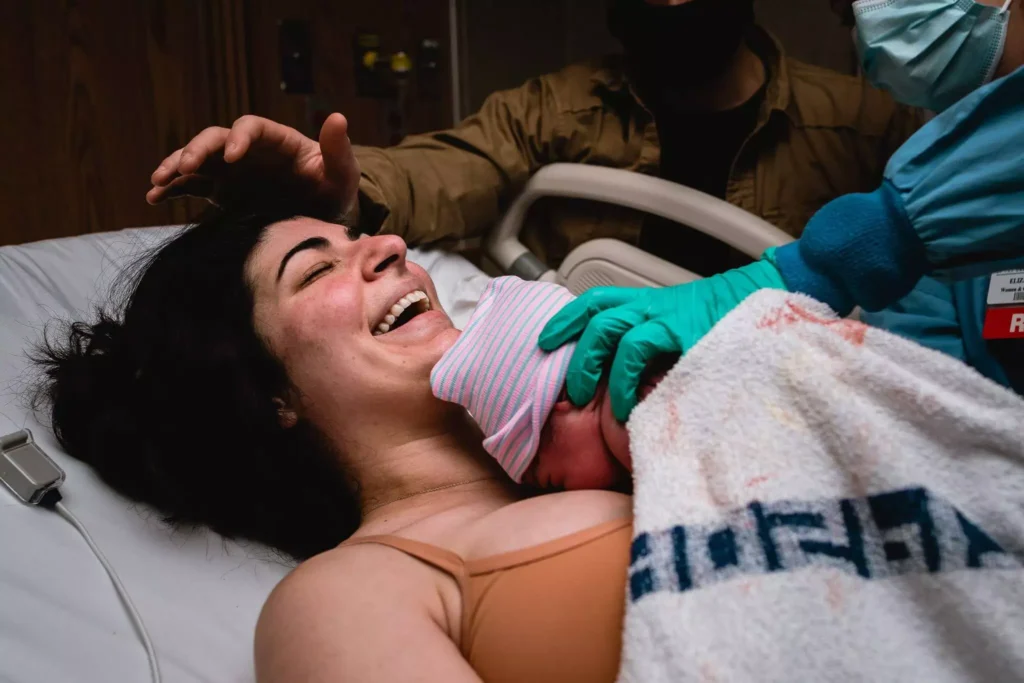
Moments later, Brooke held her baby skin-to-skin.
Her very first thought?
“I did it.”
Recovery and Postpartum
Despite needing a second-degree tear repaired, Brooke’s recovery went smoothly.
Her placenta delivered without complication.
Breastfeeding got off to a wonderful start, with her daughter latching almost immediately after birth.
She found that physically, recovery wasn’t dramatically different from her first birth.
The biggest adjustment was emotional and logistical.
Going from one child to two proved more challenging than becoming a first-time mom.
Balancing the needs of an energetic toddler while caring for a newborn required patience, flexibility, and grace.
Still, she was able to begin taking gentle walks within the first week postpartum, something she felt greatly supported both her physical recovery and mental health.
Brooke's Biggest Advice for Expecting Parents
If Brooke could leave every pregnant family with one message, it would be this:
Prepare.
Not because preparation guarantees a certain birth outcome.
But because preparation gives you options.
- Learn different comfort techniques.
- Practice multiple positions.
- Understand the stages of labor.
- Read birth stories.
- Take childbirth education classes.
- Listen to other families’ experiences.
- Most importantly, stay open-minded.
The strategy you think you’ll rely on might not be the one that helps you most.
Labor has a way of surprising us.
The more tools you have available, the more confidently you can adapt as your birth unfolds.
Final Thoughts
Brooke’s birth is a beautiful reminder that birth preparation isn’t about creating the perfect plan.
It’s about building confidence.
Her labor looked very different from what she imagined. The hypnobirthing she practiced for months wasn’t her favorite coping tool. The shower she planned to use never sounded appealing. Even the labor positions she expected to love changed throughout the day.
But because she had educated herself and practiced a wide variety of comfort measures, she never felt lost when her plan evolved.
Instead, she trusted her body, leaned on her support team, and discovered what worked for her in the moment.
That flexibility—not perfection—helped her achieve the empowering birth experience she had hoped for.
Prenatal Support Courses

Learn the science of pregnancy and birth to take the mystery of labor away! Understand why you are feeling what you feel, and learn strategies to confidently move through pregnancy and birth!
- 9h+ of Video
- Support Group
- Close Captioning
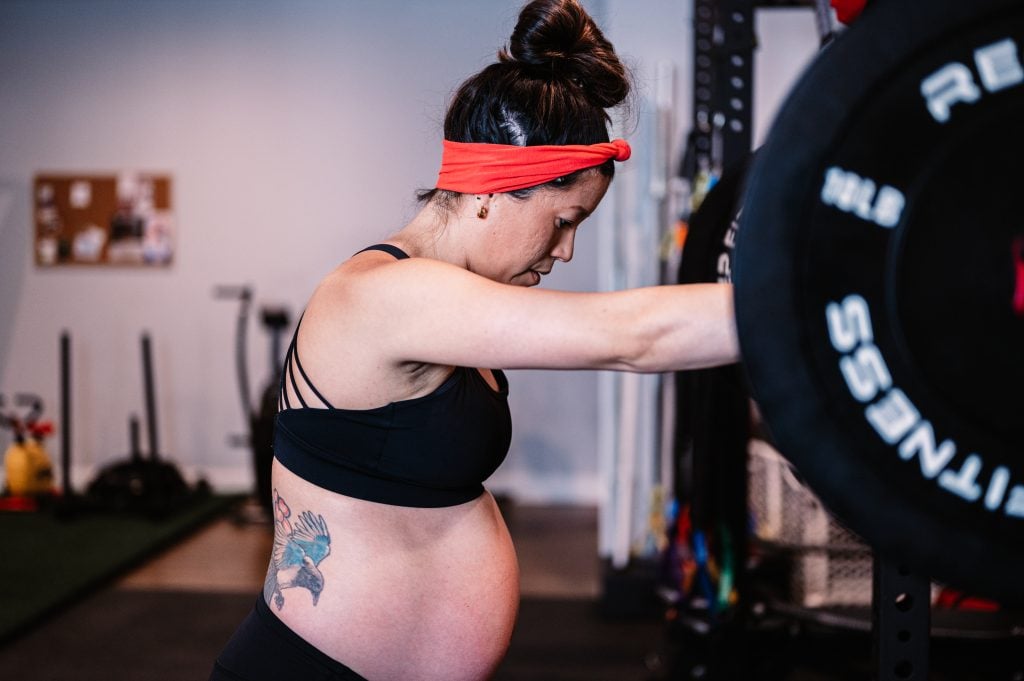

- 5 Workouts/Week
- Gym Workouts
- Self-Paced

Instructor
GINA
Workout on-demand with our prenatal fitness workout videos! Each workout is 30-40 minutes to follow along as you exercise at the same time!
- Birth Prep
- All Trimesters
- Mobility Work

Instructor
GINA
Find comfort and relief from pelvic girdle pain throughout your pregnancy and postpartum period! This program incorporates myofascial sling focused exercises to stabilize across the pelvic girdle joints.
- 3 Weeks
- On Demand Workout Videos to Follow