



Ultrasounds are commonly done throughout pregnancy at varying times. They are usually an exciting time for parents to be able to see their babies, while also assessing for some important pieces for providers.
What is an Ultrasound?
This test uses sound waves to create an image of your organs inside your body. They help your provider assess that baby is growing on track, search for the presence of any abnormal conditions or diseases, and assess how baby is doing in the womb.
This test is said to not be harmful to you or baby!
Reasons for Ultrasounds
Most will only have 2 ultrasounds (1&3) during their pregnancy, the dating ultrasound and anatomy ultrasound.
The other ultrasounds are only recommended on a case by case basis from your providers.
1. Dating Ultrasound
This is done in the first trimester, usually around week 7/8, to confirm the due date.
If you are very confident on your last menstrual cycle this is not always done. Many providers are doing this more often though because it can be more accurate than determining the due date by your last menstrual cycle.
Learn the science of pregnancy and birth to take the mystery of labor away! Understand why you are feeling what you feel, and learn strategies to confidently move through pregnancy and birth!
- 9 hours of on-demand video
- Lifetime Access of E-Course
- Watch on Mobile Device
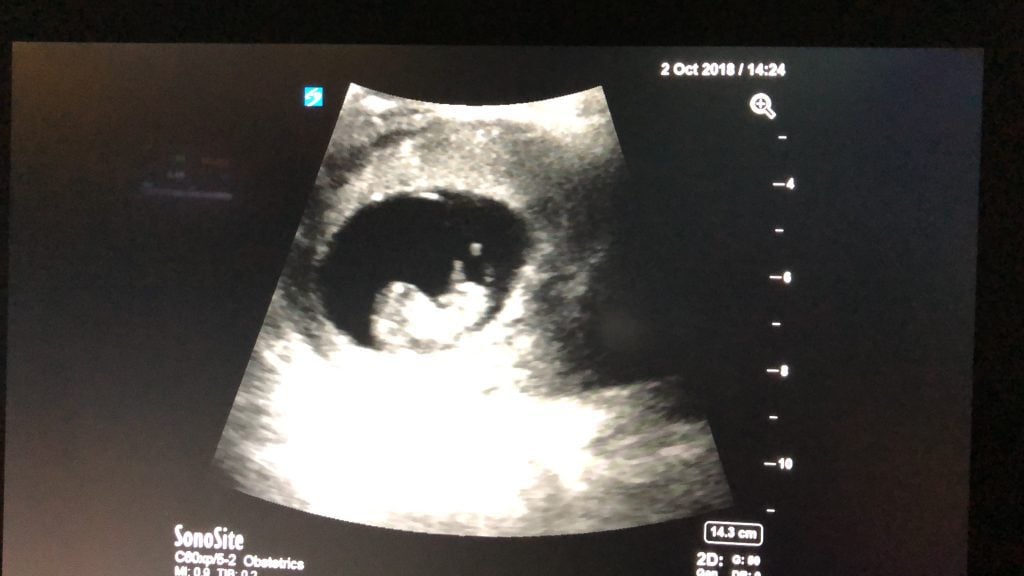
They are also looking for baby’s heart rate, so sometimes referred to this as the “viability scan.” Since they are looking for the heart rate, this can be when multiples are found, such as twins or triplets.
This can also be used to determine that baby is in the uterus and not still in the fallopian tube (ectopic pregnancy).
2. Genetic Screening Ultrasound*
This is completely optional! Not everyone gets genetic screening done.
This ultrasound done in the first trimester between 11-14 weeks. One thing they are looking for is called the nuchal translucency screening, this is a screening to rule out Down Syndrome and other abnormalities such as a congenital heart defect or neural tube defect.
3. Anatomy Scan
This is done between 18-22 weeks to look for any abnormalities in baby’s anatomy. They look at all of baby’s body parts and organs to see if there is anything concerning. They will check the amniotic fluid level, the placenta location(determine if its low-lying/placenta previa), and look at blood flow to ensure everything checks out.
This is also where people will find out the gender of baby if that’s something they are wanting to know.
4. Growth Scan*
If there is any indicators that baby’s growth may be off, both bigger or smaller than usual, your provider may recommend a growth ultrasound.
This ultrasound takes measurements of every limb, abdominal and head circumference, and
5. Monitoring Ultrasounds
They will recommend more ultrasounds if they you are a high risk pregnancy, they are monitoring to see if something is resolving (such as placenta previa or low lying placenta), or there is any concern that arises as pregnancy progresses.
They can also be checking on cervical length if history of preterm labor, or shortening of cervix
6. Biophysical Profile (BPP)
This is a test that uses the ultrasound to check the well-being of baby along in combination with a Non-stress test.
It is a 5 part test with the Non-stress test being part 5. Some providers will omit this depending on resources and time. Each test you get 2 points for a total score of 10, there is no possibly to get 1 point for each part though!
- 8-10 is normal
- 6 is uncertain and requires more testing (usually repeat BPP in 24 hours)
- 4 or less is considered abnormal. This is usually where expediting delivery with an induction or c-section is recommended.
The 4 parts assessed by ultrasound:
- Fetal breathing movements
- Fetal movements
- Fetal Tone
- Amniotic Fluid Volume
Some providers will only asses for Amniotic Fluid volume and do a Non-stress test. This is called a “Modified BPP.” If the amniotic fluid volume is normal and the Non-stress test is reactive this is a good indicator that baby is doing well.
7. Fetal Postion during labor
Sometimes during labor if baby’s position is being questioned, the provider will offer an ultrasound to see where exactly baby is facing and how they are positioned.
They may also confirm that baby is head down before admission, for both those in active labor and being induced.
8. Boutique Ultrasound Clinic

This is a cash based clinic that offers ultrasounds to either just get pictures of baby that are 2D, 3D, or even 4D at some point during pregnancy. Sometimes offering packages to come back multiple times throughout pregnancy.
They may also offer gender reveal ultrasounds to find out baby’s gender if your anatomy scan is not scheduled till later in the second trimester.
These can be nice to be able to see baby more often, especially if you are anxious during pregnancy on if baby is okay.
Conclusion
There are many different types of ultrasounds throughout pregnancy and not all are needed by every person.
Some only get one ultrasound their entire pregnancy, and some can have multiple!
Myself, I had multiples in both pregnancy because I was really anxious. It helped give me peace of mind that baby was doing okay in there.