



In today’s episode, we have the privilege of having Dr. Puja Shah with us, a double board certified anesthesiologist and interventional pain management specialist based out of New York City, approaching wellness from the inside out, she uses her intensive medical training and deep understanding of the mind body connection to deliver comprehensive pain management care to her patients.
Dr. Shah performs a variety of interventional procedures for spine pathology, headaches, inflammatory conditions, chronic nerve, joint and pelvic pain and other ailments.
As one of the few female pain management specialists in the area, she also has a special interest in women’s health as pertains to both mental and physical wellness. Dr. Shah taps her cultural roots to incorporate concepts of Eastern and Western medicine.
Maintaining that success comes from treating the whole patient passionate about providing a greater understanding of chronic pain. She believes that many conditions have multifactorial sources and works diligently with each patient to find their own specialized wellness profile and treatment plan. She enjoys working collaboratively with her husband, who is an orthopedic spine surgeon, and tackling spinal pain issues in a stepwise matter.
Listen to the MamasteFit Podcast and empower yourself as a mother! With two new episodes every week, we bring you educational insights on Wednesdays and captivating birth stories on Fridays.
Subscribe now to never miss an episode and stay up-to-date with the latest insights, stories, and advice from our expert hosts and guests.
What are the top things your friends ask you about when they are pregnant or most common advice that you give to your friends about pain relief during labor?
Dr. Shah: Thank you so much for having me on the episode. I feel really honored to speak about this, especially having given birth about three months ago. So the tough questions I get asked are pain relief during childbirth, which can be a variety of different topics going from our spine related procedures, such as epidurals and spinals, all the way to I.V. medications and of course, general anesthesia.
The advice I give to my friends are the same advice I give to my patients is that it’s always important to make an informed decision, and knowledge is key. So I think today we’ll be discussing a lot of the different types of pain medication and labor relief, and hopefully that can help a lot of you understand it a little better and make these informed decision
Can you give us a quick birth story for yourself?
Gina: It’s kind of a unique position that you’re in to also be providing like labor personally for moms that are in labor and then also having gone through it yourself too, so our listeners can understand kind of where you’re coming from.
Dr. Shah: Absolutely. I’ve been trained extensively in anesthesiology, especially in New York City hospitals. I really touted myself as really being aware of what goes on. But nothing is as humbling as being in labor yourself and of course, delivering a child. So my story in short, started off with an induction. I was passed 40 weeks with my first baby and I went in for what was a quite uneventful induction.
I did opt for an epidural anesthesia quite early, given that I was going to have what they call a cervical balloon to help my cervix dilate, as well as be placed on Pitocin, which is an agent that helps the uterus contract when you’re not already going into labor, which I was not. I progressed slowly and luckily the cervical balloon did help.
I went to full dilation, which is ten centimeters, and my uterus was doing its thing and contracting as much as possible. Unfortunately, at that time, Baby had a different desire. His heart rate started to decelerate, which means that it was going down. And for fetal heart rate, we need to see a nice wave of being able to go up and down based on how your uterus is contracting.
If the baby’s heart rate continues to go in a downhill trend, it can be a sign of distress. And at a certain point, the anesthesiologists and obstetricians do feel like it can end up being something that’s not healthy for the baby as far as not getting enough oxygen in during a vital time. So I then progressed to a C-section quite suddenly and would call it an emergency C-section.
At that point I already had an epidural in place. So this epidural was now dosed into what we call almost like a spinal full level of anesthesia. I’ll explain a little bit more of that during our questions. And so when I was in my C-section, I really did not feel anything from the breastbone down. This epidural now became a full on, numbing agent, and I was able to progress through my C-section the entire time without any pain.
I delivered a very healthy baby boy, and postoperatively I did utilize the epidural for some pain relief, especially in that first postoperative hour period. And then I progressed with I.V. pain medication and then oral and was pretty lucky in being able to be discharged quite early from the hospital.
Doctors are usually the worst patients, and they like to get out of the hospital as soon as possible.
And I was sent home with pain medications and really just like your regular Tylenol and Advil around the clock, which I progressed to really on day five
How do you think your care as an Anesthesiologist changed after going through birth yourself?
Dr. Shah: Oh, it’s an absolutely transformed. I don’t perform labor epidurals on a daily basis. However, I do perform epidurals for other sorts of pain management, including chronic back pain. And regardless, I just have a sensitive and humbled approach to what pain really is. I realized that a lot of patients these days, regardless of how much the Internet informs us, really don’t necessarily have a very medically informed idea of what pain relief is and that is why podcast episodes like this are so important.
And I spend even more time than before explaining to them what exactly they will be choosing or not choosing and what that means for them and the choices that they have, and if that aligns with the story that they do envision.
Labor Pharamacological Pain Relief Options
Roxanne: So we know that there are a lot of different types of pharmacological pain management options during labor that we can use and that are commonly used in the U.S. specifically. So we know I.V. pain relief options, nitrous oxide is an option in some hospitals and then the epidural is probably the most common option that people know about.
But also Spinal and General Anesthesia can be used as well.
Epidurals, most commonly known and talked about probably for labor pain management. About 70% of people, they say, get an epidural during labor. And I find that a lot of people really don’t fully understand what an epidural is and the process of getting one. I think most people are like, oh, like epidurals are so scary because they’re putting a needle into your spinal cord and like injecting things into your spinal cord.
Can you explain more on what an epidural actually is in the placement procedure of an epidural?
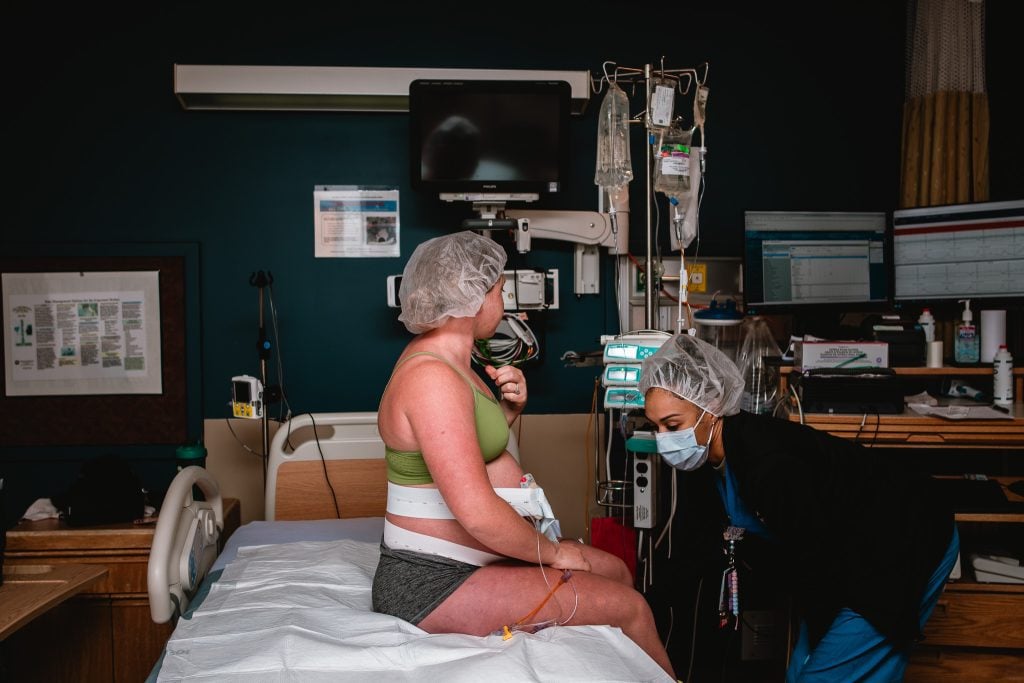
Dr. Shah: So I understand why it’s exceptionally scary, especially when you have a large fundus. I’m not very comfortable with a pregnant belly, and often you might already be in labor. So what a epidural does require, regardless of the scenario that you’re in, it does require mom to be still for at least a short amount of time. What that means is that you are told to sit up and lean over onto your stomach like a cat or in some options lay lateral on your side and lean over so that the spinal area right in the back around your hipbone region can be open for the anesthesiologist to insert the needle.
There’s a medium sized needle that actually inserts into the spaces between your spinal bones. Many of us can feel that space between our spinal bones if we take our hand back. It goes through ligaments and it goes in to an area that is surrounding spinal nerves, where there’s fluid, where the medication is inserted, the medication or the needles go nowhere near the spinal cord.
The spinal cord ends at the L2/L3 level, L meaning lumbar, which means lower back, and the epidural is placed below that level, always. So the medication coats and surrounds the nerves that are important for pain during labor, and it essentially numbs the the angry nerves that will get even more angry as we progress in labor.
But it does not by any means touch the spinal cord, which is extremely important because the spinal cord is in charge of all of our movement.
The next thing is a spinal. So a spinal is something that people will have for a C-section, especially if they have a scheduled C-section, where they’re going in without having an induction prior and not having any labor.
A spinal is different in the sense of the needle is slightly smaller and it goes past all the layers. I just mentioned for the epidural and goes into what we call the dura and exactly around the spinal fluid. We notice a tiny amount of spinal fluid release itself into our needle so that we can ensure we’re exactly where we want to be. The medication is pushed exactly directly into where the CSF cerebral spinal fluid is living. The spinal acts immediately and has much denser block than epidural because the point is to numb you completely.
\Whereas the point of an epidural is to give you pain relief while you are able to push in labor. And for some individuals in certain hospitals, maybe even be mobile and walk around
Are there different types of epidurals?
Dr. Shah: So the actual epidural, the needle and the equipment that we utilize is pretty standard of care throughout the United States. The differences lie in depending on hospital with the medications. Everywhere that I have practiced and trained uses a combination of a local anesthetic, something like lidocaine that we all know from the dentist, plus fentanyl. Fentanyl gets a really scary, bad rep these days for obvious reasons, but it’s an extremely low dose.
It comes in a bag and it infuses itself straight from the catheter that attaches to the epidural that was placed by the physician into that spinal area surrounding once again the nerves. It’s an extremely low dose infusion that most hospitals have as an ongoing, you know, drip, drip infusion. And then often the patient gets what we call a PCEA, patient controlled epidural administrator, where you can press every so often to give yourself a bolus or a top off of more medication.
The question I get asked here is,
Will I overdose? Will I make myself too numb? It has felt on it. What will it do for my baby?
So because the dose is extremely, extremely low and is really localized to the area that’s aforementioned, there is hardly any amount that is actually transmitted to the fetus. And the amount of fentanyl that is going into the body at that point is leading to a synergistic pain relief with the local anesthetic, but not really leading to any worries about respiratory issues for the fetus, nor the mom.
With an epidural, how long does it take for someone to have relief? Typically.
Dr. Shah: So when I perform an epidural, I’ve explained by now the concept of an epidural and spinal. The spinal being immediate.
When I perform an epidural before I throw it in the catheter, a catheter meaning a really long thin straw like tube that goes from your lower back out and connects to that pump with the medication. I give a bolus or a, you know, a nice push of medication so that by the time I’m done getting the epidural set up into the pump, the patient is already having relief.
This can happen within anywhere from 90 seconds to 3 minutes. The important thing is to communicate with your physician. What are you feeling? It is common at times for people to say things like, I feel one leg going and not the other. Haven’t had many friends, including physicians, tell me these things or have stories. At the end of the day.
Medicine is not a perfect science. And when you’re in labor and we’re doing a procedure that is blind, meaning there’s no X-ray, we are not aware of exact anatomic deviations for each of us, including myself. If you’re feeling anything like this, you can ask your anesthesiologist to troubleshoot. Sometimes the wire that’s in there has coiled up so it can be retracted.
Sometimes it just so happens that the medication was deviating in one way or the other due to something like a blood vessel. And so there’s always ways to make sure that you’re getting the full pain relief that you deserve. And I’m a huge advocate for people speaking up about their own personal experience
Roxanne: So I’ve definitely seen it be pretty common that one side is usually denser than the other. And then we do know that epidurals usually work by gravity, so the medication is going to the lowest portion.
So us as nurses are usually trying to be aware that like we’re putting patients on their sides because we still want to move them during labor.
But like if one side is a little less numb than the other, we’ll try to put them on that side a little bit more. So that that creates more of an even block.
Do you find that it's pretty common that people will have like one side be stronger than the other?
Roxanne: Or it’s like we usually call them hot spots for like one spot.
They feel absolutely everything, but everything else is numb.
Dr. Shah: Yeah. So let’s talk about my own story. And it was a very interesting to get an epidural from another anesthesiologist when I do this for a living.
When I first had that bolus of the medication, I said, Wow, this feels great in my entire right leg, right side of my pelvis went numb and my left side did not.
So given that I am quite aware of this, I spoke up before that catheter was pasted on my body and the anesthesiologist likely pushed the catheter back, maybe a millimeter or so I would assume, and gave another small amount of bullets. And I felt it on both sides. This is my experience. The point of the matter is that I spoke up early, knowing that if I had another 45 minutes of medication going to only one side, it would also make the life of a labor and delivery nurse like yourself a little bit more difficult.
I wouldn’t say that I see it in every patient, but it’s not uncommon. People have different anatomic deviations. There might be a little fat cell that’s there. There might be a blood vessel. These are not things that are wrong per se, but it’s anatomy. You don’t have to proceed into labor hoping for an epidural with only one side of your entire body numb.
There is no reason for that. There are many ways to get around it. We don’t like to have to repeat the entire epidural entirely, but if you’re not comfortable, often just changing the position or going up a level or below a level can alleviate that problem entirely. This is our job and it is our job to make you as pain relief as possible within safe guidelines.
Roxanne: With an epidural, sometimes people will say like that it almost wears off. So you don’t want to get it too early because like the effects could wear off over time.
Have you seen it where it like gives like really full relief at the beginning and then you start to see where it is one sided relief on either side or like they just start to feel everything again?
Dr. Shah: So I can’t comment on every hospital because I’ve only worked at, of course, the ones I have. What I’ve noticed is that a steady infusion can really eradicate that issue because it’s a steady infusion. Once again, the importance of speaking up early. If you’re feeling the one side, it makes 100% sense to me now. Also, as a patient, I can’t imagine that if a patient is having full relief on both legs that it would turn into one sided unless maybe something has happened, the patient has been moved or somehow the catheter has been dislodged.
All things you would want to tell your nurse. First and foremost, the steady infusion plus the bolus, either the button that self-administered or the anesthesiologist coming in and physically giving a bolus throughout the labor stay will prevent things like having more of a patchy epidural and feeling like it’s wearing off because you’ve allowed yourself a nice, steady administration of anesthesia.
Pre-Epidural Fluid Bolus
Gina: So in some hospitals that I’ve supported birth as a doula, they all require like a full bag of fluid before someone can get an epidural, and then in other hospitals they will just administer it during the bag of fluid being administered. So it’s kind of like but it seems to vary from hospital to hospital. Are there any like new evidence out there that says like you don’t need like a full bag of fluid to prevent like that blood pressure drop because it seems to vary from hospital to hospital for me?
And so I feel like maybe evidence has kind of changed over the years.
Dr. Shah: Yeah, surprisingly enough, I was a good advocate for myself and I actually asked for an entire bag of fluids to be infused before I got my epidural. The reason being is that I know I tend to be on the side of low blood pressure and knowing that an epidural does cause your blood pressure to go lower. Why is that?
It’s that the medication is now numbing the nerves like I spoke about. And so these nerves, these vessels, everything in that area no longer has that tight resistance that we speak of. And now it’s open and like a flowing chamber. So if you can imagine, an open, flowing chamber allows that blood pressure to drop versus being tight and constricted and especially during pregnancy.
My predisposition for going down the lower blood pressure level, I felt that it was important for me. I don’t think that most hospitals really have a rule, nor is there an exact evidence currently of whether one way or the other truly prevents having hypertension during an epidural administration.
Anesthesiologists also have medications that can increase your blood pressure right after that drop. They are not harmful medications. They’re short acting. It’s just a way for us to keep everything stable for mom, but especially for babies, so that the blood flow is going in the right direction.
I am a huge, huge advocate for hydration, but understanding that individuals with other conditions such as pre-eclampsia, tend to have a lot of water weight and may not be the best candidates for extra water or hydration infusion.
So it’s really a case by case scenario.
Overcoming Fear of Epidural
Gina: So someone’s afraid of an epidural or a spinal if they’re having a scheduled C-section. What tips do you have for them to kind of overcome this fear?
Besides just being educated on like what is happening is I tend to find the word we tend to be afraid of things that we don’t understand or we don’t have a good education on.
So are there like any other tips besides just learning more about the epidural to kind of overcome this fear, especially if someone is wanting pain relief?
Dr. Shah: I agree. And we are definitely more anxious about the unknown, even as individuals who, like all of us, do work in the birthing space. I think as simple as that may sound, it’s important to speak up about your fear. You know, tell your doctor, Hey, you, everything has been going well. But this is something that is just really been causing me anxiety.
I just want you to know that a good physician will be very attentive to that. And he or she may not be necessarily aware of your fear of that if you’re holding it all together, especially those of us who are used to these things often that may allow them to do one of two things. They may walk you through the process.
I personally will say, Do you want me to tell you each step that I’m doing, I’m coming up the back area now you’ll feel a little bit numb. Now you might feel a crunchy sensation. Now you might feel numb on one side. I have patients that say, don’t tell me anything, put on some music and let’s just do this.
So as a physician and now a patient or postpartum patient, knowing the personal needs of that individual truly is a great way for anxiety relief. And that makes the person feel heard.
Epidural Complication/Risks
Roxanne: So as we know, with everything in life, there’s always like risks and benefits. And like the huge benefit of that epidural is that labor pain relief so that they’re able to relax during labor if they find that they’re really tense or if they’re just like don’t want to feel that pain, which is totally fine. That is like one of the biggest benefits of an epidural.
But what are some complications associated with an epidural that is the other side of that.
Dr. Shah: Right? There’s always two sides. The first thing I’ll say, which is not a complication, but something just to be aware of, is that most hospitals, after you have an epidural, you have to have what as a urinary catheter placed in, because remember, you’re numb and many hospitals do not allow you to walk around after an epidural. So just being aware of if it’s your choice to really be able to get on that birthing ball, walk around, that ability may not be present.
Now that you have something that’s truly numbing you, there are certain institutions that will still allow you with assistance to walk around, but be aware of that and ask the question.
The next thing, as far as risks go, is that any time you are having a needle enter your body anywhere, there’s always a risk of infection. This procedure is done sterile with masks, hat, gloves and gowns, and the whole area is cleaned in a septic way, even though you’re in, you’re not in the operating room, you’re in your birthing suite.
Other issues could be that the medication goes in to the area and can be too strong a medication that’s too strong can start to often creep up in the areas that are not low based on gravity. And so it can sometimes make people feel uncomfortable. And if nerves around the diaphragm do get numb, it gives individuals a sensation that they can’t breathe even if they can. Just because it’s an odd sensation to be numb up closer to your sternum or breastbone. Once again, we are trained to navigate these issues at the drop of a hat.
Other complications that can arise are nerve damage. Once again, a needle is going around the spinal nerves as well as bleeding.
If we do come across a blood vessel, if anything like that does happen, that needle is always immediately removed. We are paused. We have a conversation about it and think about the next steps to proceed. It doesn’t mean that you can’t get a repeat epidural. It just means that we proceed with caution and we and the patient make a well informed decision on what to do next.
Will an epidural cause labor to stop or slow?
Gina: So can an epidural stop or slow labor because this is sometimes a concern for folks is like, well, if I’m not, you know, moving around, is my labor going to stop? And I’ve kind of see it go both ways or maybe it slows things down. But if someone’s, like super tense and fighting their contractions, I’ll see them like just finally relax and they go from like two centimeters to ten.
So in your opinion, as an anesthesiologist, can epidurals slow or even stop your labor?
Dr. Shah: In my opinion, there is so much research about this, and this is maybe a question I get every day from friends. You know, off the record, I do not believe, medically speaking, that it can slow your labor. But what I do know is that it can make you feel quite numb, which is the point of it, to the point where some individuals, when they get to that layer of pushing, they may not feel as much as they intended.
Friends that have had a birth without an epidural versus what one will comment on when it was time to push without the epidural, I felt so much pain that I could do nothing but push because I had to get the baby out. Whereas if you are feeling quite numb with the epidural, you may need the assistance of wonderful nurses like yourself to let you know there’s a contraction on the monitor.
You might feel a small sensation. This would be a time to push because of course you’re not getting that, you know, mind blowing sensation of just wanting to get it out. Whether that’s a good or bad thing, I cannot comment on it because it also depends on your personal threshold for pain and really the outcome that you want.
Also remember that if you are to move from an induction or regular labor to a C-section, if you have the epidural in place, that itself is already in place for the C-section. So you’re not getting another spinal on another level of anesthesia. This is not a reason to get an epidural in advance, as most of us don’t know that will happen.
But it does make that process very seamless versus, you know, having to think about what to do for the C-section at the end when things might be a little bit rushed.
Pushing and Movement with an Epidural
Gina: So for me, as a doula, the things that I found to be helpful for my clients who do have an epidural and they are not feeling anything when it comes to pushing is to like have a mirror so that you can kind of reconnect that mind body connection and be like, okay, when I push, I’m seeing this with the mirror.
Therefore, like I can kind of reform that connection between like this new sensation that I’m feeling in my body sometimes, like the provider or the nurse doing like some internal pressure, like push here can sometimes be helpful and some folks can’t even feel that. And so it’s just really trying to reach, learn this new sensation and like what that new sensation means.
And so when it comes to like the labor progress side movement is key for labor progress. Can someone still move if they have an epidural?
Dr. Shah: So it depends on the hospital. The hospital that I was at did not allow the movement. I do have colleagues that work at hospitals that do. So these are definitely choices that some people also make based on where they want to deliver based on these rules. I was unable to walk around or move, but luckily my labor did progress pretty quickly and so I didn’t necessarily find that to be a deterrent.
What Gina said as a doula I find is incredible. I truly like to practice an Eastern Plus Western philosophy for all medicine, and especially when it comes to something like childbirth, because there are just so many things that are not truly medical and babies really do have a mind of their own. So working with a labor and delivery nurse, a physician and Anesthesia, I think is the ideal combination of individuals that have an expertise in the medical side of things, monitoring the baby, and of course, then also giving you the empowerment of the mind body connection to really manifest what your body is really meant to do.
Roxanne: So with the movement portion, like they may not be able to like get out of the bed and like move around outside of the bed, but they can still move within the bed.
Dr. Shah: Right. So with assistants, you know, I changed positions in the bed. I didn’t want to get muscle spasms because at the end of the day, just because you have an epidural, you’re still in a bed where it’s easy to get very tight and your shoulders and your neck and being someone with a yoga background, I found it very important to try to keep all the parts of my body that weren’t necessarily numb, loose and free so that I could have all the power when it came time to push or proceed.
So I would go from one lateral side to the other. I would have my neck be massage and my wonderful partner, my husband would come around and just help mobilize the parts of my body that weren’t fully dead weight, so to speak. So I found that to be helpful, and I would give that advice to anyone, individuals that are able to walk around with assistance.
I do advocate for that because if nothing more, it’s really good for the mind to just get moving and also make the time go a little bit faster.
Timing of Epidural
Roxanne: So is there a good time during labor that you recommend to get an epidural? So I do know like some people recommend waiting until they’re more active labor where they’re like actively making change and labor seems to be self-sustained. Or I’ve also seen people, especially with inductions, get those like epidurals earlier. But there’s always like that caveat of like, hey, like the longer this epidural is running potentially again could wear off for lack of a better word.
So do you recommend like a good time to get an epidural if they’re wanting that for pain relief?
Dr. Shah: So like you said, there are so many different scenarios. Some individuals are in, you know, true labor, as they say, that end up at the hospital. And it’s time, you know, the anesthesiologist like me is is rushing over to that location and within an hour, baby’s out. And those are really the scenarios that are not necessarily planned in advance.
Induction can mean many things. And this is also something I’ve learned now as a patient. It could mean cervical ripening agents that are suppository, which can be relatively painless, or it could be a balloon, which could be, of course, more invasive. I ended up with a balloon because that was a protocol for my OB-GYNs. And so I was given the information that I could have an epidural in advance because placing a balloon into a cervix that was not dilated at all didn’t necessarily seem fun, for lack of a better term.
So that was my choice. If your induction is going to proceed more slowly, may not have a cervical balloon, the Pitocin will find its way working in a stepwise fashion. You may not notice that you’ll even have pain for the first three 8 hours. And so it might be your choice to wait and really see how your body feels before making that informed decision.
So back to the question. I think the biggest thing is saying, what am I signing up for here? Of course, this is not the scenario of rushing into the cab in the hospital on labor because your body is already making the decision for itself. But in the scenarios where it’s scheduled, what do patients usually do? What are my options here?
What do you recommend? And what is a stepwise approach? What parts of this do I or most patients anticipate being painful? What does it really mean to get a cervical dilating agent? What options are there and what exactly is pitocin? Are we going to start this uterine contraction agent pretty aggressively and have a go to a high dose where then, of course, the uterus is going to be talking to it in pain?
Or are we doing a little bit of a steady, slower scenario where you might want to give yourself time?
The other thing I want to mention, which is not mentioned enough, is mental health. So history of trauma, history of anxiety, a history of hospital related fears is huge. It is a phenomenon that we don’t realize has such an impact on our bodies.
What does that mean for someone? If someone has a true fear of needles really questioning what is this procedure going to do? And you know, by waiting and putting it off for so long. Am I doing myself a disservice? Or maybe that fear just hasn’t been answered and I just need to have a nice chat with my anesthesiologist.
Or listen to this podcast. Fear of Pain. Some individuals had a lovely pregnancy but have such a fear of pain during labor that their entire body clamps up and they may choose to arrive at the hospital and have an epidural. The moment that they’re changed into their gown and what does that look like? A conversation that they’d have with the whole team.
So self-awareness, first and foremost, what are my fears? What are my anxieties? What is the physician, doula, midwife, nurse really looking to do for me? And at the end of the day, my options are laid out in front of me. I will make the best informed decision I can, knowing as always that the fetus baby may also have a mind of its own.
Roxanne: So true. And I love that it is so situational based because we’re all not the same type of people. One person may want to wait until they’re like nine centimeters and someone else would be like, I am. I’ve had my first contraction. I am ready for my epidural. Mm hmm.
Why may someone not be able to get an epidural?
Roxanne: Because we know that is an option. I mean, not an option. It is sometimes a situation where someone comes in and they’re not able to get that epidural due to either previous like back surgery or their platelets are too low. So what are some reasons someone can’t get an epidural?
Dr. Shah:So those would be the two most common individuals with back surgery if they do have good prenatal care in advance. And I have dealt with patients like this sometimes do present us with images such as X-rays and MRI’s of past surgeries. So we’re well aware it’s often very easy to put it into a that stuff I’ve had back surgery but where does that what does that really mean?
What is the location? Are you entirely fuzed at the level that our needle would be inserted? I’ve seen very few scenarios in my personal career where a history of a back surgery has made it impossible for a patient to get an epidural just because the surgeries that are done these days tend to be more minimally invasive. But once again, it’s a case by case scenario, and I, as an anesthesiologist, would want the full story.
The other aspects are more medical. So a history of low platelets. Low platelets are these molecules in our blood that do clotting. Often low platelets in pregnancy is not an uncommon thing because they can be associated with other conditions such as pre-eclampsia. When you have low platelets, you cannot get an epidural just because when the catheter does come out, we are worried about that area not clotting enough and swelling and causing what we call an epidural hematoma that’s swelling around those spinal nerves can cause increased numbing and not the scenario that we like to get into.
So what are my options? Do I have to go through this entire procedure with pain? No, there are other options. Some hospitals do, like you said, provide nitrous. I’ve never actually worked in a hospital that provides that. But I do know that that is not an uncommon thing. And of course, none of that gas touches your spinal nerves, your blood. So that’s a great option for an individual if that is offered.
The other options are IV medications. So I think, Roxane, you had mentioned one of the medications that you you had heard about recently.
Roxanne: Yes. So one of my hospitals that I worked at, they started doing a remi-fentanyl PCA pump for those that could not get an epidural, but they did want some sort of pain relief. And so I think we’ve only had like two people use it while I was there. And it was a very new experience in kind of different where they had to be monitored pretty closely with like their oxygen rates and monitoring baby and then to make sure their not sedated right.
But it’s still an IV pain relief option. So it didn’t take away everything, but it was a better option than just like regular IV pain.
Dr. Shah: Right. So, Remi-fentanyl is a medication that’s in the fentanyl family that is extremely short acting. We colloquially use it. We think of it as as soon as it hits the blood, it disappears. And that’s why it does have to be in an infusion format, because it’s not something that if I push an IV amount of remi-fentanyl into your body, it will last.
It has to be a constant stream of infusion whenever you’re getting any kind of opioid medication through an I.V., whether in delivery or not, you do have to be monitored for things like your pulse ox is your oxygen saturation, especially because Mama’s oxygenation stats duration relates directly to babies. The thing with Remi-fentanyl is that it is going into your body and allowing those opioid chemicals to decrease the pain.
You know, going from a systemic standpoint and that is a wonderful option for the right candidate. But just be aware that it will not equal the exact type of pain relief from an epidural. Not saying it’s better or worse, but an epidural does work locally in the sense of numbing those spinal nerves. I don’t think that individuals that can’t get an epidural should feel that they can’t advocate for themselves and they should have access to pain relief.
It just may look like a little bit of a different story than in normal, more average spinal administration would look like.
C-section Pain Relief Options
Roxanne: So we’ve talked to talking about epidural. So let’s talk C-section. So what type of pain relief is available during a C-section that may be a little bit different than an epidural. So I do know that when you are in labor and you have that epidural in place, that’s what they normally will use for the spinal, for the C-section.
But I’ve also seen scheduled C-sections have not just a spinal, but they would place an epidural as well in certain situations because they knew that the surgery potentially was going to take longer than the length of the spinal, especially depending on the provider.
Can you talk more about one? What is a spinal and then why a spinal epidural is like a little bit different and used, especially during labor or potentially during scheduled cases?
Dr. Shah: Right. So when I referenced my story, I had an epidural in place for my labor. This transitioned seamlessly to my anesthesia for the C-section. It was bolus with a higher dose of local anesthetic that is more potent so that I would feel fully numb versus the pain relief for contractions. So that was my scenario and that is the scenario for most people who are progressing from labor to a C-section in an unscheduled kind of stepwise process.
Now we’re talking about a scheduled C-section. So The majority of patients with a scheduled C-section will get a spinal, which is a smaller needle that goes in directly into that cerebral spinal fluid, numbs you from the waist down immediately. And what you would be feeling during a procedure like this is sensations of, you know, maybe tugging, maybe a light finger touch, but never anything sharp and prickly and nothing like what a surgery would normally in your mind feel like.
In some scenarios, anesthesiologists will place a combined spinal epidural, which is not two different procedures. It’s a term for when an epidural needle is utilized to place the catheter her first and foremost, so that it’s there for after the C-section. However, at the same time, the spinal dose of medication is administered to lead to that numbing from the waist down.
So it’s a two for one, so to speak. We usually reserve this for patients that have had a history of multiple C-sections in the past. Usually at least two, so that maybe their surgery may take a little bit longer due to things like scarring and or adhesions. And in certain hospitals, it may be the standard of care because they are utilizing that epidural catheter, which is now in place for post-operative pain relief.
Certain hospitals, like the one I was that would not have done that if I was in a scheduled C-section, because after the C-section was done, we would have proceeded to IV pain medications and then oral. The epidural would have placed for me in advance of the C-section. Like I explained, I don’t think there’s a plus or minus to either.
They’re just all different approaches. And once again, important to speak with your obstetrician and anesthesiologist about what that C-section looks like, especially for individuals with history of prior surgeries.
General Anesthesia
Roxanne: So we do know, like general anesthesia is an option, especially for a lot of surgeries. Most people are just like put to sleep for their surgery. But why is general anesthesia not used for C-section surgeries very commonly?
Dr. Shah: So most of the time when you go to someone like me for any procedure, you will say, Oh, you’re going to be the one who puts me to sleep. You know, we’re the sleep doctor. We’re able to give you this level of pain relief, plus, you know, this beautiful beauty sleep, as we call it. Why is that not the standard for C-sections, especially now during today’s day and age with the research that we have, it’s due to something called aspiration risk.
So what aspiration means is having the contents of your stomach, including kind of food or liquid or acid bile, move up from your stomach into your throat, leading to, you know, an essentially a vomiting kind of scenario pregnant woman are greater than five times at a higher aspiration risk just at baseline due to the actual anatomic reason of the organs being pushed up closer to the esophagus.
And also because of the ligament laxity, the esophageal sphincter, which is that little valve at the bottom of the esophagus that keeps our food down, it is no longer as good as keeping food down. We know this because of the beautiful reflux we experience. And so that leads to a higher aspiration risk because with the sphincter being a little bit more loosey goosey, that acid can come up faster.
Why are we worried about this? So if someone is to aspirate and there are stomach contents, even if they have been fasting, their stomach acid comes up from their esophagus. It can potentially go into their lungs, causing something like aspiration pneumonia, going down the breathing tube. So to speak. And that’s a high risk. Of course, we want all of the airway to be clear at all times.
So it’s not the standard to have general anesthesia as an elective scenario by any means. Does that mean that absolutely no one gets general anesthesia for a C-section? Of course not. It depends on situations, you know, scenarios that are very case by case dependent. And then during those times, the anesthesiologist takes extra care to minimize any aspiration risk.
In today’s day and age, patients usually do not have the option to elect for general anesthesia if they don’t really have a reason to not go for a spinal. For the obvious reasons, I just mentioned due to the higher aspiration risk.
Roxanne: So is there also a risk to baby with general anesthesia?
I’ve been told that when we had a general anesthesia C-section, I think hers was scheduled for like other reasons. They had to like kind of push “we need to get this baby out soon. As soon as she’s under because of the risk of the medication that we’re giving to them, and to the baby that could cause harm to the baby, they’re like, we need to get the baby out.”
Like within a couple of minutes. So you need to, like, tell us when she’s asleep. Is this like a true risk? And then what are the risks to the baby from the general anesthesia meds?
Dr. Shah: So not having been in that scenario, you speak up directly. I can’t comment on the exacts, but in general, obstetricians do have a mental timeline of skin uterus to baby out. You know, I’m not an obstetrician, so I won’t comment on those exact research, but the sooner the better. Just so that the baby can be out in the world taking that first breath, crying, and then, you know, it’s the job of the obstetrician to literally stitch back up general anesthesia in and of itself with IV medication, with what’s administered based on the safety of mom does not, in those first 5 to 8 minutes automatically mean that now the fetus is in distress.
That is not a 100% correlation. Perhaps this individual was already having fetal distress for other reasons. We do provide general anesthesia for a pregnant woman a little bit differently than we would for a non-pregnant individuals just based on the medications that we utilize, ensuring that what’s going into the bloodstream is not something that we are not wanting a pregnant woman and a fetus to have at that time.
Once the fetus is physically out, we then do administer other medications that we are more comfortable administering now that the fetus will no longer have any exposure to them. So to answer your question, general anesthesia in and of itself does not equal fetal distress. The reason that it’s not the current standard of care as the first choice is due to the aspiration risk.
What to expect during a C-section?
Roxanne: Okay, that totally makes sense. What are some things to expect during a C-section, especially from like anesthesia point?
Usually you’re the person at the head of the bed with the birthing person and their support person. Kind of like either talking them through because you’re obviously monitoring everything going on during the C-section. But what are things that you can do to help minimize things like one, either just fears associated with that C-section, things that you like do to kind of help calm them down.
And then also like side effects of the medications that are being used, what are like common side effects and how do you deal with them?
Dr. Shah: Right. So I would say one of my favorite parts of my job is being the anesthesiologist during a C-section it’s such an intimate time. I also get to spend time with some of the partners that are often there, especially during now that some of the COVID rates are obviously lower. A lot of the spouses are allowed back into the room, which has been fun.
So my job is to do a perfect combination of medical monitoring, plus hand-holding and comfort for the family here. When a patient has a spinal or epidural, they’re awake, they are numb, but they are awake. And that is important to keep in mind for some individuals that can cause an incredible amount of anxiety. They don’t want to be awake in an operating room where they may have had previous fears or they would like to be put to sleep.
So as we speak about which, for the reasons I told you prior, is not necessarily our go to. So it’s my job to talk them through the process and have a great liaison with the obstetrician of what’s going on. Once again, some patients love being told exactly what they’re doing. Other patients like to be distracted. We start speaking about wonderful things like whether it’s a boy or a girl, what the baby name is, and kind of the hopes and dreams of the couple in front of me.
Some of the side effects of a spinal because of the numbing people can feel nauseous. They can feel almost a little bit of an uneasy sensation going from feeling fully present and feeling extremely numb. So I talked them through that. There are medications I can provide to make sure that the blood pressure is in a steady range giving fluids, giving anti-nausea medications so that the patient can feel as comfortable as possible after the baby is out.
It’s often a very fun time because you hear the first cry. Baby goes over to the area where the pediatricians are at and the partner can usually join that area to maybe take that first picture, cut the umbilical cord, of course, all within means depending on how baby is doing during this time. I’m able to administer some more medications at times to mom now that the baby has exited the uterus.
And so we are at times now administering some anti-anxiety medications for mom so that she can have a little bit more of a restful scenario for the rest of the procedure, which will be now taking that uterus, putting it back together in perfect condition, and getting her back to, you know, postpartum body. So to summarize, the other part of my job, which is not medical, is that I am often in charge of taking that first picture of mom doing skin to skin during C-section.
Just because she’s in a C-section doesn’t mean that baby cannot come to her and do a modified version of skin to skin with partner, of course, based on the pediatricians views. And if the baby is doing stable in their opinion, once the baby is out and monitored, the partner and the baby exit the premises and it’s mom and I getting through that, those last moments of the C-section where then she can then proceed to the recovery room and, you know, start her new mom live.
Skin to skin in OR
Roxanne: So you mentioned skin to skin in the C-section, and that is like a newer thing that they are starting to implement where they’re either like baby is going immediately to the chest or they go to the warmer and then put directly on to the chest. Right.
One hospital that I worked out, they were concerned to do that because they’re like, well, maybe anesthesia has things that they need to do that the baby would be almost like kind of interfering with it.
Are there any concerns with baby being put directly to the chest that is like anesthesia related or potentially like situations that baby would need to like be removed other than just like nausea, like that’s probably the most common is they’re just like, I just feel so sick, I can’t hold the baby right now. But other than that.
Dr. Shah: Right, so we give the option. So first and foremost, baby is exiting the uterus and it’s the job of the obstetrician and pediatric nursery team to focus on what this now newborn looks like. We do things called APGARs, which is scores, reading the baby’s appearance, breathing, so to speak. Once that baby is now cleared, from the pediatricians standpoint, in most hospitals, there is now the option to say, Hey, mom, you know, would you like baby on your chest?
They, of course, clear it with myself, the anesthesiologist, to ensure that, you know, mom is not feeling uncomfortable, anxious or nauseous, nor is there anything in the way as far as myself administering any fluids or something that, you know, the positioning of the mom may not be ideal at that time. I would say for the majority of situations, I try to ensure that at least for 30 seconds to a few minutes, mom does have that moment because it’s quite special for really everyone involved.
But like I said, I defer to the obstetrician and the pediatrician first and foremost to make sure baby is in the condition to do that and then ensure mom is in a mental space and monitoring is appropriate for the newborn to arrive, you know, for those very first intimate moments.
Post C-section Pain Relief Options
Roxanne: Perfect. So with obviously C-sections, their major abdominal surgery. So you’re going to need a little bit more pain relief after the C-section compared to potentially a vaginal birth. What are some pain relief options for someone who has had a C-section, especially if they had that epidural spinal after it wears off? What are their pain relief options?
Dr. Shah: Right. So what we often go into a C-section with an epidural with the aforementioned story. The epidural is utilized anywhere for only the first few hours. Post C-section, up to usually about a day. Most hospitals do not really want the patient to have it for much longer because they want the patient to be up mobilizing and really transitioning to a place of being independent and, you know, getting on to mom life, so to speak.
So once the epidural medication is no longer that priority that epidural catheters pulled out.
If somebody had a spinal, there really was no epidural catheter. So they go directly to this next step that I’m speaking of.
Most hospitals will then start off with I.V. medication, with opioids such as morphine, Dilaudid. Some locations will skip over the I.V. medications and go directly to oral medications of narcotics such as Percocet, morphine, Dilaudid, whatever that drug of choice is for the team.
When you are sent home, you most likely will also be sent home with a prescription of these high dose pain medications that you’re instructed to take based on the schedule that your doctor determines. And then most individuals are cleared to start back on to a Tylenol and Motrin/Aleve around the clock when they feel like they no longer need that heavy narcotic medication.
It is quite case by case based on each person’s recovery, what they’re feeling with the opioid medication. There are other aspects that people are concerned about. There are things like nausea that can exist sedation, drowsiness, constipation, which is no fun after surgery. So there’s always those things to keep in mind. And we often provide adjunct medications like a stool, softeners, anti-nausea.
If those scenarios exist. Once again, I can’t stress strong enough. What are you feeling? You know, there is a standard of care for most patients, but you’re not most patients. You’re your own person. What are you feeling? What are your goals? Are you someone that would like to get up and walk as soon as possible? That was me and so I express that to my physicians and my goals and pain management treatment protocol was really based on that versus someone who might be a little bit more hesitant to do so.
There’s no right or wrong answer. The communication is key.
TAP Block
Roxanne: So in some hospitals I’ve been seeing a TAP block being used for post-op pain relief and I’ve seen like a lot of success, like people reporting a lot of success.
We even had someone who had to go an unexpected general anesthesia in a C-section. They started with a spinal and then had a convert because it was taking too long due to complications.
And then they actually had to like extend her leg incision up and she had like nothing on board. So they ended up doing a TAP block for her postpartum like a couple hours after after I like advocated for it because the pain medication she was getting was not enough and it was like life changing for her.
And ever since that, I’ve really advocated if someone was interested in it, to ask about it.
So can you tell us more? What is the tap block and why would it be beneficial? Even though I know it’s not like standard of care for C-sections?
Dr. Shaw: Right. So I am quite impressed that you advocated for that. And I love that. And I would hope that especially after a podcast like this, more people will be informed by it, especially labor and delivery staff. So a tap block is an injection, a nerve block that goes into the muscles that surround the area with a C-section is it’s really the abdominal muscles that are cut through and it provides a depot of local anesthetic numbing medication to help that pain postoperatively.
You have to remember that in order to get to the uterus, we do have to cut through skin fascia, a bunch of very important abdominal muscles to get that baby out. And so by numbing directly, which is what a block does, it provides pain relief to the exact locations that the surgery just went through. I think it’s an excellent idea.
I agree. It is not the standard of care at this time for most C-sections, depending on the hospital, for some locations, it may be to the point where in some locations, even before the patient exits the operating room, there’s a TAP block administered before going to the recovery room. And in other locations, patients do ask for it and advocate it.
And in other locations it doesn’t exist at all.
In the scenario where this patient had general anesthesia, she had no nerve blocking agents on board. Her spinal had worn off, she had no epidural catheter. And so I can imagine that now going into the area that was cut and the surgery was done numbing, that location is just so key.
It will help her do so many things. It will help her sit upright faster, drink water a little bit more efficiently, maybe be able to cough and sneeze without as much pain and of course, feel mentally more comfortable and so I think it’s an excellent tool.
And like I’ve been saying throughout the podcast, ask your doctor about it, ask if it’s an option and ask if it’s appropriate for you having a nerve block administered to the exact location where the surgery was done seems to me like an excellent advantage for especially someone who was not able to get the other forms of pain relief.
Advocating for Yourself
Roxanne: So we had kind of mentioned it a little bit, but like asking questions and advocating for yourself to learn all of the options available to you.
We have had people who have consulted with anesthesia during their pregnancies or even prior to inductions to ask them any questions prior to like labor starting kind of or one hospital even offered a prenatal class that you had to attend where they went over all of the risks and benefits of an epidural and spinal.
How could someone either advocate for this in their care or ask for this for their care that you would recommend?
Dr. Shaw: Yeah, I was quite impressed when I heard that you had worked in hospitals with these resources. I, as an anesthesiologist, have not been a part of a committee or program where we do prenatal visits with individuals who will be coming in for things like scheduled C-sections and explaining things like epidural. However, I do personally make a point of really going, you know, above and beyond in explaining the options when there is that time.
Once again, it’s great to ask, you know, now that I’ve learned it from you, it’s something that I would even tell my own friends and colleagues. Does the hospital that you are going to or your scheduled delivery or for an unscheduled, you know, scenario where you will be going into labor, have these consultations, will you be to talk with an anesthesiologist or an anesthesiologist, staff member, labor and delivery nurse about what to expect?
What will my options be? What is the standard at this hospital? Asking questions like if I get an epidural, will I be able to walk around is quite important for some individuals. So it never hurts to ask if you’re not able to get that prenatal prior to ending up in your birthing suite consultation. No, do not be alarmed.
Never think that any question is silly or too much. It’s your health, it’s your mental health. It’s your physical well-being and that of the babies. So go ahead and ask any question that comes to mind. And hopefully the team that’s with you will put your thoughts at ease.
Roxanne: We are big advocates on asking the questions and learning the options that you have. And I feel like we’ve presented a lot of options that maybe people have not heard of before, that they hopefully will be able to ask in their prenatal care. But it was so amazing talking to you. I feel like we could talk about like pain management during labor for just hours, but how can our followers connect with you or learn more from you?
Dr. Shaw: So you can follow me @DrPujaNYC. I practice in New York City and I do a lot of women’s advocacy and woman empowerment work in and outside of the hospital. Because as we spoke extensively in this podcast and knowing your rights, knowing your own knowledge base is so important for your mental and physical well-being. So can follow me at my Instagram, especially now that I’m postpartum.
I really take the knowledge that I’ve learned in medical school, in my training, with my own personal experiences and that of experts like yourself, and really try to make a well-rounded, holistic, East meets West approach for, you know, maternal well-being.
Listen to the MamasteFit Podcast and empower yourself as a mother! Subscribe now to never miss an episode and stay up-to-date with the latest insights, stories, and advice from our expert hosts and guests.