



You may think that you are stuck on your back if you decide to get an epidural–but this couldn’t be further from the truth! You can absolutely still change positions, and even try more upright positions like the squat or lunge, with an epidural.
In this blog, we will be breaking down several upright laboring positions that you can do with an epidural AND more restorative positions you can do with an epidural if you find that you are limited on mobility.
If you want to learn more labor positions, and how each of these positions creates space in the pelvis, join our online childbirth education course! Our online course breaks down pelvic mechanics, so you know HOW certain movements create space and WHEN to do certain types of movements to support your labor progress.
Explore our online course here and bundle our childbirth education course with prenatal fitness and pelvic floor prep for birth to save an additional 15%!
The epidural is a pain relief option that over 70% of us in the United States will opt for during labor–so it’s important that you know what type of movements you can still do with an epidural! Ideally, your medical team is knowledgeable in helping you change positions and find more upright positions. But it can still be helpful to be familiar with labor positions and able to advocate for your movement preferences!
Grab Our Free Epidural Birth Guide!
Tips for Choosing an Epidural Labor Position
When choosing the best epidural labor position, the first thing you want to consider is where is your baby in the pelvis? We want to create space based on where baby is in the pelvis.
If baby is high, we are creating more space in the top of the pelvis. If baby is engaged, we are creating more space in the middle of the pelvis. And if baby is really low, we are creating more space in the lower midpelvis or pelvic outlet.

Next, consider your mobility with an epidural. Each of us will respond differently to the epidural–the same dosage can affect different people in different ways, and it can also depend on how the epidural is placed because it is a blind procedure (which can also depend on your personal anatomy).
The goal with an epidural that is you can move, and feel pressure, but don’t feel the pain of your contractions anymore. But, some epidurals may be really dense where you can’t move at all and feel nothing, and others can be too weak where you are still feeling pain. You can work with your nurse and anesthesia to adjust the strength of your epidural too.
When choosing an upright labor position with an epidural, a key thing to remember is that you need to be able to get yourself into that position with very little help. If someone needs to pick you up and put you in an upright position like a squat or lunge, it may not be a safe position for you.
Now, let’s discuss a few laboring positions you can do with an epidural!
We will be breaking down upright laboring positions and restorative positions if you find that you need more support with your positioning! You can learn more about laboring positions and dive into more depth into the mechanics behind labor positions in our online childbirth education course.
Squat Labor Position: Squat Bar Attachment

The hospital labor bed is incredibly modular! You can change the set up of it, add attachments, and even physically move the bed around the room. When you have an epidural, you can reposition the bed so it is in more of seat or throne position, and attach the squat bar to find a supported squat position!
The supported squat does require some mobility in your legs, but most of your weight will be in your butt (sitting on the bed) and then your arms draping over the top of the squat bar.
All Fours Labor Position: Ball Support or Bed Supported!
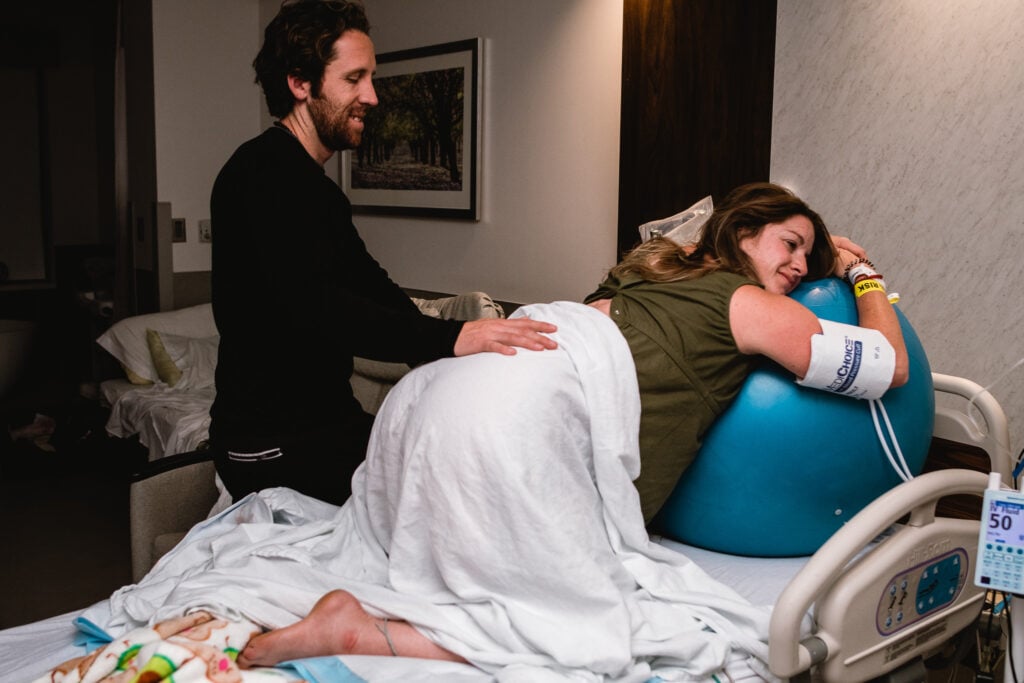
Next, you can bring the birth ball into the bed to provide support as you find an all fours position! Lower the head of the bed to a flat position, and place the birth ball in between the side barriers.
You can rock back and forth or side to side when you feel contrations.
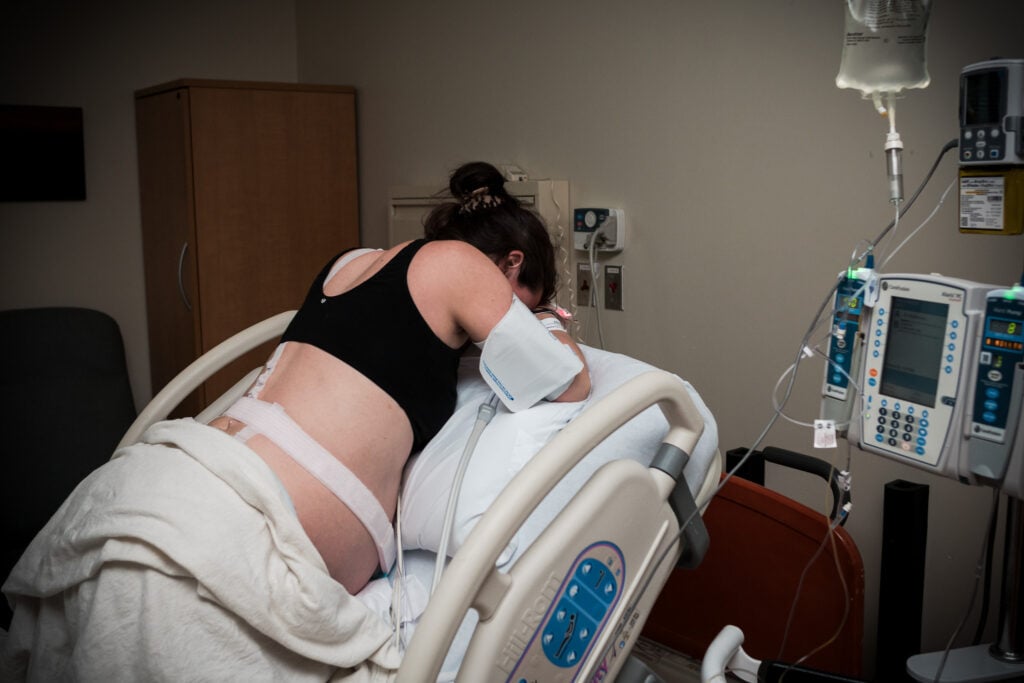
You can also use the head of the bed as a support by reclining it to about a 45-degree angle (or your preference). You can then lean on the top of the bed as a support in a kneeling position!
I like to place pillows around the chest area to provide some comfort, as well.
Half Lunge with Birth Ball
Another birth ball supported position is to find a half lunge position. This is a great position to create more space in the middle of the pelvis if your baby is engaged! You can rock back and forth in the lunge for a few contractions on each leg.
With all of the upright positions, I prefer to have a support person standing nearby to give any assistance as needed.

Epidural Resting Positions: Peanut Ball
If you don’t have as much mobility or you are feeling fatigued from the upright positions, you can use a peanut ball to create space in your pelvis!
If baby is still trying to engage, try placing the ball between your knees with your ankles closer together.
If baby is engaged and in the midpelvis, you can place the ball along the lower leg and rock it back and forth.
If baby is pretty low, or you can only lay on one side because baby doesn’t tolerate your rolling, you can kick the leg behind you and place you lower leg on the peanut ball.
The peanut ball is a great tool to use if you have an epidural to create different positions with your hips!
Partner Supported Hip Shifts: Create Space in the Lower Pelvis
Your partner can also be a great support with laboring positions with an epidural! Some of my favorite support techniques is to add a hip shift if baby is pretty low in the pelvis.
You can do a hip shift with just your arms (see IG video) or you can use a pillow or peanut ball to help with a hip shift.
Epidural Pushing Positions: Not Limited to Only Your Back!!
And when it comes to pushing, you do not need to push on your back just because you have an epidural. Now, you may find that you like being on your back (which is totally fine), but do not feel like you are limited to only a supine pushing position.
You can push in all of the positions we listed in this blog, such as kneeling with the bed support, supported squat, and even side-lying!
Read this blog for epidural pushing tips!
Epidural Labor Positions: More Than JUST On Your Back!!
Over 70% of us will choose to get an epidural during our birth, especially if it is your first birth! It is a good idea to have an idea of different types of positions you can get into so you can MOVE to help with your labor progress!
Learn more in our online childbirth education course–we break down pelvic mechanics (aka how does the pelvis moves and opens) and positions you can find both unmedicated and with an epidural to support your labor progress.