



Welcome to the MamasteFit Podcast! In this episode, we sat down with Hanna, who shared her remarkable journey to achieving a home birth after two cesareans (HBA2C). Not only did she birth vaginally after being told she would never be able to, but she welcomed a 9 pound, 11 ounce baby at home after years of preparation, education, and determination.
Her story isn’t about proving anyone wrong. It’s about finding the right support, preparing intentionally, and learning to trust both her body and her birth team.
"I Knew Things Had to Be Different"
Looking back on her first pregnancy, Hanna doesn’t hold any resentment—only perspective.
Like many women pregnant during 2020, life was filled with uncertainty. Between losing her job, navigating COVID restrictions, and simply not knowing much about prenatal nutrition or birth preparation, she approached pregnancy with an “I’m eating for two” mindset.
By the third trimester, her body was struggling.
She dealt with:
- Significant swelling
- Bilateral carpal tunnel syndrome
- Exhaustion
- Daily discomfort
At nearly 42 weeks, after declining an earlier induction, she ultimately underwent a lengthy induction that lasted over 36 hours.
After hours of Pitocin, an epidural, and three hours of pushing, her baby never descended below a -2 station. She ultimately had a cesarean birth.
But what happened afterward left a much deeper wound.
One day postpartum, she was told she had an “android pelvis” and would never birth vaginally.
Those words stayed with her for years.
When One Sentence Changes Everything
Anyone who works in birth knows how powerful language can be.
Hanna believed what she’d been told.
If a provider says your pelvis is too small, it’s easy to assume that’s simply fact.
But months later, after researching VBACs, she realized there was far more nuance than she’d been led to believe.
Instead of accepting that birth story as her future, she started asking questions.
Could another birth look different?
Pregnancy Number Two: Closer, But Not Quite
For her second pregnancy, Hanna came in prepared.
She:
- Hired a doula.
- Became a certified doula herself.
- Studied VBAC research.
- Planned an unmedicated birth.
This labor looked very different from the first.
She labored naturally.
She experienced contractions fully.
She worked incredibly hard.
But once again, when it came time to push, baby never made it underneath the pubic bone.
After trying multiple positions—including Walcher’s Position—labor eventually ended with another cesarean.
Emotionally, this birth was much harder.
During surgery, providers told her:
- Her uterus had “split in half.”
- Future pregnancies weren’t recommended.
- If she became pregnant again, she should schedule a cesarean at 35 weeks.
For Hanna and her husband, it felt like the door had closed forever.
The Operative Report Told a Different Story
Months later, Hanna met Dr. Rebecca Cohen, an OB-GYN who specialized in individualized care.
Rather than relying on verbal recollections from the hospital, Dr. Cohen reviewed Hanna’s operative report.
What they found surprised everyone.
Instead of a catastrophic rupture, the report documented a small uterine dehiscence—a partial separation of the previous scar that had not fully ruptured before surgery.
The larger tear actually occurred during the cesarean itself while delivering the baby.
This completely changed Hanna’s understanding of what had happened.
It also changed what she believed was possible moving forward.
Rather than hearing, “You’ll never labor again,” she finally heard someone say:
“I think you were never truly given a physiological chance to birth.”
Preparing for Pregnancy Instead of Just Preparing for Labor
Once Hanna and her husband decided they wanted another baby, she knew preparation would begin long before labor.
She focused on supporting her entire body.
Nutrition became a priority.
She began incorporating:
- Bone broth
- Collagen
- Protein-rich meals
- Nutrient-dense foods inspired by Lily Nichols’ Real Food for Pregnancy
She also realized that simply running during pregnancy wasn’t enough.
She wanted strength.
Mobility.
Stability.
And exercises designed specifically for birth.
Finding a Pregnancy Fitness Program That Made Sense
The book immediately stood out because every exercise included QR codes linking directly to video demonstrations.
Instead of guessing whether she was doing movements correctly, she could follow along confidently.
Within just a few weeks, something unexpected happened.
The aches and pains she’d accepted as “normal pregnancy discomfort” disappeared.
Her:
- Sciatica resolved.
- Hip pain improved.
- Back pain disappeared.
- Nighttime pelvic discomfort faded.
Whenever discomfort started creeping back, she’d revisit the mobility exercises, pelvic resets, and stretching routines—and her symptoms would settle again.
By 39 weeks, she had a massage appointment where the therapist asked what was hurting.
Hanna laughed.
“Nothing.”
At 39 weeks pregnant, she genuinely felt great.
A Completely Different Pregnancy
There was another noticeable difference.
During her previous pregnancies, she barely dilated before induction.
This time?
At 41 weeks, she was already 4 centimeters dilated and 80% effaced.
Even Gina pointed out how improved pelvic mobility may have helped baby settle deeper into the pelvis during late pregnancy, allowing the cervix to naturally prepare for labor.
While no one can say for certain why this happened, Hanna couldn’t ignore how different this pregnancy felt compared to the first two.
Waiting...Again
Just like her previous pregnancies, labor didn’t begin until nearly 42 weeks.
Instead of becoming consumed by frustration, Hanna made a conscious decision.
She spent those final days:
- Taking her boys to the zoo.
- Walking several miles.
- Doing yard work.
- Completing a gentle workout.
- Spending time with friends.
She wanted to enjoy the last days of pregnancy instead of fearing them.
Then, the night before their scheduled induction plan…
Everything changed.
Labor Finally Begins
After friends prayed over her one evening, Hanna noticed her contractions felt different.
By 11 p.m., labor was unmistakably underway.
Rather than rushing to call everyone immediately, she spent several quiet hours laboring alone.
She soaked in the bathtub.
She rested.
She breathed.
She savored every contraction because spontaneous labor was exactly what she’d hoped for.
Eventually, her doula arrived, followed by Dr. Cohen.
Everything remained calm.
Until her water broke.
"This Is What We've Been Praying For"
As soon as her water released, contractions intensified dramatically.
For a brief moment, panic crept in.
That’s when her husband stepped in.
Holding her face, he reminded her:
“We’re watching everything we’ve been praying for happen right now.”
Those words grounded her.
She recommitted herself to the work ahead.
Because the next two and a half hours would become the hardest physical challenge she’d ever experienced.
Pushing a Big Baby Through a Narrow Pelvis
Unlike her previous births, this time she could actually feel her daughter moving through her pelvis.
Every contraction brought progress.
Every push mattered.
When her baby’s head finally passed beneath the pubic bone, Hanna knew something was different.
She had never reached this point before.
The intensity was unlike anything she’d experienced.
She laughed afterward, admitting she’d once believed pushing was supposed to be the “easy” part.
Instead, she described it as the hardest work she’d ever done.
When Shoulder Dystocia Happened
As her baby’s head emerged, Hanna immediately recognized something wasn’t right.
She had attended births involving shoulder dystocia before and knew exactly what it felt like.
Her daughter was stuck.
Fortunately, this was something she and Dr. Cohen had specifically prepared for.
Her birth team responded immediately.
After an initial maneuver in the birth tub wasn’t successful, Hanna quickly climbed out of the water and onto the bed, where additional techniques successfully resolved the shoulder dystocia.
Her daughter required brief resuscitation but recovered quickly.
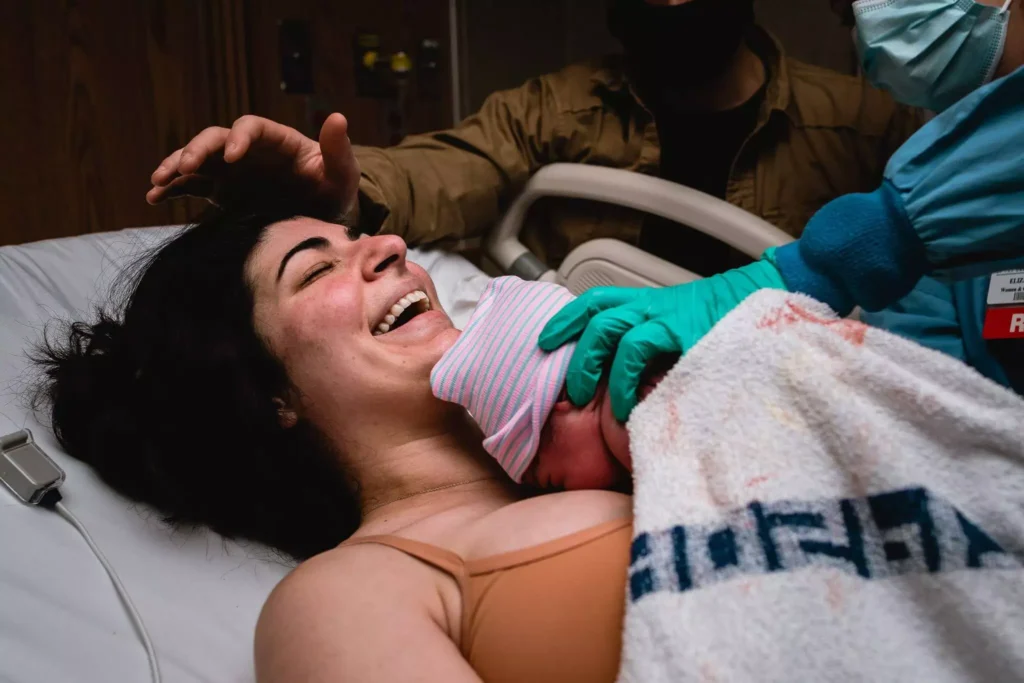
Mom and baby were soon together.
Later, Hanna learned her daughter weighed an incredible 9 pounds, 11 ounces.
The very pelvis she’d been told could never birth a baby had successfully birthed her largest baby yet.
Recovery Was Different Too
Hanna is honest that vaginal recovery wasn’t painless.
After two and a half hours of pushing, her core was exhausted.
She also had vaginal tearing that required healing.
But emotionally?
There was no comparison.
Without recovering from abdominal surgery, she felt mentally clear, energetic, and fully present.
She prioritized:
- Five full days of bed rest.
- Nourishing postpartum meals.
- Breathwork.
- Gradually returning to movement.
Breastfeeding also came much more naturally this time, creating another healing experience after the struggles she’d faced with her first baby.
Hanna's Biggest Takeaway
Perhaps the most powerful part of Hanna’s story wasn’t the VBAC.
It wasn’t the home birth.
It wasn’t even the nearly 10-pound baby.
It was her perspective.
She doesn’t see her previous births as failures.
Instead, she sees them as part of becoming the person she needed to be.
The commitment she developed throughout pregnancy—showing up consistently, taking care of her body, learning, preparing, and building endurance—helped prepare her for one of the most physically demanding experiences of her life.
Her story is a reminder that birth preparation isn’t about controlling the outcome.
It’s about giving yourself every opportunity to move through pregnancy and birth feeling informed, supported, and strong.
Whether you’re planning a VBAC, a first birth, or simply hoping for a healthier pregnancy, Hanna’s journey demonstrates the incredible difference that education, intentional preparation, and the right birth team can make.
Additional Resources
Find Hanna here!:
@hanna_elisabeth_turner on Instagram
@joysofbirth doula page on Instagram
🎉 Grab Your Copy of Training for Two → https://amzn.to/3VOTdwH
Understanding Shoulder Dystocia
Is Your Pelvis Too Small for Birth? Exercises to Create Space for a Safe Delivery!
MamasteFit Podcast Episode 23: Is Your Pelvis Too Small? Probably Not
Prenatal Support Courses

Learn the science of pregnancy and birth to take the mystery of labor away! Understand why you are feeling what you feel, and learn strategies to confidently move through pregnancy and birth!
- 9h+ of Video
- Support Group
- Close Captioning

- 5 Workouts/Week
- Gym Workouts
- Self-Paced

Instructor
GINA
Workout on-demand with our prenatal fitness workout videos! Each workout is 30-40 minutes to follow along as you exercise at the same time!
- Birth Prep
- All Trimesters
- Mobility Work

Instructor
GINA
Find comfort and relief from pelvic girdle pain throughout your pregnancy and postpartum period! This program incorporates myofascial sling focused exercises to stabilize across the pelvic girdle joints.
- 3 Weeks
- On Demand Workout Videos to Follow