



What are helpful cues when it comes to pushing? Our pushing cues are:
Knees In, Ankles Out (Internal Rotation of the Femur)
Allow for Space for the Sacrum to Move (Get off your back)
Neutral Spine with Lat Engagement
Belly Breath to the Baby
Panting
These cues tend to be the opposite of what you would typically hear in the labor room as the birthing person is pushing.
You’d hear coaching phrases such as: “Spread your knees wide to make room for the baby,” or “bring your chin to your chest and curl around the baby.” While these make sense momentarily, when we consider anatomy and biomechanics, they do not.
However, ultimately, it should be up to the birthing person how they want to push. They are the more knowledgeable about their own birth experience, and that should be respected. If we pay attention to how they choose to push intuitively, we may find that they tend to follow the cues we listed above at the beginning of this article.
Let’s break down why the traditionally heard cues don’t make much sense, and how we should approach pushing.
This mini-course focuses on pushing during birth! Learn pushing strategies, positions, and breathing techniques to meet your baby faster.
- 1+ hour of on-demand videos
- 4 downable resources
- Lifetime Access of E-Course
- Watch on Mobile Device
First: Laboring Down
f we are able to labor down, or allow the body to spontaneously push the baby down to a lower station, then we may not start pushing till baby is +2 station (made the final rotation under the pubic bone in prep for birth). This may decrease pushing time overall, as there is less distance the baby has to be actively pushed; typically, the birthing person starts to spontaneously bear down with the fetal ejection reflex, and the body is communicating that it is ready to push.
So, if we labor down to, then baby is +2 station or below. If baby is +2 or below, then we need to focus on opening the outlet, or the lowest portion of the pelvis.

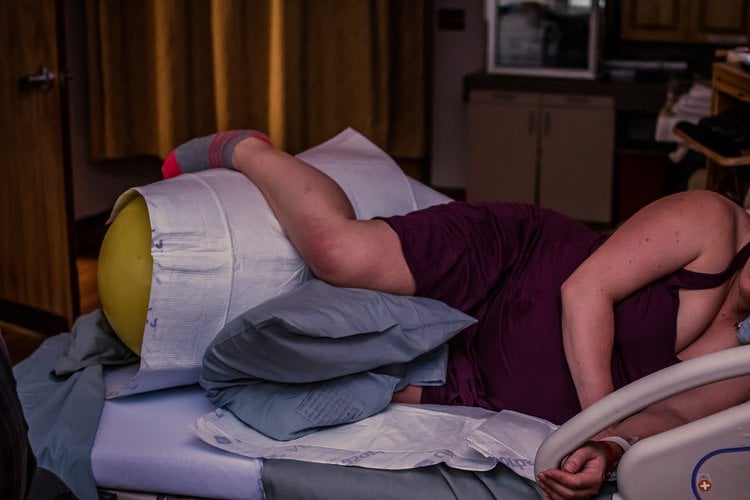
Movements that will open the outlet are:
Internal Rotation of the Femurs (Knees in, ankles out) = Side to Side Opening
Space for the sacrum to move = Front to Back Opening

Knees In, Ankles Out / Creating Space for the Sacrum
Now, for internal rotation of the femurs, the knees can still be wide! But the ankles just need to be further out than the knees. This can be a very gentle and mild rotation, no need to force joints to move.
We typically hear the cue, “spread your knees wide to make room for the baby.” While this sort of makes sense; the baby is coming out of the vagina, so if we spread the knees then there must be more room. But, if we consider the position of the legs and where the vagina actually sits when we are in hip flexion, then how far apart the legs are doesn’t seem as relevant. But, more importantly, when we have wide knees this prompts external rotation at the femurs that closes the pelvic outlet from side to side.
If we can ensure there is space for the sacrum to move, then we can open the outlet more front to back. No need for an anterior pelvic tilt or arching in the back to exaggerate the sacrum moving out of the way; this typically creates an ineffective push and feels awkward and unnatural for most moms. Simply, allow there to be space.
How? Get off your back. Try side lying, all fours, any position that is not flat on your back, and the sacrum will have space to move during pushing. The typical position to birth on your back is not helpful for you as the birthing person (although, you may choose to birth this way out of comfort for your own personal reasons); this position tends to be easier for the provider to manage the delivery out of habit. If we only did one thing one way, we would probably be out of our comfort zone if a variable was changed, as well.
If you do want to push on your back, check out this Instagram reel on some tips to still create space for the sacrum!
Neutral Spine: Lat Engagement
Now, our next cue for pushing also tends to be opposite of what you may here in the labor room: Neutral Spine with Lat Engagement. Typically, you hear “curl around your baby” as a cue to help focus the effort on pushing the baby out. This could make sense in theory, since the abdominal compression must help with pushing the baby out! Right? Maybe not, because your abs don’t push your baby out, your uterus does. Secondly, pushing is a pressure management method; we change the pressure in the abdomen to help the uterus push the baby out. If we are curled up, we can’t effectively manage pressure in the abdomen.
The cue to curl around the baby decreases the direction of force from the diaphragm to the pelvic floor.
If we can maintain lat engagement during pushing, the spine tends to stay neutral and allows for the most direct line of force on the pelvic floor for pushing. This means that your pushes will be more effective aka less pushing.
Our main cue to help laboring women engage in their lats is to pull the shoulders down and back, and to focus on pulling [insert whatever they are holding onto] towards them as opposed to pulling themselves towards [insert whatever they are holding onto]. When you pull towards you, shoulders tend to go down and back and lats engage = neutral spine = direction of force down onto the pelvic floor. When you pull yourself towards something, shoulders tend to rise and back tends to round = direction of force is upwards into the shoulders instead of the pelvic floor.
Belly Breathing to Baby
If we can incorporate diaphragmatic breathing, we can increase the effectiveness of our pushes, as well. When we inhale, we inhale down and out, increasing the pressure in our abdominal cavity aka where baby is. Think of your baby as fluid: fluid wants to go from high to low pressure gradients; your baby wants to go from where there is high pressure (your abdominal cavity) to low pressure (the world). If we inhale into our chest, where our ribs thrust upwards, the pressure in the abdominal cavity does not change and pushing will be a bit more difficult.
Watching this video to understanding using your breath to push!
Panting
The last cue we will use during pushing is panting! As baby is crowning, we encourage mom to pant and stick her tongue out. This will generate short, significantly less powerful pushes to allow the tissues to stretch and may prevent tearing. It will look silly, but if it keeps you from tearing, it’s not that silly after all.
All our cues to push are what I have found to be successful working with my clients during labor. Not every cue makes sense to every mother, and not every cue needs to be used. Follow her intuitive movement; you may find that mom naturally moves into a neutral spine and brings her knees in when she prepares to push. Support that intuition! It is so powerful to help mothers see how in sync they already are with their bodies and the labor process.