Inversions could help adjust your baby's position both during pregnancy and labor! There are several types of inversions you can do based on if you are pregnant, in labor, have an epidrual, and even your strength levels!
Inversions could help adjust your baby’s position both during pregnancy and labor! There are several types of inversions you can do based on if you are pregnant, in labor, have an epidrual, and even your strength levels!
There are a variety of positions that you can do to achieve an inversion! Inversions can be done both during pregnancy and labor to support your comfort and baby’s position.
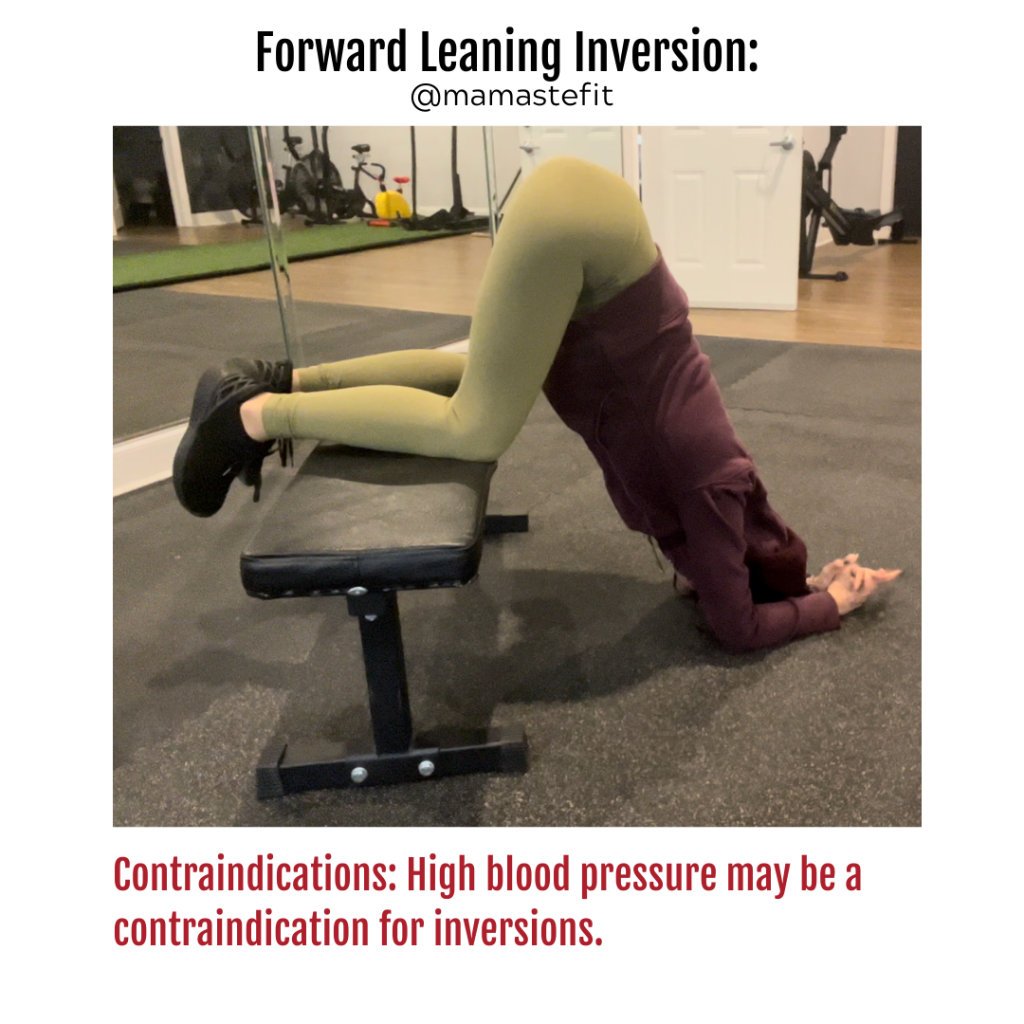
The forward-leaning inversion is one of the more intense inversions and requires shoulder strength to maintain.
During pregnancy, you can hold a forward-leaning inversion for three full breaths (roughly 20-30 seconds) once a day after 20 weeks.
If baby is breech or transverse lie, you can do 7-14 inversions a day. Once baby flips head down, stop all inversions for a week.
During labor, if you are wanting to help baby’s position, hold the inversion for three full contractions.
You do not need to hold the inversion the entire time; you can come up in between contractions to rest in an upright position.
Open Knee Chest
The open knee-chest position is when the hip angle is greater than 90 degrees, not when the knees are wide apart. There is some confusion about what the open knee chest position means.
This position can be challenging to maintain, though! So, partner support could help.
Take a long fabric, such as a Rebozo, scarf, or bed sheet, and place around the thighs spread out. This will increase the surface area and make it so the fabric is not putting too much pressure on one spot. Then your partner will place their feet against your so you do not slide backwards, and you maintain this position for 20-30 minutes in the Miles Circuit.
Bed Supported Inversion
You can use the bed to support your inversion if you are at the hospital!
There are two options for this:
You can adjust the bed, then position yourself.
You can position yourself; then, your partner can adjust the bed into an inversion.
For this inversion, you will place your forearms on the foot of the bed and your legs on the middle of the bed.
In the setup, the foot of the bed will be lowered to bring you into an inversion.
This inversion is great because it is a less intense inversion, and someone else can support you more easily in this position!
May not be great for epidural, even though it is in the bed, since you would need to completely flip around. But it is also not impossible depending on your mobility.
Trendelenburg: Inversion for Epidural
If you have an epidural and your medical team is supportive, tilting the bed can be a great way to do an inversion!
The bed handle is usually pushed down and on both sides and tilts the head of the bed down. If the bed still seems flat, ensure that the entire bed is flat. Sometimes the head of the bed is tilted upwards.
You can place a peanut ball between the legs to help open your pelvis, depending on your baby’s position and station.
Inversions: Supporting Baby's Position
Inversions can be used during both pregnancy and labor to support your baby’s position! Inversions use gravity to allow baby to back up a little out of the pelvis so they can readjust their head position.
There are so many options when it comes to inversions depending on if you are pregnant, in labor, have an epidural, and your strength levels! We explore ways to support baby’s position in more depth in our childbirth education courses!