

When I was first diagnosed with pelvic organ prolapse (POP), I felt overwhelmed. Was I done lifting? Would I never run again? Was my body falling apart—literally?
If you’ve been told that your active lifestyle is over, or that you should never lift more than 10 lbs (which your baby likely already weighs), I want to reassure you: that’s outdated advice. You can return to strength training and endurance running after a prolapse diagnosis—and I’m living proof.
In this blog, I’ll break down:
- What pelvic organ prolapse really is
- Common symptoms and what they might actually mean
- How your pelvic position impacts symptoms
- The exact prolapse recovery exercises I use to run and lift without symptoms
What Is Pelvic Organ Prolapse?
Pelvic organ prolapse is when one or more pelvic organs (bladder, uterus, rectum) begin to descend into the vaginal space due to weakened pelvic support. It’s incredibly common postpartum but not always well-understood.
Many are told they need surgery, to stop breastfeeding, or to avoid exercise altogether. But recent research doesn’t support this. In fact, many symptoms can be managed—and even resolved—through targeted movement, strength training, and pelvic floor support strategies.
Common Symptoms of Prolapse
The most common prolapse symptom is a sensation of heaviness or pressure in the vagina. Some describe it as “something is there” or a dragging feeling.
But here’s what surprised me: that sensation isn’t always your organs. Often, it’s caused by tension in the pelvic floor and surrounding muscles—not prolapse severity itself.
Your pelvic floor is directly affected by how your pelvis is positioned. If your pelvis is out of balance, it can increase pressure and lead to more noticeable symptoms.
How Pelvic Positioning Affects Your Symptoms
Most of us (especially during pregnancy and postpartum) favor our right leg and shift into an anterior pelvic tilt—where your lower back arches and your pelvis tips forward.
This results in:
- Right hip: more internal rotation, posterior tilt, and adduction → weak glute med & quad, overactive pelvic floor (can cause bladder urgency)
- Left hip: more external rotation, anterior tilt, and abduction → weak hamstring & adductor, tighter posterior pelvic floor (can cause tailbone pain, constipation, or SI joint discomfort)
The solution? We need to re-balance the pelvis through strength and mobility work.

This posture is not inherently bad–but if we always stay in this position, it could cause an imbalance and increased tension in the pelvic floor. We want to improve mobility so we can easily change position but also increase strength so that we can control that shift in position.
Prolapse Is a Pressure Management Issue
Let’s clear something up: prolapse isn’t just a pelvic floor issue—it’s a pressure issue.
And how you breathe during exercise plays a huge role.
Here’s the goal:
- Inhale down and back into your lower ribs and low back—not just your belly.
- Avoid “bearing down” with your inhale, which increases pressure on the pelvic floor.
- Exhale to lift the pelvic floor gently. This recoils your diaphragm upward and activates your core and pelvic floor muscles.
Then we apply that to movement:
- During the eccentric phase (like squatting down), inhale either before or during the descent.
- During the concentric phase (standing up), exhale before or as you move.
- For example: inhale before squatting down, exhale as you stand up.
This coordination of breath and movement is the foundation of managing symptoms during workouts.
In my book Training for Two, I break down exactly how to approach prenatal fitness in a way that supports your pelvic floor through breathing, positioning, and intentional movement. You don’t need to suffer or feel uncomfortable during pregnancy—there’s a better way to move. I dedicate an entire chapter to finding relief from common pregnancy symptoms so you can exercise and live more comfortably throughout each trimester.
Want Me to Guide You Through It?
If you want help applying the breathing and pressure strategies I talk about in this blog, I walk you through a full workout on YouTube that’s prolapse-friendly and focused on breath-to-movement coordination. I’ll cue you through how to breathe during each movement, modify if you have symptoms, and show how these strategies come together in a real workout.
Subscribe to our YouTube channel for more prenatal and postpartum workouts—we drop new workouts every Tuesday to help you feel strong, supported, and confident in your body.
👉 Subscribe here
Releasing Tension Before Building Strength
Before jumping into strength work, I focus on releasing tension and improving mobility. Most of us don’t realize how much asymmetry and tightness we’re holding—especially postpartum.
Here’s what I commonly see:
- We shift more weight into our right leg, causing uneven tension across the pelvis
- Our right hip is often in posterior tilt and internal rotation → tight pelvic floor and bladder urgency
- Our left hip is more anteriorly tilted and externally rotated → tight back pelvic floor, constipation, SI joint pain
These uneven patterns can cause or worsen prolapse symptoms. That’s why I start with targeted mobility work.
You can try this thoracic mobility with hip shift mobility flow to support your positioning for your workouts too! This helps position the rib cage in a way that allows the diaphragm and pelvic floor to work together, and it can help release excess tension in the pelvic floor before your workout even begins. By improving rib cage mobility first, you’ll set yourself up for better breathing mechanics and more effective pelvic floor support throughout your workout.
This warm-up includes:
- Hip shifts to mobilize the pelvis
- Side body openers to create space in the rib cage
- Back expansion breathing to activate your core without bearing down
Key Release Exercises:
Right Inner Thigh/Groin:
These two exercises stretch the right inner thigh/groin to release uneven pull on the pelvis.
- Half Lunge Rocks
- Adductor Rock Backs
Left Posterior Pelvic Floor:
The left posterior pelvic floor is stretched more with hip shifted exercises, where the belly moves towards the thigh. This is known as a closed hip position. In this position, you will feel more of a stretch in the back of the glute/hip pocket area.
- Hip Shifts: Supported and Unsupported with Movement
Right and Left Side Releases
Next, you can incorporate both a right inner thigh release with a hip shift in a lateral hip shift. In this exercise, the straight leg (ideally the right side) inner thigh is being stretched as you hip shift into the left glute. Keep weight in both big toes as you shift into the hip. Adding a weight allows you to sink deeper into this position!
Strength Work to Rebuild Pelvic Balance
Once mobility and pressure management are in place, I focus on strength—but not symmetrically. Since the pelvis often sits unevenly, it makes sense to train each side a little differently to restore balance.
My Favorite Strength Exercises:
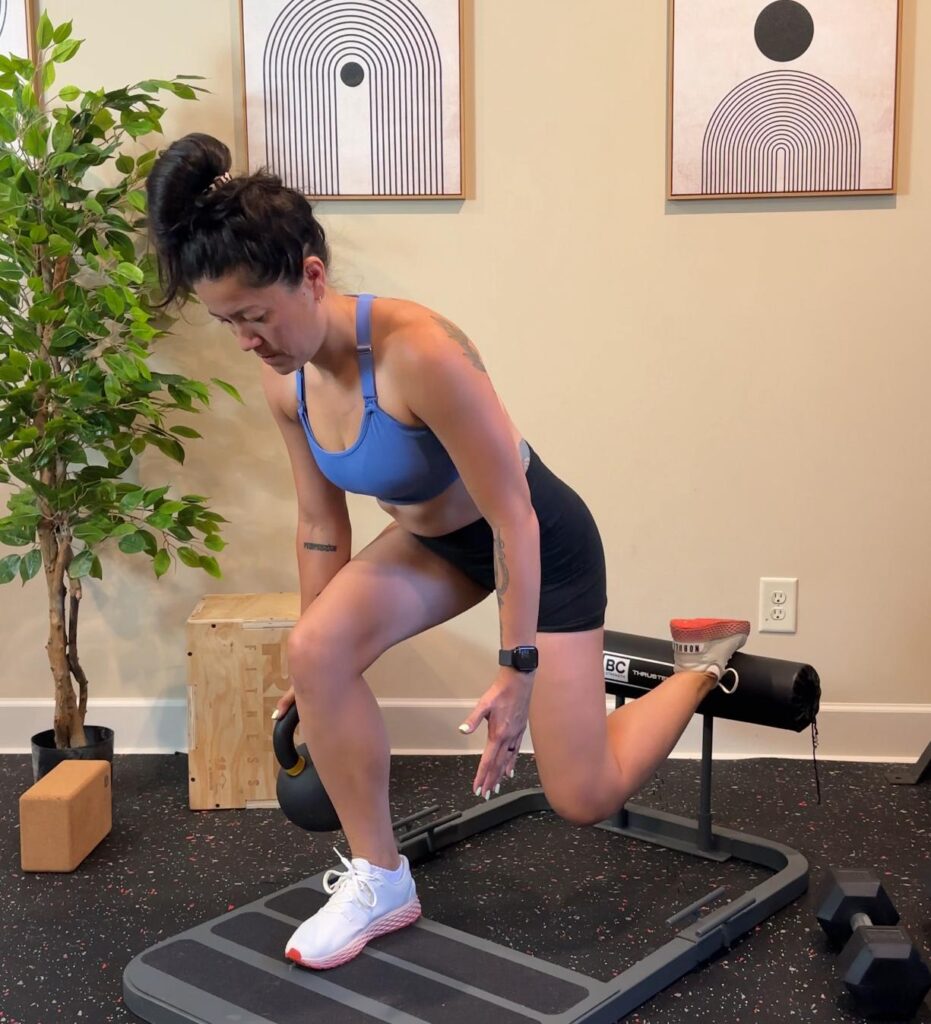
Bulgarian Split Squat (Unilateral Work)
- Hold the weight in your right hand (for both legs)
- Right leg: targets glute and quad with external rotation bias
- Left leg: targets hamstring and adductor with internal rotation bias

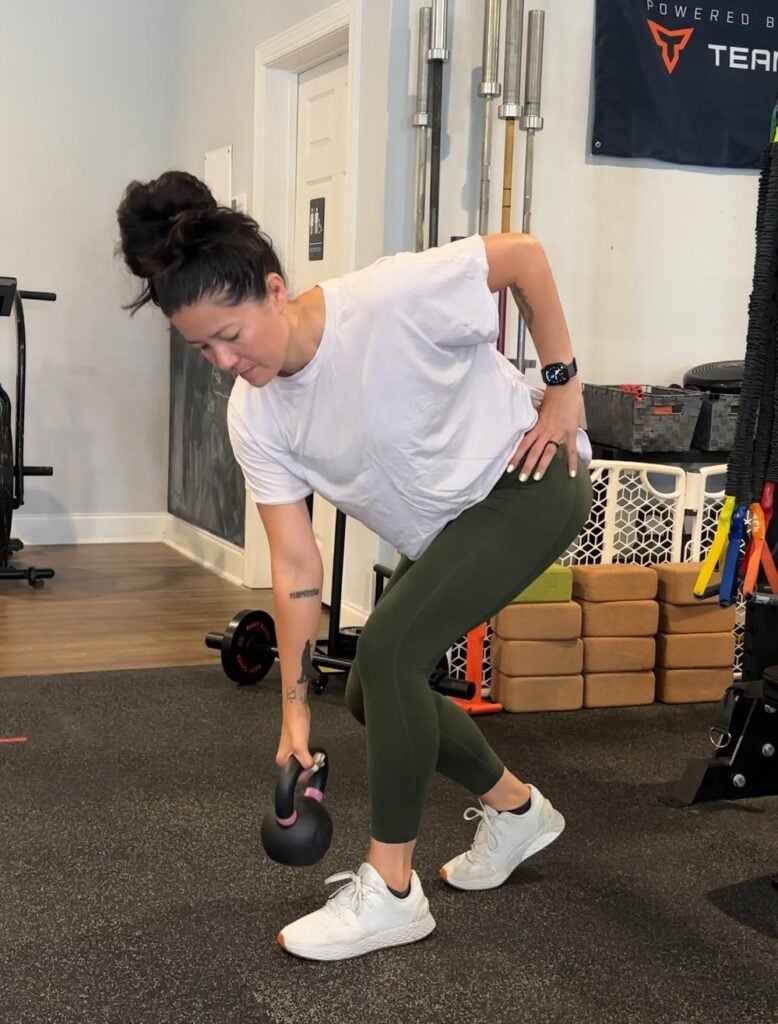
Staggered Stance RDL
- Offset stance and weight load to bias each side’s weak links–same as the Bulgarian split squat where you are holding the weight in the right hand for BOTH sides.
- Helps retrain the posterior chain for better pelvic positioning

Banded Squats and Lunges: Right & Left Bias
- Band around left inner thigh: targets adductors
- Band around right outer knee: targets glute medius
- This combo helps support pelvic floor symmetry and function
These movements help reposition the pelvis, support your pelvic floor, and rebuild core stability—all while keeping you strong and moving confidently.
You Deserve to Feel Strong Again—Even with Prolapse
Understanding how to manage pressure, optimize your breathing, and train with intention is key to feeling strong and symptom-free after birth. Prolapse doesn’t mean you have to stop lifting, running, or chasing your fitness goals—it just means you need the right approach.
When we support the pelvic floor through breathing, mobility, and strength, we can move confidently again. And that confidence carries over into every part of motherhood—because feeling good in your body matters.
That’s exactly why I created our Postpartum Fitness Programs—to give you a clear, progressive path to return to movement after birth, whether you’re managing prolapse or simply want to rebuild strength safely.
Our Postpartum Programs Include:
- 64 progressive workouts for postpartum recovery and return to fitness
- First 24 workouts include a follow along video!
- Options for general fitness, running, Olympic lifting, and C-section recovery
- Lifetime access to videos and self-paced guides
- Developed by a doula + birth worker team and approved by pelvic floor physical therapists
- Designed to support your core, pelvic floor, and confidence
If you’re looking for safe prolapse exercises after birth, a way to return to lifting and running, and a program that was truly built for postpartum recovery—this is it.