



The pelvis has three main levels:
The Inlet: The top of the pelvis, opens more with external rotation of the femurs and a posterior pelvic tilt
aka wide knees, knees out, ankles in, and tucking the butt underneath
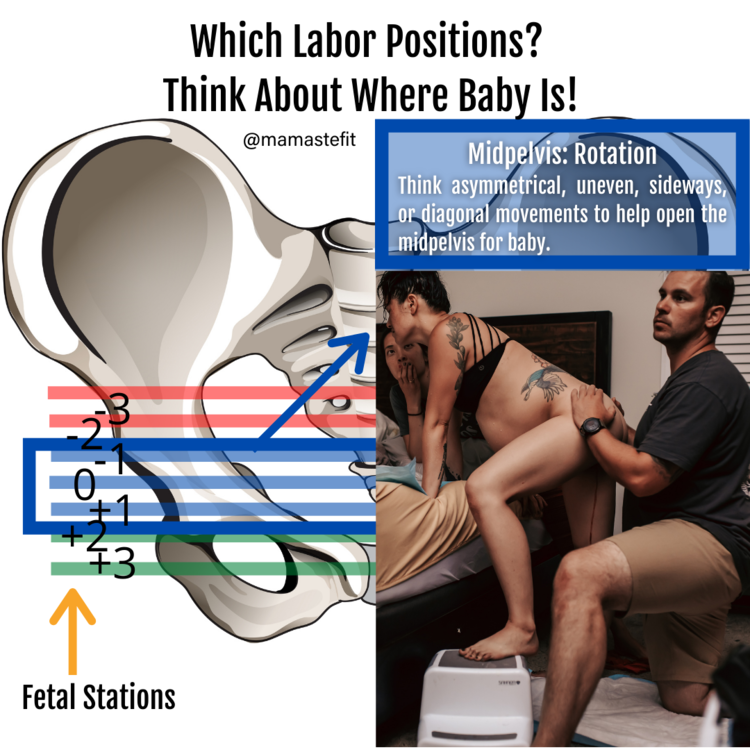
The Midpelvis: the bony structure of the pelvis, opens more with asymmetrical or uneven movements
But the midpelvis also has its own levels that open more or less with external versus internal rotation of the pelvis on the femur
The Outlet: the bottom of the pelvis, opens more with internal rotation of the femurs and space for the sacrum to move
aka knees in, ankles out, and off your back
The Inlet
The top of the pelvis opens more side to side with external rotation of the femurs, or wide knee movements, and a posterior pelvic tilt, or tucking the butt underneath. You may also find that movements that favor more front-to-back rocking patterns help you to achieve these movements.
Movements that may open the top of the pelvis, and would be helpful if baby is still “high,” -2 station or above (sometimes -1 station), or not yet engaged:
Deep, wide knee squats with a rounded back. Key is to hold onto something so the legs can relax.
Wide knee all fours ball rock backs
Seated with wide knees on ball
Leaning on an elevated surface and rocking forward and backward
You may intuitively do these movements without even thinking about it, which is sometimes a really cool aspect of labor! But, you will notice that these movements are not the same when it comes to opening different levels of the pelvis. So, you will likely only want to do these movements until baby has engaged, then you will shift to movements that open the midpelvis.

The Midpelvis
The midpelvis is open more with asymmetrical or uneven movement patterns. This can sometimes be difficult if you have pelvic girdle pain, so keeping the feet more even and swaying side to side may be a better alternative to different leg stances. The midpelvis has an upper and a lower level that each open in a different way, but overall the midpelvis opens with asymmetrical or side to side movements. I usually tell my childbirth education clients to not worry about the upper versus lower unless they are pushing and trying to help baby finish their rotation. Focusing rather on side to side movements, and swaying, will help open both levels with movement.
We would want to focus on opening the midpelvis when baby is engaged (usually -1 to +1 station), and is rotating through the pelvis.
Movements that may open the midpelvis could include:
Elevated Lunges
Standing Sway
Lizard lunge while leaning on birth ball
Side to side rocking while leaning on birth ball
Side to side swaying while seated on birth ball
The Outlet
The outlet is the bottom of the pelvis, and usually what we focus on opening when we are pushing! Baby is usually super low at this point, and YOU CAN TELL baby is low. There is a lot of pressure, and a feeling like something is right there. That something is your baby. Even with an epidural, you may feel constant pressure.
If you are pushing and baby is +2 station or below, and ideally under the pubic bone, we want to focus on internal rotation of the femurs, or knees in, ankles out, and ensuring there is space for the sacrum to move. We do not necessarily want an anterior pelvic tilt, or an arch in the low back.
Movements that could be helpful while pushing could include:
Supported Hinge
Sidelying pushing
Supine pushing with sacrum support
All fours or kneeling pushing
There is no one movement that opens the ENTIRE pelvis. You will likely want to continue to change positions during labor, and it would be more helpful to shift your positions as labor progresses to help baby descend and rotate through the pelvis. A common phrase I heard is “motion is lotion,” which means, the more you move, the more baby is able to wiggle through the pelvis!

Learn more about how to open the pelvis, and clues to labor progress in our childbirth education courses, upcoming webinars, and right here on our blog or IG page!