



If you’ve been doing deep squats to stretch your pelvic floor and Kegels to strengthen it—but your pelvic floor still feels tight or uncomfortable—you’re not alone. These exercises are often labeled as the top pelvic floor exercises, yet many people continue to experience pain, pressure, or dysfunction during pregnancy and postpartum.
In this blog, I explain why deep squats and Kegels are not enough for true pelvic floor health. We’ll explore what the pelvic floor actually needs, why balance matters, and how targeted strength and release can support comfort and function beyond basic exercises.
There Is No One Exercise That Stretches Your Entire Pelvic Floor
The pelvic floor is not a single muscle that lengthens or contracts in one uniform way. It’s a layered, dynamic system that responds differently depending on body position, hip rotation, weight shift, and breath. Because of this, no single exercise—yes, even deep squats—can stretch every part of the pelvic floor at once.
Different areas of the pelvic floor lengthen and load based on how the pelvis and hips are positioned. When we repeatedly rely on one movement pattern, we may feel relief in one area while other regions remain restricted, overworked, or under-supported. This is why many people continue to feel “tight” despite consistently stretching.
True pelvic floor support comes from variety, intentional asymmetry, and understanding how different movements create space in different parts of the pelvic floor—especially during pregnancy and postpartum, when tissue demands are constantly changing.

The pelvic floor attaches directly to the pelvis, which means it responds to how the pelvis moves and positions itself in space. When the hips or spine change position, the pelvis shifts—and the pelvic floor changes tension right along with it. Depending on the position, different areas of the pelvic floor may either shorten or lengthen.
For simplicity, the pelvic floor can be divided into four quadrants: anterior right, anterior left, posterior right, and posterior left. Each of these quadrants responds differently to changes in spinal position, pelvic orientation, and hip rotation. As you move, shift weight, or change posture, tension is constantly redistributed across these regions.
This is why one single stretch or exercise can’t address the entire pelvic floor at once. Different positions create space in different quadrants, which is why intentional movement variety is essential for true pelvic floor balance—especially during pregnancy and postpartum.
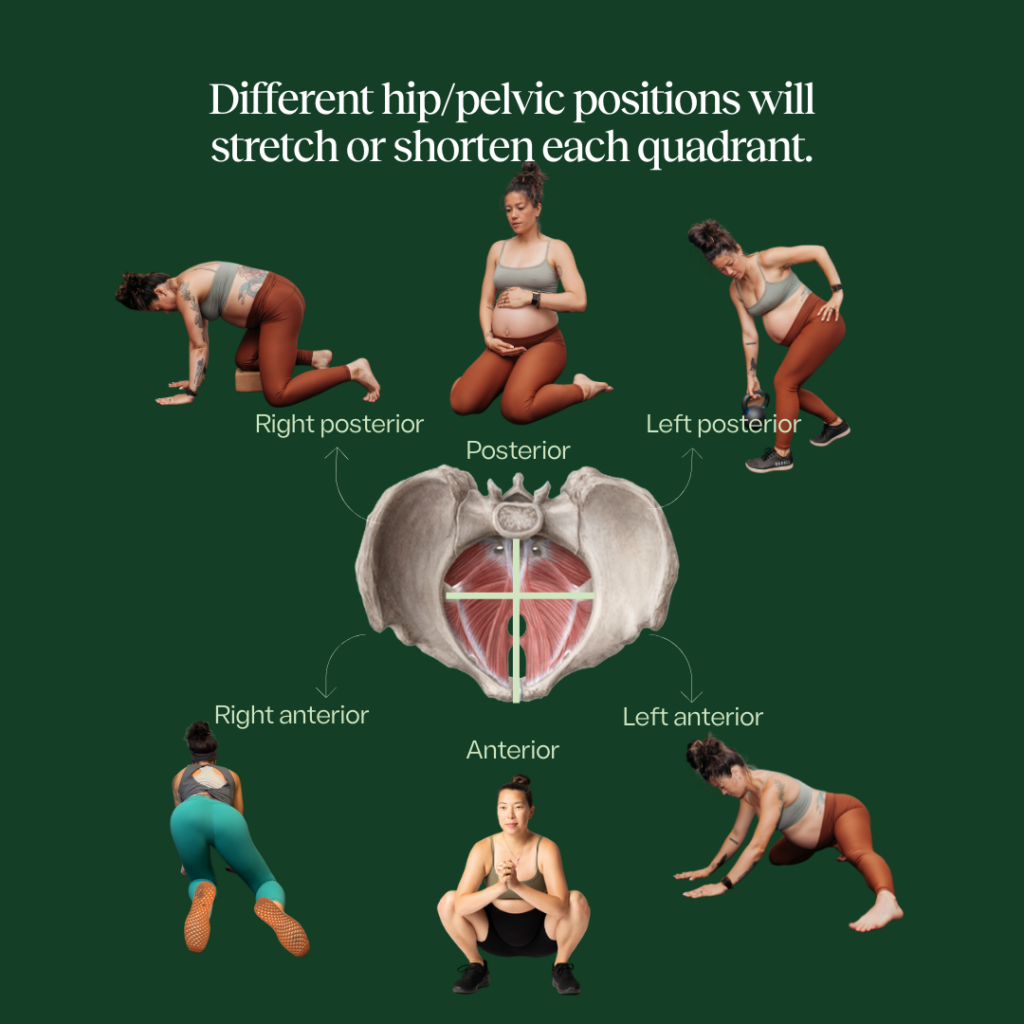
If you want to target more of the front (anterior) pelvic floor, positions with wider legs and more spinal extension can help create length in this area. In these positions, the pelvis tends to tip in a way that allows the anterior pelvic floor to open—while the posterior portion may actually tighten.
To target more of the back (posterior) pelvic floor, bringing the knees in with internal rotation and adduction, combined with a more rounded spine, can help create length through the posterior pelvic floor instead. This changes how tension is distributed through the pelvis and shifts the stretch to a different region.
From there, each individual pelvic floor quadrant can be influenced even further by using one-sided positions. Open versus closed hip positions, weight shifts, and asymmetrical stances allow you to bias the right or left side of the pelvic floor—rather than stretching everything the same way every time.
You can better see (and feel) this concept in this 10-minute pelvic floor relaxation workout. In this workout, I will walk you through several exercises that target different portions of the pelvic floor (not just deep squats and tons of wide legged positions).
Want More Pelvic Floor Support?
Subscribe to our YouTube channel for weekly workouts designed to support pregnancy, birth preparation, and postpartum recovery. We intentionally weave pelvic floor work into our movement videos and pair it with educational content to help you better understand your body—not just move it.
Whether you’re preparing for birth, rebuilding after pregnancy, or simply wanting to feel stronger and more confident in your body, our videos are here to support you through every phase of motherhood.
👉 Subscribe on YouTube to stay connected and supported each week.
Postural Patterns and Why the Posterior Pelvic Floor Is Often Tighter
While the pelvic floor can be divided into four quadrants, we also tend to hold predictable patterns of tension in our bodies based on normal posture, daily movement, and habits. For many people, the posterior portion of the pelvic floor is more restricted, while the anterior portion is relatively lengthened.
When the posterior pelvic floor stays tight, it can contribute to symptoms like lower back pain, pelvic pain, tailbone pain, and even issues with bowel movements and overall pelvic floor function. If you’re dealing with these symptoms, it’s common to think, “I just need to stretch.” Unfortunately, the stretches most often recommended—like deep squats or butterfly pose—are wide-legged positions that primarily target the anterior pelvic floor, not the posterior portion that is often driving the problem.
This is where we need to flip the script.
To better target the posterior pelvic floor, we want to focus on back expansion and intentional rounding through the spine. Finding space in your back, combined with slow, intentional breathing, can help create length through the posterior pelvic floor. From there, hip shifts allow us to bias each posterior quadrant individually, rather than treating the pelvic floor as one uniform structure.
Below is our Pelvic Floor Reset Instagram post showing how to target the posterior pelvic floor using these principles.
If you’d like to go deeper, we also have a full posterior pelvic floor release workout you can try. This workout combines back expansion, breathing, and hip shifts to help you find relief and improve pelvic floor balance.
Asymmetrical Postural Habits: Why Your Pelvic Floor Doesn’t Need the Same Thing on Both Sides
The next concept that truly changes everything is understanding that pelvic floor patterns are not just front to back. They are also side to side. This is where things can feel challenging, because it means we do not always need to do the same exercises on both sides of the body.
Most of us naturally favor weight bearing on the right leg. The organs are denser on the right side of the body, and the right side of the diaphragm is larger, which often makes the right side feel more stable. Because of this, many people shift more weight into the right leg without realizing it.
When this happens, the right pelvic half commonly moves into more internal rotation and adduction, paired with a posterior pelvic tilt. As a result, the right hip tends to sit slightly farther back.
This creates a predictable pattern of tension through the body, including:
- Increased activation of the right anterior pelvic floor
- Lengthening of the right posterior pelvic floor
- Overactivity in the right hamstring and inner thigh
- Tension through the right latissimus dorsi
- Increased activity in the right obliques
On the left side, we tend to shift away from weight bearing. The left pelvic half often moves into more external rotation and abduction, paired with an anterior pelvic tilt. This means the left side of the pelvis tends to tip forward. This pattern commonly shows up as:
- Tightness in the left posterior pelvic floor
- Lengthening of the left anterior pelvic floor
- Increased activation of the left quadriceps and glute
- Tension in the upper trapezius
- Increased activity in the pec major
- Overactivity in the low back extensors, which can compress the back rib cage
Understanding these asymmetrical patterns helps explain why doing everything the same on both sides often falls short, and why intentional, one sided work can be so effective for improving pelvic floor balance, comfort, and function.
Using Pelvic Floor Asymmetry to Reduce Pelvic Pain
Once you understand common asymmetrical patterns in the pelvic floor, it becomes much easier to identify which movements to favor on each side of the body to support overall pelvic floor balance. This is especially important if you are dealing with pelvic pain, pelvic floor symptoms, or discomfort during pregnancy or postpartum.
Rather than stretching and strengthening everything the same way, we can use these patterns as a guide for more intentional movement.
A Quick Review of Common Pelvic Floor Patterns
For many people, the pelvic floor tends to organize in the following way:
- The right anterior pelvic floor and left posterior pelvic floor tend to be more overactive and tight
- The right posterior pelvic floor and left anterior pelvic floor tend to be more underactive and lengthened
- Overall, the posterior pelvic floor often holds more tension than the anterior portion
These pelvic floor patterns are often paired with predictable lower body strength imbalances as well:
- The right quadriceps and glute tend to be weaker compared to the left
- The left adductor and hamstring tend to be weaker compared to the right
Why This Matters for Pelvic Pain and Pelvic Balance
When we understand these patterns and where balance is needed, it helps us choose the right combination of stretching and strengthening exercises rather than relying on generic pelvic floor work. This targeted approach allows us to support pelvic floor balance more effectively and can be especially helpful for reducing pelvic pain and ongoing pelvic floor issues.
For now, we are focusing primarily on the lower body, but these same patterns extend throughout the entire body. Once you understand where tension and weakness tend to show up, movement becomes more intentional, more efficient, and far more supportive of long term pelvic floor function. Here is a quick preview of what my pelvic balance workouts look like, and what I include in our Beyond Postpartum Strength Program because supporting our pelvic floor extends beyond pregnancy and early postpartum.
How We Use Targeted Release and Strength to Restore Pelvic Floor Balance
In our approach to pelvic floor balance, the goal is not just to stretch or strengthen randomly. Instead, we focus on releasing areas of the pelvic floor that tend to be overactive and hold excess tension, while strengthening areas that are underactive and lengthened.
For many people, this means prioritizing the following patterns:
- Releasing the right anterior pelvic floor
- Releasing the left posterior pelvic floor
- Strengthening the right quadriceps and glute using more right sided external rotation and abduction
- Strengthening the left inner thigh and hamstring using more left sided internal rotation and adduction
This targeted approach helps restore balance across the pelvic floor rather than reinforcing existing asymmetries.
Common Exercises We Use for Pelvic Floor Release
To address these patterns, we often start with intentional release work on each side.
Right side release
- Right sided lateral hip shifts, performed either standing or in an all fours position
- Primary sensation is a stretch through the right groin or adductor
- This helps offload overactivity in the right anterior pelvic floor and pelvic wall
Left side release
- Left sided hip shifts paired with deeper glute focused stretches
- Primary sensation is a deep stretch in the left glute
- This helps release the tighter posterior pelvic floor on the left side
By matching the exercise to the pattern, we can be far more effective than doing the same stretch or movement on both sides. This is a key piece of why our pelvic floor reset focuses on intentional, one sided work to support comfort, balance, and function. Here is a full workout video that includes the targeted release for the anterior and posterior pockets with some pelvic floor strengthening, as well!
The Strengthening Side of Pelvic Floor Balance
After release work, we also need to strengthen. While Kegels are often the first recommendation for pelvic floor strengthening, tightening the pelvic floor is not the solution to every pelvic floor issue. If it were that simple, pelvic pain and dysfunction would be much easier to resolve.
Instead, we want to strengthen the muscles that help support pelvic floor balance based on common asymmetrical patterns.
What Typically Needs More Activation
On the right side, we often want to strengthen:
- Quadriceps
- Glute
- Posterior pelvic floor
On the left side, we often want to strengthen:
- Adductor
- Hamstring
- Anterior pelvic floor
To support this, we can intentionally bias movement patterns. On the right side, we favor more external rotation and abduction. On the left side, we favor more internal rotation and adduction.
Right Side Strength Focus
On the right side, exercises that bias the quadriceps and glute while supporting posterior pelvic floor activation include:
- Bulgarian split squats
- Step ups
- B stance squats
You can further emphasize external rotation and abduction by:
- Holding the weight on the same side as the working leg, meaning the weight stays in the right hand
- Using a band around the outside of the right knee or thigh to cue abduction
Left Side Strength Focus
On the left side, we prioritize exercises that strengthen the adductors and hamstrings while supporting anterior pelvic floor activation, such as:
- Copenhagen planks
- Deadlifts
- Staggered stance RDLs
To bias more internal rotation and adduction on the left side, you can:
- Hold the weight on the opposite side, meaning the weight stays in the right hand while the left leg works
- Use a band around the inside of the left knee or thigh to emphasize adduction
Putting It All Together
When release and strengthening are paired intentionally, we can support pelvic floor balance more effectively than relying on isolated pelvic floor exercises alone. This approach helps address the underlying patterns that contribute to pelvic pain and pelvic floor symptoms.
Below is a full body workout I did that applies these concepts using bands and weights to support pelvic floor balance from head to toe. These concepts are included in all of our fitness programs for both pregnancy and postpartum.