
1. Breath Connection
One of the first core exercises that you can do postpartum is breathing! Diaphragmatic breathing is something you can do immediately postpartum. Now, we want to focus more on gentle breathing techniques as opposed to deep, expansion inhalations and strong contraction with exhalations. But, we can begin the process of feeling our core (abdominal wall, back, and pelvic floor) expand with inhalations, and gently contract with exhalations.
As we inhale, we want to focus on the expansion and stretching of the core. This is not a state of relaxation, which is sometimes confusing in cueing. You may have incorrectly heard inhale to relax. But, inhalations are a state of tension not relaxation; the core is stretched and energetically loaded to recoil in response to the exhalation.
This mini-course guides you through the first month postpartum as you begin your recovery after birth! This program includes weekly guidance on how to reconnect with your core and pelvic to support your healing.
- Breathing and Core Connection Exercises
- Mobility Exercises to Relieve Common Discomforts
- Gentle Core Exercises
- Watch on Mobile Device
Watch the video below for a breakdown of diaphragmatic breathing to better understand the inhalation-exhalation relationship.
Then when we exhale, we want to gently contract up and in. Focus first on the posterior pelvic floor lifting up, think like a flower is closing at the anus. Then lift the front half of the pelvic floor, think like lifting a blueberry with the vagina. Then pull the lower abs in towards the spine in a zipping up motion. All of this is really gentle!
We can start breathing in a variety of positions. Each position will provide a different type of demand, such as supine positions will be gravity supportive and allow you to really focus on the core’s movement, while more upright positions will be more gravity intensive and will require more muscular activation and coordination.
Two breathing positions you can start within the early days include supine with hips elevated and side-lying breathing positions.
2. Core Support
It can be beneficial to provide some support for our core (belly and pelvic floor) postpartum in our initial healing journey. A belly band or support device can provide some external feedback for our core to respond to as we breathe and stabilize, and it can provide some external support for our core in the early days. We would not recommend wearing the band 24/7, but if you are up and on your feet, it could be helpful to wear a band for the first few weeks.
When wearing a belly band or support device, it is important that the band is not super tight or restricting your core’s ability to expand! If the band is too tight, it can redistribute pressure in less optimal ways, such as directing too much pressure onto the pelvic floor (which could increase pelvic floor pressure management-related issues). The band should be loose enough to where your belly can freely expand during inhalations, but tight enough to where you have some external feedback as you breathe.
Bao Bei has a great support garment to wear after birth! I loved wearing the support bloomers to give some gentle support for my perineum and belly.

3. Gentle Core Exercises
We can slowly add movement to our early postpartum routine as we feel more ready. We would recommend potentially starting these movements closer to at least 2 weeks postpartum. In the early postpartum, we want to focus more on the actual movement as opposed to the number of rounds or repetitions. As you do each exercise, focus more on breath to movement coordination and how the movement feels, and don’t worry about the number of reps or setting a timer. Just move your body!
Core exercises that you could include:
90/90 Deadbug: place your feet into the wall or on top of your couch at a 90-degree angle, with the knees stacked over the hips or slightly closer to the chest. With your back on the floor, exhale to extend one arm overhead. As you exhale, focus on keeping the rib cage aligned with the pelvis, as there may be a tendency to arch in the back as you extend the arm overhead. Then inhale, feeling your back push into the floor, lift the arm back up to its starting position.
Side-Lying Hip Abduction with Ball Squeeze: place a pilates ball or small pillow between your knees. Align your elbow, hip, and ankle in a line with your knees more forward. Exhale to extend in both hips, thinking pushing up and out as opposed to only up. Squeeze the ball as you extend. Then inhale to sit back and lower the hips. As you move, focus on the side body maintaining alignment, as there may be a tendency to “sag” or bend in the side body as you lower down.
One Arm, then One Leg Bird Dog: starting with the arms, place the pilates ball between the thighs. Exhale to extend one arm overhead, similar to the deadbug, focusing on keeping the shoulders level and torso position. Avoid arching in the back as you reach forward. Inhale to lower the arm, then switch sides. Switching sides will challenge the core more than doing all the reps on one side then switching sides. Then progress to the legs. Place the pilates ball under one hand, and exhale to extend the opposite leg as you press down into the ball. As your extend the leg, focus on keeping the hips level and avoiding any arching in the low back. Inhale to bring the leg back to the floor.
Watch the video below for more of a breakdown!
4. Scar Mobilization and Desensitization
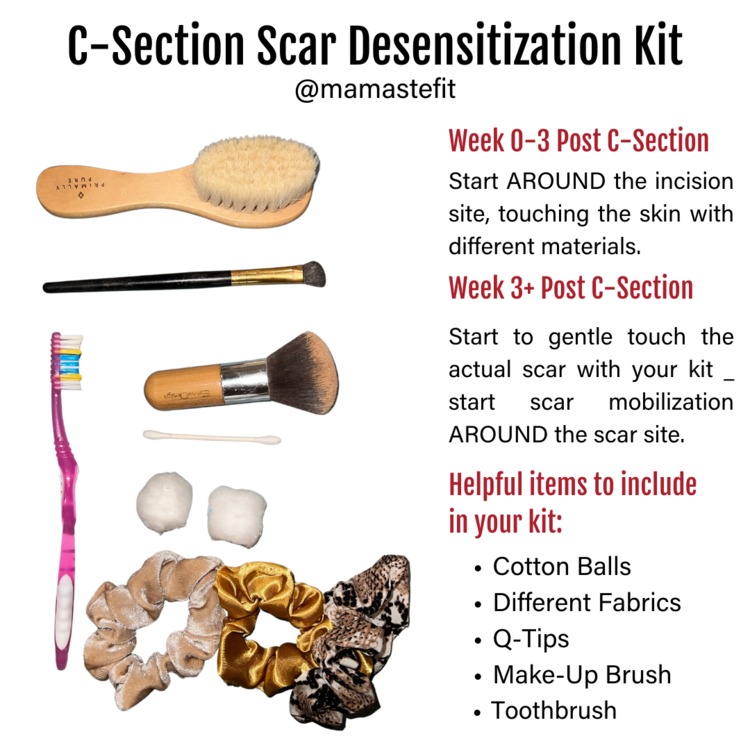
If you had a c-section, we need to also consider our scar health and healing as a part of our early postpartum recovery. Week 0-3, we want to focus more on scar desensitization to help “reset” the sensation at the scar site. You may be experiencing numbness or increased sensitivity at your incision site. These sensations could continue postpartum if we do not approach rehabilitation of the scar.
In preparation for postpartum, or if you had an unexpected c-section, gathering a small desensitization kit could be helpful! This kit should include a variety of textures and objects, such as a make up brush, toothbrush, different fabrics, and/or a cotton ball.
In the first few weeks, gently touch the skin AROUND the incision site with your different objects. The different stimulus from each object helps to reset the proprioception at the incision site. After 3 weeks, you could gently begin to touch the actual incision site and incorporate scar mobilization techniques AROUND the incision site. Learn more about scar mobilization in our c-section scar mobilization course and webinar.

We can use these different techniques to help support our initial healing journey postpartum. We don’t need to wait til we are 4-6 weeks postpartum and get the “all clear” from our provider to start to enhance our healing! You could even reach out to connect with a physical therapist around 2-3 weeks postpartum to start learning basic movement patterns, such as breath coordinating and gentle core activation!