



Welcome to the MamasteFit Blog! Today, we’re sharing a runner accessory workout that can be used to improve your running form and/or alleviate discomfort during pregnancy and postpartum. This session focuses on enhancing thoracic mobility through exercises like pelvic tilts, half lunges, side body openers, lateral hip shifts, and rotational presses, incorporating resistance bands and weights. Suitable for all fitness levels, these exercises are designed to help you achieve better hip extension and overall comfort.
Subscribe to our YouTube Channel for more weekly workouts and educational videos! We publish one new workout video and 2-3 educational videos a week on our channel.
Why Thoracic Mobility and Hip Strength Matter
The thoracic spine (mid-back) is designed to move in flexion/extension, rotation, and lateral bending. When pregnancy or daily habits limit this mobility, compensations often occur in the neck, shoulders, or lower back—resulting in pain or discomfort. For runners, limited thoracic rotation can lead to inefficient arm swing, decreased hip extension, and ultimately a less fluid stride and higher injury risk.
Similarly, healthy hip mechanics—including the ability to shift laterally and access both internal and external rotation—play a key role in supporting the pelvis, stabilizing the lower back, and optimizing gait. By combining thoracic mobility drills with targeted hip exercises, this brief routine helps alleviate tension, reinforce correct movement patterns, and improve overall comfort—whether you’re sitting at a desk, chasing after toddlers, or logging miles on the pavement.
Equipment Needed
Long resistance band (or similar length of band you can loop around your ribs)
Anchored band or cable (for 90/90 rotational rows)
Light to medium weight dumbbell or kettlebell (for lateral hip shifts and supine presses)
Optional: Mat or soft surface for floor work
If you don’t have a band or cable attachment, you can perform these movements without it—using body weight cues to find the same ranges of motion and feedback.
Part I: Thoracic Mobility
1. All Fours Pelvic Tilts with Band (Flexion/Extension)
Setup: Begin on all fours (tabletop position). If using a band, loop it around your rib-cage area (just under the armpits).
Movement Cue:
Pelvic Tilt (Spinal Flexion): Inhale, tuck your tailbone under, round your spine, and allow the band to lengthen as your ribs round.
Spinal Extension: Exhale, gently arch your lower back to lift the chest slightly, creating a subtle concave shape.
The band provides tactile feedback, encouraging you to find a full rounding of the thoracic spine. Many of us unconsciously dwell in a slight arch—especially when pregnant or postpartum—so this cue helps “wake up” deeper rounding and extension.
Repetitions: Flow through flexion/extension for 1 minute, moving at a controlled pace. Focus on smooth transitions, feeling the band give just enough tension to remind you when your ribs collapse or overarch.


2. Half-Kneeling Thoracic Rotations with Band Row (Rotation)
Transition: Step your left foot forward into a half-lunge, keeping the right knee on the ground. Hold the band ends in both hands at shoulder height.
Movement Cue:
Exhale to “row” the left arm, pulling the band toward your left hip as your torso rotates toward that front leg. Imagine twisting through the mid-back, not just pulling with the arms.
Keep the pelvis steady—tuck the tailbone under slightly so you’re not hyperextending through the low back.
Form Notes: If rotation feels “sticky,” lightly tuck the pelvis to encourage a more even twist through the rib cage. Think of your bottom ribs “sinking in” to facilitate a cleaner thoracic rotation.
Repetitions: After 1 minute of thoracic rotations, place the band across the left leg and move into the next exercise (side body opener) before switching sides.


3. Half Kneeling Hip Flexor Release with Side-Body Opener (Lateral Extension)
Setup: From the half-lunge position lay the band across your leg (left leg forward, right knee down for the first side.)
Movement Cue:
Hip Position: Tuck the hips under (posterior pelvic tilt) and push them forward slightly to avoid arching in the low back.
Side‐Body Reach: Reach your right arm overhead (for left lead knee) and gently lean away, creating a long line from hip to fingertips. You should feel a deep stretch along the side-body (latissimus and obliques) and the right thoracic region opening up.
Switch Sides: Hold the side-body opener for 1 minute. Then move the opposite leg forward (right leg forward, left knee down) and repeat the same thoracic rotations with banded row and side-body opener with your left arm reaching overhead.


Part II: Standing Lateral Hip Shifts
Now that the thoracic spine has been “awakened,” we’ll shift focus to the hips—mobilizing adductors and glutes while integrating core and thoracic rotation.
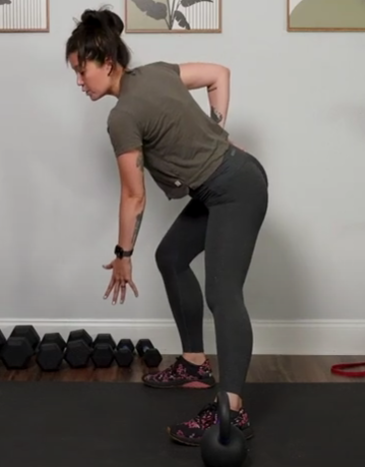
Setup: Stand with feet wider than hip-distance apart. Hold your light to medium weight in both hands (optional to do body-weight only for the first round).
Movement Cue:
Hinge Back: Slightly push your hips back as if you’re sitting into a shallow squat. Keep a soft bend in both knees.
Shift & Rotate: Bend one knee (e.g., left), straightening the opposite leg (right). As you lower toward the left, rotate your torso so your belly button turns toward the left thigh, reaching your hands (with the weight or without) toward the floor. You should feel a deep adductor stretch on the right inner thigh and a glute stretch on the left hip.
Switch: Push up through the bent knee, then shift to the other side (right knee bent, left leg straight) while rotating the belly toward the right leg and reaching toward the floor.
Weight Feedback:
First Round (No or Light Weight): Focus on finding a smooth shift from side to side, sensing the stretch on each inner thigh.
Second Round (Add Weight): Holding a dumbbell deeper into the pattern will encourage a slightly greater stretch and greater control—aim to keep weight distributed through the big toes of both feet (avoid collapsing onto the outer edges).
Reps: Flow continuously for 1 minute (about 8–10 shifts per side), emphasizing a controlled hinge and rotation.



Part III: 90/90 Rotational Rows
This exercise combines hip external/internal rotation with thoracic rotation, adding a resisted pull to intensify the stretch.
1. Setup for Left Lead
Position: Sit on the floor with your left leg bent at 90° in front of you (shin parallel to the front edge of your mat) and right leg bent at 90° behind you (shin perpendicular to the mat). Your hips should be square to the front.
Band/Cable: Hold the band (or cable handle) in your right hand, anchored at hip height or low enough so that when you sit, you can fully extend your arm.
2. Movement Cue
Reach Over (Front Leg): Inhale as you reach your right arm forward, allowing your torso to hinge over your left thigh. This creates a deep glute stretch on the front (left) side.
Row & Sit Back (Back Hip): Exhale as you sit your hips back into the right hip. At the same time, pull the band handle toward your right hip—rotating your thoracic spine toward the back leg. Feel a stretch in the right groin and stimulate external rotation in that back hip.
Key Point: Keep both knees planted equally; don’t lift either knee. The goal is to find alternating stretch/rotation on both hips/legs, coordinated with the row.
Repetitions: Perform controlled reps for 1 minute on this side, allowing each reach and twist to be fluid. If using a cable machine, adjust the height so you can bracket the same line of pull—choking up on the band handle if needed to match your arm length.
3. Switch to Right Lead
Position: Swap legs so the right leg is in front (90°), left leg behind (90°). Hold the band in your left hand this time.
Movement: Repeat the same reach-and-row pattern: reach your left arm over the right thigh (glute stretch), then sit back into the left hip as you row the band toward that hip (groin stretch).
Notes on Asymmetry: Many people notice one side feels “stiffer” or more awkward due to inherent pelvic asymmetry. Take an extra moment to settle into the “sticky” side—maintaining equal weight on both knees as you hinge, twist, and row.


Part IV: Supine Rotational Floor Press
Now, we transition to the floor, combining shoulder blade movement with spinal rotation—perfect for relieving neck and shoulder tension while reinforcing thoracic mobility.
1. Left-Side Start
Setup: Lie on your back. Bend your left knee and bring your left foot off the floor. Extend your right leg straight on the mat. Hold a moderate-light dumbbell (or kettlebell) in your left hand.
Movement Cue:
Press & Rotate: Press the weight straight up toward the ceiling. As you press, lift your left knee and rotate your lower body so that knee moves gently toward the right side of your torso. Simultaneously, keep your left arm pressing straight—imagining your shoulder blade gliding on your rib cage.
Return: Lower the knee back to neutral (left leg bent, foot off the floor), keeping the weight pressing overhead, then bring the arm & leg back to the starting alignment.
Variation: If bringing the knee over the body is too complex, simply focus on pressing the weight straight up and rotating your torso slightly toward the opposite side, feeling a mild oblique stretch and scapular glide.
Reps: Perform presses and rotations on the left side for 1 minute. If you need more feedback to truly engage the shoulder blade, use a slightly heavier weight—just enough that you feel the scapula pressing actively into the back.
2. Switch to Right-Side Press
Setup: Now bend your right knee, right foot off the floor; extend the left leg straight. Hold the weight in your right hand.
Movement: Press the weight overhead, lifting the right knee and rotating the hips/torso toward the left. Focus on keeping the pressing arm tall and the shoulder blade moving smoothly on the back.
Reps: Continue for 1 minute, feeling both the shoulder-scapula connection and a gentle spinal rotation.


Part V: Second Rounds & Progressions
If you’re feeling good and ready for more, complete a second round of exercises to reinforce the patterns and deepen the stretch. If you followed Part II and Part III without weight or band initially, now is the time to add them for extra feedback.
Lateral Hip Shifts (Second Round):
Repeat the side-to-side shifts, this time definitely using your light to medium weight.
Move slower if you’d like: hinge, shift, rotate, hold the stretch briefly, then switch. Focus on pressing through both big toes (not letting weight migrate to the outer edges of your feet).
90/90 Rotational Row (Second Round):
Return to the 90/90 position (left leg front first, then swap).
If you used the band lightly the first time, tension up or choose a slightly thicker band for this round—aiming to pull yourself a bit deeper into the hip/glute stretch as you row and rotate.
Concentrate on “even hips” as you rotate—especially on the side that felt stiffer previously.
Tips for Success
Consistency Is Key: You can add this workout on to your existing strength or cardio workouts or perform as a stand-alone workout if you’re short on time.
Modify as Needed: If any movement causes sharp pain, back off the range of motion or skip that variation. You can omit bands or weights, focusing simply on body-weight cues.
Breathe Intentionally: Coordinate an inhale with opening or lengthening movements (e.g., reaching over the leg) and an exhale with twisting or loading phases (e.g., pulling the band).
Listen to Your Body: Pregnancy and postpartum bodies can vary widely. Feel free to decrease loading, shorten ranges of motion, or hold movements longer in the areas that feel especially tight.
Progress Gradually: As you get more comfortable, increase band resistance, add a few more seconds in each stretch, or hold the weight a bit longer in the lateral hip shifts.
Next Steps: Returning to Running Postpartum
If you’re specifically focused on returning to running after childbirth, be sure to check out our online Postpartum Return to Running Program. It starts with gentle breathing exercises and basic mobility for the early postpartum phase, progresses into foundational strengthening, and ultimately guides you back to impact-based activities like running—ensuring you build strength safely and sustainably. Be sure to use code YOUTUBE10 for 10% off any online course!
Whether you’re a seasoned runner, a new mom looking to regain confidence in movement, or simply someone who sits at a desk all day and craves relief from back-and-hip stiffness, incorporating this 17-minute mobility and strength sequence can become a cornerstone of your weekly routine. Give yourself the gift of consistent thoracic and hip health—it’ll pay dividends in comfort, performance, and longevity.
Prenatal Support Courses


Learn the science of pregnancy and birth to take the mystery of labor away! Understand why you are feeling what you feel, and learn strategies to confidently move through pregnancy and birth!
- 9h+ of Video
- Support Group
- Close Captioning

- 5 Workouts/Week
- Gym Workouts
- Self-Paced

Instructor
GINA
Workout on-demand with our prenatal fitness workout videos! Each workout is 30-40 minutes to follow along as you exercise at the same time!
- Birth Prep
- All Trimesters
- Mobility Work

Instructor
GINA
Find comfort and relief from pelvic girdle pain throughout your pregnancy and postpartum period! This program incorporates myofascial sling focused exercises to stabilize across the pelvic girdle joints.
- 3 Weeks
- On Demand Workout Videos to Follow