

The pelvic floor plays a large role in our overall function and most importantly for this phase of life, our labor and comfort throughout pregnancy (and beyond).
Let’s explore HOW to approach releasing tension in the pelvic floor and HOW the pelvic floor supports our pregnancy and birth (and beyond).
Relaxed Pelvic Floor = Easier Labor and Less Prenatal Pain
The pelvic floor supports:
- Stabilization (bottom of the core canister)
- This can support comfort throughout pregnancy and into the postpartum period!
- Sexual function and childbirth
- Supports the pelvic organs
- Sphincter control
- Keeps fluids IN or relaxes to release fluids OUT
- Sump pump
- Lymphatic flow
A tight or tense pelvic floor (especially an unevenly tense pelvic floor) can affect the above functions!
If we have a tight pelvic floor, it can affect how we can stabilize, which may mean we are in more pain throughout pregnancy.
If we have a tight pelvic floor during labor, it can affect how baby can navigate through the pelvis and result in a labor stall or longer labor!
Releasing tension in the pelvic floor is important for pregnancy, birth, and into postpartum (as you can see that all of those functions are important even beyond birth)!
This course explore your pelvic floor anatomy, function, and how to prepare your pelvic floor for birth! This course includes educational videos, mobility exercises, relaxation drills, and how to relax your pelvic floor during labor tips.
- 2+ hours of on-demand videos
- Immediate and lifetime of the course access
- Watch on Mobile Device
3 Pelvic Floor Relaxation Exercises
The pelvic floor attaches to the pelvis. If we change the pelvic position (usually with hip movement or pelvic tilting) we can adjust the tension in the pelvic floor, which means we can stretch or target different places in the pelvic floor.
The movements we want to focus on to release the pelvic floor include:
- External Rotation: Wide Knees
- Targets more of the anterior half of the pelvic floor
- Internal Rotation: Knees In, Ankles Out
- Targets more of the posterior half of the pelvic floor
- Asymmetrical Positions: Internal AND External Rotation
- Targets specific quadrants of the pelvic floor (usually focus is back posterior quadrants)
How to Release the Pelvic Floor:
Diaphragmatic Breathing
First, it’s important to discuss HOW to stretch the pelvic floor. While hip positioning is one part of the equation, we also want to address breathing!
Breathing is how we move the pelvic floor as a part of stabilization and support. We can use breathing to lengthen the pelvic floor (stretch it) and then relax it.
When we breathe to relax the pelvic floor we want to focus on:
- Inhalations are DOWN and OUT
- Feel the rib cage expand laterally when you inhale NOT the chest lift
- As you inhale, feel the pelvic floor also lengthen DOWN
- Exhales are RELAX
- If you are under demand, the exhale can also be UP and IN with a contraction, but for pelvic floor relaxation, we want to focus on the relax as we exhale.

What if you can’t feel it?
- Place your hands on your rib cage and focus on trying to expand your ribs as much as you can to the SIDE
- Round in your back a little, and repeat step 1
- Sit on a soft object, and try to push your perineum into the object with inhalation
- OR Insert a finger vaginally and try to push your finger out with an inhalation
Watch the video below for more of a breakdown of how to do diaphragmatic breathing!
1. Butterfly Pose: External Rotation
The butterfly pose focuses on external rotation!
This is where the knees are out wider than the ankles, common with deep squat positions.
The butterfly pose will emphasize external rotation even more so than a squat though since the ankles are in!
In this position, focus on the diaphragmatic breathing that we discussed earlier: inhale DOWN, and exhale to RELAX.

2. Heros Pose: Internal Rotation
Next, we have the hero’s pose. Hero’s pose focuses on internal rotation! This pose will target more of the posterior pelvic floor.
This is where the knees are in more than the ankles, which is a helpful movement to be able to do in preparation for birth and pushing!
I find sitting on a yoga block helps find internal rotation more easily! In this position, also find a slight rounding in the low back to target the back half of the pelvic floor more.

3. All Fours Hip Shift Drill: Asymmetrical
Then, we can focus on asymmetrical movements that find BOTH internal and external rotation. This will help us target different quadrants of the pelvic floor diagonally.
- Starting in an all-fours position, place a yoga block under one knee. This will already shift the hips into asymmetry.
- Then, shift your weight to the elevated knee to emphasize the asymmetry.
- And finish by pushing the chest and belly away from the ground to find that posterior pelvic tilt.
- You should feel more of a stretch in the elevated hip back pocket.

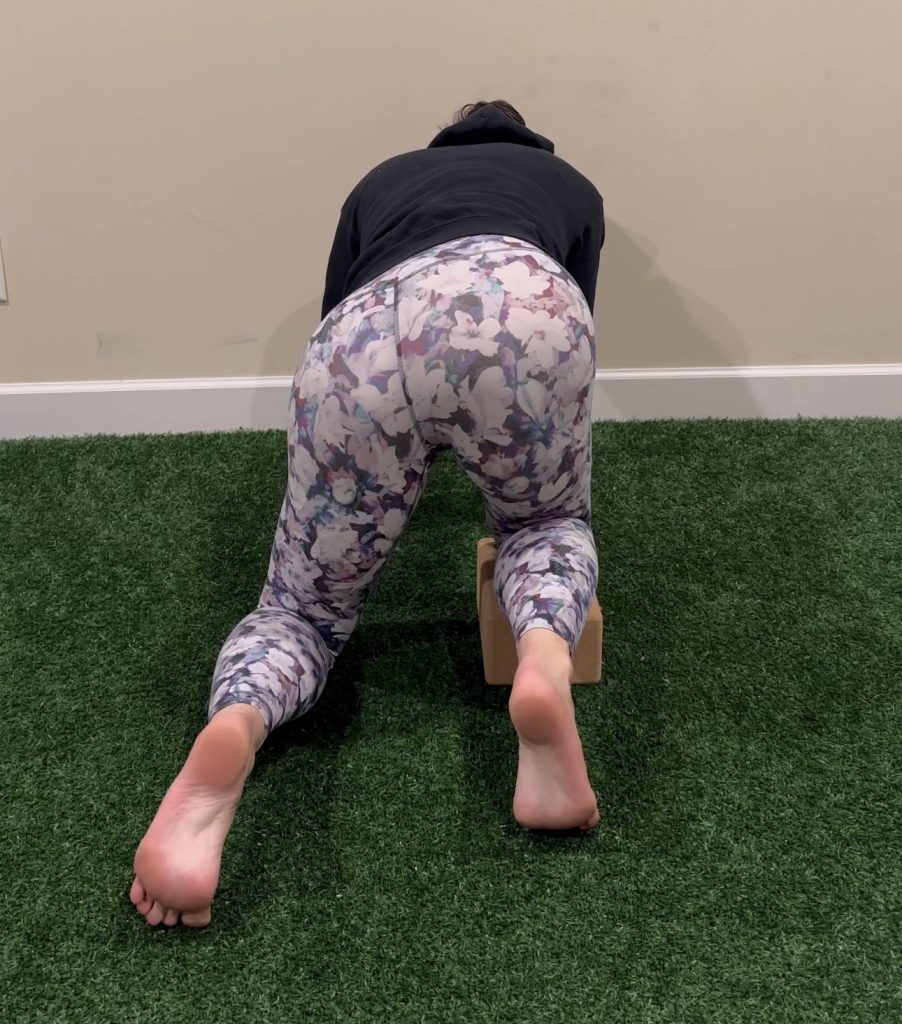
Then, we can move deeper into this position! Drop the same side elbow as the elevated knee to the floor. This will add some side body compression to that side, and will help you find more of an internal rotation on the elevated hip.

If you want to move deeper, reach across with the opposite arm to find more length in that side. This will be the deepest expression of the pose.
In this position, focus on pushing the chest AWAY from the floor with every inhalation.
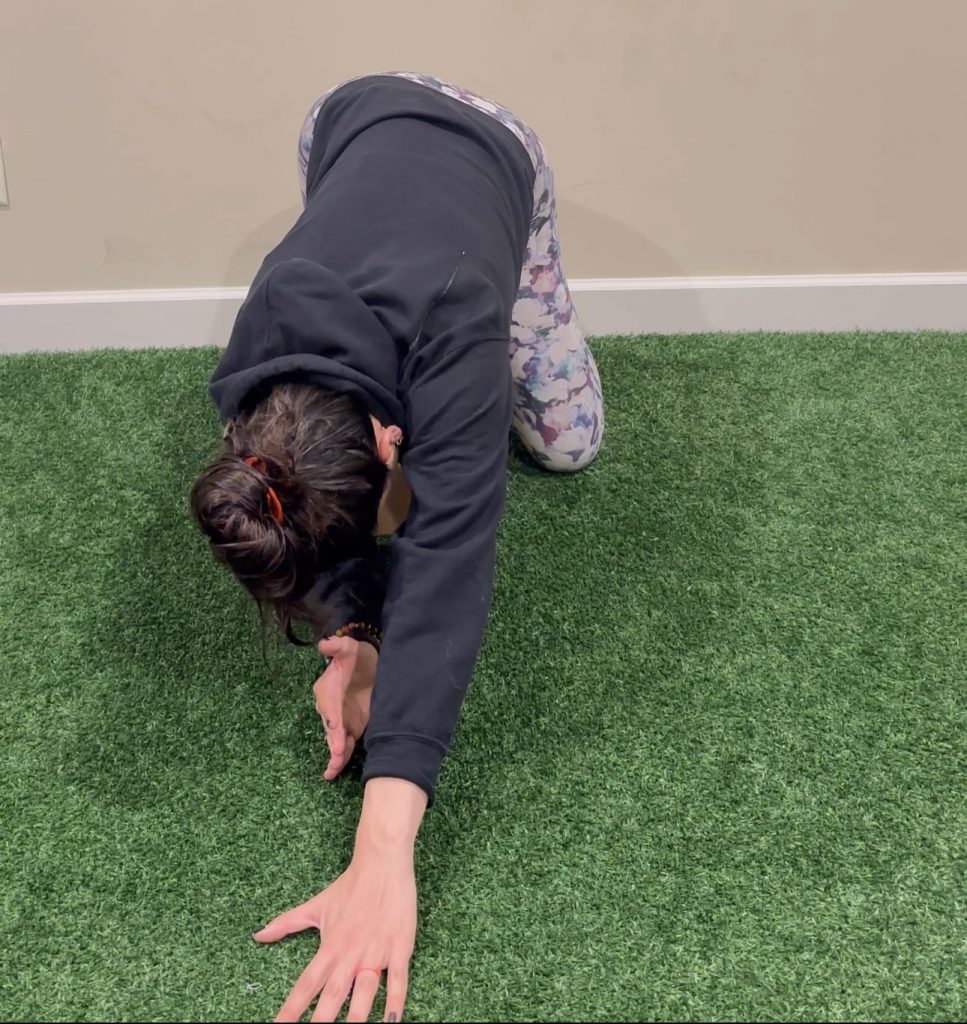
Watch a breakdown video on how to shift the hips in the all fours pelvic tilt.
Release the Pelvic Floor Tension for Easier Labor
We can release tension in the pelvic floor during PREGNANCY to support easier labor. We do not need to wait until birth to relax our pelvic floor!
A few times a week, we can shift our hips into the three positions: external rotation, internal rotation, and asymmetrical [ostiions so that we can release and stretch all the different portions of our pelvic floor.
Learn more on how to release tension in the pelvic floor in our prenatal fitness programs and pelvic floor birth prep course!