



If you find out that your placenta is low-lying at your anatomy scan or at an early ultrasound, you may be advised to limit physical activity. But, what exercises should you do, or should you even be modifying at all at this point in pregnancy?
Let’s explore a few ways to modify exercise due to placenta issues such as low-lying or Previa, and ways to facilitate a conversation with our provider to better understand their recommendations!
When should you NOT exercise??
Before we dive into tips of how to modify exercise for placental issues, let’s break down a few reasons to NOT exercise or STOP exercise immediately.
Some of those situations may include (not an inclusive list):
- Any vaginal bleeding;
- Cramping or contractions;
- Water breaking;
- Increased pelvic pressure with movement;
- Other prenatal complications;
- Advised by your provider to stop activity due to your complication.
1) Consult with your provider!
Discussing your current medical situation with your provider can help you better gauge what types of exercises may or may not be appropriate for pregnancy for YOU. If you feel that your provider is potentially giving outdated advice, it is worth asking questions!
If you are not sure about the exercise recommendation that your provider is giving you, ask questions!
- Ask them when you can have another ultrasound to assess your placenta position (it tends to move away from the cervix as pregnancy progresses).
- You can ask if you can focus on upper body movements or if there is a certain exercise they recommend or don’t.
- You can ask if there are any signs and symptoms you should be aware of with a low-lying placenta or placenta previa, and ask what to do if you experience any of those signs and symptoms!

Want to learn more? Explore our fitness trainers course or our upcoming fitness trainer webinar series! Earn .8 NASM CEUs and 8 AFAA CEUs by attending the webinar series. Our fitness trainers course also earns CEUs!
This webinar series can also be registered as a standalone series!
3 Exercise Modifications for Placenta Previa and Low-Lying Placenta
Here are our three main tips for exercising with this prenatal complication, but remember: ALWAYS follow your provider’s guidance on exercise recommendations for pregnancy. If you do not agree with their recommendation or feel it is not based on current research, ASK QUESTIONS. This blog is not medical advice!!
- Decrease hip flexion to decrease pressure on the perineum.
- Focus more on upper body movements from a supportive position, such as seated.
- Do NOT bear down with exertion!
Typically, we do NOT need to modify exercise until 28 weeks with placenta previa or a low-lying placenta. But, you may have a cautious provider recommending modification at your 16-20 week anatomy scan!
If you are feeling unsure, again, ask questions! You should still be allowed to exercise (outside of any other complications), but facilitating the conversation with your provider is really important!
1) Decrease Hip Flexion
The main focus of our prenatal exercise modifications for a placenta-related issue is to avoid increased pressure down on the cervix! The easiest way to do this is to decrease hip flexion to more than 90 degrees.
Most leg-based movements will need to decrease in range of motion at the bottom, such as the squat, deadlift, hip thrust, and lunges.
Learn more lifting modifications in our prenatal fitness programs, where we break down how you can modify your lifts, and in our fitness trainer course! We breakdown common prenatal complications and how to modify exercise to support your clients throughout their pregnancy based on current research.
Understand how to approach training clients throughout pregnancy, prepare for birth, and then recover in the postpartum as they return to fitness!
- 12.5 hour of on-demand videos
- 6 Guest Lectures from Pelvic Floor PTs
- Lifetime Access of Program
- Earn 1.3 NASM CEUs and 13 AFAA CEUs
Common Squat and Deadlift Modifications
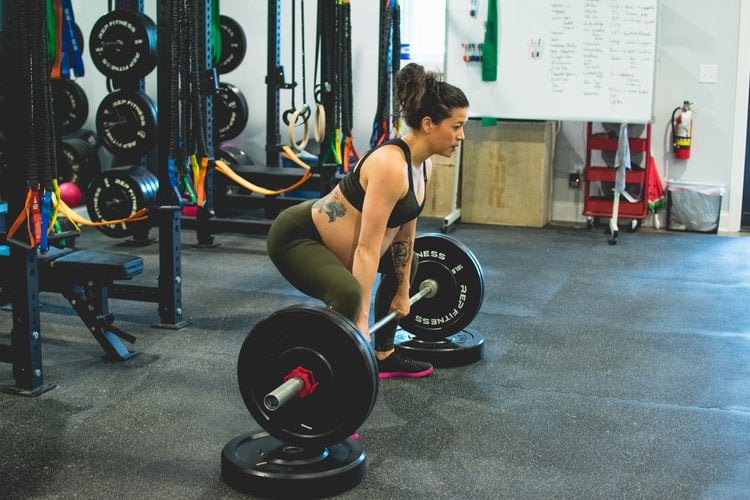
We want to decrease range of motion with the squat and deadlift to avoid deep hip flexion that may put more pressure on the perineum.
In the squat, we recommend squatting to an elevated surface to prevent going below 90 degrees with the hip.
In the deadlift, we recommend elevating the bar to avoid deep hip flexion at the bottom of the movement.
2) Focus on upper body exercises from a supportive position
Next, the easiest way to continue to exercise without complications is to focus on upper body exercises.
Ideally, we can do these exercises from supportive positions, such as seated. But, you can do them standing or more upright, as well!
Movement patterns to focus on:
- Horizontal Push (Bench Press type movements)
- Horizontal Pull (Rows)
- Vertical Push (Overhead press)
- Vertical Pull (Tricep pull down, lat pull down)
Watch the videos below for some examples of upper body exercises that you can do that are more supportive!
3) Pressure Management: NO bearing down!
And finally, we want to continue to avoid downward pressure on the cervix by focusing on our breath to movement coordination!
When we inhale, we want to inhale to feel expansion in the rib cage, back, abs, and pelvic floor. This will increase pressure to help stabilize the spine. The amount of pressure we need depends on the demand, so we would recommend decreasing loading to decrease overall pressure demands on the system and cervix!
But, it’s also important what we do when we exhale! We want to exhale to lift UP on exertion.
If we exhale to bear DOWN as we come up from our squat or press the weights away, we could be increasing pressure on the cervix.
Watch the video below to learn more about pressure management and how it supports our stabilization to avoid bearing down!
You can safely lift for a strong and comfortable pregnancy!
You can lift throughout your pregnancy, but if we develop a complication we may need to modify HOW we approach our movements to stay safe! Consulting with your provider on how to modify exercise to support your individual pregnancy is important! If you feel unsure on their guidance, or their guidance feels vague, ask them about doing these three tips and see if they support it!
Strength training has been shown in research to be beneficial for managing low back and pelvic girdle pain, in addition to increasing bone, muscle, and tissue density (which helps with recovery postpartum too)! So, continuing to exercise is beneficial, even with a complication, but we want to stay safe doing so!