
You may have been told that you shouldn’t lift weights during pregnancy. Or you may have been told to significantly limit how much you lift, such as “don’t lift more than 20 pounds.”
Why is this a common exercise recommendation (or lack thereof)? There is this myth that lifting can cause the placenta to detach (this is false) or cause a miscarriage (also false).
You can safely lift weights throughout pregnancy BUT we do need to modify them. Lifts tend to not look exactly the same as pre-pregnancy. Let’s explore three tips for lifting throughout pregnancy!
When should you not exercise??
Before we dive into tips of how to lift throughout pregnancy, let’s break down a few reasons to NOT exercise throughout pregnancy. For most of us, exercising and lifting weights is a perfectly safe activity to do for prenatal exercise, but there are some situations in which we may want to modify our activity based on a prenatal complication.
Some of those situations may include (not an inclusive list):
- Vaginal bleeding
- Cervical issues
- Multiples
- Health issues such as heart or pulmonary issues
- Severe Pre-Eclampsia
- Your water has broken
Discussing your current medical situation with your provider can help you better gauge what types of exercises may or may not be appropriate for pregnancy for YOU. If you feel that your provider is potentially giving outdated advice, it is worth asking questions!
If you don’t have any prenatal complication and are a low-risk pregnancy, there is usually no reason you can’t exercise! Explore the conversation as needed!
Want to learn more? Explore our fitness trainers course! Our course includes access to our upcoming webinar series for fitness trainers, where we will break down prenatal complications and exercise recommendations based on current research!
This webinar series can also be registered as a standalone series!
3 Tips for Lifting Throughout Pregnancy
Here are our three main tips for lifting throughout pregnancy!
- Decrease overall loading to about 50-70% effort. This will ensure we can move with optimal form and focus more on a strength endurance rep scheme.
- Make space for the belly! This will be the biggest reason for modifying lifting throughout pregnancy!
- Don’t hold your breath! We shouldn’t be lifting so heavy that we need to be doing a breath-holding strategy.
Let’s explore our top three tips for prenatal lifting!
1) 50-70% Effort: Decrease the loading but still lift the weights!
During pregnancy, there are a lot of musculoskeletal changes happening in our body!
- Center of mass shifts up and out, which can adjust our postural tendencies and stabilization patterns.
- Increased mass can increase force and loading on our body.
- Increased joint laxity, which increases the stabilization demand.
And that’s just a few of the changes! The biggest thing to remember is there is a change in how we distribute force and loading through our bodies during pregnancy.
This may change our stabilization and movement patterns.
So, it is important that we move under load with really good form, otherwise, we could be increasing our risk of injury or pain during pregnancy.
Feel strong and move comfortably throughout your entire pregnancy. Our program syncs to your current week of pregnancy, so you can start at any time!
- 5 Workouts Per Week
- Labor Prep Workouts
- Teambuildr App Access
During the first and second trimesters, we should decrease our loading to about a 70% effort.
This may fluctuate from day to day, but we want to move weights so that you feel like you could do a few more reps after you finish your set.
A 70% effort level also tends to support a high volume in exercise.
In our prenatal fitness programming, we use an 8-12 rep range for main lifts to focus more on strength endurance. Focusing more on strength endurance can be beneficial throughout pregnancy since there are more endurance demands!
As you move into your third trimester, lowering the effort level to about a 50% level may be more appropriate, but it may take a few weeks to reach this level as you transition into your final trimester!
2) Make space for your belly!
The biggest reason for modification throughout pregnancy is your belly!
We need to make space for the belly throughout our lifts so that we can stay comfortable.
Usually, this may include:
- Widening the stance
- Moving from a standing to seated position
- Elevating the torso for more comfort as belly gets heavier
- Omiting certain movements that press against the belly
Learn more about lifting modifications in our prenatal fitness programs, where we break down how you can modify your lifts, and in our fitness trainer course!
Let’s break down a few common prenatal lifting modifications!
Understand how to approach training clients throughout pregnancy, prepare for birth, and then recover in the postpartum as they return to fitness!
- 12.5 hour of on-demand videos
- 6 Guest Lectures from Pelvic Floor PTs
- Lifetime Access of Program
- Earn 1.3 NASM CEUs and 13 AFAA CEUs
Common Hip Thrust Modifications
As belly grows, placing a barbell across the lower abdomen for the hip thrust can be uncomfortable.
Our first modification is to do an elevated hip thrust. This decreases the range of motion of the movement, and decreases the amount of pressure on the belly with the bar.
After this modification is no longer comfortable, we recommend using bands in either a horizontal or vertical set up!

Common Squat and Deadlift Modifications
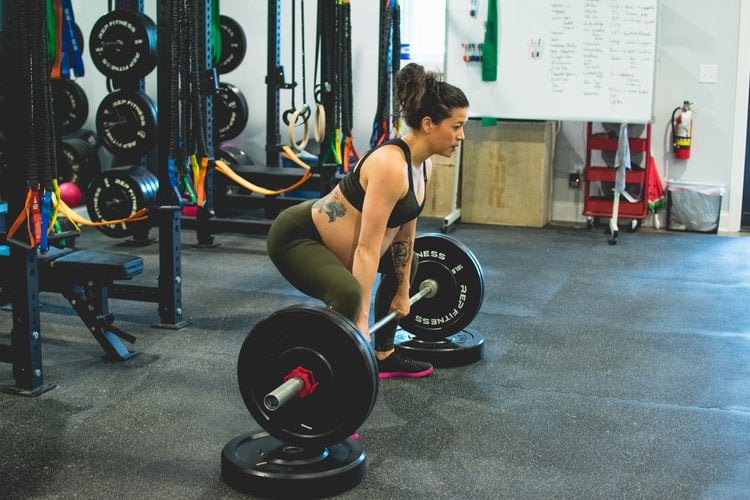
As belly grows, it tends to impede hip flexion, or how much we can bend at the hip. This could cause us to decrease range of motion in the squat or deadlift, or cause rounding in our back.
A common modification is to find more of a sumo stance with our squats and deadlifts! We can also decrease the range of motion to something more comfortable by elevating the bar in a deadlift or doing a box squat.
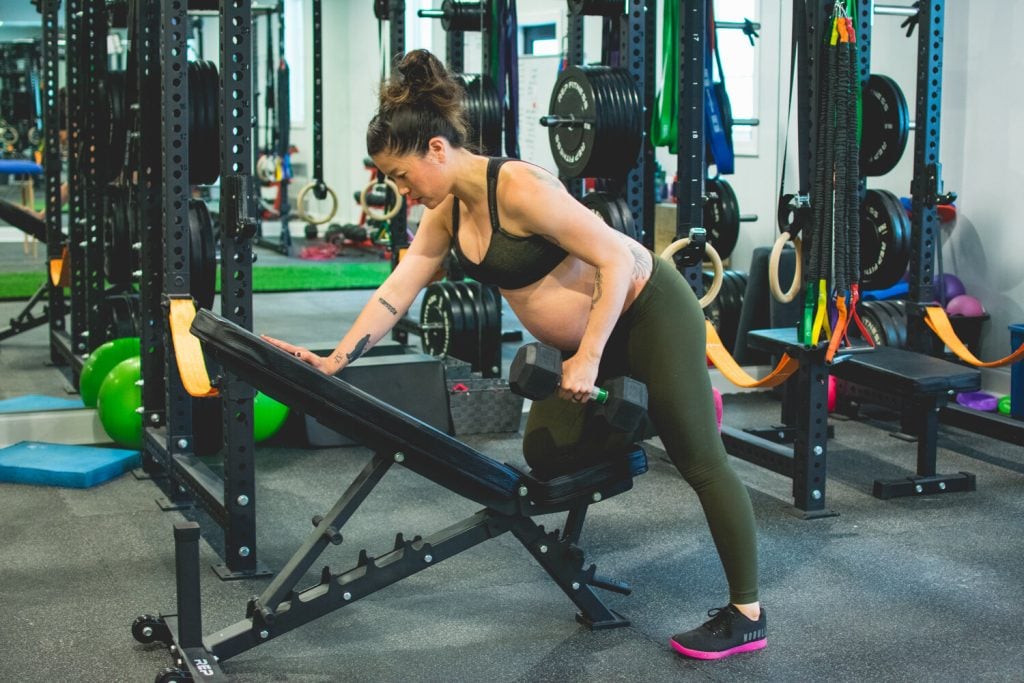
Common Bent Over Row Modifications
As belly grows, it tends to get heavy! This extra weight in forward bending postures, such as the bent over row, can be pretty uncomfortable or put too much strain on low back.
Inclining movements can help decrease the tension on the low back!
3) Pressure Management: Don’t Hold the Breath!
We may be accustomed to a Valsalva or breath holding strategy as we lift, but it may not be appropriate for pregnancy. Our recommendation is to NOT hold the breath throughout your entire lift. If you remember tip 1, we recommend a 50-70% effort level with your lifts, so we should not be lifting at a level that requires a breath-holding strategy.
This technique tends to maximally increase pressure in the abdominal cavity to stabilize the spine under high loads! But our core is already challenged, and we shouldn’t be lifting heavy enough to need a high-pressure breathing strategy.
During pregnancy there are two breathing strategies that we would recommend:
- Inhale to lower or move WITH gravity. Exhale to lift or move AGAINST gravity.
- Hold breath as you lower or move WITH gravity. Exhale to lift or move AGAINST gravity.
Watch the video below to learn more about pressure management and how it supports our stabilization.
You can safely lift for a strong and comfortable pregnancy!
You can lift throughout your pregnancy! We may need to modify movements so they accommodate for your belly and musculoskeletal changes in our pregnant bodies. But, we can still feel strong and stay comfortable throughout our pregnancies!
Strength training has been shown in research to be beneficial for managing low back and pelvic girdle pain, in addition to increasing bone, muscle, and tissue density (which helps with recovery postpartum too)!