



If you’ve ever been told to “just do Kegels” for your pelvic floor and thought, this doesn’t feel right, you’re not alone. The pelvic floor is complex, dynamic, and deeply connected to how we move, breathe, and load our bodies — especially during pregnancy and postpartum.
In this 30-minute pelvic floor workout, we focus on mobility, release, and intentional strength to help reset and bring more balance to the pelvic floor so you can feel better in your body during pregnancy and beyond.
I’m Gina — perinatal fitness trainer, birth doula, and mom of four — and I’ve personally used these strategies throughout my pregnancies and into motherhood to feel stronger, more functional, and more comfortable while chasing after my kids. This workout is designed to help you understand your body better, not just move through exercises mindlessly.
Subscribe to our YouTube Channel for more weekly workouts and educational videos! We publish one new workout video and 2-3 educational videos a week on our channel.
What This Pelvic Floor Workout Is Designed to Do
Rather than focusing on “tightening” the pelvic floor, this workout helps you:
Release excess tension (especially in areas that tend to overwork)
Improve pelvic mobility and awareness
Strengthen muscles that support pelvic floor balance
Explore natural asymmetries without trying to “force” symmetry
Feel more supported in daily movement, exercise, and motherhood
We move through three main sections, completing one round of each. If something feels especially good for your body, you’re encouraged to pause and repeat sections as needed.
Equipment You’ll Need
One medium to heavy weight
A yoga block
A soft object or pillow (or Pilates ball)
Optional:
A wedge
A long resistance band (anchored around knee level)
Once you’ve gathered your equipment, you’re ready to begin.
Section 1: Pelvic Floor Mobility & Reset
We start by focusing on mobility and release, especially in areas of the pelvic floor that tend to hold excess tension.
Back Expansion Breathing on All Fours
Using a pillow, Pilates ball, or simply rounding through the spine, we find a back-expanded position. This helps target the posterior portion of the pelvic floor, which often becomes compressed due to habitual arching of the spine.
Inhale deeply into the back body
Exhale gently, drawing the belly toward the spine to round a bit more
This breath-driven movement encourages release, not force.

All Fours Hip Shifts (Using a Yoga Block)
Placing the left knee on a yoga block, we shift most of our weight into the elevated hip and move through gentle pelvic tilts.
This variation:
Targets the posterior pelvic floor quadrants
Highlights side-to-side differences
Improves pelvic rotation and control
From here, we add knee lifts, moving from a closed hip position to an open hip position. This transition is essential for pelvic floor function and often reveals natural asymmetries — which are completely normal.
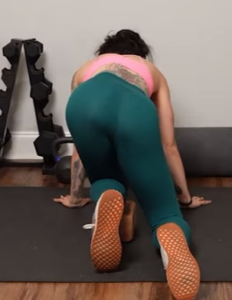


Lateral Hip Shifts for the Anterior Pelvic Floor
Next, we widen the knees and shift into the left hip, externally rotating the right leg. Hold here or gently move forward and back, side to side. Hold for about a minute before switching sides. These movements target the anterior pelvic floor, including the groin and inner thighs.
You may notice:
One side feels stretchier
One side feels more guarded
One side feels easier to access
That information is valuable — it helps guide how we strengthen later.


Side-Lying Inner Thigh Activation
Using the yoga block again, we move into a side-lying position on our right side and place the left knee onto the yoga block. Press through the elevated knee to lift the hips. After one minute, switch sides.
This activates the adductors (inner thighs), which play a major role in supporting the front half of the pelvic floor. Many people notice asymmetries here, especially on the left side, which commonly tends to be underactive.

Section 2: Strength to Restore Balance
With mobility established, we now move into strength work that intentionally biases the hips to encourage better pelvic alignment.
Offset Holds with a Weight
Holding a weight on the right side while squatting or hinging helps encourage different rotational patterns at each hip.
The left hip often favors external rotation
The right hip often favors internal rotation
By intentionally biasing the opposite pattern, we help bring more balance to the pelvis and pelvic floor.


Lateral Groin Shifts
With a wide stance, we shift towards one side while gently rotating the pelvis toward the bent knee. This is key — without the rotation, you won’t get the same pelvic floor benefit. After holding on each side, move into gentle lateral shifts from side to side, with or without added weight.
This movement:
Releases anterior pelvic floor tension
Improves your ability to transition between sides
Supports comfort in squatting, walking, and daily movement


Single-Leg Deadlifts
These emphasize hamstring engagement, which is often underactive compared to quads and glutes.
Holding the weight on the right side for both legs allows us to:
Encourage internal rotation where needed
Encourage external rotation where needed
Strengthen without forcing symmetry


Standing Hip Shifts
This standing version of earlier hip shifts is more intense and deeply effective. Focus on:
Weight in the big toes
Gentle pelvic rotation
A slight posterior tuck if needed
These are often a “lightbulb moment” for people dealing with hip or pelvic discomfort.
From here, move into an alternating hip shift, gently shifting from one side to the other.

Section 3: Banded Strength & Integration
In the final section, we add a long resistance band to create assisted tension and deeper awareness. This section will be one-sided as we focus on the right glute and the left hamstrings / inner thighs.
Banded Lunges
With the band assisting hip positioning, we:
Strengthen quads and glutes
Improve end-range hip extension
Support balance on the side that typically needs it most
If you don’t have a band, you can still perform standard lunges.

Banded Lateral Hip Shifts
The band gently pulls you deeper into the hip shift, increasing both stretch and activation.
One side stretches
The opposite inner thigh works to push you out
This combination is powerful for pelvic floor balance. After holding the stretch, feel free to grab a weight and gently move in and out of the lateral shift.


Staggered RDLs & Banded Standing Hip Shift
We finish with staggered stance hinges and a more complex banded hip shift that activates one glute to deepen the stretch on the opposite side.
This pairing helps:
Strengthen weaker muscle groups
Release overactive areas
Reinforce balanced movement patterns


Final Thoughts
This 30-minute pelvic floor reset and balance workout is designed to help you better understand your body, not just work it. Even doing a few of the hip shifts regularly can be a game changer for pelvic discomfort, tension, or feelings of imbalance.
If you loved this workout and want more intentionally designed programming:
Prenatal & Postpartum Fitness Programs – Daily workouts with lifetime access
Beyond Postpartum Strength Program – For those 6+ months postpartum who want more challenging strength work
Be sure to use code YOUTUBE10 for 10% off any of our online offerings.
Our goal is to help you feel strong, capable, and supported in your body — through pregnancy, postpartum, and every season of motherhood.
Prenatal Support Courses


Learn the science of pregnancy and birth to take the mystery of labor away! Understand why you are feeling what you feel, and learn strategies to confidently move through pregnancy and birth!
- 9h+ of Video
- Support Group
- Close Captioning

- 5 Workouts/Week
- Gym Workouts
- Self-Paced

Instructor
GINA
Workout on-demand with our prenatal fitness workout videos! Each workout is 30-40 minutes to follow along as you exercise at the same time!
- Birth Prep
- All Trimesters
- Mobility Work

Instructor
GINA
Find comfort and relief from pelvic girdle pain throughout your pregnancy and postpartum period! This program incorporates myofascial sling focused exercises to stabilize across the pelvic girdle joints.
- 3 Weeks
- On Demand Workout Videos to Follow