



Feeling anxious or stressed? Take a deep breath in, pause, then exhale to let go.
Did you know that slowing our breathing with deep, slow, and long breaths can help to calm the nervous system?
We can use breathing techniques to find pain relief during labor! There are a number of techniques, some more complicated and others as simple as just slowing the breath, that can help release tension and find relief during labor!
4 Breathing Techniques for Labor
Breathing techniques for labor are more than “just take a deep breath.” We can use diaphragmatic breathing throughout pregnancy to:
- Enhance stabilization and support during movement (which will mean less discomfort and pain)
- Improve digestion (which tends to slow during pregnancy to allow us to better absorb ALL the nutrients for baby)
- And to prepare for birth!

Diaphragmatic breathing utilizes the movement of the diaphragm to pull air into the lungs and push air out of the lungs by adjusting the pressure in the thoracic and abdominal cavities.
When we inhale:
- The diaphragm moves down to PULL air into the lungs by decreasing pressure in the thoracic cavity (and increasing pressure into the abdominal cavity)
- This increase in pressure in the abdominal cavity, aka where your uterus is, could act as an internal counter pressure during labor!
When we exhale:
- The diaphragm moves up to increase pressure in the thoracic cavity, which forces the air OUT of the lungs.
- When we exhale, we can either exhale to CONTRACT to counter an increase in pressure with muscular force
- Think kegel or activating the core
- This is done with exertion, for example, picking up something or exercising
- When we exhale, we can alternatively RELAX which is what is preferred for labor!
Watch the video below for a breakdown on diaphragmatic breathing!
1. Breathe In, Breathe Out
The first breathing technique that we can use during labor for pain relief is to simply breathe in and breathe out.
But as we do this we want to focus on:
- Long, slow breaths both in AND out
- You could do a 3 to 8 count for an inhale, and 3 to 8 count for an exhale; this will force you to SLOW down the breathing
- Focus on using diaphragmatic breathing, as described above!
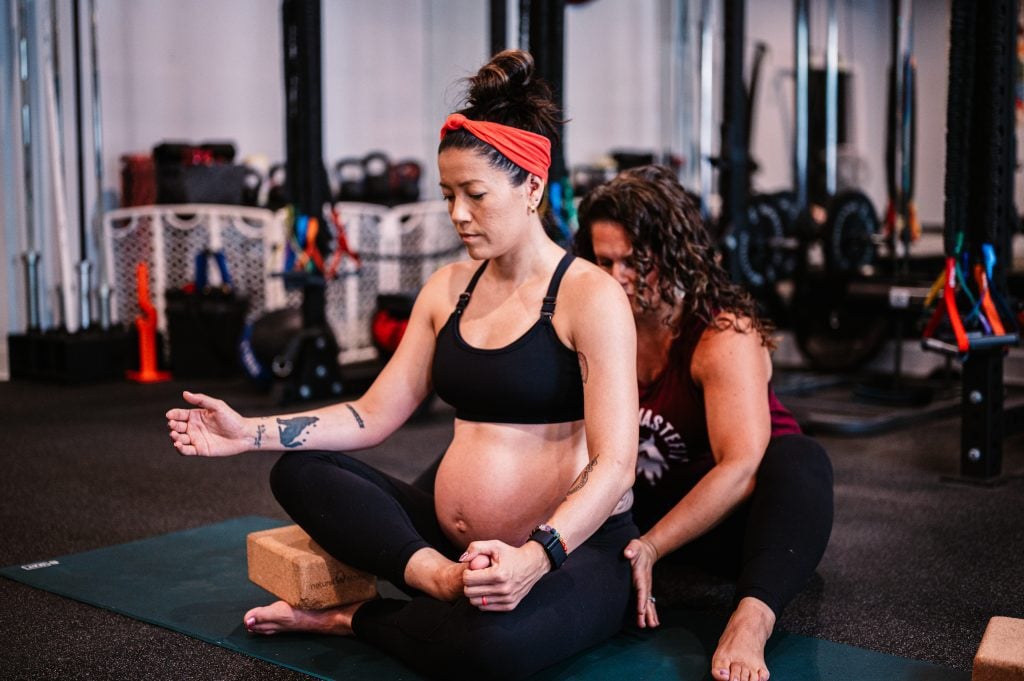
When we breathe TOO fast or hyperventilate (think panicking), it can increase the heart and respiration rate, triggering a fight or flight response. This activation of the sympathetic nervous system could make labor MORE painful!
As you labor, if you find that you are starting to breathe faster or begin to panic, having your partner or a birth team member cue you to SLOW down can be helpful!
I like to use a cleansing breath if my doula clients are beginning to panic with their contractions.
After the contraction is done, I ask them to take a deep inhale in, then exhale to LET IT GO. This cleansing breath can RESET the breathing pattern so we can resume slow, long breaths for relaxation.
Learn more labor comfort techniques and ways for your partner to support your labor in our childbirth education courses!

2. Box Breathing
The next breathing technique that we can do is box breathing. This technique utilizes a PAUSE in the breathing cycle that requires more mental focus (which could act as a distraction during labor).
In box breathing:
- Inhale for a count of 4-8
- PAUSE for 2-4 (or longer if you wish)
- This means holding your breath
- Exhale for a count of 4-8 (same number as the inhale)
- PAUSE for 2-4 (same pause as the previous pause)
- And repeat
This breathing technique is requiring much more mental focus, which can act as a distractor during labor. Instead of focusing on the intensity of your contractions, you are focusing on your breathing.
Learn more breathing techniques and mantras in our prenatal yoga on-demand classes!
Join us for on-demand prenatal yoga classes specific to each trimester!
- 20-30 minute long on-demand yoga classes
- Trimester Specific Classes
- Pelvic Opening Yoga Flows: Prepare for Birth!
- Lifetime Access of Program
3. Inhale, Exhale to Make Noise
Another breathing technique that you could utilize during your labor is to make noise with your exhales!
The noises should be DEEP and LOW in pitch, which can help you relax more!
Try to make a HIGH pitched noise, such as an EEKKK, and take note of how it feels in your body. You likely felt more tension and tightening.
Now, make a DEEP, LOW noise such as a moan or oohhhhhh noise. And then take note of how it feels in your body. You likely felt that you moved closer to the ground and relaxed.
So, take a deep breath in (count 4-8) and then exhale to make a deep, low noise for a count of 4-8!
4. Partner Led: Relaxation Sequence
And finally, we can use another distraction technique which is the partner-led relaxation sequence that includes a breathing prompt throughout or at the end.
In this sequence, you start from the head and work your way down cueing your partner to RELEASE a certain body part. It is important that there is a sequence and predictable order to this.
As you cue to release, you can include an inhale, and exhale to let go. Or you can wait until you make it to the feet to cue the cleansing breath.
Watch the reel for an example of how to do this!
Breathing for Relaxation During Labor
Focusing on our breathing is a great way to calm our nervous system so that we can relax and release during labor (and life in general). There are SO many techniques that we could utilize, but simply focusing on breathing SLOW can help to release tension.
If you need more support, using some of the partner-supported techniques can give your partner a more involved role in you rlabor too!
Prepare for Birth Courses
Feel strong and move comfortably throughout your entire pregnancy. Our program syncs to your current week of pregnancy, so you can start at any time!
- 5 Workouts Per Week
- Labor Prep Workouts
- Teambuildr App Access
Stay strong with our shorter prenatal workouts! Workouts are 15-20 minutes long, including a warm up, strength workout, and mobility cool down! This program includes pelvic stability and pelvic opening workouts too!
- 5 Workouts Per Week
- 20 Min Workout
- Labor Prep Workouts
- Teambuildr App Access
Learn the science of pregnancy and birth to take the mystery of labor away! Understand why you are feeling what you feel, and learn strategies to confidently move through pregnancy and birth!
- 9 hours of on-demand video
- Lifetime Access of E-Course
- Watch on Mobile Device