TRAINING FOR TWO

Move Confidently in Pregnancy!

NEW COURSE! ‎ ‎ ‎ ‎ ‎‎ ‎ ‎ ‎ ‎ ‎ ‎ ‎ ◆ ‎ ‎ ‎ ‎ ‎‎ ‎ ‎ ‎ ‎ ‎ ‎ ‎ Pelvic Biomechanics ‎ ‎ ‎ ‎ ‎‎ ‎ ‎ ‎ ‎ ‎ ‎ ‎ ◆ ‎ ‎ ‎ ‎ ‎‎ ‎ ‎ ‎ ‎ ‎ ‎ ‎ for Pregnancy and Birth. ‎ ‎ ‎ ‎ ‎‎ ‎ ‎ ‎ ‎ ‎ ‎ ‎ ◆ ‎ ‎ ‎ ‎ ‎‎ ‎ ‎ ‎ ‎ ‎ ‎ ‎ NEW COURSE! ‎ ‎ ‎ ‎ ‎‎ ‎ ‎ ‎ ‎ ‎ ‎ ‎ ◆ ‎ ‎ ‎ ‎ ‎‎ ‎ ‎ ‎ ‎ ‎ ‎ ‎ Pelvic Biomechanics ‎ ‎ ‎ ‎ ‎‎ ‎ ‎ ‎ ‎ ‎ ‎ ‎ ◆ ‎ ‎ ‎ ‎ ‎‎ ‎ ‎ ‎ ‎ ‎ ‎ ‎ for Pregnancy and Birth. ‎ ‎ ‎ ‎ ‎‎ ‎ ‎ ‎ ‎ ‎ ‎ ‎ ◆ ‎ ‎ ‎ ‎ ‎‎ ‎ ‎ ‎ ‎ ‎ ‎ ‎ NEW COURSE! ‎ ‎ ‎ ‎ ‎‎ ‎ ‎ ‎ ‎ ‎ ‎ ‎ ◆ ‎ ‎ ‎ ‎ ‎‎ ‎ ‎ ‎ ‎ ‎ ‎ ‎ Pelvic Biomechanics ‎ ‎ ‎ ‎ ‎‎ ‎ ‎ ‎ ‎ ‎ ‎ ‎ ◆ ‎ ‎ ‎ ‎ ‎‎ ‎ ‎ ‎ ‎ ‎ ‎ ‎ for Pregnancy and Birth. ‎ ‎ ‎ ‎ ‎‎ ‎ ‎ ‎ ‎ ‎ ‎ ‎ ‎◆ ‎ ‎ ‎ ‎ ‎‎ ‎ ‎ ‎ ‎ ‎ ‎ ‎
Written by

Gina Conley, MS

4 Exercises to Flip Your Breech Baby Head Down!

Breech is a variation of normal.  Breech is when the baby’s feet or butt are presenting first, with the head up towards the rib cage.

Some babies are meant to be breech, but breech positioning could limit your birth options depending on your provider.

In some countries and areas within the USA, breech vaginal delivery is an option available to you for your birth.  But in most areas in the USA, if your baby is breech, you will likely have a scheduled c-section.  

Let’s explore some ways we can encourage baby to flip head down if your desire is to have a vaginal birth and your provider is not able to support a breech vaginal delivery.

3 Exercises to Flip Baby Head Down

First, it is important to note that there is no exercise that will manually flip your baby head down.  We can encourage baby to flip head down or rotate or adjust to any position by releasing the tension that may be holding them in a specific position.

The only way to manually flip your baby would be with an ECV with your provider.  If your baby is breech at 28 weeks, it may be worth discussing your birth options with your provider.  

If baby is breech at 28 weeks, they are most likely to still be breech at term, and this gives you more time to make decisions for your birth than if you start asking questions at 36 weeks.

Questions to ask could include:

  • What are my options if baby is still breech at 36+ weeks?
  • Will you support a vaginal breech delivery?
  • What are my options if I have a cesarean birth?
  • What reasons may you or may not recommend an ECV to flip my baby head down?  Do I have any current contraindications that would make you NOT want to do an ECV?  

Now, let’s explore what may be causing baby to be in a breech position (or any position that you may find to be less optimal). 

Your baby’s positions are not random, they are based on the space that is available.  If baby is breech. it may be due to a number of reasons.  But we are going to explore the tension culprit in this blog post.

Two areas that may be causing tension that could be inhibiting baby’s ability to flip head down could include:

  1. Lower Uterine Ligament Tension
  2. Posterior Pelvic Floor Tension

If we can release tension in the lower uterus, then we could encourage baby to flip head down!  Let’s explore three ways to release tension in the lower uterus to support your baby’s position.

1) Inversions: Release the Uterine Ligaments

The forward leaning inversion helps to release the round and uterosacral ligaments.  These vertically running ligaments can influence the shape of the uterus, and thus decrease or increase space for your baby.

The forward leaning inversion will be the most intense of the inversion variations, and requires some shoulder strength.

For inversions, we will hold them for about 3 full breaths, or 20-30 seconds.  You may want to do multiple inversions throughout the day, upwards to 7-14.

If you find that the forward leaning inversion is too intense, you can try a dolphin pose or puppy pose!  These two variations at less shoulder intensive than the forward leaning inversion, and sometimes easier to get into and out of which makes them less intimidating.

Contraindications for inversions could include:

  • High blood pressure
  • Shoulder strength limitations
  • Heartburn where inversions worsen your symptoms to an intolerable level

2) Supported Standing Drills: Release the Posterior Pelvic Floor

Next up, we have the posterior pelvic floor that could be influencing the space available in the lower uterus. 

The posterior pelvic floor can sometimes become tighter throughout pregnancy due to common postural tendencies, such as more external rotation and anterior pelvic tilt tendencies.

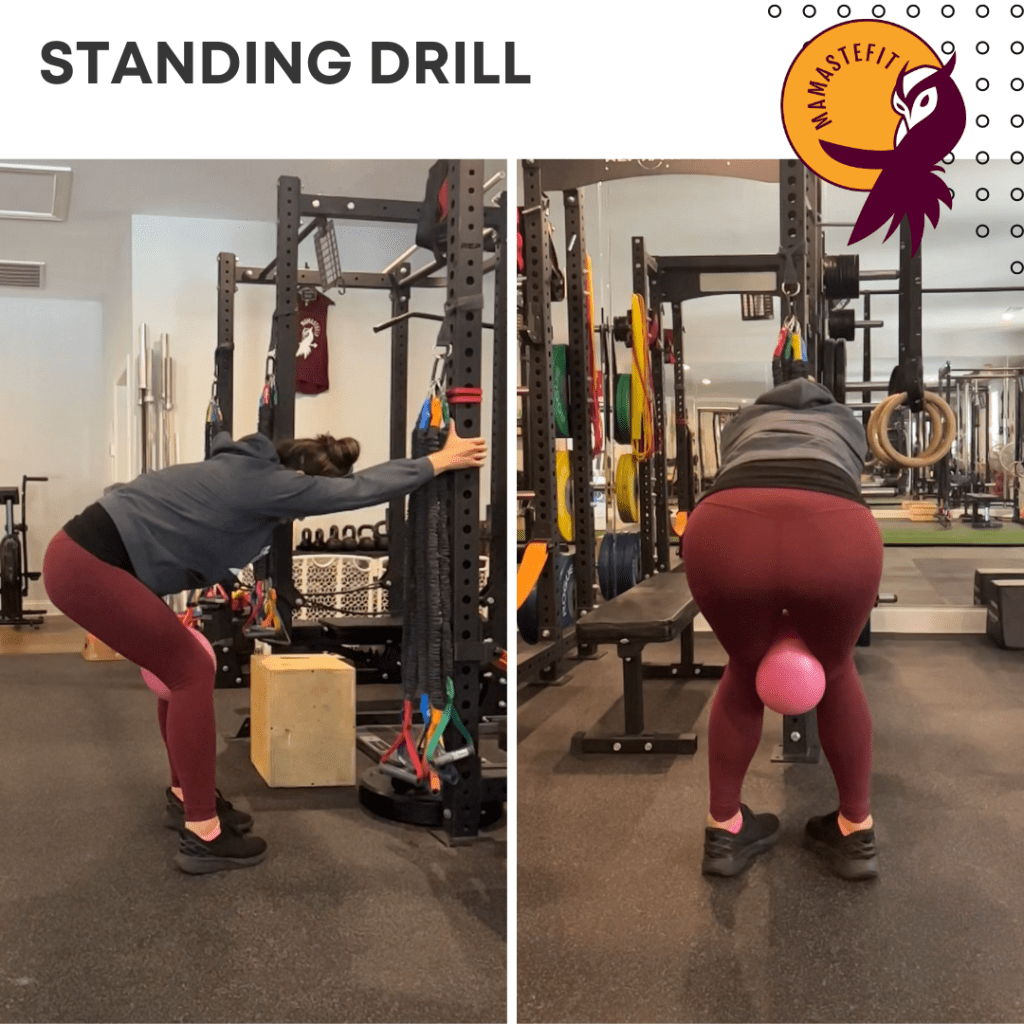
The standing breathing drill is one of my favorite ways to release the posterior pelvic floor.  

Tips for the standing breathing drills:

  1. Place a Pilates ball or yoga block between the thighs
  2. Point toes inward
  3. Grab onto a supported structure
  4. Hinge back into the hips (think belly to the floor and hips to wall behind you)
  5. Find a slight rounding in your low back
  6. Deep inhale into the pelvic floor to feel it stretch and lengthen
  7. Exhale to release and relax
  8. Repeat 10-20 times

Watch the video for a breakdown of the bilateral and hip shifted variations of this drill!

We incorporate breathing drills and mobility drill within our prenatal programming to help you stay mobile and comfortable throughout your pregnancy!

Our programming is more than “safe” pregnancy exercises!  We intentionally design a programs to support a preparation for birth. 

We incorporate movements designed to help open each pelvic level, release tension to support baby’s position, and build stamina so you can stay upright longer in your birth!

Tracey
Tracey
Their prenatal workout program rocks!! This is my 2nd pregnancy (1st pregnancy I worked out nonstop since the beginning). This one I was more cautious and finally when I got my energy back I joined their programming at 2nd trimester and never felt better. They provide MANY modifications and are readily available for questions or concerns. I recommend this to ANY mama to be! I’m excited to do their postpartum workout program when that time comes.
Claire
I completed both the prenatal and postpartum programs as well as the comprehensive childbirth class. Thanks to this programming, I was able to keep my SI joint pain to a minimum and remain active through the entire 9 months which was a huge win. The benefits of this programming and education were even more pronounced during my delivery and postpartum recovery.
Kristen
I started the pregnancy program when I was 16 weeks pregnant and continued it through my third trimester until I was 37 weeks pregnant. It helped me keep connection to my pelvic floor as my body changed to accommodate my growing baby. It kept me feeling strong and flexible throughout the entire pregnancy. I fully believe that the program is what helped me birth my son with 49 minutes of pushing as I had the strength and stamina to continue strong pushes despite my son being sunny side up.

3) Myofascial Release: Release the Posterior Pelvic Floor

We can also address the posterior pelvic floor tension with some myofascial release!  

Grab a ball (we like the Yoga Tune Up ball over a lacrosse ball because they are a bit softer) and place the ball in the hip pocket between the sitz bone and sacrum.

Sit on the ball and roll around to find any trigger points.

If you find a point of tension, pause and take a big inhale to release the tension!

Create space to flip baby head down!

Your baby’s position is not random: they go where there is space available for them.  We can encourage baby to flip head down by releasing tension in the lower uterus, such as inversions to release some uterine ligaments and posterior pelvic floor releases. 

Please note that none of these movements will manually flip your baby, so exploring options with our provider will be important in case baby does not flip!  And breech is a variation of normal, so for some babies, it is their best position or there is a reason beyond restriction that is causing their position.

Stay Comfortable and Strong Throughout Your Pregnancy and Postpartum