
One of the biggest aspects of planning for birth is to decide on your pain relief preferences: do you plan on having an epidural or do you want to have an unmedicated birth?
Please note that we refer to giving birth without an epidural as unmedicated. You may commonly hear unmedicated birth, or giving birth without pain medication, called natural birth. In our view, all birth is considered natural, regardless if you have pain medication or not!
If you are planning an unmedicated birth, we need to prepare to be able to cope with the pain of labor contractions! There are a number of ways we can do this, but let’s break down four tips that I found most helpful with my unmedicated, home birth.
4 Ways to Cope with Labor Contractions for an Epidural-Free Birth
Unmedicated birth is a mental game! We need to prepare mentally for our birth, and there are a number of different tricks we can incorporate into our labor to help us view our contractions as less painful.
I still feel that labor is painful and using words to pretend that is not painful such as “discomfort or pressure” are not helpful when preparing mentally for birth. But we all use different words to describe the same type of sensation, so you may very well describe it as pressure or discomfort, when someone else may refer to contraction pain as painful.
Some strategies I used in my unmedicated home birth include:
- The intensity of contractions is only at its peak: I told myself contractions were 10-15 seconds long.
- Comfort measures, such as counterpressure, to find some relief with the contractions.
- Hydrotherapy, shower or tub, can help with pain relief
- Progressive Relaxation to release tension in a predictable manner
Learn the science of pregnancy and birth to take the mystery of labor away! Understand why you are feeling what you feel, and learn strategies to confidently move through pregnancy and birth!
- 9 hours of on-demand video
- Lifetime Access of E-Course
- Watch on Mobile Device
Learn more comfort strategies in our childbirth education course! We break down comfort measures, and labor positions, and teach you the science of birth so you understand the WHY so you can better apply the HOW.
Our course is completely online and self-paced, so you can start it at any time and work your way through it at your own pace. Gain immediate access when you register plus maintain lifetime of the course access!
1) Contractions are most intense for 10-15 seconds!
Contractions generally last about 60 seconds in duration.
The difference between Braxton Hicks and contractions is that contractions will build, peak, and then release in intensity. There is a distinct difference in sensation throughout the entirety of the contraction.
I would describe contractions as a similar sensation to a Charley horse, or leg cramp, where you feel it starting to tighten. Then there is a peak in tightening that tends to be most painful. Then you feel the release as it slowly decreases in intensity.
Contractions do just that!
A mental trick that I did during my unmedicated birth was when a contraction would come, I would tell myself the hard part of this was only 10-15 seconds long. I can do anything for 10-15 seconds.
I would feel the contraction begin to build and signal my partner to apply a comfort measure.
I would then begin to really focus on releasing and letting go as I worked through the peak of the contraction, telling myself it was almost over.

Then the contraction would begin to release, and I would ease into the final 20 seconds of the contraction knowing it was over.
This trick worked really well for me with every contraction! It felt much more manageable to focus on releasing for only 10-15 seconds, as opposed to being focused the entire 60 seconds.
2) Comfort Measures: Decrease the Intensity of the Contraction Pain
Comfort measures can help you release tension and distract from the pain of contractions.
The biggest role your birth partner can play during your unmedicated birth is to be in charge of applying comfort measures!
Some comfort measures may feel better for you than others, and this can even change as labor progresses! I found some comfort techniques a lot more effective at different points in my birth.
Counterpressure was one of my favorite comfort measures! I preferred the hip squeeze over the sacral counterpressure. Some folks find that sacral counterpressure feels better especially if they have more back labor.
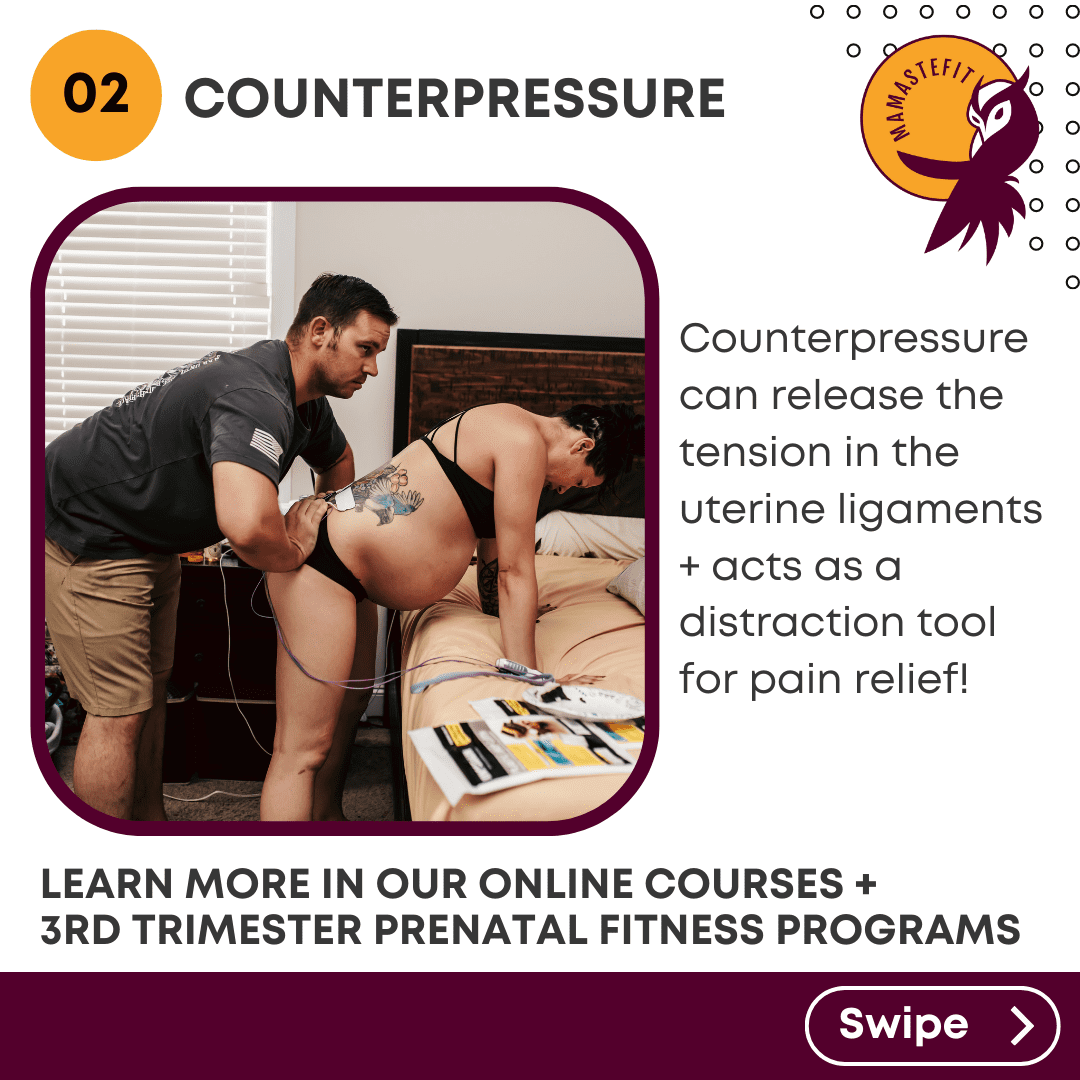
Exploring comfort measures together during your pregnancy can be a great way to practice and figure out what your preferences may be.
We incorporate labor preparation on-demand classes in the 3rd trimester of our 40-week prenatal strength program and the 3rd-trimester prenatal fitness on-demand program. These are classes that you and your partner take together to practice different laboring positions and comfort techniques! See the video below for a sample of the counter pressure workout!
3) Hydrotherapy: Use the shower or tub to release tension!
Hydrotherapy is the use of water to relieve labor pain! The shower is commonly referred to as the midwives’ epidural due to the pain relief it can provide!
Water can trigger our mammalian dive reflex, which prompts a slowing of our heart rate and respiration rate. This is a survival instinct that we can trigger to help us release tension during labor!
You may find that you prefer the shower or the tub more, so explore both!
Helpful Tip: Have your partner bring swimsuit or clothes they want to wear in the shower so they can hop in there with you to provide comfort!
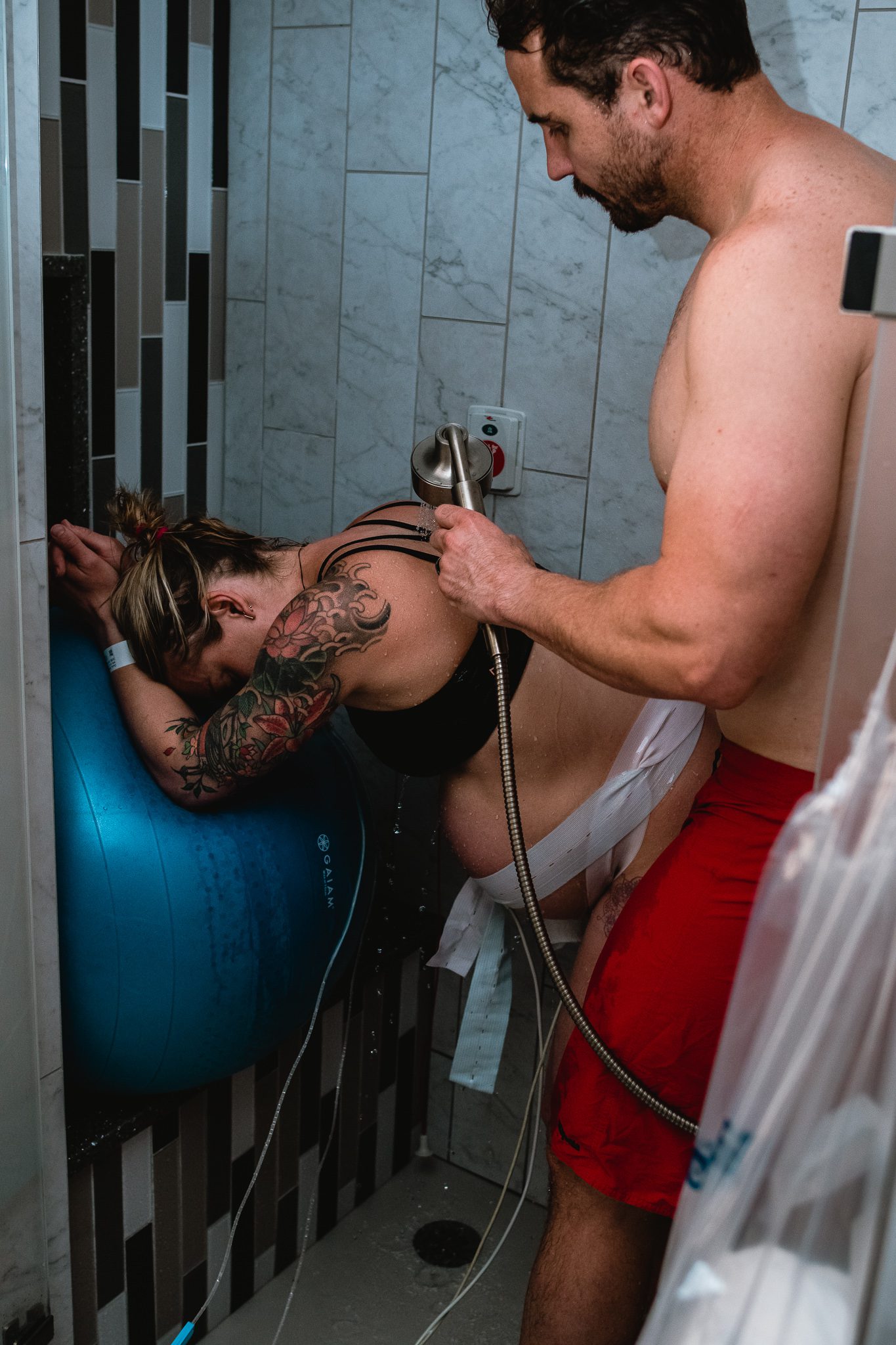
I found that running water helps with my pain relief, so either using the shower to run on my belly or back or having my partner pour a cup of water on me if I am using a tub made a huge difference!

4) Progressive Relaxation: Sequenced and predictable method to release tension
There are so many relaxation strategies that we can use to find relief during labor! One that I find most helpful with my birth clients and for myself is progressive relaxation.
Starting at the head, you list different body parts to focus on releasing. Example: release between the eyes, release the jaw… and work your way all the way to the feet.
Progressive relaxation is predictable, so you know what to focus on next, and can easily be cued verbally by your partner so you can also focus on their voice!


Prepare for Your Epidural-Free Birth
If your birth desire is to have an unmedicated or epidural-free birth, know that it is totally possible! You can totally do it if that is your goal!
Preparing for an epidural-free birth involves birth education preparation so you and your partner know comfort techniques to try during your labor (and you can practice them during pregnancy) and having a few mental strategies on hand to help you release tension and cope with labor!