



Welcome to the MamasteFit Podcast! In this episode, host Roxanne talks with Alex about her unmedicated hospital birth. Alex shares her preparation for birth, the support she received from her provider, and how she used distraction to manage early labor. She describes her quick progression once she arrived at the hospital, the transition through labor, and her birthing experience, which included pushing on all fours. Alex also discusses her postpartum journey, which remained positive for the first six months, and gives advice for expectant mothers preparing for an unmedicated birth. The episode touches upon various aspects of prenatal care, including the management of Group B Strep (GBS) and the importance of shared decision-making with healthcare providers.
Read Episode Transcript
Gina: Welcome to the MamasteFit Podcast. In this episode, we have Alex here to share her unmedicated hospital birth, where she had a really supportive provider, but also she used distraction as an excellent tool to be able to get through all of her early labor. And then once she got to the hospital, she hit transition and quickly progressed through labor.
Roxanne: Welcome to the MamasteFit Podcast, birth story Fridays. On this episode, we have Alex here to share her unmedicated hospital birth. Thank you so much for being here, Alex.
Alex: Thanks for having me.
Roxanne: So let’s just dive right in. How did you prepare for pregnancy and birth, either before pregnancy and then throughout pregnancy?
Alex: For sure. I took your guys’ birth education course, and then I did your guys’ prenatal kind of 15 minute workout plan. The 30 minute ones were too hard for me to get in, in a day, so I really loved 15 minute ones. And then I had a book that I read on natural, unmedicated hospital births, which I found really helpful too.
Roxanne: So you used our childbirth education and prenatal fitness throughout your pregnancy to prepare, but throughout pregnancy, was there anything that came up during? Any aches or pains, or anything like that you were feeling throughout pregnancy? Were your providers pretty supportive of your want for an unmedicated birth? So tell us a little more about that.
Alex: Yeah! We found out we were expecting fairly early on. And so I thought I was one of those lucky ones that skipped the whole, morning sickness piece- turned out, I just knew I was expecting sooner than I think most women know that they’re expecting. And so I started getting morning sickness about four to six weeks, and then it lasted until 32 weeks.
Roxanne: Oh, Lord!
Alex: So I was pretty sick throughout the whole pregnancy, but I didn’t have any back pain or anything like that, so I always told people that I feel like I got one and kind of skipped out on the others.
Roxanne: I don’t know if you like skipped out on it. Morning sickness can be worse for a lot of people than like pelvic pain.
Alex: It was good. I always remember that… I always tried to remind myself that it was a sign that we were still pregnant, so that helped, that mindset carried me through.
But as far as preparing for the unmedicated hospital birth, I found early communication with both like my husband and then my provider was really helpful. I think it just really spoke to the fact that it was a long-term goal of mine and not just that, “Oh, maybe I wanna try, maybe I don’t wanna try.” But from the very start, that was something that I communicated, so I think that really helped.
Roxanne: So did you shop around for providers, or like the first one you saw was really supportive, or like how did you find your provider?
Alex: Yeah, so we live in my husband’s hometown, so I had to reach out to a few girlfriends that lived here and had delivered here already and got their synopsis of the different providers in town. And there were a couple that I just didn’t think that I’d mesh as well with, but there was one who, her description was more laid back, she was rather more supportive, and so I went with her and I loved her from the start.
Roxanne: So let’s get into your end of pregnancy and into your birth story. So you were nauseous all throughout your pregnancy from four to six weeks till 32 weeks, and then you started feeling better again. So then after you started feeling better again, let’s get into the birth story.
Alex: So I was pretty determined to go to 41, even like 42 weeks, just ’cause from the, yeah, like research I had done, usually your first time pregnancies did tend to go a bit longer, so that was what I was determined to do. I also am a bit of a perfectionist, so taking time off for maternity leave and leaving my work for others to tend to was a bit nerve wracking for me, and so I wanted to make sure I had all my ducks in a row at work before baby came.
But then we had our 37 week appointment scheduled for on a Friday, and that morning I woke up to a gush sensation and I was like, “Oh no. Oh no!” And so then I ran to the bathroom and my mucus plug had come out. So I ran back into the room to make sure that our like mattress wasn’t like soaking wet and the mattress was still good. I told my husband what was happening, but I told him not to panic ’cause we were only 37 weeks, so we had a long time to go. So then we just, we both got up and we went to work and then, the day kinda escalated from there.
Roxanne: Okay. Don’t keep us on our toes. Tell me how the rest of the day went!
Alex: I then, I felt like I used distraction- was my best coping mechanism. I just was very under the impression that labor could last for up to 24 hours so we still had a long time to wait. And then we went to our 37 week appointment at two o’clock that day and my doctor was ready to admit me but I was like, “No, like we have a wedding that we’re going to tomorrow, and I still have work things to do,” and she’s like, “Girlfriend, you’re having a baby tonight!” I am like, “No!” So then she asked if she could do a cervical check in clinic because I was a bit more apprehensive of going to the hospital right away. And I was like, “Okay.” So I consented for her to do a cervical exam, but I didn’t want to know what the results were, ’cause just from the research that I had done and resonated with, they can be like useful information, but it like, it’s just a moment in time. And so I was like, “But you could tell my husband if you wanted.” So she told my husband how far along I was, but I like opted not to know.
So then our game plan was I’d go home. We had to somehow find a car seat ’cause we didn’t have that ready, we didn’t have our bags packed.
Roxanne: Yeah, 37 weeks! Not prepared.
Alex: Not well prepared, but yeah. Had a while to go.
So we got home and my husband and I, for the very first time, weren’t on the same page, ’cause he knew how far along I was. I had to, I was like group B strep positive and so we were opting to get the antibiotic when we got to the hospital. So he was like running around trying to get everything packed, I’m like, “Hey, just hang out. Like just let’s take a deep breath, like we’re fine.” So once we got on the same page with that, I felt he was a little bit better.
And then on our way to the hospital, I asked if we could stop at the eye doctor to get my contacts, and he respectfully said, “No, we’re just gonna go to the hospital.” So then I had to just wear my glasses all day.
And then we got to the hospital, and at that point, I felt like, I dunno, I feel like I went from like after early labor, straight into transition, and I think a large part of that was just, I had been distracted all day long. So whether or not like I was having…
Roxanne: Denial
Alex: Yeah. Whether or not I was like having contractions throughout the day, they seemed manageable just ’cause I was focusing on other things. But as soon as we got to the hospital, I quickly then hit transition.
We couldn’t find the baby’s heartbeat right away, but I think it’s just ’cause she was so low into the birth canal at that point. And so then the nurse there wanted to do a cervical check just ’cause she, was a little nervous about baby’s heart rate. But I was a little bit more reluctant just because my doctor had just done one, and, I again, at least again, from my understanding, they are a little bit subjective. So I was like, I didn’t want her to have told like Zach a different measurement and then like I either be the same or further along. So I denied that cervical check.
And then they let me just labor in the bathroom. I had my husband and then my doula with me. And there only stipulation was that when I started to have the urge to push that I needed to come back to the bed. So I was like, “Okay.” And through the birth education course I did with you all. I felt pretty confident knowing like the different phases of labor, but then when I was like laboring on the toilet, I’m like, “I don’t actually, I’ve never pushed out a baby before.” I don’t know if it’d be two pushes, if it’ll be like an hour pushing. But then I had the urge to start pushing, so I started pushing on the toilet because I was like, I’m just like in my groove and like I don’t wanna really like interrupt this. And my doula recognized that I was pushing- I don’t think my husband really knew what was going on.
Roxanne: Yeah.
Alex: But, so I pushed on the toilet for, I don’t know, maybe, I don’t know, time was wonky, but maybe 5, 10 minutes, and then I realized that I didn’t wanna give birth on the toilet, so then I agreed to come back to the bed.
And then at that point my provider got there, and she showed up in just like her regular, like regular day clothes, which was such a sense of calm for me, ’cause like she didn’t walk in and this get up of like scrubs and like her hazmat suit kind of thing.
Roxanne: Yeah.
Alex: So the fact that she just showed up in her jeans and sweater, I’m like, “Okay, like this can get that messy I guess.” She eventually did put on like her scrubs and whatnot, but it helped me, I think, stay calm.
And then we had talked about the options of delivering on all fours and side lying because that, just in my birth prep, I felt that’s what I would be most comfortable in. So I transitioned between those two- I would push on all fours and then when I needed to rest, I would then transition to side lying. But then I ended up delivering on all fours. And the best part though was, ’cause I had my glasses on, at some point in time, they took my glasses off ’cause they were getting all wonky, but then I couldn’t see my baby when she was born.
Roxanne: Oh, no!
Alex: So then they had to like, they had to scramble around to try to find my glasses so I could then catch her and turn around.
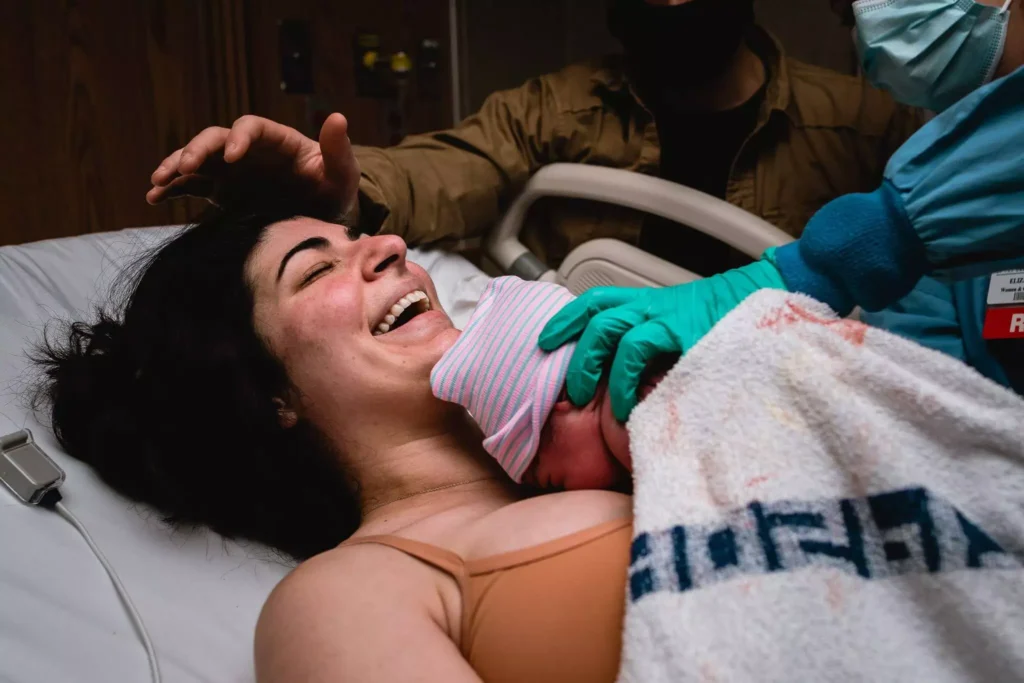
But when I was telling, when I was preparing for this, I was telling my husband how I loved our birth story, like after the fact, just because, I feel like I had the birth that we wanted. We were able to have the unmedicated birth, we were supported at the hospital, like my provider was great all along- it just came a little earlier than I was expecting, but I, that was okay. And so now we have our sweet little girl that we love.
Roxanne: That’s awesome. So you said you’re GBS positive and you guys did opt for the antibiotics.
Were you able to get the antibiotics four hours before delivery or did you not make it?
Alex: We got just one, one round of- because we got there at 4:00 and then she was born at 6:30.
Roxanne: Okay.
Alex: So I think the first like round administered. So then we stayed the two nights.
Roxanne: Yeah.
Alex: Because we didn’t get both rounds.
Roxanne: The full, yeah.
Alex: Yeah.
Roxanne: And then how long was your pushing, like, period? Total?
Alex: I, my guess is like 45 minutes, but…
Roxanne: Okay.
Alex: I don’t think anyone like had great timestamps on it. And that was one thing, like my husband and I, I don’t know that we talked about, but I think like long labors can seem really daunting, but at least for me, like I felt like my body was able to just naturally dilate and stretch, and so then that helped with the birthing process, versus being like so rapid fire. So I wasn’t against pushing for that long.
Roxanne: No. Yeah, 45 minutes is about average I find for a lot of like first time birthers. Like that’s how long I pushed for my first, 45 minutes. And I think I agree with you, it is, I think, it’s a good amount of time to allow the body to stretch. I don’t think anyone would say no to a ten second push phase ’cause it is a lot. But, yeah, I do think that it can, it is beneficial to like slowly push the baby out to allow your body to stretch around it. So that’s, that’s awesome.
So you had a pretty smooth, for lack of a better word, delivery. Like it was exactly what you were wanting. How was your postpartum experience?
Alex: I felt like I was on an endorphin high for the longest time. I think I am now just slowly coming out of that endorphin high, six months later. Which I will say is something I wouldn’t have expected, because like my maternity leave and early postpartum was so magical that I feel almost like now I’m starting to feel some of those, like postpartum depression, anxiety things just because the newness and everything is gone.
Roxanne: Yeah.
Alex: But I, she was like immediately born, I was like, I think “I could do that again.” And my husband’s like, “Let’s just wait a little bit.”
Roxanne: That’s literally Gina.
Alex: Yeah. And so I, I will say during the pushing part though, from your guys’ birth course that like, I definitely could talk myself through it and I felt the ring of fire, but it just felt like that stretching sensation, and like my provider offered for me to reach down and feel her crowning. But in hindsight, I wish I would have. Like in the moment I’m like, no, like I’m in my groove, like I don’t wanna like move.
Roxanne: Yeah.
Alex: But the part I was super surprised by was when they, when she like delivered the shoulders and like the rest of the body, how sensational that was.
I guess from all like the birth videos I watched prior, that part seemed so fast and, yeah, like babies just fly out. So I didn’t really think that would’ve been… but I can just remember like her whole body coming out, whoa, that was….
Roxanne: Some people will report, they feel like they’re feeling their legs like wiggle out of their body, ’cause they’re like kicking.
Alex: Yeah.
Roxanne: And I was like, yeah! But yeah, you’re right. Like most people don’t. They’re like the head came out and then the body just wiggled out. They don’t really talk about like how that feels as like the rest of the body comes out. So that’s a really great like report. I love that.
So you are six months postpartum. Your birth was the birth of your dreams, minus not being prepared at 37 weeks. You’re one of the 25% of people that have their baby before 39 weeks! You were GBS positive, so you did have to get some antibiotics, but then you still had to stay at the hospital for two days ’cause you weren’t what we would consider adequately treated, so you didn’t get the, it wasn’t four hours from that first dose. But like your postpartum experience for the first six months was great because you were just living life up here in the clouds, just living on that dream. That birth high, like seriously is one of the best experiences. It’s so sad when it like runs away.
But thank you so much, Alex, for coming on the podcast and sharing your story with us, and I’m so glad that we were able to support you throughout your pregnancy and birth. And maybe we will support you in future ones.
Before we go, if there is like one piece of advice that you would give somebody who may be preparing for an unmedicated hospital birth, or like preparing for their first one and maybe is unexpectedly in labor at 37 weeks as well- what is one piece of advice that you would give to them?
Alex: I would say, I think just having the confidence that you can do it, which I know it can be maybe like a wishy-washy answer. But you can do it. And I think just having that confidence and whether you have the support or not, knowing that, I think all moms are super women, and so just knowing that you have that superpower to do it.
Roxanne: Yeah, no, that’s a great one. No one has said that, but it really does… the confidence throughout labor is so important. ‘Cause as you can report the mental aspect of labor in like coping with labor is so important. Like you’re able to be in denial that you’re in labor and be distracted from it until two hours before having a baby. So like the confidence and the mental preparation is so important.
But thank you again, Alex, for coming on the podcast and sharing your amazing story with us, and thank you for letting us support you.
Alex: Thanks for having me! Thank you.
Roxanne: Thank you for listening to Alex’s full birth story on her unmedicated hospital birth, where she experienced morning sickness throughout a large portion of her pregnancy, but was able to find a really supportive provider to support her pregnancy that also respected her wishes of not wanting a lot of cervical exams, wanting to have an unmedicated birth. Where she was able to move around during pushing, and was very supportive and honored all of her wishes without being pushy or anything like that. And because of that, she was able to have a really positive birth experience because she was supported by everyone around her.
One thing that she did mention was the fact that she was able to be distracted throughout her entire labor by using like almost denial as a coping mechanism, which can be a very powerful coping mechanism. There are some studies that support using central nervous system kind of distraction techniques, denial meditation, kind of things that like affect our brain, our central nervous system, is a really powerful way to cope with labor, to stay in that coping side of labor instead of going over to the struggle side. So using these different techniques throughout pregnancy. And she even shared that with her meditations during her labor, she was able to recall certain portions of her labor of letting your baby like move down within your pelvis and stay relaxed throughout the entire portion. And she really attributes the fact that she did all of those preparation techniques for having the type of birth that she had, to have the confidence in her body and be able to release and let go and surrender to the process.
She was GBS positive and she chose to get the antibiotics by having a conversation with her provider and they chose that this was the right thing for them. With GBS positive that if you are not what we would consider adequately treated or treated at all, they do like to monitor the babies for about 48 hours in the hospital, or if you are delivering outside of the hospital, they will just give you things to look for in baby for that first 24 to 48 hours for something called GBS infection of the baby. Babies’ immune systems are not as mature as us, so if they’re going to develop an infection, it’s going to be more of a systemic response, rather than a localized response like we would. So if we get a stomach bug, our immune system will respond to the stomach and like we’ll just feel mostly GI symptoms. Whereas a baby, if they get some sort of infection, it’s not gonna be localized to that spot, it’s gonna be a full body response. So with GBS, if we have it, we don’t really usually have any sort of response to it, but for a baby, any sort of infection can cause a full body response where they have really high fevers and could have some long-term complications. So this is why if someone is GBS positive and does not get the antibiotics, this is what we would monitor for, any signs or symptoms of that GBS infection of those babies so we can respond to it and get that baby the treatment as soon as we possibly can.
She was not able to get the antibiotics. So we normally recommend having at least one dose of antibiotics and it has to be greater than four hours from the birth, so that gives the antibiotics four hours to start decreasing the amount of GBS, to decrease the transfer to the babies. If baby is born before that four hours, this is what we would call inadequately treated, and so this is when they would monitor those babies. And since Alex was not adequately treated, we would consider that as why she had to stay for around 48 hours just to be closely monitored throughout her postpartum stay for baby.
So this is a really great conversation to have with your provider during pregnancy if you are GBS positive. Like what are your options for treatment? So what if you are allergic to penicillin? If you’re not allergic to penicillin, what are the treatment options? How, does that work? How often is it given? As well as what happens if you don’t want the antibiotics or you are inadequately treated? So just like Alex, where she chose to get the antibiotics but they did not get enough of the antibiotics to be considered adequately treated- what does your plan of care look like in those instances? And then maybe what are the symptoms that we’re gonna be looking for in that baby to alert us that maybe something is going on?
Whenever we’re having any of these big discussions with our provider- Alex, thankfully had a really supportive provider- but these are really great shared decision making conversations to have with our provider to learn what are the risks, what are the benefits? What does our gut tell us about these things? What are alternatives to these things? So we can use the acronym of BRAIN to help create the conversation. B and R stands for benefits and risks. A stands for alternatives, ’cause most of the time there is some sort of alternative to that. Intervention, I is what is our intuition telling us? What is our gut telling us about this thing? And then what happens if we, N, do nothing? So all of those things are tools that we can use to have this conversation with our provider and then be able to make a decision based off of that for ourself. And knowing that a decision that I make for myself may be different than yourself based off of the same information, same benefits, risks, interventions, alternatives, all of these things, we may choose something differently because we are two individual peoples. But by having a conversation and having a provider that supports shared decision making can be really beneficial for our birth.
So again, thank you for listening to Alex’s birth story on how she had an unmedicated really empowering birth in a hospital and how she was able to do that with a supportive provider, a doula, and a really supportive husband.
And if you are pregnant and looking for more support, just like Alex used our childbirth education and prenatal fitness, you can grab it yourself at mamastefit.com. Our childbirth education goes over the science of labor and birth to break down some of that mystery so that you can feel empowered and confident going into labor. And that our prenatal fitness can help you be strong throughout your pregnancy to prepare for having a pain-free pregnancy, but also prepare for birth. And you can bundle those two together to save an additional 15% off. And then as a thank you for listening to this entire episode, you can use code STORY10 to get 10% off as our thank you.
If you enjoyed this episode, please like and subscribe to our podcast so you can be notified whenever we release new episodes. Write a review, share with your families and friends! We release new educational episodes on Wednesdays and new birth stories every other Friday. Thank you again.
Additional Resources
Prenatal Support Courses

Learn the science of pregnancy and birth to take the mystery of labor away! Understand why you are feeling what you feel, and learn strategies to confidently move through pregnancy and birth!
- 9h+ of Video
- Support Group
- Close Captioning

- 5 Workouts/Week
- Gym Workouts
- Self-Paced

Instructor
GINA
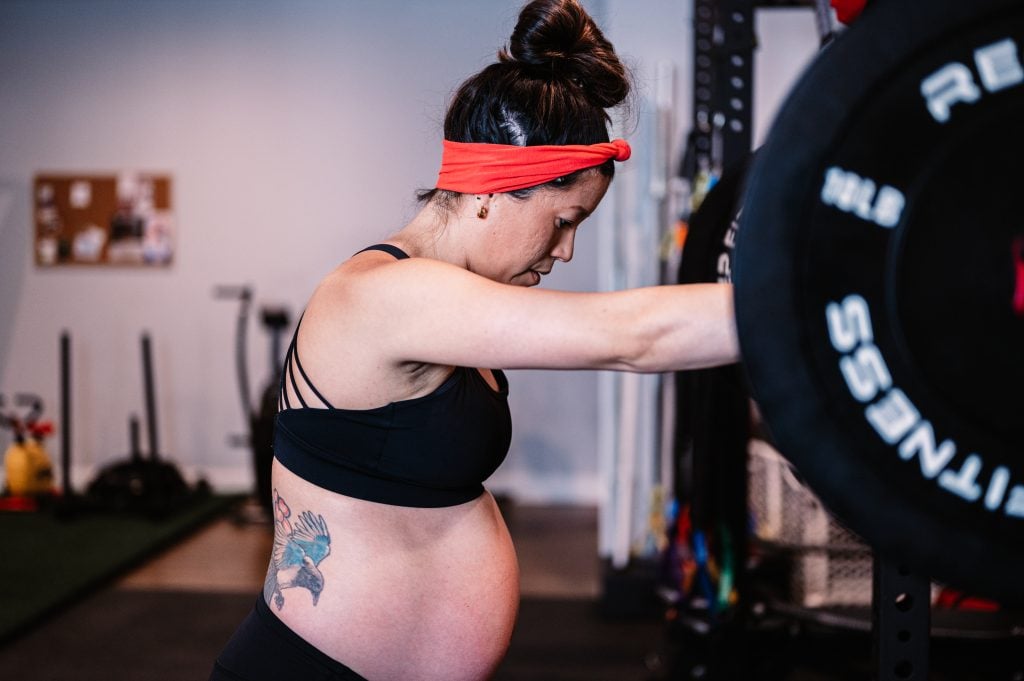
Workout on-demand with our prenatal fitness workout videos! Each workout is 30-40 minutes to follow along as you exercise at the same time!
- Birth Prep
- All Trimesters
- Mobility Work

Instructor
GINA
Find comfort and relief from pelvic girdle pain throughout your pregnancy and postpartum period! This program incorporates myofascial sling focused exercises to stabilize across the pelvic girdle joints.
- 3 Weeks
- On Demand Workout Videos to Follow