



Welcome to the MamasteFit Podcast Birth Story Fridays. In this episode, Alyssa shares her unmedicated hospital induction and the unexpected complications she faced during her postpartum journey. Gina and Roxanne discuss Alyssa’s detailed preparation for birth, the intense labor process, and Alyssa’s significant postpartum challenges, including hemorrhaging and developing a vaginal hematoma. The episode also touches on emotional struggles and the importance of reaching out for support and resources during postpartum recovery.
Read Episode Transcript
[00:00:00] Gina: Welcome to the MamasteFit Podcast, Birth Story Friday. In this episode, we have Alyssa, who’s going to be sharing her hospital induction birth story where she went unmedicated, but she really shares a lot about her postpartum experience as well, where she dealt with some complications that she was not expecting.
[00:00:16] Gina: Welcome to the MamasteFit Podcast. This is Gina, perinatal fitness trainer and birth doula.
[00:00:21] Roxanne: And I’m Roxanne, labor and delivery nurse and student midwife.
[00:00:24] Gina: And this is the MamasteFit podcast, where we empower you on your perinatal fitness, birth, and postpartum return to fitness journey.
[00:00:31] Roxanne: Our podcast shares how to move throughout your pregnancy to stay strong and comfortable because pain is not a requirement of pregnancy, understand the science of birth, and how to approach recovery after birth.
[00:00:42] Gina: We share our personal experience as mothers navigating this stage in our lives, plus our professional expertise as birth workers and fitness professionals.
[00:00:50] Roxanne: Our goal is to help you feel confident as you navigate the perinatal time frame for an empowering pregnancy, positive birth, and postpartum journey.
[00:00:57] Gina: We are glad to have you with us on this journey and that you have chosen us to support you.
[00:01:01] Gina: Welcome to the MamasteFit Podcast, Birth Story Friday. In this birth story we have Alyssa here who’s going to be sharing her hospital induction birth story where she actually went unmedicated. I know that’s a story that a lot of folks are really looking to hear about because induction can be really scary. So thank you so much Alyssa for being here.
[00:01:23] Alyssa: Thank you for having me. I’m very excited!
[00:01:25] Gina: So let’s start with how you prepared for birth. So what were you doing throughout your pregnancy to prepare for your birth?
[00:01:33] Alyssa: From the moment that I found out I was pregnant, even before I was pregnant, I was like, okay, I’m going to prepare for this like anything else that I’ve prepared for in my life, I’m just going to dive straight in. And so I tried to utilize as many resources as I could. I feel like I mainly prepared for birth by podcasts and audiobooks. I have a commute to work, and so I probably listen to almost every book on birth out there. My husband jokes that I have a PhD in Labor and Delivery when I do not.
[00:02:13] Gina: I have a PhD in Google, so I think yours is better.
[00:02:17] Alyssa: Right? And so I just, I just dove straight into books and podcasts. And I started finding out about you guys being local to the area, found out about MamasteFit and the birth prep courses and just the inspiration to move.
[00:02:36] Alyssa: I’ve always been into exercise, but I didn’t know what that looked like in pregnancy. So it was really awesome to find a resource that showed me you can continue to lift heavy. You do have to make some types of modifications, but you can continue to work out and actually continue to build muscle and be strong throughout your pregnancy. So I’d definitely say, you guys helped me prepare a lot, just via your birth stories, your podcasts, I’m pretty sure I’ve listened to almost every single one, which is maybe a little creepy. But I learned, so much from you guys. and just following the prenatal programming was amazing. I took your guys’s birth prep class. I hired a doula. I did a lot to prep for birth.
[00:03:25] Gina: So let’s talk about the end of your pregnancy then. So what was the end of your pregnancy like, and we can just go straight into your birth story.
[00:03:32] Alyssa: Okay. Sounds good!
[00:03:34] Alyssa: So the end of my pregnancy, around 38 and a half weeks, things started to feel a little different. I noticed more Braxton Hicks type symptoms, but nothing really happened. So many of my friends had gone into labor early. I was, per the first time mom code, delusional that I would also go into labor early, like I quit work early, all of these things! And, so yeah, the end went great. The end was fine. I really wasn’t uncomfortable. I wasn’t uncomfortable throughout my entire pregnancy, which was great. I was doing well. But yeah, I thought that I was gonna go early like everyone else. I did not.
So at the end of my pregnancy, I started doing everything in the book, everything in the book, besides castor oil- anything you can name, I did it. Chiropractor, massage, dates, tea, everything.
[00:04:37] Alyssa: At my 40 week appointment, which was when I was at 40 and 2, I had a little bit of a high blood pressure reading. It was nothing crazy, it was like 135 over something, wasn’t anything crazy, but they wanted me to come into Labor and Delivery the next day, which was a Saturday, to check it out and do a non stress test on baby. At that point in time, I accepted a cervical exam just to see what I was walking into, and I was one centimeter dilated and 50 percent effaced. So Saturday, I went into Labor and Delivery, had another elevated blood pressure reading, nothing crazy. No protein in my urine or anything, but whenever they did the non stress test, they noticed some random decelerations in Baby’s heart rate. Who knows if the random decels were normal, or everything was still progressing normally, but, we didn’t know if it was a sense of urgency or not, but we just decided to stay for an induction just because that’s we didn’t know what was going on with her. We decided to stay for an induction, so I went into Labor and Delivery on Saturday and did not leave.
[00:05:48] Alyssa: So yeah, I guess into the induction and the birth story. We decided we weren’t going to leave. This was kind of Saturday afternoon. I spoke with the midwife that was on staff, it was actually who I saw during my 40 week appointment. And me being in the military, that was one of the harder things is because I can’t really like interview providers or anything like that. Who you get is who you get, and that’s another reason why I was so adamant in hiring a doula because I really wanted somebody, like a constant, there for me.
[00:06:24] Alyssa: So the midwife that was there at the time did a really good membrane sweep on me at around 4:30 on Saturday, and we decided to start with Cervidil. So that’s a 12 hour thing, of course. So we started that Saturday night. Once that was placed, my husband went home, got our bags, got the dog to boarding, all those things. At that point in time, I was 2 centimeters, 70 percent, and negative 2 station. I started having some irregular, stronger contractions where I was uncomfortable. It wasn’t anything crazy, but it was affecting me trying to go to bed. So I got some IV Benadryl, which was really great. I think I was asleep before the nurse left the room so that was great!
[00:07:12] Alyssa: The next morning, so Sunday morning, Cervidil came out. I was still two centimeters and negative two, but I was 80 percent effaced, so, a little bit more. I was trying to do everything in my power to avoid Pitocin. I really wanted just like natural labor contractions to happen. I really didn’t want Pitocin. I was a little nervous about the Pitocin contractions. So I really wanted to do everything. So we decided to go forward with a Foley balloon, and that was put in at 9:30 on Sunday. The contractions definitely intensified, they were pretty strong. Every 45 minutes I was on the ball. I would turn on like birth affirmations on my headphones when a contraction would hit and just breathe through it and then turn off the affirmations and go back to watching TV, that type of thing. And they were definitely, they were very intense for awhile. And then as I dilated and there was less pressure from the Foley balloon, or bulb, what have you, they definitely died off. They started dying off, and I was like, “Oh no, here we go, they’re dying off again.”
[00:08:20] Alyssa: That afternoon, they asked if I wanted to use a breast pump, I said, “Yes, I’ll try it.” Tried that. Might have helped? Nothing consistent. They definitely started waning. So my doula showed up that afternoon and asked if we could maybe do some positional changes before starting Pitocin. It was great, but those monitors were like the bane of my existence. I hate those monitors. Even though they were wireless, I was like, going into birth, I was like, “Oh, perfect. They have wireless, waterproof monitors. I’m set!” Wrong. Like they kept having to reposition them. Like I would get into a certain position. They’d be like, “Oh, a baby doesn’t like that. Baby doesn’t like that. You need to move.” And it was, just a whole thing. So it was very, annoying, very irritating just cause I also just wanted to go into labor on my own and it wasn’t happening. So nothing really happened. Foley did fall out around 3:30. We tried to do some more positional changes, but it just wasn’t working.
[00:09:22] Alyssa: So we started Pitocin around 5 PM and active labor really started getting going around 7:30 on Sunday night. The TENS unit was my best friend in the whole wide world. The surge button on it was great to help get me through it. I also gaslit myself, as you guys have talked about, into telling myself the contractions, I told myself like, “It’s only 15 or 20 seconds of pain, like I can do this.”
[00:09:49] Gina: It’s a good technique.
[00:09:50] Alyssa: It worked! I completely gaslit myself. I was like, “I only need the surge button for 10 seconds.” Completely gaslit myself. Oops! But it worked.
[00:10:04] Alyssa: Around like 9pm, I looked at my doula and my husband and I said, “I want an epidural.” And me and my doula talked about this beforehand, and she told me, “At some point you will probably ask for one, so what do you want me to do? Do you want me to go get the anesthesiologist or do you want me to help you move into a different position?” And I told her, pre labor, “Get me into a different position. I want to keep going.” So we tried the shower. The only problem with this is that the monitors wouldn’t stay on in the shower. So a very annoyed nurse was like halfway in the shower with me trying to keep the monitors on. She’s not pleased. I wouldn’t be either if I were in her situation. So, my husband put on his swim trunks and tried to get in the shower with me to hold the monitors on. It just wasn’t working. I was getting so fed up. So I, just got out. I said I was just so annoyed. Everyone was annoyed in that situation. I really wanted to utilize the shower, but alas. I just, I gave up.
[00:11:13] Alyssa: I got on the toilet for a while, and there was some leaking, like super intense contractions. This was around, like 10:00, super intense contractions. And I guess I was making the sounds like I was bearing down. So the midwife ran in, and she checked me. I was around seven centimeters, a hundred percent, zero station. So I was feeling pretty good at that point. Everything was really intense, but I just kept telling myself, “You can’t back out now. The show is already on the road. You cannot back out now.” And it was very interesting through every contraction, every time a contraction would hit, I would be listening to my birth affirmations, trying to repeat them and pressing the surge button, but in the back of my head, the little piece of doubt was like, “What are you doing? You are an idiot. This is so silly of you.” And then after every contraction ended, it was this burst of, “I’m amazing! This is so cool. I’m doing this. I’m going to do this!” It was, I mean, my emotions were a gigantic wave the entire time.
[00:12:24] Gina: It’s like having multiple personalities.
[00:12:27] Alyssa: Absolutely! I felt it really was! Like, in a contraction, I was like, “What am I doing? This is hard! This is really hard work.” And my husband was trying to bring up, hard things that I’ve done in my life, “Oh, honey, you did this!” I just told him to shut up. I don’t want to hear it.
[00:12:48] Roxanne: Stop talking to me.
[00:12:49] Alyssa: Stop talking. My doula tried to put some essential oils on my face. I think I told her, I was like, “No!” So many things. I was definitely in the labor land. That’s for sure. I had no concept of time.
[00:13:04] Alyssa: But yeah, so around 10:30- at 10:15 I was around 7 centimeters, and around 10:30 there was some leaking or something. I don’t know if it was amniotic fluid, mucus plug, I have no idea, but it was very intense, I was still on the toilet. Midwife checked me and I was complete. So I went from seven to complete in approximately, apparently 15 to 20 minutes. It seemed like a lot longer to me, but this is according to my husband’s notes.
[00:13:32] Gina: Time is magic during labor.
[00:13:33] Alyssa: Yeah. So it took me a while to get there, but we got there!
[00:13:39] Alyssa: Once we figured out that I was complete, we were like, okay, time to push, and I pushed. And I pushed for three hours in many different positions, which was one of my main goals in going unmedicated was I really, I wanted to be able to move. I wanted to be able to move around and to feel free, and I did that, which was really great. But I did, I squatted at the end of the bed, and all fours, I did, tug of war with the Rebozo band on the squat bar. Every position, I probably did it. I just moved around a lot. Hip squeezes the entire time, my husband is a champ. So yeah, I pushed in almost every single position, for three hours, and she was born, at 2 AM on Monday.
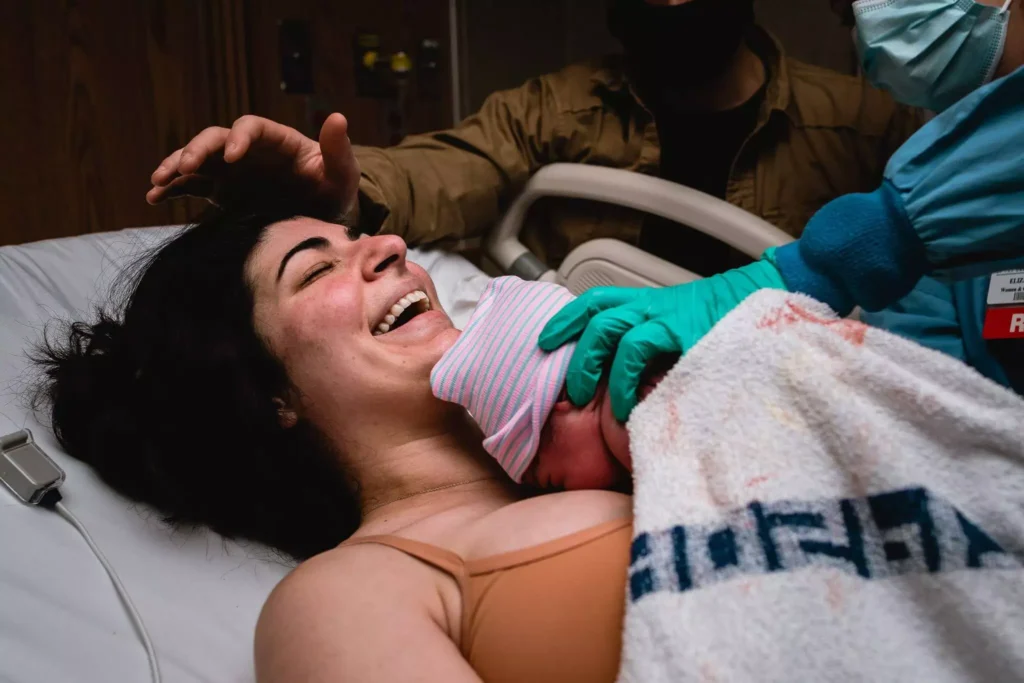
[00:14:32] Alyssa: So it was a long process, but we got there. She was there. It was amazing. We had immediate skin to skin, the whole thing. It was really amazing. Like pushing her out was very gratifying, even though it was like three hours long and felt like I wasn’t making any progress. But when she finally was out, it was like, “Oh my gosh, I know this is why I did this. I know now.” yeah, so she was born. We got a little bit over an hour of skin to skin. the placenta was delivered about 30 minutes afterward. My midwife tugged on the cord a little bit.
[00:15:11] Alyssa: We got, like I said, a little over an hour of skin to skin before I started noticing some pretty intense cramps. A nurse that was there was like, “It’s normal, no big deal.” But I just really wasn’t feeling great. And my doula actually noticed that I was going pale, like color was draining from my skin. And so she advocated…
[00:15:32] Roxanne: Oh gosh!.
[00:15:32] Alyssa: Yeah. So she advocated for the midwife to come check me again. And it turns out I was hemorrhaging.
[00:15:39] Roxanne: Oh, excellent.
[00:15:40] Alyssa: Yes. So my midwife got her hand all up in there and started just like pulling out giant clots. Super uncomfortable. That was more painful than labor and delivery. Just like all the clots coming out, I was like screaming in pain. My husband was perfectly fine throughout all labor and delivery, but when he saw all that blood, he had to step out of the room. I didn’t know that he stepped out. I didn’t know how much blood was coming out, but apparently it was… it was a lot. So that was super fun.
[00:16:16] Alyssa: And then an added bonus, I started having some really intense rectal pressure and I was so confused. I was like, “What is this? Am I still hemorrhaging? What’s going on?” Like I had this, I felt like I was trying to poop, but I was like, “There’s nothing in there,” I got so confused. Just really intense rectal pressure. So they did another exam and revealed that I was developing a vaginal hematoma. So they tried to suck it out with some type of machine, but that was so painful, I couldn’t stand it. They were trying to get pain meds on board. It was, 3:00 in the morning. That was super painful. They tried to place some gauze up there to help soak up the blood. We don’t know if that helped. They put ice in gloves, like in sterile gloves, and put that up there to try to slow the bleeding.
[00:17:07] Alyssa: It was a whole ordeal, and I didn’t really know what was going on. Everyone, me and my husband, are exhausted. Eventually, when I was stable, we got a CT. I wasn’t actively bleeding from the hematoma anymore, which was good, but we got the CT around 10 AM, so that’s how long it took me to get stable. And it was around, 11 by 6 centimeters, which is the biggest hematoma my midwife had said she’d ever seen. So, yeah!
[00:17:36] Gina: Look at you! Number one.
[00:17:37] Alyssa: Go me! Yeah. I know.
[00:17:40] Roxanne: Not the number one you wanted though.
[00:17:42] Alyssa: No! I was like, “Really? Okay. The biggest one you’ve seen. Awesome!”
[00:17:46] Gina: Was that necessary to tell me?
[00:17:48] Alyssa: Yeah, I was like, great! Woo hoo!
[00:17:53] Alyssa: That explains why I was having so much pressure, because it was on the posterior aspect of my vaginal wall. That was just a wild ride.
[00:18:03] Alyssa: I’m really happy that I had expressed colostrum and brought it to the hospital, because there were hours where there is no way I could have tried to nurse her. She latched on a little bit during our initial skin to skin, but then, I didn’t hold her again for probably another five hours. So luckily, I brought that with me, so my doula showed my husband how to feed that to her. So I was really happy that we brought that.
[00:18:35] Alyssa: But yeah, so once I was stable, we got the CT around 10 AM on Monday, and then around 4 PM they assessed me again. I was able to stand and walk around, which is progress that they didn’t think they were gonna see. So they gave us the okay to move to the mother baby area. And I was hooked up to a whole bunch of pain pumps and all the fun things, had to have a Foley put in, all the things that I was trying to avoid for labor and delivery, I successfully avoided, only to have them all happen afterwards.
[00:19:06] Roxanne: In the postpartum, yeah.
[00:19:07] Alyssa: In the postpartum area, like, the Foley, a bunch of IV drugs, needed a blood transfusion, a bunch of pain meds. But after she was out, I was in so much pain with them getting out the clots and the hematoma. I was like, “Yes, everything you have, just throw it at me.”
[00:19:26] Gina: Yeah. This pain is not the same. It’s not. There’s no purpose.
[00:19:29] Roxanne: I think the difference is like in the postpartum, like that’s not a purposeful pain. I mean it’s happening a little bit for a reason because it’s like saving your life, but it’s not like labor contractions are like, they’re purposeful, and they’re also a slow build, peak, and let go to bring your baby out. You can reason it. But like when they’re reaching their hand up there to pull out some clots, there’s…
[00:19:50] Gina: There’s no 10 second contraction.
[00:19:52] Roxanne: There’s no build up, or like tiny bit of a peak, and then let it out. Like it’s just their hand in your vagina pulling clots out. So you’re like, at that point, “This is no longer purposeful. Give me all the drugs, please. I’ll accept.”
[00:20:08] Alyssa: That was so much worse than anything. People ask me now, “Oh, do you think you’ll do unmedicated again?” I’m like, “Oh yeah, that was nothing in comparison to the pulling out clots.”
[00:20:20] Roxanne: Postpartum, yeah.
[00:20:22] Alyssa: That’s nothing!
[00:20:23] Alyssa: But yeah, so that was a very big 180. Because I just had this amazing experience. I was so proud of myself, and then all of a sudden it was like, “Oh, this is all coming crashing down on me.” So yeah, it was a very tough several hours and immediately after, but I just tried to get everything off and out as quick as I could. They were like, “Oh, do you want to disconnect this?” I was like, “Yes. Let’s just disconnect.” I was getting so uncomfortable with all of carrying around the IV pole and then the Foley, so uncomfortable with everything. I was like, “I went into this wanting to be able to move freely, and now I am so restricted!” Like it was a very big 180 in my, my expectations of what especially the postpartum, immediate postpartum was supposed to look like. So yeah.
[00:21:19] Gina: I think it’s hard to prepare for what the postpartum will be like because there’s this huge emotional, like hormonal shift that happens and then…
[00:21:28] Roxanne: Like we can prepare, obviously as much as we possibly can, for what to expect. But no one can prepare to expect a postpartum hemorrhage. It just happens, especially for first babies. You don’t expect to pass out on your way to the bathroom. you’re like, that’s not going to happen to me. I’m not going to develop a 11 centimeter hematoma.
[00:21:47] Alyssa: No, never!
[00:21:47] Roxanne: Like, why do I need to prepare for that mentally? Because again, it’s not super common. But then when it does happen to you, like you were at such a high having your baby, you’re like, “Oh, I’m amazing!” to then just like suddenly drop to be like, “What the hell is happening?!”
[00:22:01] Roxanne: So how did that affect your postpartum journey, once you got home and settled in a little bit.
[00:22:09] Alyssa: It definitely affected it, I think. And you know what, one of the things I do want to mention is I’m so thankful for all of your guys’ Podcasts and birth stories because it is a little crazy that I think I listed every single one of them, but I did know that postpartum hemorrhage is something that can happen. Like it is something that can happen. I knew like the medications they were going to possibly offer me, just all these things from preparing myself the way I did and from listening to all the different types of stories you guys have. So thank you. Because I, if I hadn’t listened to podcasts or seen so many different stories, I would have been in a lot worse shape, just very confused.
[00:22:52] Alyssa: So anyways, yeah, it definitely did impact me. I think just having all those things on me and from losing so much blood, it did take a lot longer for my milk to come in. So it was just, I prepped for postpartum in the sense that I had meals in the freezer, and I had ice packs at home, and pads and things like that, but nothing prepared me for the emotional shift. I think also from losing all that blood, being on a bunch of medications, my milk wasn’t coming in, she was cluster feeding- I’ve never, obviously I’ve never experienced that. But even talking to other moms, they’re like, “Oh yeah, that’s not very normal.” I mean, cluster feeding continuously, not just like overnight. There was a solid 48 hours where she was trying to eat every 15 to 20 minutes.
[00:23:46] Alyssa: I was already nervous about breastfeeding, and then it started not going well. I had blisters on my nipples. She’s trying to feed. I was, for whatever reason, so scared about supplementing with formula. I thought, the moment we supplement, she’s never going to be able to breastfeed, which is incorrect, but for whatever reason, I just had that in my head. I didn’t, nothing prepared me for the emotional toll of not being able to do something, or seemingly not being able to do something that my body was supposed to be doing. I just thought, “Oh yeah, you just, you breastfeed. It just works.” And no, it was a lot harder. She ended up having a class four tongue and lip tie that we had to get revised, and she just, she wasn’t eating properly, and so there were just a lot of, a lot of issues at the beginning with her feeding.
[00:24:42] Alyssa: My sister-in-law got married when I was two weeks postpartum. And so we traveled to Florida for that wedding and that was… it was really hard. I would definitely maybe not recommend traveling at the two week mark. But obviously I’m so happy that we went. It’s my sister-in-law, and I love her, and wouldn’t have traded it for the world. But wow, it was just a lot going on at once.
[00:25:08] Alyssa: And so people say baby blues are supposed to be like two weeks. I think it was like four weeks for me. Really not sure. I’m an emotional person, but I didn’t go 24 hours without crying until at least four weeks afterward. I think I even celebrated my first 24 hours without crying with a glass of wine.
[00:25:31] Gina: As you cried.
[00:25:32] Alyssa: That’s how excited I was. Yes. I was like, Oh, I went a whole day with no tears.
[00:25:38] Alyssa: But hey, it was really hard, just some postpartum anxiety, I started every sentence for the first several months with, “I’m scared,” or, “I’m worried,” and it was really unhealthy. And it was mainly surrounding her sleep and wanting her to be on this schedule and not introduce these crutches, but then realizing that she’s going to sleep better with these so called “crutches,” and I wish I could go back to those first couple months and just give that girl a hug. Like, “Hey, it’s gonna be okay. Calm down.”
[00:26:14] Alyssa: But I started seeing a postpartum therapist, which was a really good decision, just to have somebody to talk these things through with, and just look at me and be like, “But is that a rational thought?” and be able to look at myself and say, “Actually, no, That’s not rational.” The thoughts I’m having in my head, while they’re valid, they’re not always rational. You know, the postpartum anxiety hit me pretty hard and started sending me into this spiral of doubt and and worry about just every single little thing, when I really just needed to be enjoying my baby.
[00:26:52] Alyssa: But yeah, the postpartum period was really hard. I’m happy to say that we’re doing a lot better now. She turned four months yesterday! Doing a lot better now, but yeah, it was really tough. The hematoma hung out for a while too, which made things very uncomfortable. It finally shrunk. And at my appointment in the middle of July, they told me it was, about three by three centimeters. It was just really painful to sit. I couldn’t sit down without being uncomfortable for several months, and when you’re already trying to deal with breastfeeding’s uncomfortable and I can’t even sit comfortably, it was a lot, a lot of stuff that I didn’t know about.
[00:27:31] Gina: That sounds like a lot.
[00:27:32] Alyssa: It was a lot. A lot that I just didn’t, I didn’t know how to prepare for that and nothing can prepare for that, or prepare you for that. It’s just, you just have to go through it.
[00:27:43] Gina: And seek resources out as well. Like you don’t have to go through it alone, which I think is something that like we can really highlight from your story, from pregnancy, through your birth, to the postpartum- there are resources and people available to help support you throughout this entire journey. And sometimes it’s just trying to find that person that is the best fit for you, but it’s not something that we have to necessarily suffer through by ourselves.
[00:28:09] Roxanne: Exactly.
[00:28:10] Gina: Which sometimes I feel like in the postpartum, it feels like that’s what you’re I’m supposed to do, “I should be able to do this, I’m an independent woman,” and all that kind of stuff.
[00:28:20] Roxanne: I’m a mom now. I’m supposed to suffer through, but it’s not.
[00:28:24] Gina: But yeah, I think it’s important to also know like when to get the help that you need.
[00:28:28] Roxanne: So baby blues does last up to four to five weeks for some people. So like you were totally within that normal timeframe. A lot of people believe like after two weeks, they’re like, “I should be fine now.”
[00:28:39] Gina: “I’m totally healed.”
[00:28:41] Roxanne: “This is abnormal if it persists past that!” But no, most people it’s like a month, like four to five weeks. And then if it persists past that, that’s when, that’s definitely when we should seek help. But it should always slowly be improving. If it’s worsening, then that’s also a sign to seek help.
[00:29:01] Gina: I feel like if it’s impacting your daily life or your ability to function, that would be like a reason to seek help earlier too. Like, you don’t have to wait till four to five weeks to seek help.
[00:29:14] Gina: So do you have any advice for someone who may be going through similar situations as you at various stages throughout your pregnancy, or birth, postpartum? I know there was a lot that happened. There’s a lot that happens in this very short period of time. But what would you, what advice would you give to somebody who found out that they suddenly needed an induction and they were planning to have a low intervention birth, or they had complications postpartum and they’re like, “What do you mean I’m having issues postpartum? Like, I prepared, it’s supposed to be perfect!” What advice would you give to like yourself? If you can go back to Alyssa four months ago, like what advice would you give yourself?
[00:29:50] Alyssa: Honestly, I would just tell her to breathe. Especially with the induction, I was so sad when they told me that they recommend induction and we decided to stay. I was texting my doula and couldn’t see the screen because I was just weeping. I was so upset. And that obviously doesn’t help the situation. And so I don’t know if I could go back or provide advice, it would just be like, you can still have an amazing birth with an induction. Like it doesn’t have to be this scary thing where you’re trying to, I don’t know, avoid it at all costs. Like it can still be a really amazing thing. You can still go unmedicated if you want. I don’t know how much harder or not it is cause that’s all I got. But, you can still go unmedicated. It can still be a really wonderful experience. My hospital was pretty good at, besides those monitors, respecting that I want to keep the lights down, I want to, do X, Y, and Z. And and they were okay with that. So just speaking up for yourself, and you can still have an amazing birth with an induction for sure, even though it is a little scary. So advice is that it’s not as scary as you think.
[00:31:15] Alyssa: But, and then postpartum, I said exactly what you said, “Oh, I prepared for this. This shouldn’t be happening.” But it does. It happens. And just to expect the unexpected of postpartum, you never really know what’s going to happen. And just to reach out to, like you said, reach out to your resources. Like I’ve always seen things that say, “Oh, motherhood takes a village.” And I never really got it until I gave birth and had all these complications and postpartum was so hard on me. Reaching out to people and having people reach out to me, even just friends and moms being like, “Are you okay?” or, “How are you really doing? Don’t tell me, ‘yeah, everything’s great.’ Tell me how you’re really feeling.” So just having resources that you can be your genuine self with, I think is so important. And just to know it’s going to get better. I remember the first couple of weeks just crying and crying cause I’m like, “What have I done? This is so hard. I don’t feel like I know what I’m doing. I thought I was supposed to just know these maternal instincts.” And you don’t always know, but you’re gonna figure it out. And I think that’s what I would, tell myself. You might not know now, but you will.
[00:32:33] Roxanne: Yeah. No, those are, I love those words of wisdom.
[00:32:36] Gina: Thank you so much, Alyssa, for coming on the podcast and sharing your birth story. And for choosing us to support you throughout your pregnancy! It was really wonderful getting to know you throughout your pregnancy, bring you seaweed soup postpartum, and then to continue to support you after birth as well.
[00:32:50] Alyssa: Yes! Thank you!
[00:32:52] Gina: So thank you again for coming on the podcast.
[00:32:55] Alyssa: Of course!
[00:33:51] Gina: Thank you so much for listening to this birth story. If you want more support throughout your pregnancy, check out our online prenatal fitness programs and online childbirth education course. Our online prenatal fitness programs are offered in two main formats. We have our app based program, which is going to be a list of exercise with short demo videos. This is a great option if you like to work out self pace, you want to work out with a barbell, or you like to work out in a gym setting. But if you prefer to follow a video as you work out at the same time, we do have our prenatal on demand program, a prenatal yoga program, and a birth prep on demand program. So lots of different options depending on what you’re looking for. And this is going to be a full length workout video that you follow and work out with at the same time.
[00:34:27] Roxanne: And if you’re looking for a childbirth education course to help prepare you for birth and labor, check out our online childbirth education course that is nine plus hours of education to include understanding the science of labor and birth to take away that mystery to make it less scary, as well as discussing different birth options and different birth interventions that may be introduced to you during your labor process. By understanding what your options are, it helps you decide which ones you would actually be open to and which ones maybe you’re not open to.
Prenatal Support Courses

Learn the science of pregnancy and birth to take the mystery of labor away! Understand why you are feeling what you feel, and learn strategies to confidently move through pregnancy and birth!
- 9h+ of Video
- Support Group
- Close Captioning
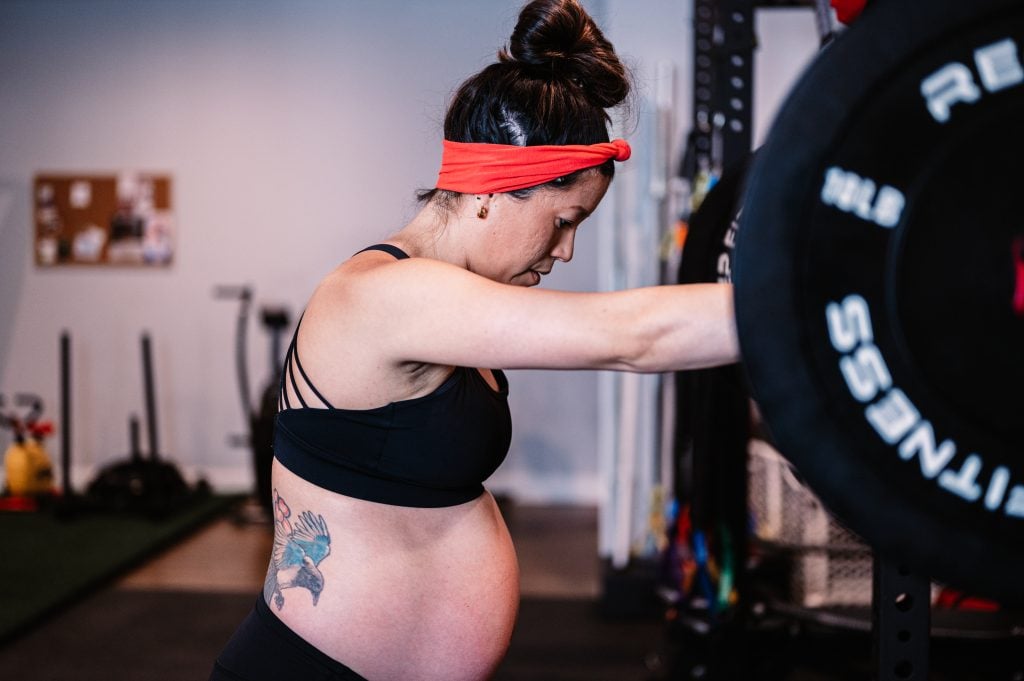

- 5 Workouts/Week
- Gym Workouts
- Self-Paced

Instructor
GINA
Workout on-demand with our prenatal fitness workout videos! Each workout is 30-40 minutes to follow along as you exercise at the same time!
- Birth Prep
- All Trimesters
- Mobility Work

Instructor
GINA
Find comfort and relief from pelvic girdle pain throughout your pregnancy and postpartum period! This program incorporates myofascial sling focused exercises to stabilize across the pelvic girdle joints.
- 3 Weeks
- On Demand Workout Videos to Follow