



Table of Contents
Labor stalls can be a common concern during childbirth, but proper birth preparation can help prevent them by improving pelvic mobility and creating space for the baby’s descent. We’ll address common pregnancy tendencies that decrease pelvic space, focusing on lat releases, hip flexor stretches, and pelvic mobility exercises to create more space for your baby. In this guide, we will explore essential exercises to prepare for labor, designed to release tension, enhance pelvic alignment, and support an easier labor process.
Subscribe to our YouTube Channel for more weekly workouts and educational videos! We publish one new workout video and 2-3 educational videos a week on our channel.
Why Does Labor Stall?
Labor stalls can occur when the baby has difficulty navigating through the pelvis due to limited space or poor pelvic mobility. Common causes include:
Tight lats and hip flexors: Pregnancy often leads to an arched back posture, which compresses the lats and hip flexors, restricting pelvic movement.
Limited internal pelvic rotation: Difficulty rotating the pelvis can hinder the baby’s ability to descend and rotate properly.
Pelvic floor tension: Excess tension in the posterior pelvic floor can prevent effective movement within the pelvis.
By incorporating specific exercises into your prenatal routine, you can help alleviate these issues and create a more favorable environment for labor progression.
5 Exercises to Prepare for Labor and Boost Pelvic Mobility
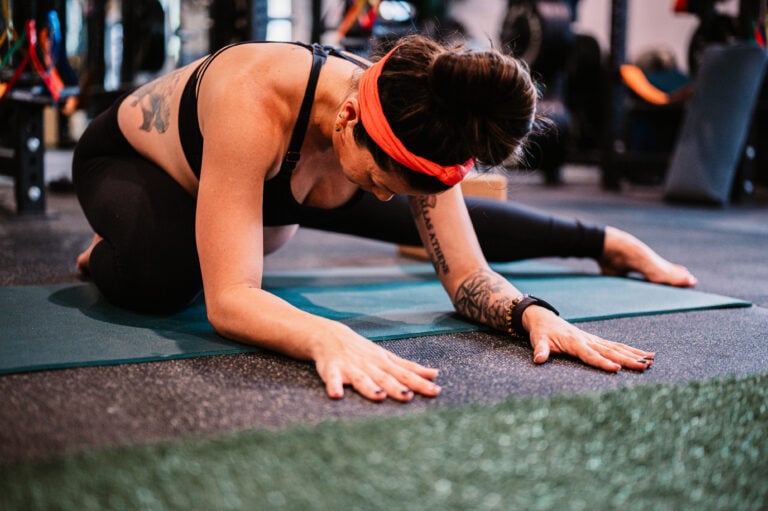
1. Lat Release Exercise
Purpose: Releases tension in the lats to improve front-to-back pelvic mobility.
Use an elevated surface like a chair or couch.
Get into a tabletop position and reach one arm onto the surface.
Lower your chest towards the floor to stretch the side body and lats.
Breathe deeply and hold for 1 minute per side.

2. 90/90 Side Camel Stretch
Purpose: Opens up the side body and hip flexors to relieve tension.
Sit in a 90/90 position with one leg in front and one behind.
Reach toward the back leg for a side body stretch.
Extend the hips forward to stretch the hip flexor.
Repeat the movement, alternating between the side body stretch and hip flexor extension for 1 minute per side.


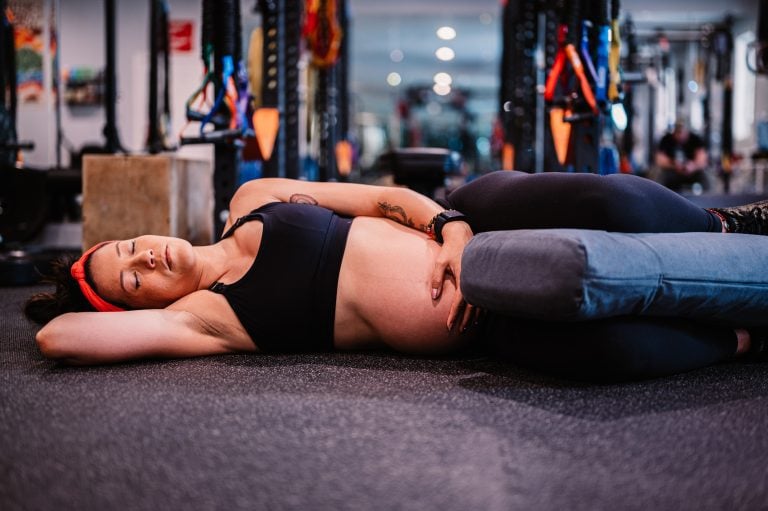
3. Hip Shifting in a Side-Lying Position
Purpose: Enhances hip mobility by allowing the femur to move within the pelvis.
Lay on your side with knees bent.
Shift the top knee back slightly while squeezing a yoga block or pillow.
Focus on feeling a stretch in the top hip pocket.
Breathe deeply and repeat on the other side.
To deepen the stretch, gently rotate the pelvis forward and backward, allowing for a more dynamic range of motion.
You can also experiment with small circular movements in the hip joint to further release tension and improve mobility.
If comfortable, engage in slow and controlled movements where the top knee gently moves forward and backward, mimicking natural pelvic adjustments during labor.


4. Tabletop Hip Shift with Pelvic Tilts
Purpose: Improves internal pelvic rotation to facilitate baby’s descent.
Place one knee on a yoga block in a tabletop position.
Shift weight toward the elevated knee and lift the opposite knee.
Move through pelvic tilts by arching and rounding the back.


5. Standing Hip Shift on a Yoga Block
Purpose: Enhances pelvic mobility while mimicking labor movements.
Stand with one foot on a yoga block and the other flat on the ground.
Rotate the belly toward the elevated thigh and hinge slightly at the hips.
Optionally, add gentle hip extension movements to transition between open and closed pelvic positions.


 Video course · 9 CE credits
Pelvic Mechanics Course
Four modules on pelvic mechanics in pregnancy and labor — foundations, mobility training, resolving stalls, and clinical decision-making. 9 nursing and 9 ICEA CE credits.
Learn more
Video course · 9 CE credits
Pelvic Mechanics Course
Four modules on pelvic mechanics in pregnancy and labor — foundations, mobility training, resolving stalls, and clinical decision-making. 9 nursing and 9 ICEA CE credits.
Learn more
 Video course · 7 modules
Prepare Your Pelvic Floor For Birth
Seven modules on releasing the pelvic floor rather than only strengthening it — breathing drills, thoracic and pelvic mobility, and how to relax it during labor.
Learn more
Video course · 7 modules
Prepare Your Pelvic Floor For Birth
Seven modules on releasing the pelvic floor rather than only strengthening it — breathing drills, thoracic and pelvic mobility, and how to relax it during labor.
Learn more
 On-demand video · 24 workouts
Birth Prep Workout Program
Twenty-four workouts that open the pelvis for each stage of labor — strength, mobility, and positioning you can start at any fitness level, 15 to 30 minutes each.
Learn more
On-demand video · 24 workouts
Birth Prep Workout Program
Twenty-four workouts that open the pelvis for each stage of labor — strength, mobility, and positioning you can start at any fitness level, 15 to 30 minutes each.
Learn more
How These Exercises Help During Labor
By practicing these movements, you can:
Improve pelvic mobility to help the baby engage and rotate through the pelvis.
Reduce pelvic floor tension, which can aid in a smoother labor process.
Encourage optimal fetal positioning to prevent labor stalls and prolonged pushing phases.
Final Thoughts
Incorporating these exercises into your prenatal routine can significantly improve labor outcomes. Focus on performing them regularly to prepare your body for birth. If you’re looking for more structured guidance, consider a prenatal fitness program that includes targeted workouts for labor preparation.
For more exercises and in-depth prenatal fitness programs, explore our childbirth education and pelvic floor preparation. Don’t forget to use code YOUTUBE10 for an exclusive discount!
By prioritizing movement and pelvic mobility, you can take proactive steps toward a smoother labor and birth experience.
 Video course · 9+ hours
Childbirth Education
Over nine hours of video on contractions, comfort measures, pushing, and recovery — so you walk into labor knowing what's happening and what your options are at each stage.
Learn more
Video course · 9+ hours
Childbirth Education
Over nine hours of video on contractions, comfort measures, pushing, and recovery — so you walk into labor knowing what's happening and what your options are at each stage.
Learn more
 Bundle · lifetime access
MamasteFit Bundles
Combine courses and programs for lifetime access and save up to 15% — grouped for birth preparation, the third trimester, or the whole pre and postnatal journey.
Learn more
On-demand video · 30 workouts
Core, Pelvic Floor & Pelvic Stability
Thirty follow-along workouts across beginner, novice, and advanced levels, ten per level — core and pelvic floor strength for pain relief in pregnancy or postpartum.
Learn more
Bundle · lifetime access
MamasteFit Bundles
Combine courses and programs for lifetime access and save up to 15% — grouped for birth preparation, the third trimester, or the whole pre and postnatal journey.
Learn more
On-demand video · 30 workouts
Core, Pelvic Floor & Pelvic Stability
Thirty follow-along workouts across beginner, novice, and advanced levels, ten per level — core and pelvic floor strength for pain relief in pregnancy or postpartum.
Learn more