



Welcome to the MamasteFit Podcast Birth Story Fridays. On this episode, Allegra is going to be sharing her hospital birth where she had an unmedicated twin vaginal birth. She felt very empowered during her birth process to understand what her options were, to understand what her provider’s preference was, but also what options she was able to choose herself.
Read Episode Transcript
[00:01:11] Roxanne: Welcome to the MamasteFit Podcast, Birth Story Fridays. Today, we have Allegra who’s going to be sharing her hospital unmedicated twin birth. Thank you so much for being here to share your story with us.
[00:01:21] Allegra: Yeah. Thank you so much. I’m excited to be here.
[00:01:24] Roxanne: So let’s dive into what did you do to prepare for both pregnancy as well as birth?
[00:01:30] Allegra: Yeah, with going into this pregnancy, I was actually still breastfeeding my toddler, and that’s a huge physical demand on the body, and so I really tried to prioritize my nutrition, especially mineral repletion, so I’ve been really intentional with, incorporating nutrient dense foods like animal products, organ meats, lots of fruits and vegetables, and then also incorporating mineral mocktails, which are really just like electrolytes. So really focusing on those electrolytes.
[00:02:04] Allegra: I did start tracking my cycle, which with my previous pregnancies, I never did. And with my first pregnancy, I was actually vegan and just did not focus on my minerals. And it took me, my cycle was pretty irregular at the time. going into this pregnancy, I wanted to track and just make sure that everything was, lining up. And, I was very regular and I was still breastfeeding, which I think is funny because a lot of people think that breastfeeding affects fertility and it can, but I find in my practice that it’s more so nutrient depletion that actually impacts fertility more than just breastfeeding.
[00:02:43] Allegra: focusing on my nutrition was really important and we got pregnant, pretty soon, as we were trying. And going into the first trimester, everyone has that exhaustion and nausea. and I definitely felt that, but once again, minerals were huge with supporting my nausea and supporting my energy. I really prioritized protein and I know that can be hard with like food aversion. So what I did was focus on protein rich carbs. So if I was like craving crackers, could I pair those crackers with, some cheese or, rotisserie chicken as a snack? and a lot of times I had to eat that cold because, sometimes those hot foods makes you more aversive to certain foods, or contributes to the nausea and vomiting. instead of just a plain bagel, I would choose Dave’s Killer Bread, because that’s higher in protein. Instead of just regular pasta, I would do the protein rich pasta. I would really try to stay on top of my snacks, especially protein rich snacks, because if I didn’t, I was more nauseous. There were times in the morning I would wake up nauseous and I just had to run to the kitchen and grab a cheese stick or take a bite of Greek yogurt just to help with that nausea.
[00:04:09] Allegra: so definitely like prioritizing nutrition really helped with my symptoms throughout my pregnancy. just, I strongly believe that our body speaks to us through symptoms. So Charlie horses or nausea or just insomnia, sometimes that’s just our body telling us it needs something. And so I would take magnesium at nighttime, adrenal cocktails, sometimes eating something high in protein before bed, that really helped with my sleep. I know so many people say they toss and turn, they get up multiple times to go pee, and I slept like a rock. And I honestly attribute that to the high protein snack.
[00:04:53] Roxanne: Yeah.
[00:04:54] Allegra: Because that keeps your blood sugar steady overnight, and then the magnesium and minerals. I feel like that really helped with just my pregnancy symptoms.
[00:05:06] Roxanne: what exact minerals do you think that you focused on?
[00:05:11] Allegra: magnesium.
[00:05:11] Roxanne: Or just, overall.
[00:05:13] Allegra: Yeah. magnesium, sodium, and potassium, specifically.
[00:05:18] Allegra: And there’s actually some interesting studies, showing that the mineral needs, specifically sodium, jumps up to 7,000 milligrams during pregnancy and lactation. And, the RDA, the Recommended Dietary Allowance is 2,300. that huge jump, no wonder we crave salty things during pregnancy, like olives or pickles. And I definitely felt the days I didn’t have my mineral drink, I craved more pickles. So I always had pickles around. but it’s just interesting that a lot of those cravings are actually your body needing more of those minerals. so I know some people will crave like milk or dairy products and it’s actually the iodine and like calcium that your body needs.
[00:06:09] Allegra: once again, listening to your body, listening to those cravings. but yeah, so sodium, I really emphasize as well as potassium because you can’t increase your sodium without increasing potassium. if you just up your sodium without potassium, you will experience more swelling, and that was another thing people were like, “Oh my gosh, you have twins and you have no swelling?!” And every time I went to my OB, she would look at my ankles and she was like, “Nope, no swelling!” and I’m like, “I’m telling you, it’s the electrolytes, it’s the minerals!”
[00:06:41] Roxanne: Yeah, no, I think I totally agree with that. Like the sodium, like demands of our bodies, I feel are just in general higher than the 2,300. But I notice a huge difference when I don’t drink a little bit of sodium, like more sodium throughout the day, at the end of the day, and like even, I’m nine months postpartum and my legs will be swollen. So that’s so interesting to hear like that research supports that. So, cool.
[00:07:07] Allegra: And that is not an excuse to eat junk food. So I know junk food is loaded with sodium, but it’s still junk food. So we need salt, but we don’t need all the other processed things in junk food.
[00:07:17] Roxanne: And it does, I’m sure junk food doesn’t have the potassium, which helps with that sodium,
[00:07:23] Allegra: Yeah.
[00:07:23] Roxanne: That’s a good caveat to put in there though, because some people be like, “I’m going to go to McDonald’s. There’s a lot of sodium in that.” Yeah, but probably not a lot of potassium.
[00:07:31] Allegra: Yeah, exactly.
[00:07:32] Roxanne: So you prepared for like pregnancy and like the early part of your pregnancy with a lot of the nutrition which like you are one of like an expert a little bit in the nutrition aspect of the perinatal time frame and breastfeeding.
[00:07:46] Roxanne: But how did you prepare for like actual birth with twins?
[00:07:51] Allegra: Yeah. So I was doing yoga every single week. I’ve actually incorporated some of your videos too, that you share on Instagram, which I think is so awesome and helpful. I was seeing a Webster Certified Chiropractor and so they really, supported my body and just the rapid changes, just because with twins, it’s a lot on your body and I definitely felt the round ligaments and back pain, and so every time I felt something a little more off, I would stretch, I would do some yoga and I feel like that really helped.
[00:08:26] Allegra: I did hire a birth doula and she was wonderful. I went to 39 weeks and three days, which I feel like mentally was so long because everyone tells you that with twins, you’re going to deliver prematurely, have your hospital bag ready by 33 weeks.
[00:08:46] Roxanne: Yeah!
[00:08:47] Allegra: Doctors want to induce at 37, 38 weeks. And I had an amazing OB that was like, if everything’s medically fine, let’s just trust your body.” And I was like, “What? Can I give you a hug?” I really wanted a spontaneous delivery.
[00:09:01] Roxanne: That’s awesome.
[00:09:02] Allegra: And, so. Yeah, every appointment, she was like, “Everything’s looking great, your blood pressure’s looking great, babies are looking great, even though I would prefer we induce early,” just because, quote unquote, there’s less complications, but I don’t know.
[00:09:21] Roxanne: Yeah.
[00:09:22] Allegra: Yeah. But, she was like, it’s just a preference. If you want to go longer, that’s fine. but definitely by 39 weeks, I was so uncomfortable. you’re carrying two placentas, two babies, like 30 pounds of weight in my belly. And, I had every belly band and I still had to carry my belly because it was just so heavy.
[00:09:48] Allegra: So by 39 weeks, I was definitely like feeling it. I did end up being induced. I really wanted a spontaneous delivery, but my mom was leaving them like three days and I was just like, honestly, over pregnancy. so as much as I wish I had gone in spontaneously, and I did all the spontaneous, or all the natural inducing things, I even did castor oil. And that just made me have diarrhea.
[00:10:17] Roxanne: It did not do anything.
[00:10:18] Allegra: I threw up twice with that. So that was not fun. I did, the miles circuit, the curb walking, like literally everything you Google to induce labor naturally, nothing worked. So I went in and I just needed a little kickstart of Pitocin. I think they only gave me like four, I don’t know what the units are, but
[00:10:41] Roxanne: Miliunits.
[00:10:42] Allegra: Okay. Yeah.
[00:10:43] Roxanne: That’s pretty low. Yeah. Four mili units.
[00:10:45] Allegra: Yeah, I just needed a little like kickstart. and then they turned it off once my body took over. so I labored as long as I could in the labor and delivery room. My doula was amazing. I did a lot of like kind of breathwork and hypnobirthing, like listening to those, audio things during my pregnancy.
[00:11:07] Allegra: I would, focus more on like breathing. I ended up getting, these like wooden balls that have pricks on them and you like squeeze them during contractions and it’s supposed, it’s the same thing as a cone.
[00:11:21] Roxanne: yeah, it was like the acupuncture, or yeah, acupuncture points.
[00:11:25] Allegra: Yeah. Yeah. So my doula had given that to me.
[00:11:29] Allegra: my husband did the counter pressure and my previous two pregnancies, I did it unmedicated and it was very painful. But, I kept, my husband kept reminding me like, “You did this before, you’ve done this before, you can do it again.” I was like, “Okay, and per the hospital protocol, for twins, you have to deliver in the O. R. just in case there’s, any concern. they typically do always give the epidural just because there is a higher risk of, having a C section. but I really told my O. B., I trust my body. I really don’t want the epidural. I really want to do this naturally. And thankfully, she was very receptive to that and like understanding and was like, “Okay, it is once again, my preference, but this is ultimately your birth.” and so I think finding an OB that is supportive of your delivery is so important. so I really lucked out.
[00:12:32] Allegra: I labored as long as I could in the deliver, in the, the labor and delivery room. But then, as soon as I felt like I had to push, they took me in a wheelchair to the OR room. And, I really did not like the OR, just the bed was so small and it wasn’t conforming to like how you want to labor. I really wanted to labor up, on my knees, hands and knees, with the ball. But that was really hard to do on this like small OR bed.
[00:13:01] Roxanne: So thin bed. Yeah.
[00:13:03] Allegra: Yeah. So thankfully she let me labor a little bit more, but then once again, once I needed to push, she did put me on my back, which I really wanted to try a labor with, without being on my back, but it was really hard to do in the OR room. And I guess that’s just protocol with twins. And anyways, my doula was really great with coaching me and just, trust your body once when you feel like you have to push, breathe into it. So I did, and my OB helped stretch my perineum, and so I thankfully did not tear at all.
[00:13:44] Allegra: I pushed the first baby out, Baby A, and he was 7 pounds, 8 ounces. And then, they broke my water with Baby B, and I initially did not want to do that. I wanted just labor to, run its course, like how it naturally should. But at the same time, I just wanted labor and delivery to be over with. I was just like, “I just need this to be done. This is painful. I’m just ready.” And so they broke my water with Baby B, and he actually went breech after Baby A came out. And so my OB manually turned him back, head down. And I was holding Baby A, but apparently during my contractions, I kept squeezing him and they were like, “Okay, he’s not looking good.”
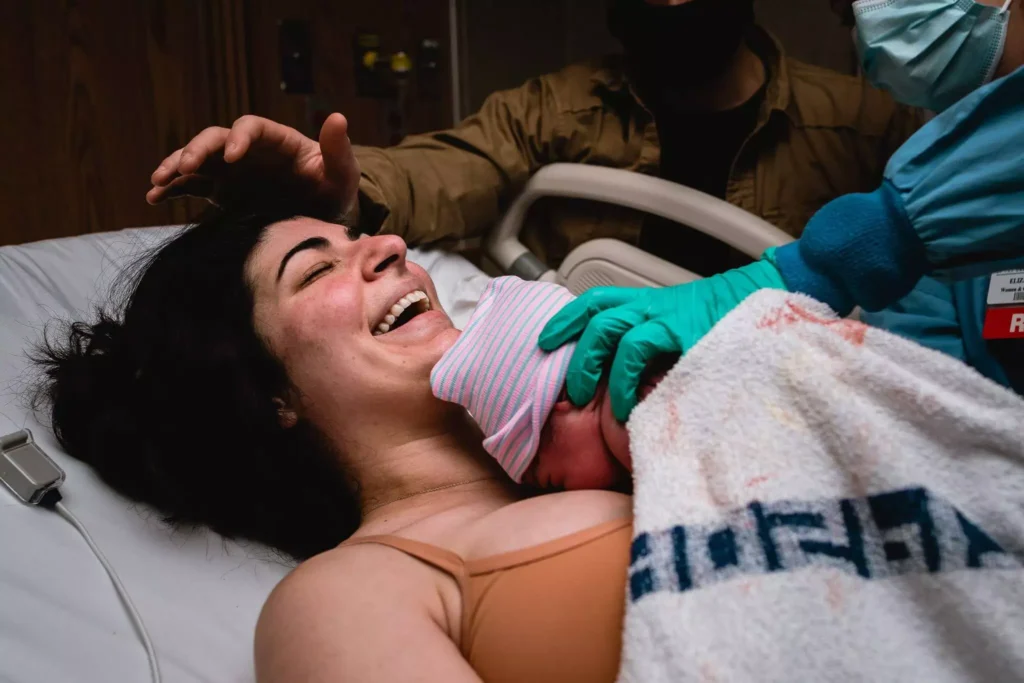
[00:14:35] Allegra: So they took Baby A away and my husband held him and did skin to skin while I pushed Baby B out. And as soon as Baby B came out, I was able to do skin to skin and we did delayed cord clamping. Which I did not get to do with my second delivery. So I was really happy to be able to do delayed cord clamping with both of them.
[00:14:59] Allegra: They said, my OB said that my placenta was the best placenta she’s ever seen, and I really attribute that to nutrition. Like she said, it looked great. The color was vibrant. She took a picture of it for me. So that was cool to hear. But yeah, Baby B was six pounds, three ounces, so he was a lot smaller, but still, a healthy weight.
[00:15:25] Roxanne: So in all, how long did you push for with the two?
[00:15:30] Allegra: In between, you mean in between the two?
[00:15:34] Roxanne: Or I guess like total, and then like how long was the break in between?
[00:15:38] Allegra: Uh huh. So for Baby A, I want to say I pushed for maybe 15 minutes or so. I don’t know. I don’t know. It was a slow, gradual push though, like he didn’t torpedo out, which was good. He was able to get squeezed. And then after she broke the water for Baby B, maybe it was another ten minutes before I pushed out Baby B. And because he was smaller, he came out a little faster.
[00:16:06] Roxanne: Yeah, the path was paved.
[00:16:10] Allegra: Yeah, and my OB really, stretched my perineum. My husband filmed it, and I was like, “Oh my gosh!” Just really helped support, open things up for the head to come out.
[00:16:22] Roxanne: Yeah, and then, the slow pushing definitely helped as well. It sounded like you had, like, obviously your OB had their preference and they like voiced their preference, because we all have biases and knowing what our biases and our preferences are is beneficial, but they were very open and supportive to what you really wanted to do and let you make all of the decisions yourself, which is not very common, especially I feel like with twins. Like it’s very much like people are like, “Yeah, well, I had twins. So like I had to be induced, and they told me i had to get an epidural, and had to go deliver in the OR.” Where you still like, they still obviously had their usual routines of like delivering in the O. R. and like delivering on the O. R. bed just in case, but you are still able to do so much with your labor that you decided. Which was probably very awesome and empowering to be able to do that with not one baby, but two.
[00:17:18] Allegra: Yeah. And I told her, I was like, if I had it my way, I would have a home birth. So like I really wanted a home birth, but no midwives in my area will do home birth twins. There’s no birthing center. The closest one is two hours away and I just didn’t want to risk that. I, and I was fine to deliver in a hospital, but I really wanted like a more natural approach and thankfully my OB was open to that.
[00:17:45] Allegra: I had listened to a lot, I follow on Instagram, a lot of like twin home birth, like stories and watching birthing videos. I think was super helpful just to see, your body can do this. And obviously, medical intervention is there for a reason, and thank goodness for it. But, if I can, I want to see what my body can do.
[00:18:10] Allegra: And it was, I was happy with my OB. I had actually initially asked on Facebook who the more holistic OBs are in the area. She came recommended by some other families, so that’s how I was able to choose her. But I know in a lot of places, if you’re having twins, this is what they want to do, they induce at this time, higher risk of C section. So that’s what I went into my pregnancy and, thinking about delivery, worst case scenario, okay, I’m going to be induced at 36, 37 weeks, Baby A, or Baby B is not going to grow well, just like you start thinking, you start hearing all these worries about twin births and, how it’s just like automatic C section.
[00:19:03] Allegra: And I’ve even had some followers on my Instagram say “Oh, you’re not having a C section? I thought all twins were a C section.” And so like to have it be a vaginal delivery and medicated and go to 39 weeks, like I’m really curious how long my body would have kept going.
[00:19:19] Roxanne: Well, it sounds like you’re like your birth and pregnancy was very supportive and you had a pretty like empowering and awesome birth story with twins.
[00:19:29] Roxanne: But how was postpartum? So like you had postpartum experience with two kids, with one at a time, and now you have two babies and you are breastfeeding both of them like exclusively. So how is that like postpartum experience going?
[00:19:44] Allegra: Yeah. So I knew, I prepped so much during pregnancy for the postpartum period.
[00:19:50] Allegra: I started making freezer meals around 31 weeks pregnant. So just whatever I would make for dinner, I would double, triple, quadruple batch and just freeze it. I set up, like support, set up a Meal Train, for this first couple weeks. I made sure we had house help. So like coordinating family, like we’re a military family. We live in the middle of Texas. We don’t have any help around here. But just like reaching out. Who are the moms that have other kids that might take my older two out for a couple hours or take them to the park? What family members can come out? And so I really tried to plan those, that first month postpartum so that I could rest because I knew that I cannot push myself too much to where I have like prolapse or, just other complications because I really need to heal so that I can be more present with my older two and just do things once that help leaves. I follow like the 5 5 5 rule, 5 days in bed, 5 days on the bed, 5 days near the bed, I’m sure you’ve heard of that.
[00:21:06] Roxanne: Yes.
[00:21:07] Allegra: I really tried to prioritize that. I did not do that with my first pregnancy, I just I mentally felt fine, so I just jumped into things and my healing took a lot longer. Yeah.
[00:21:20] Roxanne: Yeah. I feel you.
[00:21:22] Allegra: Yeah. This time I was not afraid to ask for help. I was not afraid to say, “Hey, Michelle,” who is my mother-in-law, “can you throw in this laundry?” Or can you make me a piece, get me some breakfast? Can you make some eggs for me? Like I was not afraid to vocalize it and she appreciated it because she wants to help. She just didn’t know how. And so I think that’s one thing too, is people want to help us. I think we just need to be fine vocalizing that and be okay with asking for help. So that was a big thing that, I did differently this postpartum. And so really I just stayed in bed and did skin to skin with my babies, with my twins.
[00:22:04] Allegra: With breastfeeding, I did breastfeed them individually first just to make sure that they were competent, that they were latching well. And then probably by five days postpartum, I started tandem feeding them. Babies, newborns are very sleepy too. So making sure that they are eating, as soon as they’re done eating, they fall back asleep and then, you change them, you feed them again and they fall back asleep.
[00:22:30] Allegra: So when they were sleeping, I really tried to be intentional with hanging out with my older two and spending quality time with them, filling their cup up. I got some like busy toddler books and just different books, sticker books, coloring books. for them before I delivered and then after I delivered, I gave it to them as a present from their babies, from their baby brothers. And I would bring that to our bed so that I could still sit and rest, but also, color with my daughter or, do some Legos in bed with my son. So still trying to rest and sit, but also fill their cup up.
[00:23:13] Allegra: So I’m very proud of myself for that, for just resting and being intentional because my first two, I was not. And my bleeding stopped at two weeks, whereas like with my first, I bled until five weeks postpartum. And I think it’s because I was trying to do too much.
[00:23:31] Roxanne: Yeah.
[00:23:32] Allegra: But yeah, I think just really prioritizing that rest and sitting really helped. Nights were, are very hard with twins. You’re waking up instantly. It’s a lot of work with twins when one baby, there’s just always someone crying. So when one baby starts crying,
[00:23:54] Roxanne: It’s like they take turns.
[00:23:55] Allegra: Yes, they do. And as newborns that you can’t really put them on the schedule just yet. Like right now they’re two months postpartum, so we’re trying to work closer to a schedule, just so that we can have a break so that a baby is not up all the time.
[00:24:12] Allegra: So we’re working towards a schedule now. But those early weeks, even months, just someone was always crying. You would get one settled and then they would fall asleep, but then the next one would wake up. And then they would start crying and then wake up the first baby. Or then your toddler is making too much noise.
[00:24:31] Allegra: Or he’s on the toilet, needs to be wiped, so you put the baby down, and then they start crying while you take care of your toddler, and then your preschooler is like getting into the pantry, getting a bag of chips, and you’re like, “No!”
[00:24:43] Roxanne: Oh my gosh.
[00:24:44] Allegra: It’s, a lot.
[00:24:45] Roxanne: Yeah.
[00:24:46] Allegra: So I think that’s been the hardest part, not the physical recovery, more like the mental overload of everything.
[00:24:53] Roxanne: Yeah, it’s like you have not just one baby, you have two babies, along with two older kids that you are also trying to juggle with not a ton of support. Like you don’t have like family nearby that you can just call on like a whim. So it sounds like you prepared like pretty intentionally though, with postpartum, which a lot of people forget about preparing for the postpartum.
[00:25:17] Roxanne: And I was similar to you with my first postpartum that I did not do any, I was like, “I’m fine. I had a baby. I can go buy a TV today. Let’s go shopping!” When you know, I should not I should go lay in bed and rest So postpartum prep is definitely forgotten about and you, I mean you prep not just meals but also like the schedule of who’s going to be there to help you especially that first month postpartum, which is so smart and like really great advice. But it sounds like you had not just like an empowering birth and like you were super supported by like your doula, your husband, and your provider, but also like pretty supported for that first month postpartum, obviously, thanks to all of your hard work, but I’m glad that you had so much help to be able to rest.
[00:26:04] Allegra: It didn’t come naturally, like I had to put in the work and I think that’s where, people will say, and I saw you guys did a post like, “Oh, you just had an easy recovery,” or, “you had an easy pregnancy.” No, it takes work. You have to be intentional. You have to plan. Like I know your spouse was like very supportive, got you the meals, got you this and that.
[00:26:27] Allegra: And so I think that support is so important. And so it’s not just oh, I had an easy postpartum recovery, or I had an easy pregnancy. I had to see the chiropractor. I had to make sure I was doing yoga. I had to make sure I was eating consistently postpartum. I needed to make sure I had that help, so that I could rest.
[00:26:48] Roxanne: Yeah, exactly.
[00:26:50] Allegra: It doesn’t just come easily. There’s work involved.
[00:26:53] Roxanne: Yeah, you had to work for it. Exactly. No, I love that. So if someone, if there was someone else either in your shoes, like having, having a twin birth and they want to go unmedicated or have a vaginal twin birth, what is some advice that you would give somebody that’s in your shoes or even like yourself, like, when you found out you were pregnant with twins, what is some advice that you wish you had gotten or that you want to give to somebody who is in the same situation as you?
[00:27:21] Allegra: I think really, advocate and research. And once again, like I said, advocate because you’ll hear so many stories. You’ll, so many people will tell you their birth stories, how it didn’t go well, or it was scary, traumatic. and yes, that certainly obviously happens, but doesn’t have to be your story.
[00:27:43] Allegra: And so I think, trying to advocate, talk to your OB about what you do want to do, what kind of delivery you want. And yes, it is like a goal or like a dream type of delivery, so be prepared for what could go wrong, but also still encourage, like push to have the delivery that you do want.
[00:28:10] Roxanne: Yeah.
[00:28:11] Allegra: I think, reading other books, like I read the book, A Holistic Guide to Twin Pregnancy. So it was actually one of my followers that suggested the book and I got it, and it was just very encouraging and it just showed me that just because I’m having twins doesn’t mean that I have to follow this script. Like I have to follow what everyone, like the masses are doing in regards to their twin delivery or their twin pregnancy. Sometimes we write off these symptoms as, “Oh, you’re just having twins,” or, “Oh, you’re just pregnant.” But once again, our body speaks to us through symptoms. So can we do things? And especially with twins, we’re gonna really have to up our calories, up our mineral intake. Like by third trimester, everything, every cup of water, I was adding minerals to that. So like I really pushed minerals that last third trimester. And the way that I knew that I was getting enough was I wasn’t having those Charlie horses or cramps or muscle spasms or even Braxton Hicks.
[00:29:18] Allegra: If I felt something coming on, I would right away up my electrolytes and then the feelings would go away. So I think that’s also the thing, is just like, really pay attention to your body, listen to your body. Don’t feel like you have to just struggle through different symptoms. And obviously there are some symptoms that you can’t control, like a giant belly that is just putting a strain on you.
[00:29:40] Roxanne: Yeah.
[00:29:41] Allegra: Some things are going to be very uncomfortable. Or like the stretchy, itchy skin, like my skin got so itchy. I would put tons of lotion on and, different oils. But your skin is just like stretching.
[00:29:55] Roxanne: Stretching, yeah. You got two babies in there.
[00:29:58] Allegra: Yeah. By 20 weeks, I was the same size as full term with my first and second babies. And I was only 20 weeks. And I was like, “How?!”
[00:30:08] Roxanne: You still had a whole pregnancy to go. Oh gosh.
[00:30:11] Allegra: Yeah. So even all my maternity pants that felt fine with my first and second, I couldn’t wear those anymore. I had to go up like XL and even start wearing things under the belly because just nothing fit over. And I had to wear dresses all third trimester. So your body is going through a lot.
[00:30:35] Allegra: But, yeah, going, back to your initial question, I think, really, just try to advocate, listen to other stories, follow some more holistic accounts on Instagram, and twin stories, if that’s what you want. And also even just interview different OBs and see what they say.
[00:30:56] Allegra: At the end of the day, this is you, so your OB might have a preference, but, can we do additional research? Can you, try to advocate? I always ask my doctor, “Is this medically indicated or just a preference?” And she’d be like, “It’s just, a preference.”
[00:31:15] Roxanne: That’s a really great question. Cause some people will say this is how I do things, but that’s my preference versus yes, this is like the medically safe option, this is why we recommend this medically, but versus Oh, well, I just prefer this. I think that’s a really great question for somebody to ask.
[00:31:31] Allegra: And I definitely trust my OB, so if she was like, “No, this is serious,” then I would obviously listen. she’s the obstetrician, like the medical doctor. So I definitely trusted her, which is why I always ask the question, is this medically indicated or a preference?
[00:31:49] Allegra: And then some of the appointments, I always had anxiety going into the appointments because the technician, who’s doing the ultrasound, she would say “Okay, Baby B isn’t growing as fast.” And you have to take babies as their individual self. Like my OB was like, “As long as he’s, Baby B is still growing, even if he’s growing at a slower rate, he’s still growing. So I don’t think we need to induce you. He’s not IUGR.” But I feel like every appointment they kept talking about, “Hey, we need to monitor this a little bit more,” or, “he’s not where I want him to be.” And I’m like, but is he still healthy? Is he still growing? Are things still looking good? And also a lot of those ultrasounds aren’t 100 percent accurate. Like they told me that Baby B was almost eight pounds and he ended up being six.
[00:32:47] Roxanne: He was not 8 pounds!.
[00:32:51] Allegra: So take it also with a grain of salt.
[00:32:54] Roxanne: I think that’s, I think that’s great advice for somebody who’s in the same shoes that you were in a couple of months ago.
[00:33:00] Roxanne: So I know that you have an Instagram account. Do you want to share a little bit about more that people can learn from you and where they can learn more from you?
[00:33:07] Allegra: Yeah, so you can follow me on Instagram, @Aloha.Nutrition. So I started my private practice in Hawaii, we’re now in Texas, we’re a military family. But I’ve practiced both functional nutrition, which is getting to the root cause of what’s going on with someone’s symptoms, their body, as well as I’m a IBCLC Lactation Consultant. I have a team of practitioners and we see families worldwide, whether that’s helping you with your breastfeeding journey, infant feeding journey, bottle feeding, or addressing your health and your nutritional needs, even postpartum. We blame things on motherhood, “Oh, you’re chronically exhausted. It’s because you’re a mom or you’re up all night with your baby,” but it doesn’t have to be that way. A lot of times it’s nutrient depletion. So once we can support your body, you can feel more energized and I quote unquote “energized,’ but you shouldn’t feel like you’re, you’ve been hit by a bus.
[00:34:08] Allegra: I do have a course called Beyond Birth, which is all about postpartum nutrition and just making these, focusing on the foundations with the baby. Like, how do you do this with a baby? How do you do this on when your baby is waking up like every two to three hours? Being through it myself and just figuring out shortcuts in the kitchen and focusing on quality sleep, not so much quantity. You can feel good postpartum. So, you know, I feel great.
[00:34:41] Allegra: I think it’s more the overwhelm that I struggle with and just like balancing my business and two older kids and two babies and the witching hour. But physically, even with the lack of sleep, I know what to do to get quality sleep. So yeah, I have that course, Beyond Birth, and then we can also work one on one.
[00:35:03] Roxanne: Well, thank you so much, Allegra, for coming on the podcast to share not just your birth story, but how you prepared and your postpartum experience with twins.
[00:35:10] Allegra: Thank you so much!
[00:35:12] Roxanne: We’ll link all your courses and your Instagram in the show notes below, but thank you so much for coming on.
[00:35:17] Allegra: Yeah, thank you!
[00:35:22] Danielle: My name is Danielle and I’m grateful for the MamasteFit postnatal programming because it helped me heal my body and mind after both of my pregnancies. I was able to come back stronger than ever before and I really love how they build up from the basic building blocks all the way up to personal records.
[00:35:45] Roxanne: With our birth stories and our birth plans, understanding what our comfort and our preference is, is important, but also understanding our provider’s preference can be helpful to help guide and make decisions together as a team to help make sure that we are both safe. But we can still have that empowering birth just like Allegra did. By having a hospital induction, she was still able to make a lot of those decisions herself so that she could have an empowering birth.
[00:36:11] Roxanne: If you enjoyed this birth story, please and subscribe to our channel so that you can be notified whenever we release new episodes. We release new educational episodes on Wednesdays and new birth stories every other Friday.
[00:36:22] Roxanne: If you’re pregnant and looking for more support, check out our prenatal fitness programs where it’s synced to your week of pregnancy, offered in the TeamBuildr app with demo videos. Or if you prefer following a video, we have an On Demand program that’s separated out into all three trimesters.
[00:36:37] Roxanne: If you’re also looking for education, check out our online childbirth education course that discusses the science of labor and birth to help take some of that mystery away and to understand your options so birth can be less scary.
[00:36:49] Roxanne: And you can bundle those two together to get 15 percent off, and for listening to this entire podcast episode, you can get an additional 10 percent off with code STORY10, so that it’s pretty much free!
[00:37:02] Roxanne: And if you’re postpartum, we offer a postpartum education course to help prepare you of what to expect so that you’re not always on Google. And we also have postpartum fitness courses so that you can return back to activity after having a baby.
[00:37:14] Roxanne: And if you’re a professional, we also offer a birth workers course and our prenatal/postpartum fitness trainer course, so that you can learn from us while earning continuing education credits.
[00:37:22] Roxanne: And you can check out all of our offerings at Mamastefit.Com. And again, you can use code STORY10 to get 10 percent off anything that we offer.
Prenatal Support Courses

Learn the science of pregnancy and birth to take the mystery of labor away! Understand why you are feeling what you feel, and learn strategies to confidently move through pregnancy and birth!
- 9h+ of Video
- Support Group
- Close Captioning
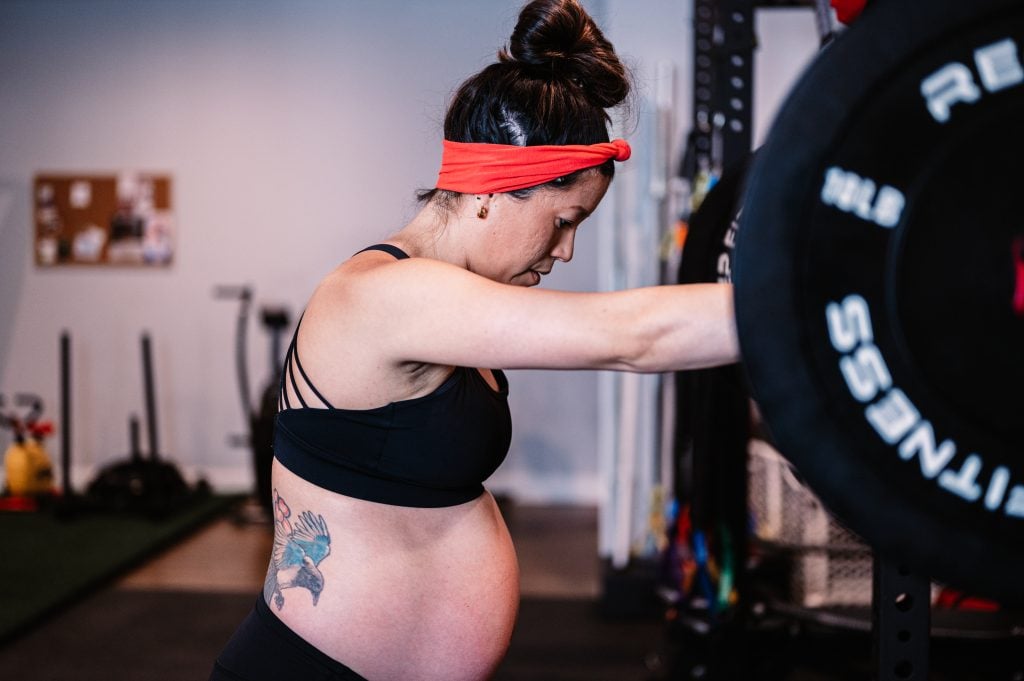

- 5 Workouts/Week
- Gym Workouts
- Self-Paced

Instructor
GINA
Workout on-demand with our prenatal fitness workout videos! Each workout is 30-40 minutes to follow along as you exercise at the same time!
- Birth Prep
- All Trimesters
- Mobility Work

Instructor
GINA
Find comfort and relief from pelvic girdle pain throughout your pregnancy and postpartum period! This program incorporates myofascial sling focused exercises to stabilize across the pelvic girdle joints.
- 3 Weeks
- On Demand Workout Videos to Follow