


Welcome to the MamasteFit Podcast Birth Story Fridays. In this episode, Roxanne welcomes Erica, who shares her hospital water birth story and postpartum experience. Erica discusses her intentional preconception health changes, commitment to prenatal fitness, and the time she took to get educated on what to expect and how to prepare for birth. She recounts her labor journey, starting at home, transitioning to the hospital, and finding relief in a birthing pool. Erica then shares the intense emotional and physical challenges of the postpartum period, emphasizing the importance of taking time to prepare for this much longer phase of life in advance.
Read Episode Transcript
[00:01:01] Roxanne: Welcome to the MamasteFit Podcast, Birth Story Fridays. On this episode, we have Erica here to share her hospital water birth, birth story. Thank you so much, Erica, for being here.
[00:01:11] Erica: Of course.
[00:01:12] Roxanne: All right. So let’s get into your birth prep and pregnancy. How did your pregnancy go as well as all of the preparation for birth?
[00:01:21] Erica: Yeah, so I’ve had a long time fascination with pregnancy in general. I’m a chiropractor and I work with pregnant women, but much before I was ready to have my own babies, I saw The Business of Being Born and I’ve just loved physiologic birth. So when I was ready to have a baby, we did my husband and I did a few months of preconception diet changes and support and then…
[00:01:43] Roxanne: Awesome!
[00:01:45] Erica: Very much intentional with that.
[00:01:47] Erica: And I already had goals of maintaining activity levels through pregnancy to train for birth, as well as pregnancy, and have a better postpartum recovery. And I always wanted to birth with as little intervention as possible, although being aware that we can’t control all things.
[00:02:05] Erica: So the first part of pregnancy was really great. I had fatigue and nausea, but never threw up, which was awesome.
[00:02:14] Roxanne: Oh, that’s positive!
[00:02:15] Erica: Because I had colleagues who would drive to work, pull over to the side of the road, throw up, and then continue to work.
[00:02:20] Roxanne: No!
[00:02:21] Erica: And I was like, no, I don’t think I could do that.
[00:02:25] Roxanne: No, same.
[00:02:26] Erica: Overall, it was good. And then I just started getting too fatigued for my normal workout, so that’s when I found MamasteFit. And I really wanted a prenatal specific plan. And I love just like a full plan to follow.
[00:02:40] Roxanne: Yeah.
[00:02:40] Erica: So I found you, and I, so I did the full, barbell level one, as well as the birth… information… lesson plan.
[00:02:55] Roxanne: The childbirth education?
[00:02:57] Erica: Yes! That’s it. That’s what that’s called.
[00:03:00] Erica: So I started doing your workouts and as soon as I got to second trimester, I was feeling so good. Great energy. I was like, “Oh, I can absolutely work until I go into labor. No problem.” But then like week 36 of the third trimester is when things just went a little haywire cause I had a long seminar one weekend so I was sitting much more than I used to, and then I got a cold, so then I couldn’t move as much either. And I couldn’t do your workouts, and I wasn’t moving, and I felt awful. And I was walking and with every step I was getting this SI joint pain and this hip pain and I hadn’t had any pain until then and I was like, “How am I going to get through labor? How am I going to do any of this? I can’t even walk!”
[00:03:53] Roxanne: I know!
[00:03:53] Erica: And so I was getting all in my head, right? But when I started feeling better, I was able to start doing more of the strength things, and the strength workouts, especially any of those cross patterns, were so important for pelvic stability. Because I was getting adjusted, but I needed the other side of it with the workout.
[00:04:13] Roxanne: Yeah.
[00:04:14] Erica: That all got better again, and I was like, okay. I got in a good mindset again. But that was just a little bit of a struggle, and that’s when I realized, too, just like how much your workouts really saved me during pregnancy.
[00:04:32] Roxanne: Awesome! I’m so glad that we were able to support you.
[00:04:35] Erica: Yeah!
[00:04:36] Erica: And, this is back to when I was preparing for my first baby and I had always thought I wanted to do a home birth, and my husband was less comfortable with that. So I said, “No problem. Let me just find a midwife somewhere then.” And there’s a midwife practice within a hospital here. And so I found them and I don’t need to see an OB at all, which was something I really wanted. And I found out they were doing a water birth study at the time because otherwise you aren’t allowed to give birth in the water unless you’re at like a birth center or at home. So no hospital is allowing you to do it, except they were having a study. So I got to do it! Which was great.
[00:05:19] Roxanne: So exciting!
[00:05:19] Erica: It turned out the water was great. I did really well with the water.
[00:05:24] Roxanne: Spoiler alert.
[00:05:25] Erica: Yes. And I also, I listened to your birth story podcast a lot because it helped with my mindset hearing different people go through birth, go through labor. I didn’t want to get too in my head with due dates or timings, or worry that it was taking too long or anything like that. So it was good to hear all these different perspectives. However, I think that made me feel a little in doubt that labor was happening, too. “Oh, it’s not really there yet!”
[00:05:57] Roxanne: Denial!
[00:05:58] Erica: I didn’t expect it to progress as fast as it did, which it wasn’t too fast, but, yeah, that was just something that was interesting.
[00:06:11] Roxanne: Let’s dive into your birth story. You’re giving us all these little spoilers.
[00:06:15] Erica: Oh, oops!
[00:06:16] Roxanne: Little sneak peeks.
[00:06:18] Erica: Yeah, so, thinking about how I was feeling in pregnancy, at first I was like, “I don’t want to do any of these natural induction methods because I’m just going to let the baby come when he’s ready.”
[00:06:32] Erica: But as soon as I was 36 weeks, I was like, “I want this baby to be born.” So I started…
[00:06:36] Roxanne: You’re uncomfortable, you’re in pain!
[00:06:38] Erica: …a few things like, primrose oil and dates. And then my last day of work was Friday, October 13th. And so from that day, then I started doing some nipple stimulation, too. And I was like…
[00:06:53] Roxanne: How many weeks were you then?
[00:06:54] Erica: That was 39 weeks. So I delivered one day before my due date, which I also wasn’t expecting. I also stopped taking fish oils around 36 weeks, this is just a little anecdotal, because a few of my friends who were taking, Omega 3s, a lot of people had prodromal labor, stalled labor, that I knew, and just because Omega 3s help to reduce the prostaglandins, which you need for labor to start, I was like, “Let me just get rid of these for now because I don’t want to reduce any prostaglandins.”
[00:07:27] Roxanne: Interesting!
[00:07:28] Erica: And I want to promote, I want to promote labor. So I did stop. I have no idea.
[00:07:35] Roxanne: I’m going to look that up.
[00:07:36] Erica: But really, at any point, when you think something is helping, you’re going to do it.
[00:07:41] Roxanne: Yeah. Yeah. I love that.
[00:07:44] Erica: So on Sunday, oh! I had never had any Braxton Hicks contractions, so like I had no idea what anything was going to feel like.
[00:07:54] Erica: I ended up going into labor on a Monday, but the Sunday before, I did lose my mucus plug and I was like, “Oh, that’s like a sign.” But I had a friend who lost her mucus plug and didn’t go into labor for a week after. So I was like, yeah, whatever, it could mean nothing.
[00:08:14] Erica: But then that Monday morning I woke up around five and I felt a little crampy, how people say it feels a little like period cramps. I was like, “Oh, okay. I think that’s what I’m feeling.” But it was very minimal, very irregular. The first time I ever felt anything like that. This was my first official day where I wasn’t going to work, and I was like, “Oh, interesting.” And I think not going to work, helped my body relax too, enough to go into labor.
[00:08:43] Erica: So I didn’t tell my husband anything, and he left for work around 7:15, because I thought it might go away or like it would be really early, 24 hours or something.
[00:08:53] Roxanne: Or it could take all day.
[00:08:54] Erica: It could take all day. I didn’t need to freak him out. So I just started like cleaning the house a little, doing some stretches, I watched some YouTube videos about breathing, and then I was like, “Maybe these are contractions…” so I downloaded a contraction timer app. And I was like, “Okay, I think this is real now.”
[00:09:17] Erica: And then around 10:00, so it started at 5:00, and around 10:00 I texted my husband that I was in labor and he like called me like, “What is going on?!” I was like, “It’s fine! I’m doing great. Probably still going to be like half a day or more before we have to do anything.” And I said, “You can probably finish the day of working.” And that was it. But then an hour later, I was like, “No, I don’t feel that way anymore!” And I want him home! So I texted him again, and he came.
[00:09:47] Erica: And so around noon, then I was already, going through a lot of different movements. I was paying attention to how my body wanted to move, like how you explain in the courses, too. “Oh, I’m probably at this stage of labor now, ’cause my body wants to move in this direction as my baby….”
[00:10:04] Roxanne: Yeah!
[00:10:05] Erica: “… is moving down.” And that was really helpful too, to figure out where I was at.
[00:10:11] Erica: And then, oh yeah, our sink was broken, so a plumber had to come over.
[00:10:15] Roxanne: Oh!
[00:10:15] Erica: So I hid.
[00:10:16] Roxanne: While you were in labor?!
[00:10:17] Erica: Yeah, I hid in the basement because I was like, “I do not wanna labor by this plumber man.”
[00:10:25] Erica: But the sink broke like on Friday and I was like, “Husband, I do not want to come home with a newborn and a broken sink. So you need to get someone here immediately.” And,
[00:10:35] Roxanne: Yeah!
[00:10:36] Erica: Yes, it was fixed and that was fine. But as soon as the plumber left, it was around, 1:30 or 2:00, and I was like, “Oh, let’s try doing some laboring in the bathtub at home.”
[00:10:49] Erica: And that felt really awesome. I was like, “Oh, this feels great!” Like the water really decreased the intensity, and I felt like I could relax more in between each contraction. So I was like, “Oh, this is awesome!” We had the lights dimmed and we’re playing some music, and just able to still have good conversation in between and lighthearted.
[00:11:14] Erica: And meanwhile, the contractions weren’t getting too close. They were still like more than five minutes apart, maybe five and a half minutes, six. It wasn’t super… it wasn’t like a straight line down, right? Like it starts at 10 minutes and whoop.
[00:11:31] Erica: So we called our doula, “Oh, what do you think” Do you think we should go to the hospital yet?” And she thought we could probably still wait a few more hours, just based on how I was doing and what the contractions were doing. Also, my midwife told me that if my goal was unmedicated, I should wait to get to the hospital as late as possible. So she said like, even three minutes between contractions. So I was thinking three minutes in my head. But I’m glad I didn’t wait till three minutes, cause I talked to one of my sisters and she said, “My contractions never got closer together than five minutes.” So I’m glad I heard that before I went into labor.
[00:12:11] Roxanne: Yeah.
[00:12:13] Erica: Because if I would have waited until three minutes, I don’t think I would have made it to the hospital.
[00:12:18] Erica: But anyway, so tub is feeling good. but I decided to get out. It’s probably around three. And as soon as I exit the bathtub at home, contractions immediately feel more intense. And I was like, “Oh no.”
[00:12:29] Erica: So I put a TENS machine on my back, trying to move. I was getting more and more uncomfortable. And then I remember I have to drive to the hospital. And I was like, “Oh, it’s going to be impossible.” I remember your story of driving to the hospital. And I was like, “Oh my gosh.”
[00:12:43] Roxanne: It was awful.
[00:12:43] Erica: It’s awful! It was so bad.
[00:12:46] Erica: But I sat in the front seat, but I was like leaning backward the whole time, trying to rock and move, and there’s construction, and traffic, and I’m just trusting that the car is going to get there. So we, called a doula again on the drive down. And I said, “I feel so much pressure in my butt!” And she was like, “Oh, that’s my cue!” So then she’s like, “I’ll see you soon!” kind of thing.
[00:13:17] Erica: So we get to the ER entrance. It takes so long to just walk into the building ’cause I have to stop and go through a contraction. And like checking in at the ER was terrible. I called ahead! I’m like, “I’m coming!”
[00:13:29] Roxanne: Takes unnecessarily long.
[00:13:33] Erica: And I’m like laboring in the waiting room area. Not caring that other people are seeing me at this point, I’m just vocalizing around these strangers.
[00:13:44] Erica: And so it’s 5:15, it’s 5:15, I get into the triage room. This is about what, 10 hours since I woke up? And they did the check and I’m seven centimeters, with a bulging bag of water and it was like. “Yes! We did it!” Because I was trying to labor so much at home to really just avoid a lot of interactions or interventions, so to hear seven was so gratifying. I was so terrified of hearing three, and then having that feeling of, “How could I do this?!”
[00:14:25] Roxanne: Oh, yeah. Yeah, I can’t do this any longer!
[00:14:28] Erica: I can’t do this any longer. Are you kidding me? I thought labor would stall on the car ride or stall at the hospital. I was so worried about getting turned away or labor stalling, but thankfully that did not happen. And so this is also my only cervical check that I had the whole time, which was nice. I didn’t really want to do that, and it didn’t, it didn’t mean anything else either, which is cool.
[00:14:57] Erica: So finally get checked in and get to the labor and delivery room. And it’s like my body knew that this is where I was giving birth, because I felt like it initially just, it just ramped up, so fast. And there was still like someone asking me questions and I’m like, trying to answer, but it’s getting harder. And then the midwife asked my husband to help fill up the tub. And someone’s trying to put IV in my hand and I’m like crushing her hand. I remember her failing a few times. It eventually it gets in, I don’t remember when. Like at this point, this is when I was in that other state, and just focusing on what my body was doing.
[00:15:33] Roxanne: Yeah, Labor Land!
[00:15:34] Erica: Labor Land! It was interesting. But again, I got into the pool again and I was like, thank God, because it, again, I had that like feeling of relief. And I was a little worried, some people say that they like the pool because they feel like they can float, and I didn’t want to feel floaty. I wanted to be really grounded. I still was able to feel very grounded in the pool. I got into this like half kneeling position, which I just stayed there the whole time. I’m crushing this nurse’s hand. Eventually she leaves, start holding my husband’s hand. Months later, he said this was the worst part because it was really hurting his hand and bending his wrist backwards.
[00:16:12] Roxanne: Oh, gosh. How, dare you?
[00:16:14] Erica: Why are you even telling me this?
[00:16:17] Roxanne: His poor hand!
[00:16:19] Erica: Poor hand. His wrist couldn’t handle it. At least he didn’t say anything at the time.
[00:16:25] Roxanne: Oh, yeah.
[00:16:26] Erica: Oh my gosh. And so I’m in the water and there’s so much pressure. And I remember asking, “Would this pressure relieve if you popped my water, if you broke my water?” The midwife was just like, “No, it would get worse.” And I was like, “Ugh! Okay.” And then, so I felt like I needed to bear down. And I said, “Is it okay if I like bear down?” And she said, “Yeah, just do whatever you feel like you need your body to do,” which was really awesome for me. That’s like the kind of support I wanted.
[00:17:00] Roxanne: Yeah.
[00:17:02] Erica: And then at one point a big pop happened and my husband said a shimmer went across the water. And the midwife was like, “Oh, there’s, that was your water!” I was like, “Oh, great! That was cool” And I said, “I feel like I need to start pushing.” And she said, “Yeah, do whatever you need to,” because again, nobody was checking how dilated I was or anything.
[00:17:21] Erica: So I’m pushing with the contractions, which was like, really good to feel that because in between the contractions, I felt so exhausted. Like I couldn’t, I can’t imagine pushing for a really long time because I would push with the contraction, like with the uterus working, and then just like completely relax as much as possible. And pushing, pushing, there was this huge pressure, and release. And I was like, “Oh, is the baby out?” And the midwife just looks looks behind me in the water and is like, “No,” and I was like, “Are you sure?! Because that felt like a head.” And then the water’s very dark with things at this point. And she was like, “Oh wait! Yeah, he is there! You can finish pushing him out.” And I was like, “I need to rest.” So he’s like halfway out or something, and then the next contraction comes and he finishes coming all the way out, and shoots behind me. And the midwife like picks him up, and I feel, like, in shock, but also like completely exhausted, but so grateful it’s done.
[00:18:28] Erica: And this was at 6:15, so from the time I entered the hospital triage room to birth, it was only one hour, so that was real fast, I was not expecting that.
[00:18:41] Roxanne: Yeah!
[00:18:42] Erica: But yeah, it was great! Baby was here. And then I was kind of like, “I’m done! I did it! That all went so great!” But I feel like the next part is where it became more painful and maybe just, I was not as prepared or expecting it.
[00:18:59] Erica: But because I didn’t have any medication and I tore, I had a grade two laceration everything was so painful and sore, and I remember the umbilical cord hitting my swollen vulva, and I was like, “Oh my God! That is terrible!” And still having uterine contractions, as it does. And I like, knew, knowledge wise, that it would still contract to get the placenta out, but didn’t think about how it would still hurt.
[00:19:34] Erica: And once the baby was out, I wanted just to relax, but could not quite do that yet. I’m holding him on my chest and we’re having that initial bonding and that’s really nice. And we wait till the cord stops pulsing and my husband cuts the cord and everything. And then, midwife is waiting to see how the placenta, if it’s coming, if it’s going to get delivered. She does like a little gentle tug on the cord and nothing really happened, and I was like, “Ow. That sucks.” And so she said, “Okay, let’s try to get out of the tub and do this on the bed.” And my legs felt so weak at that point. I felt so strong during the labor of the baby, but like after, after he was out, it was just like, “Who am I? I’m a different person.”
[00:20:23] Roxanne: All energy gone.
[00:20:25] Erica: All energy gone. Just feel like jelly. I like barely make it to the bed. and then she helps the placenta come out and it felt so different being out of the water. It’s not as big as my baby, but it felt huge. At the end I was like, “Whoa, that was really intense!”
[00:20:42] Erica: And I just didn’t expect it because you figure the baby’s this big intense part, but I didn’t have any like ring of fire sensation during the delivery part because of the water, I think. So just being out of the water was very different. And then, everything was torn and they were doing some liquid IV ibuprofen and a local lidocaine shot, and I was just like waiting and waiting for that to take effect. And my midwife said that one of her patients did a non medicated birth, but then afterwards did medicated births because of like the stitching afterwards being so uncomfortable for her.
[00:21:26] Roxanne: Oh my god, yeah.
[00:21:27] Erica: Because it would already be numbed up, so I was like, “Oh, that makes sense.”
[00:21:32] Erica: But then that was stitched up okay, and now the postpartum begins, I guess. And that was… I was again, unprepared for that part.
[00:21:49] Roxanne: As many are.
[00:21:50] Erica: I was so like prepared for the labor, and really clear with my goals and what I wanted and very knowledgeable about the process, and knew what to expect, and listen to all these podcasts and things. And I really wanted to breastfeed and that was my goal, but I hardly looked up anything about breastfeeding. Like I knew some different holds, and like how to get your baby to latch, and things about tongue ties, and releases, but like the actual mechanics and the frequency of how often baby should be feeding?
[00:22:29] Erica: He had you know, some tie issues, which we found right away, but no one said, “Oh, he’s probably going to have issues drawing the milk out, then you should replace that with a pump.” Nobody suggested any of that until a week later, which is like a year in early postpartum time.
[00:22:47] Roxanne: Like breastfeeding. Yeah.
[00:22:48] Erica: And so that was all just so much harder than I anticipated. I figured I would just learn that part as I was in it, but because your brain is so different at that point and you’re exhausted, I just felt like a different person, and to learn more of these things beforehand, would have helped me a lot more. Because that first week was so stressful, taking baby to different appointments and I didn’t want to be in a car going anywhere, but I had to, and I was like, “Can I just rest at home?” And I felt like there was so much appointments after, and tongue tie releases and chiro appointments, and weigh ins, and trying different lactation consultants until we found someone who we actually liked. That’s a lot more work than I expected to have. And I was doing that, triple feeding, which is nursing baby, pumping, and then feeding baby with a bottle. And I was doing that for pretty much my entire maternity leave of 12 weeks, and you can’t do anything else.
[00:24:01] Roxanne: That’s a long time.
[00:24:02] Erica: That’s a long time. And I don’t know if I would do that again. I think you get like stuck in your head about doing a certain thing, “Oh if I just keep going, it’ll get better.”
[00:24:14] Erica: But as soon as I stopped trying to nurse him when I went back to work, because there were a lot of breast refusal as well, which I didn’t even know was a thing, by the baby, he just didn’t want to try anymore. And I was like, let me just not try anymore. And I’ll just pump and feed him that way. And that was so much better. And the lactation consultants at the hospital were just like, “Don’t pump because you’re going to increase your supply too much!” And that was like the only advice, which is terrible for my situation. So just to switch to just pumping and using formula as needed, too, that was a huge mental hurdle to get through for me personally.
[00:25:02] Erica: But going through that process, I have a lot more empathy for people, for everyone involving postpartum.
[00:25:09] Roxanne: Yeah.
[00:25:10] Erica: And how to feed our babies. Because you can want it so badly, but it just… you might need a lot more support or help than you realize. Even if you have like the birth of your dreams, because I did have an awesome birth, but postpartum was much harder for me.
[00:25:33] Erica: And you feel like, “I’m a mom, I’m failing,” and it takes a little to get over that. And I think I heard some of these stories, but I always just thought that won’t be me…
[00:25:45] Roxanne: As we often assume. “That’ll never happen to me. That’s what happens to other people, not me.” Yeah. But you are not alone. The number of people, obviously, that come on our podcast and they’re like, “Postpartum though, y’all! That rocked my world. I did not prepare for that!” And I’m like, “Yeah, no one remembers that birth is a small portion. Postpartum is like, a lot longer.” And it’s a lot worse, in some ways.
[00:26:15] Erica: It lasts forever.
[00:26:18] Roxanne: Yes! Yes!
[00:26:19] Erica: Birth is finite, like there is going to be an end, so to have the strength of mind to get through it- and I feel really grateful, because my first birth was only like 12, 13 hours, and like I said, I was exhausted at that, so I can’t imagine people that have to go through you know, 24 plus, 72 hours of labor! Like, amazing. Because that would be, that’s a different world, I can’t imagine.
[00:26:46] Roxanne: Yeah. Yeah. Well Thank you for sharing your birth story and your postpartum journey with us, Erica.
[00:26:54] Roxanne: If there’s any like last piece of advice that you would give someone who’s either preparing for birth or preparing for postpartum or just like pregnancy in general, what is like a piece of advice that you would give them?
[00:27:07] Erica: Definitely make time to work on muscle strength because you need it, and it’s important for both your comfort and delivery. Giving yourself a lot of grace and power, and knowing that you can do it, and our bodies are built for amazing things. But also taking the time to really research things and not just relying on the experts around you, but really learning as much as you can about every part of birth, of pregnancy, or of postpartum that you want.
[00:27:46] Erica: Because once you’re in it, there’s much less time for learning. You need to do it before.
[00:27:52] Roxanne: Yes. Yeah. Trial by fire.
[00:27:55] Erica: Yeah, trial by fire. Which is going to happen anyway, but if there’s something specific you need to learn, try to learn it before.
[00:28:05] Roxanne: Yeah. No, I love that because yes, we prepare for pregnancy and we prepare for birth, but we don’t always prepare for postpartum.
Or even within birth, like some aspects people don’t prepare for, and then it happens, and they’re like, “Wait, what? I did not expect this.”
[00:28:20] Roxanne: So thank you for that little nugget of advice, Erica. And again, also thank you for trusting us to support you during your pregnancy and sharing your birth story with us.
[00:28:30] Erica: Yeah! Thank you!
[00:28:34] Testimonial: My name is Danielle, and I’m grateful for the MamasteFit programming because it helped me navigate both of my pregnancies and kept me healthy and feeling strong and capable. And it taught me that I could do anything. I’m also grateful for the supportive environment and population that Gina and Roxanne built and continue to build.
[00:29:04] Roxanne: Thank you for listening to Erica’s birth story. She really emphasized how much she had prepared for pregnancy and birth, but she really didn’t put a lot of emphasis on preparing for the postpartum of what to expect, even delivering the placenta. She did not prepare for that at all.
[00:29:18] Roxanne: So we really educate people on preparing for birth and pregnancy is important, we don’t want to, like, not do that at all. But we also want to add a little bit of emphasis on that postpartum because it is a lot longer than pregnancy and birth. It is forever. But that initial postpartum is like four weeks for a lot of us, and can be like a Mack truck hitting us if we have no idea what to expect. With both what is happening with our body as well as what Erica experienced, breastfeeding issues, tongue tie, like as long as you have some introduction of these things that might come up as well as know what lactation consultants you’re going to reach out to, if you have the resources for a chiropractor to take your baby to, or like a massage therapist to take your baby to, all of the different resources that are available to you, so that in the middle of postpartum, you’re not like Googling in the middle of the night like, “I need a lactation consultant.” “Is this normal that I’m experiencing?” Having that knowledge already going into postpartum can really set you up for success.
[00:30:17] Gina: During my first pregnancy, I definitely thought that you just gave birth and then you were fine, because there was definitely no emphasis on the postpartum in any aspect of my life with people that I’ve interacted with. And so I just had no exposure to what is actually happening in your body, like how you might be feeling like both physically and emotionally after you give birth.
[00:30:37] Gina: And I think it’s because it’s such like a hidden thing. Like either people are hiding in their houses or they’re just hiding how they’re feeling within their body, they’re just like out and about, right away. And so when I was postpartum for the first time, I was like, “What? Why did nobody tell me about all this? I feel awful.” Or, “My brain is doing crazy things.” Or, “But I also literally love this baby.” And so it definitely is very helpful to see people in the postpartum in their true forms, without hiding it or the super bounce back type of stuff, which creates these really unrealistic expectations of what to expect after you give birth.
[00:31:17] Roxanne: And even as a labor and delivery nurse and postpartum nurse, I went into postpartum sorely unprepared as well. Like I knew what to expect for those first few days because I take care of people that are in those first few days. But after that, I was like, “Okay, now I just return to me! I just do what I was doing.” I go TV shopping. I do all the things that I was doing before. No. No. You don’t do that. You don’t do that.
[00:31:39] Gina: And so some of the preparation for the postpartum is listening to stories like this where you’re hearing other people share their experiences so that you are more familiar with what to expect in the postpartum in addition to education courses.
[00:31:51] Gina: And so lucky for you, we do have a postpartum prep course that you can take, which goes over the first month postpartum, in addition to a newborn course, which discusses what to expect with your baby and some helpful tips to care for your baby, to include infant massage and infant CPR and choking.
[00:32:06] Gina: If you want more on postpartum fitness and the physical aspect of recovery after birth, check out our online postpartum fitness programs. We offer our online postpartum fitness programs in two main formats. We have our app based format, which is going to be the TeamBuildr app. It’s a list of exercise with short demo videos. But now the first six weeks of our TeamBuildr app program includes full length follow along videos as well. So you get the best of both worlds, where if you want to follow a video, you can, or you can just do a self paced workout.
[00:32:31] Gina: If you only want follow along workouts, we do have our postpartum on demand program, which is just the first six weeks of the program, which is all follow along videos, which is newly updated. Some videos even feature Zoe in it. I quickly realized that was not gonna happen.
[00:32:45] Roxanne: She was a surprise guest.
[00:32:46] Gina: She was making my filming take really long. So she’s only featured in the first few workouts, and then it’s just me at that point. But you can check out all of our online offerings on our website at mamastefit.com and use code STORY10 to get 10 percent off any of our online offerings.
Prenatal Support Courses
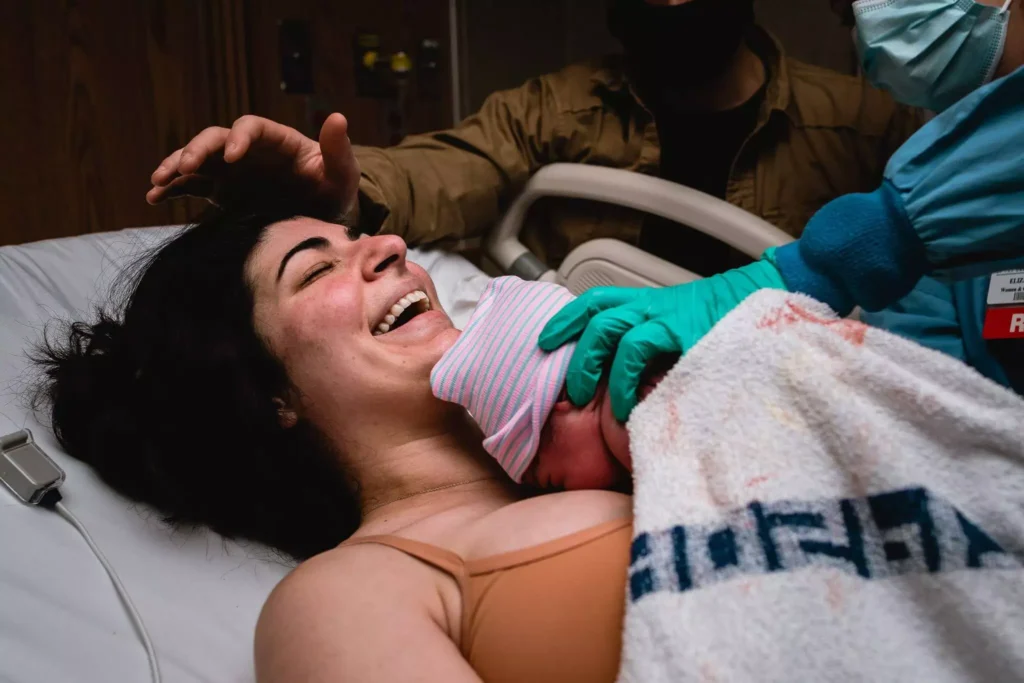

Learn the science of pregnancy and birth to take the mystery of labor away! Understand why you are feeling what you feel, and learn strategies to confidently move through pregnancy and birth!
- 9h+ of Video
- Support Group
- Close Captioning
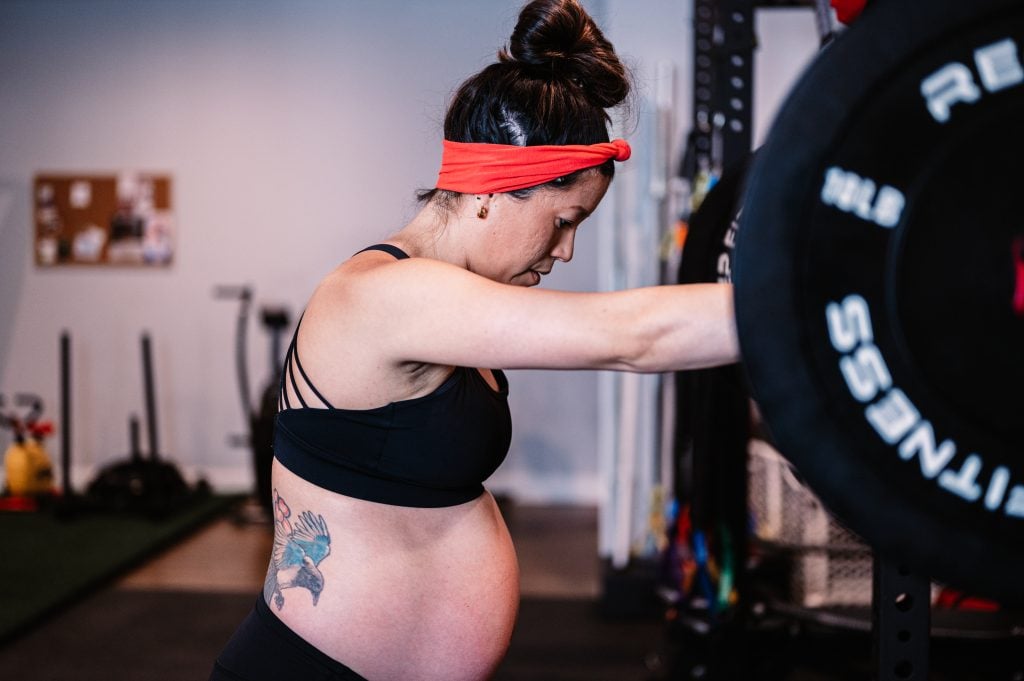

- 5 Workouts/Week
- Gym Workouts
- Self-Paced

Instructor
GINA
Workout on-demand with our prenatal fitness workout videos! Each workout is 30-40 minutes to follow along as you exercise at the same time!
- Birth Prep
- All Trimesters
- Mobility Work

Instructor
GINA
Find comfort and relief from pelvic girdle pain throughout your pregnancy and postpartum period! This program incorporates myofascial sling focused exercises to stabilize across the pelvic girdle joints.
- 3 Weeks
- On Demand Workout Videos to Follow