



Welcome to the MamasteFit Podcast! In this episode, hosts Gina and Roxanne welcome Megan Aucutt, Program Director of Healthy Birth Day, Inc. and creator of Count the Kicks, to discuss the critical role of fetal kick counts in reducing preventable stillbirths. Megan explains why starting kick counts at 28 weeks is essential, debunks common myths about fetal movements, and highlights the benefits of using the free Count the Kicks app for tracking movements. The conversation also covers how kick counts can alleviate anxiety, aid in bonding with the baby, and why it’s crucial to trust maternal instincts and seek medical advice when in doubt about fetal movements.
Read Episode Transcript
[00:00:00] Roxanne: Welcome to the MamasteFit Podcast. Today, we have Megan Aucutt from Count the Kicks, here to talk all about the importance of doing fetal kick counts starting after 28 weeks of your pregnancy to help decrease your risk of preventable stillbirths. This is a topic that is really true to my heart and one of my big soapboxes of the importance of doing kick counts throughout your pregnancy and what is the best way to do those kick counts to not just prevent stillbirth, but also decrease your anxiety and increase bonding with you and your baby, with you and your family.
[00:01:30] Megan: Thanks, Roxanne and Gina! So happy to be here! Thanks for the invite. This is awesome.
[00:01:35] Roxanne: Of course. Do you think you can introduce yourself to our listeners so they can know more about you?
[00:01:40] Megan: Absolutely. like you said, my name is Megan Aucutt. I am the program director with Healthy Birthday, Inc., which is actually the nonprofit organization that created Count the Kicks.
[00:01:50] Roxanne: Okay.
[00:01:51] Megan: Count the Kicks is our evidence based stillbirth prevention program. yeah, excited to be here today.
[00:01:57] Roxanne: Awesome. as kick counts is something that’s educated to most pregnant people during their pregnancy. We start around that 28 week mark is the recommendation, but it used to be the recommendation to, sit down for two hours a day until you get those 10 kick counts, and then you were good to go for the rest of the day. Your baby got their kicks, good. And then you didn’t have to worry about it for the rest of the day. And now, there is a newer recommendation, though, because that one is not evidence based. Do you think you can explain what that newer evidence shows for kick counts?
[00:02:30] Megan: Yeah. at Count the Kicks, we are all based on research, and one of the main studies we’re based off of is this research out of Norway that showed when parents were educated on getting to know what’s normal for their baby, in terms of movement- and I’ll explain what that means in a minute- but to get to know what’s normal for your baby, speak up if you notice a change. And so in the study, what happened was these women who were educated on this, they were handed a pamphlet of how to count their baby’s movements, when to speak up, how to speak up the stillbirth rate, which is the loss of a baby after 20 weeks of pregnancy, decreased dramatically.
[00:03:07] Megan: So where I’m located and where the organization began in Iowa, we’ve seen around a 32 percent reduction in the stillbirth rate from 2008 to 2018. And so what we’ve done is we’ve taken that Norway research and created this empowering, educational, bright, colorful program for expectant parents to get to know what’s normal for their baby, how to count their movements, the importance of counting their movements, and then speaking up to their provider if they notice a change.
[00:03:36] Roxanne: So you said you were going to describe what is normal, what would be a normal movement pattern for a baby?
[00:03:41] Megan: So every baby is different, every pregnancy is different. And so you need to get to know what’s normal for your baby. And one of the ways we help with that is with our free kick counting app. So if you are listening, go into your app store and just search, Count the Kicks, and we’re that little yellow clock icon. Download our app, it’s completely free, there’s no ads. Or we have a web based kick counter, or you can use pen and paper, we have printable kick counting charts on our website.
[00:04:09] Megan: But what we do, and what we educate on, is pick a time every day around the same time. You want to get to know what’s normal for your baby, so focus on a time when baby’s most active or what works best for you. But perhaps it’s two o’clock in the afternoon when you have a 15, 20 minute break in your work day, you can sit down and focus on baby. Or it’s in the evening when everybody else is in bed and you’re finally sitting down from doing everything and you can just focus on baby.
[00:04:38] Megan: So pick that time, open the app, the free app, or get your timer ready. When you feel that first movement that you want to start with, you tap this footprint that’s on the app. Every time you feel baby move, roll, push, jab, anything except hiccups- hiccups are involuntary, so they don’t count towards the movement- you tap this footprint on the screen. If you’re using the app, after you count to 10 movements, the timer stops automatically. And then what the app does is it asks you to rate the strength of those movements.
[00:05:08] Megan: So what research also indicates is we should be paying attention to how strong those movements are as well. So we want to rate the strength between “fluttery” to “fierce”, one through five. You can add notes on the app. And then what’s really cool about the app in particular is that you get a graph. So after you finalize your session, you get a visual representation of how your baby moved. So after a couple of sessions, you start to see the average amount of time it takes your baby to get to 10 movements.
[00:05:37] Megan: So let’s say you’re counting one day, Roxanne, and your baby for the last two weeks, you’ve been counting and takes 15, 20 minutes to get to 10 movements. And one day you’re counting and it takes a lot longer. Maybe it took an hour and 15 minutes, for example. What happens on the graph is it spikes up- there’s no alarm limits, it’s all about getting to know what’s normal for your baby- but you, who’ve been using the app and now you’re educated, you’re informed, you have data in your hands to say, “That’s not my baby’s normal. My baby’s normal for the last two weeks has been 10, 15 minutes, and now it really shot up. So I’m going to call my provider or go to my nearest birthing center to get checked out.”
[00:06:14] Megan: So really what the app does is it quantifies your intuition, essentially. It’s giving you data in your hands to show your provider, “Yep, this is my baby’s normal,” or, “Nope. I want to be seen and get to know what’s going on.”
[00:06:26] Roxanne: Yes! I love that!
[00:06:28] Roxanne: So with the kick counts, I know 10 is like the usual recommendation of getting 10 kick counts. What if your baby’s normal is less than 10?
[00:06:38] Megan: Yeah, so what we’re based off is that research, again. So we’re looking at, it’s called the Cardiff Method, and what we’re doing is taking that and the other research that we’ve cited, like Norway, and if you go to our website, we were also published in the British Journal of Obstetrics and Gynecology, we’re really focused on that 10 movement count.
[00:06:56] Megan: So I would sit down, and as long as it takes for your baby to get to 10 movements, that’s going to be the number you’re going to work off of, that timeframe. So most babies will get their 10 movements fairly quickly, 30 minutes or less, give or take. But it’s really different and dependent on each baby and each pregnancy.
[00:07:15] Megan: I think the most important message I could send to the listeners today is just, getting to know what’s normal for your baby- so get to those 10 movements, after a couple sessions around the same time each day, you’re really going to notice a pattern.
[00:07:29] Roxanne: Mmhmm.
[00:07:29] Megan: Start doing this in the third trimester, that’s when research also indicates you can track a pattern with your movements. So I know most people feel baby movements around 19, 20, 21 weeks, but that pattern comes into play that you can recognize as an expectant person around that 28 week mark- 26 if you’re high risk, go ahead and start counting then, 28 weeks otherwise.
[00:07:52] Roxanne: So I know this is another common question is if you don’t get your kick counts, what should you do? And some people will say, “Oh, try to drink something if you haven’t got those kick counts. Drink something cold, something sugary, or maybe eat something if maybe you didn’t eat something all day.” What is your thoughts on that recommendation? Obviously I have my thoughts on it. I don’t love it. But what are your thoughts as the expert?
[00:08:15] Megan: Yeah. Yeah. No, again, based off research, what research is now indicating is that we don’t want to do interventions to get baby to move. And I think about it like this- when you and I are sick, we are conserving our energy. We are resting, we’re on the couch, we’re sleeping a lot- the same with baby in utero. If baby has an infection, or umbilical cord (issue), whatever’s going on, they’re conserving their energy, so their movements are going to slow down. So that’s why we really want to focus on getting to know what’s normal and speaking up. We don’t want to try to intervene and force baby to move, just like I wouldn’t say, “Oh, go drink like three Mountain Dews and eat a Snickers bar to get up and going about your day,” when you have the flu.
[00:08:58] Roxanne: Yeah.
[00:08:58] Megan: You’re going to rest and conserve, same with baby in utero. And there’s research on our website, countthekicks.org, I know we’ll be in the show notes, go to our evidence page and you can read more on that research around that 10 and 2, and everything like that too.
[00:09:11] Roxanne: Yes, I love that because we, as a nurse, in triage, we get that phone call like at least once a shift of, “Hey, I haven’t felt my baby move today. What should I do?” And I always say, “Just come in.”
[00:09:23] Megan: Come in.
[00:09:23] Roxanne: If you’re concerned about movement at all, even if you come in and everything is fine, or as soon as you get in the car, baby starts moving like crazy, still just come in and we’ll make sure that baby’s doing okay. Because I would rather you come in 14 times a week rather than the opposite happen.
[00:09:41] Megan: Yeah.
[00:09:41] Megan: I love that. And I hope everybody listening that is a medical provider and works with expectant parents has the same message to their patients. Like, you are there for them, you want to hear from them if they have questions or concerns- no matter what it is, right? Movement, bleeding, contractions, come in. I want to be seen.
[00:09:57] Roxanne: Yeah.
[00:09:57] Megan: I think too, as I think through like our work and the impact of birthing center closures and access and rural areas, instead of waiting for your family care physician to open or anything, just go into your nearest birthing center, don’t wait. Hours and minutes really matter when it comes to this. And like you just said- you sounded amazing, I wish you were my nurse!- where you just said, “I’d rather you come in, than not.” So that’s, I think, what every expectant parent needs to hear from their provider.
[00:10:29] Roxanne: Yeah, like we’re going to be there regardless at the hospital to twiddle our thumbs for 12 hours if nobody comes into triage. So I’d rather you come in and also keep me company. Give me something to do.
[00:10:40] Megan: Yeah!
[00:10:40] Roxanne: Because we’re there to serve this population. Exactly. I get paid to do this. So come in, bother me. I don’t care.
[00:10:47] Megan: Yes.
[00:10:48] Roxanne: You’re not bothering me!
[00:10:49] Megan: Exactly. Yes. Yeah, exactly.
[00:10:52] Roxanne: So another common misconception with kick counts, and I’m sure you already know where I’m going with this, is at the end of pregnancy, your baby moves less because there’s less room for baby to move. So it’s okay if it decreases at the end of pregnancy. But what is the actual evidence on this?
[00:11:12] Megan: No, it’s not okay! Babies don’t run out of room. The types of movements may change. You know this, everything gets bigger, right? Baby, everything.
[00:11:22] Roxanne: Yeah.
[00:11:23] Megan: So instead of feeling more of those body rolls because they have that space to do those body rolls, you’re going to feel more of those jabs to the rib, and the bladder, and the kicks where you have to pee right away. So the movement type may change, but you should still get 10 movements in the same amount of time that you’ve been getting for the last two weeks. So they don’t slow down.
[00:11:44] Megan: Babies move up to and during birth. You know this too, right? Like they should move, so don’t let anybody tell you differently. They don’t slow down. They don’t stop moving. You should be getting your 10 movements. So we also, the CDC Hear Her Campaign, right? They talk about 15 urgent maternal warning signs. So if you haven’t looked at that, you can look them up. But one of their urgent warning signs is baby movements slowing down, or changing, right? We’re all about, “Is it a change? Is it a significant change that you feel like you need to contact your provider?” What the app does especially is gives you that data in your hands. If you can’t use the app, use a personal computer, go to the library and count, or print our kickable charts and do it that way with a pen and paper. That’s fine too. Just get to know what’s normal for your baby. They don’t slow down, they’re not running out of room, the movements just change.
[00:12:38] Roxanne: Yes, and I love that.
[00:12:39] Megan: In terms of how you feel them, I shouldn’t say change, but yeah.
[00:12:43] Roxanne: Yes, because again, they are bigger, so they shouldn’t be doing somersaults in there at 40 weeks pregnant, because that would be… you would notice them, but they just don’t have the room to do that. But they are still kicking and moving, and even during labor, they are actually kicking the monitors off some of the times, like the contraction monitors, you sometimes see their little feet hitting them. And people are like, “How are they still moving?” I’m like, “They’re trying to move down! They’re using all they can to move through the pelvis!” So, they should still be moving at all times.
[00:13:15] Megan: Exactly.
[00:13:15] Roxanne: I know one of the things with kick counts, obviously the big emphasis for most of the time is on preventing these stillbirths, but sometimes even just sitting down and like taking the time to do these kick counts can be really beneficial just for bonding with your baby and learning what they’re doing can be a really big bonding moment with your baby.
[00:13:33] Roxanne: Is there any like evidence really to support that at all?
[00:13:36] Megan: Yeah, that’s a great question. And, with our app users, one of the things that we’ve done is we’ve researched birth outcomes in our app users, and 77% have stated that it helped reduce their anxiety, and I’ll tell you why in a minute, and then 84 percent said it helped them bond with baby. Because just like you said, this is a way to sit down, focus on baby, include significant others, include other children, say, “Come on, let’s go count your baby brother’s movements and read to him!”- now we’re improving health literacy at the same time.
[00:14:09] Megan: The way that it really helps reduce anxiety is going back to that, think of it like that data download of mom’s intuition, or parents’ intuition is that now you know what’s normal, versus guessing and not knowing. And you can say, “Yep, this is my baby’s normal movement pattern,” or, “Nope, this is not my baby’s because I’ve been counting.”
[00:14:29] Megan: The other question I get asked a lot that kind of goes with this is, “My baby’s always active. I don’t need to count! It’s like a jungle gym in there,” right? I hear that all the time. And I always say the same thing, is, “That’s great! A healthy baby is an active baby, but we still want to count those babies’ movements to make sure that our normally active baby hasn’t slowed down,” because sometimes it can happen really quickly and without warning. Plus it takes the guesswork out of knowing if your normally active baby has slowed down.
[00:14:56] Megan: I’ve had three children, three pregnancies. My son was five minutes or less, I got 10 movements. My daughter was 30 minutes. She was a lot slower, I guess you could say than my son, but I was comparing her to my son and I shouldn’t have. So I went to triage a couple times, got checked out. Everything’s great. She’s now eight and thriving and wonderful.
[00:15:18] Roxanne: Yes.
[00:15:19] Megan: But that just goes to show don’t compare to previous pregnancies. Every baby’s different. Go to your doctor if you have questions or concerns. But I also needed to know what was normal for her. And that was her normal when I was counting. And I didn’t know that at the time before I learned about Count the Kicks. So now that I know I would have had data in my hands.
[00:15:37] Roxanne: Yes. And I think that that’s amazing that you have the data to support that it does decrease anxiety, because that is something that a lot of people will say, “I just don’t even do it because it makes me more anxious to do these kick counts, to be like sitting there worried that my baby hasn’t reached their 10 kicks yet, or like how it’s like taking so long to get those 10 kicks. Like I had sat there for five to 10 minutes, so I’d like just don’t even do it anymore because it decreases my anxiety NOT to do it.” But I think like what you’re saying that having the data in the app or on the paper to show, “Hey, this is what my baby is doing normally. I do it once a day. I know they’re doing okay.” This is decreasing your anxiety by having like concrete evidence, almost. Rather than just, “Oh, I took 20 minutes to do baby’s kick counts today. But yesterday it took me 19 minutes. Like I feel a little bit more worried now.” But I love that.
[00:16:29] Megan: Yeah. Yeah. Cause the app is really tracking day to day, but then it gives you the average, so what’s the average amount of time it takes your baby to get to 10 movements, which is really nice. And it really is a best practice. We’ve been named a best practice by the Association of Maternal Child Health Programs. We’re based off evidence. We have an amazing interactive website that really helps walk people through. We have a parent academy where you can go and watch YouTube videos and success, testimonials.
[00:16:58] Megan: I guess another thought or question or point to your listeners is, if you’re counting, talk to your provider about it, your midwife, your doula, and say, “Hey, have you heard about this? I’m doing this and I want to share my data.” you can download the data and share it with your provider. Hopefully they’re talking to you about this, but if not, bring it up to them.
[00:17:19] Roxanne: Yes, I love that. I think even us as medical providers, we love data, like love seeing data and numbers. So I think that would totally resonate with either the nurses, midwives, or even like the OB providers. So I love that.
[00:17:33] Roxanne: So I know you stated this already, that hiccups do not count as a movement. But then we will get a follow up question of how do I know that it’s not hiccups?
[00:17:44] Megan: Yes.
[00:17:45] Roxanne: Like how do you tell someone that it’s not a hiccup and it’s actually a movement? Or, that it is hiccups and those don’t count.
[00:17:52] Megan: I do not have a medical background, first of all. And so what I always go off of, so you might be able to share more about this as that labor and delivery nurse, but like I said, I’ve had three babies and hiccups are really rhythmic. They’re really like consistent, versus movements. Especially those first time parents will ask you that, and that’s what I always say, you’ll get to know the difference, right? Hiccups are really rhythmic, bump, bump, bump. And sometimes they bothered me, like they annoyed me, not bothered me. But that’s just the baby practicing breathing and, they’re involuntary movement, so they don’t count towards the movement. I don’t know if you’d say something different to your parents, but that’s what I would say.
[00:18:35] Roxanne: No, that’s exactly it. I didn’t know if the app had a feature where if they were hitting it for like that rhythmic timing, would they be like, “Are you sure these are movements? Are these hiccups?”
[00:18:45] Megan: Yeah.
[00:18:45] Roxanne: Because like of the way that they’re like pressing the button? No? that would be cool.
[00:18:50] Megan: Yeah! That’s good to know! I’ll take that to the team for updates to the app, perhaps, and see what that looks like.
[00:18:56] Roxanne: But yeah, so I usually explain hiccups as they are, yes, rhythmic, and they’re usually in the same exact spot, over and over, lasting for a couple minutes. So whether a baby’s head down or head up, it’s usually like wherever their back is where they’re going to feel those hiccups, and they’re rhythmic and they feel like, again, like a little bump.
[00:19:15] Megan: Yup.
[00:19:15] Roxanne: And some of the time, like you said, they are annoying because they like, there’s nothing you can do for hiccups. They just happen. Even when you get hiccups as an adult.
[00:19:24] Megan: Yeah.
[00:19:24] Roxanne: Like they just happen out of nowhere.
[00:19:26] Megan: All my kids had hiccups all the time, I felt like!
[00:19:40] Roxanne: I use their prenatal vitamins still to this day, and one of my favorite things about their prenatal vitamin is it comes in different variations. So they have their prenatal multi powder, which is their OG prenatal. This is something that you can add to any drinks, any beverages, you can add it to an orange juice in the morning, and this is a great one if you’re not able to drink capsules or if you’re really nauseous in that first trimester, you can still get your prenatal vitamin in without feeling nauseous. The other two variations are capsule variations. So you have their eight capsule and then their three capsules. Some of us will take all eight capsules in a day, and it has more of the optimal levels of dosages we need, but they have their essential versions where it’s just three capsules for those that don’t want to take eight capsules and then potentially doesn’t like the powder.
[00:20:23] Roxanne: So I love that they have different options because the importance of a prenatal vitamin is so important, not just during pregnancy, but also preconception, to help support and prep our bodies for carrying a baby to ensure that our vitamin levels and mineral levels and all of the nutrients that we need to carry this baby are at an optimal level prior to getting into pregnancy, as well as during pregnancy.
[00:20:45] Roxanne: And even postpartum, you can still use their prenatal vitamin. So you can check out Needed at thisisneeded.com and use code MAMASTEPOD to get 20 percent off your order or the first month of your subscription.
[00:20:57] Roxanne: And another thing with the fetal kick counts, so some people will have fetal dopplers at home, and when they are concerned about their baby’s movement, they’ll pull out their fetal doppler and listen to their baby’s heart rate and be like, “Baby’s good!” What are your thoughts, and is there any information in the app about using an at home fetal doppler for like reassurance that baby is fine?
[00:21:20] Megan: So that’s a great question. And I feel like we ran into this a lot during COVID when a lot of appointments were telehealth and things like that.
[00:21:29] Roxanne: Mmhmm.
[00:21:29] Megan: What we say, and what research says, is that actually, a change in your baby’s heartbeat is one of the last things to change when a baby’s in distress, whereas movement’s first.
[00:21:39] Megan: So to base it off of a Doppler is not something we recommend. We don’t recommend the use of Dopplers unless they’re medically trained, and even then, not to, make sure baby’s okay. Even when somebody goes in to you, for example, or Labor and Delivery for concerns, I hope that they are not just doing a Doppler and sending them on their way. You’re doing additional testing, right?
[00:22:02] Roxanne: Yes.
[00:22:02] Megan: So, Doppler’s are not recommended to see if baby’s okay, plus the chance of you hearing baby’s heartbeat versus your own and getting confused, it’s just, it’s not how it works. We do not recommend, that research does not recommend that to look at if baby’s doing okay. No Dopplers, no apps.
[00:22:22] Roxanne: Yes, exactly, like the Doppler. And I love that if someone knows how to use a Doppler, it’s like a great way to just hear a baby’s heart rate and like bond with them. So if you have one, great, you can use it. But again, if you don’t know what the baby’s heart rate sounds like on the Doppler versus your own, some people will hear their own heartbeat and be like, “Yeah, that’s my baby! I love it!” I’m like, “That was your own heart rate. Great on you for listening to yours.” But then, a Doppler doesn’t tell you anything except that baby has a heart rate. It doesn’t tell you whether baby is thriving, or if baby is in distress.
[00:22:59] Megan: Exactly.
[00:22:59] Roxanne: It just tells you that baby has a heart rate at that exact moment. Whereas when they do come to the hospital, like you said, we aren’t just doing a Doppler and sending someone on their way. We’re doing additional testing of that non stress test where we get 20 to 40 minutes of baby on that heart rate monitor to see whether or not they are contracting as well as what is baby’s heart rate doing and what are the signs that baby is giving us that they’re doing well in that moment with their like heart rate variability, which is that beat to beat difference in heart rates. We should have that beat to beat difference, as well as looking for those accelerations or increases in their heart rate above 10 to 15 beats a minute above that baseline of their heart rate. So those are things that we’re looking for on that non stress test that says, okay, baby is doing okay at this moment.
[00:23:44] Roxanne: But again, we’re not just doing a non stress test as well, because you said that is the last thing that’s going to show that baby is not doing okay. We’re doing that additional ultrasound to see like how much fluid is in there, because that could affect how much like movement you’re potentially feeling, because maybe if they don’t have a lot of fluid, they can’t move as much. It’s like being in like, if you’re in a pool and there’s no water in the pool, like you just can’t, you’re not going to be able to slosh around and feel some movements as easy. As well as looking at, is baby practice breathing? Is baby actually moving? And if you have an anterior placenta, maybe you’re just not feeling all of those movements. But is baby still moving? And all of those things that we’re looking for, the tone of baby, is baby moving, flexing, and does it have a good tone? And based off of that, that gives us a more overall picture of how well baby is doing.
[00:24:35] Roxanne: And sometimes, though, someone could come in, have that decreased fetal movement, and that non stress test and the ultrasound can show that baby is doing okay in that moment. And they can send them home, but they can still come back multiple days in a row with that decreased fetal movement, and there’s still something is off.
[00:24:53] Megan: Yeah.
[00:24:54] Roxanne: And I think as medical providers, sometimes we need to look into that further.
[00:24:58] Roxanne: Because, my worst day as a nurse, was we had- I was working labor and delivery, I’d been a nurse for two years at this point- this same patient came to the triage unit every single day, and she said, “My baby’s just not moving the same. I am concerned.” And every day we’re like, “Yes. Come on in we’re gonna check your baby out.” It was for a week, she came in straight, saying that her baby had decreased movement. Baby looked great on the monitor had great variability, having tons of accels, ultrasound looked great as well. Like she had no signs of fever or any sort of infection. So she just came in every day. But on that eighth day, she came in and baby was no longer moving and had no heart rate and I was just like, “What could we have done prior to this?” She was 36 weeks. It was like the hardest day of nursing, because this was my first that I was like, actually the nurse in the room to find it. And I was like, “What could we have done differently to prevent this?” Because as you said, how many stillbirths are actually potentially preventable?
[00:26:05] Megan: Yeah. About a quarter. So one in four. We know that not all stillbirths are preventable, unfortunately, but, a lot are. And so getting to know, coming back to that movement side of things, and I’m sorry for that mom and family and you as the medical team, because it really does impact everybody. And some are just unexplained, unfortunately, and it’s devastating to everybody.
[00:26:33] Megan: And so I think that anything that we can do to make sure that people have the education and awareness that they need. And this goes for high risk pregnancies too, and non high risk pregnancies. We should be telling everybody about the importance of tracking their baby’s movements and trusting their instinct and gut.
[00:26:53] Megan: And then one of the things that we’re doing is we’re working with the Association of Women’s Health Obstetric Neonatal Nurses, so AWHONN, the leading labor and delivery organization in the United States. You probably know this.
[00:27:07] Roxanne: Yes. Love them.
[00:27:08] Megan: You a member?
[00:27:09] Roxanne: Yes, I am a member!
[00:27:10] Megan: So we’re working with them on a protocol, an algorithm, of what to do when somebody does come in with a change in movement. Because there’s no standard of care. There’s a huge gap in the literature around this. And so we’re currently piloting that algorithm based on thousands of lit review articles, research, so that will be coming out later this year, early next year.
[00:27:30] Roxanne: Oh, I love it.
[00:27:31] Megan: That’s another piece of that evidence that we’re putting together in our toolbox.
[00:27:36] Megan: I have a medical advisory board member, a Dr. Monsager, who’s a specialist, MFM specialist, and he always says, “Movement is an acute condition, right? If there’s a lack of movement, changing movement, that’s acute, not chronic.” Even though that mom was getting ultrasounds at that point of time, right? Has she had any other issues after that? We don’t want to be thinking, “Oh, I can just get another ultrasound in a week!” Nope, come in. She did everything right, there’s nothing anybody could have done differently, it doesn’t sound like anyways. Yeah, it’s just one of those things where we just want to be aware and prevent preventable stillbirths to the best of our ability.
And that’s one way is truly through our app, which has seen success and evidence in our program.
[00:28:24] Megan: So, if you’re listening and you work with expectant parents, on our website, we do have educational materials, our brochures, our posters, things like that. That’s your patient education. We really want people to see this a variety of different ways. We want them to see it on our social media, in their restroom when they’re giving their urine sample, we want the provider, the nurse to talk about it. Maybe they see billboards. So yeah, the more times the better. And then as a provider, You should be talking about movement every single time you see them in the third trimester.
[00:28:57] Megan: I remember, when I was pregnant with my first, and this was 11, 12 years ago, all I was ever asked, and it was at 21 weeks, 20 weeks, I think, “Have you felt baby move yet?” And that was it. And I was a first time mom. I was like, “I don’t know! I think I felt movements. I’m not sure if it was gas or movement!” First time mom, second time, third, fourth, talk to them about movement because every baby, every pregnancy is different and more than just at that 20 weeks mark, right? Like consistently. And it should take three to five minutes. This does not take long at that 10 minute appointment, to have this conversation.
[00:29:35] Roxanne: Yeah. And I think that’s so important because that is something that is missing in some appointments. Granted, I was a Labor and Delivery nurse when I got pregnant, so my providers would be like, “Are you doing your kick counts?” and I’d be like, “Yes, I am,” because I should hopefully know how to do them at that point. But is that something that every provider is going over every appointment outside of like obviously my experience? Or like maybe they are only bringing it up at that 28 week point. Because we would get a lot of people in triage between 20 and 28 weeks coming in because they’re like, “My baby’s movements are different today,” When it’s that their nervous system is not fully developed, so like they’re not in that pattern yet. But it’s still always helpful to come in if you are ever again, concerned. Again, you’re not bothering us. But it’s also, it’s hard to educate, to be like, if you’re not feeling those same movements, until 28 weeks you might not, but it’s also you don’t want to tell someone not to come in and then something potentially be wrong. Because again, stillbirth happens at any point after 20 weeks.
[00:30:43] Roxanne: So obviously, this is a passion of yours, but also a super big soapbox of mine, like fetal movement, come in. Because again, I don’t want to be that nurse ever again that does find a baby that does not have a heartbeat because it is obviously really hard for the families and like having to support them through that, but also it is hard on us too because Labor and Delivery is supposed to be a happy place.
[00:31:09] Megan: Yeah.
[00:31:09] Roxanne: Where babies are born and lives are started, for both the parents and the baby, but.
[00:31:14] Megan: Yep.
[00:31:14] Roxanne: There are those few that come in that are… it is a hard time. And I remember every single one vividly.
[00:31:21] Megan: Yeah, I think the main message, too, is trust your instinct. Go in. Don’t let people make you second guess or question yourself. Don’t think to yourself, “Oh, I don’t want to be a bother.” I think as especially women, sometimes we’re like, “Oh, we’re the last to focus on ourselves.” No, you should go in if you have questions or concerns. So, absolutely.
[00:31:46] Roxanne: And I think the last word that I’ll say is, if someone comes to our triage unit and they say they have decreased fetal movement, they like, move up in priority. We’re gonna get you back as soon as we possibly can so that we can at least listen to baby’s heart rate to know that baby has a heart rate. So know that you’re not gonna be there for forever if you do have decreased movement and then everything is fine. Come in, get checked out, and we can always, again, send you home with some more education of what to look for with baby to come back if anything else is truly wrong.
[00:32:16] Megan: Yep Absolutely. Love it.
[00:32:18] Roxanne: Thank you so much, Megan, for coming on to the podcast to share about obviously this really important issue for you, but also a huge soapbox of mine. That’s something I’m super passionate about. I’ve been seeing you all over Instagram, and I’m like we need to get this information out to everybody because this Count the Kicks app is definitely evidence based. I learned about it in my midwifery program as well, that like the old way is out, this is the new way of helping to evidence based decrease the rate of stillbirth, especially those preventable stillbirths. So thank you again for coming on the podcast.
[00:32:50] Megan: Thanks for reaching out. This is awesome. And anytime that we can share this information and, I guess final points would be download the app or go to our website to learn more. And then if you’re working with expectant parents, talk to them about tracking their baby’s movements and going to our website as well. But yeah, find us on all the socials. I’m sure that will be in the after show notes and we’re just grateful for people like you and Gina to elevate this and share it with your listeners because that’s how we save more babies and parents and families and labor and delivery and everyone.
[00:33:26] Megan: And so thank you from the bottom of our hearts for truly sharing this with everybody. So we appreciate it.
[00:33:33] Roxanne: Of course. Yeah, of course!
[00:34:51] Roxanne: I really hope you enjoyed this episode with Megan Aucutt from Count the Kicks on why it’s so important to be doing these fetal kick counts throughout your pregnancy, as well as how is the best way to do those fetal kick counts.
[00:35:02] Roxanne: We get so many questions about fetal kick counts, especially as a Labor and Delivery nurse, so many people call about fetal kick counts and fetal movements in general. And it’s one of the things that I’m most passionate about educating on to ensure people are doing their kick counts and when to go in just to ensure that nothing is wrong. I’d rather somebody go in and see me and triage every single day and nothing be wrong, rather than feel like they might burden me and bother the Labor and Delivery staff or their providers with this concern, when maybe something is actually wrong and they need to be assessed.
[00:35:37] Roxanne: So I highly recommend checking out their app and utilizing all of their resources on Count the Kicks to be able to monitor your baby, check out all of their fetal movements, what’s their average, and be able to spot when there is a change in their movements.
[00:35:51] Roxanne: If you enjoy this episode, please like and subscribe to our podcast so you can be notified whenever we release new episodes. We release new educational (episodes) every Wednesday and birth stories every other Friday.
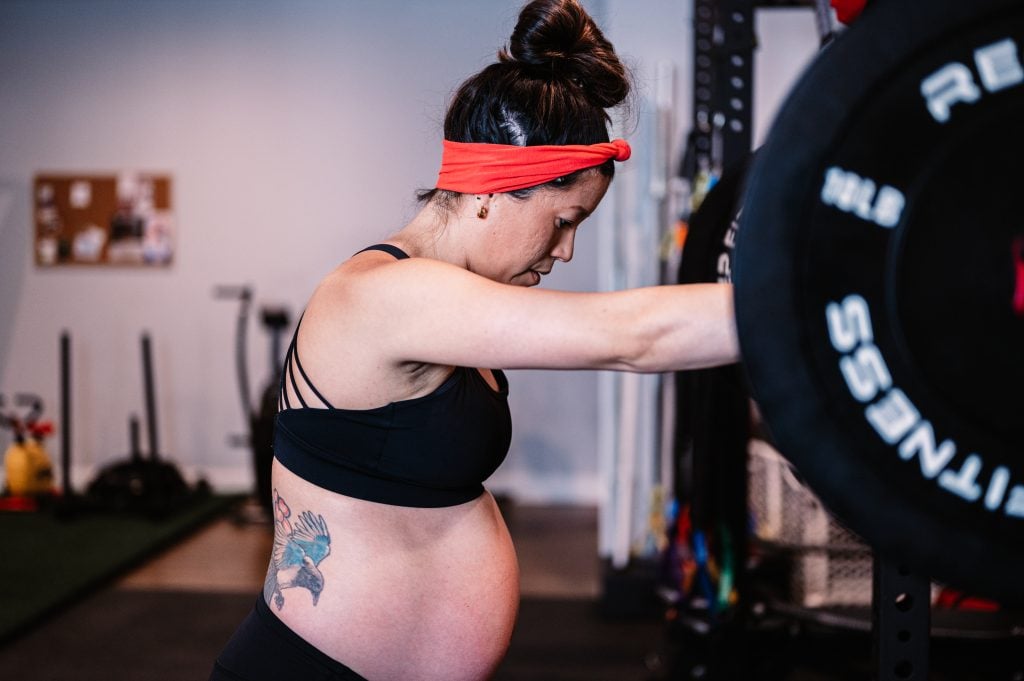
[00:36:01] Roxanne: If you’re looking for more support during your pregnancy, check out our prenatal fitness programs in childbirth education. Our prenatal fitness programs are available in two formats, in our TeamBuildr app, and an On Demand format. The programs are synced to your trimester and in the app the exact week of your pregnancy. The TeamBuildr app is a list of exercises with short demo videos that you can work through at your own pace. We have a full version and a mini version. Mini version is about 15 to 20 minutes a day with both mobility as well as strength workouts. And our full program is about 45 to 75 minutes a day with strength workouts, mobility and birth prep movements. Our on demand format is a video that you watch and follow along with that also incorporates all of the same things. So strength movements as well as mobility and birth prep movements. Both of these options can be bundled with our online childbirth education course where we discuss the science of labor and birth to break down some of that mystery and make it less scary. We find when we understand what’s physically happening within our body, both like anatomy wise and physiologically wise, this makes it less scarier and easier to cope with labor.
[00:37:03] Roxanne: We also discuss different birthing options as well as different things that we could do throughout our pregnancy, such as fetal kick counts in our childbirth education course. And this again can be bundled together to save an additional 15 percent on those courses. And as a thank you for listening to this entire episode, you can use code STORY10 to get 10 percent off any of our courses.
Additional Resources
About Megan:
Megan Aucutt is the Program Director with Healthy Birth Day, Inc. – the non-profit that created the evidence-based Count the Kicks stillbirth prevention program. Megan is a University of Northern Iowa graduate with a Bachelor’s Degree in History and an emphasis in Global Health. She has over 15 years of experience with nonprofits and governmental work, focusing on grant writing and reviewing, coalition building, and educational program development. Her true passion is maternal and child health. As Program Director, Megan oversees the organization’s research and programmatic outreach. She also manages the free Count the Kicks app and works closely with the medical community on system and policy changes. Megan believes that knowledge truly is power. She used the Count the Kicks App during her pregnancies and has three healthy and rambunctious children. She is proud to be part of such an important organization with a powerful mission of saving babies.
Check out Megan’s website and download the Count the Kicks app here!
Prenatal Support Courses


Learn the science of pregnancy and birth to take the mystery of labor away! Understand why you are feeling what you feel, and learn strategies to confidently move through pregnancy and birth!
- 9h+ of Video
- Support Group
- Close Captioning

- 5 Workouts/Week
- Gym Workouts
- Self-Paced

Instructor
GINA
Workout on-demand with our prenatal fitness workout videos! Each workout is 30-40 minutes to follow along as you exercise at the same time!
- Birth Prep
- All Trimesters
- Mobility Work

Instructor
GINA
Find comfort and relief from pelvic girdle pain throughout your pregnancy and postpartum period! This program incorporates myofascial sling focused exercises to stabilize across the pelvic girdle joints.
- 3 Weeks
- On Demand Workout Videos to Follow