
Diastasis Healing
If you have been doing all the supine breathing drills and heel slides that your physical therapist has prescribed you, but you are still not seeing improvement in your diastasis, then you could just not be challenging yourself enough! Or you’re feeling great doing your heel slides in a supine position but once you stand up to do something, you experience pressure management symptoms, such as coning, or having trouble activating your core.
Our bodies will only be as strong as the demand we put on them. If we are doing all our exercises and rehab in a gravity-supported position like supine, we will likely only be able to properly manage pressure and demand in that position. We may need to shift our position to increase the demands from gravity or load it with weights or resistance so we can start to see an increase in the density of our tissues, muscles, and surrounding structures.
We want our abdominal wall to be denser, or thicker so that it can better respond to increased demands. These demands could include: increase intraabdominal pressure, such as sneezing, laughing, coughing; picking up a heavy item (or your child); or even just moving our body around by either exercising or just daily activities. We can increase the density of our abdominal wall by increasing the challenge of exercises. So, if your supine heel slides aren’t cutting it anymore, let’s try a few different strategies.
1. Change the Position
When we adjust our position, we change the gravity demands. Instead of only doing supine, ground-supported exercises with no real gravity demand, let’s flip around! Try all fours or side-lying, half-kneeling, or even standing. When we are more upright, we increase the number of muscles that need to activate to help us stay upright and stabilize. This activation increases our neuromuscular connection since tons of muscles and fascial lines need to work together to help us maintain an upright position and then also move; and it also helps to increase the density of our bones, tissues, and muscles.
If you are finding that supine positions just feel too easy or you are able to manage your diastasis and other pressure management symptoms well in a supine position, then let’s change the setup to something more challenging. Or maybe you are finding that supine just doesn’t feel right for you, or you aren’t seeing an improvement in your symptoms. Then we definitely want to change it up!


2. Resistance Training: Increase the Loading and External Demand
When we increase the external loading, we will become stronger. This increase in strength improves the density and coordination of our muscles, tissues, and bones. This increase in density helps our body better adapt to our environment, manage pressure, and support our healing process.
We can increase external loading by holding or pushing weights, but also by using resistance bands! Anything that requires you to exert force to move against gravity with a load is resistance training. You can also adjust your stance and set up with various loading options.
For example, you can hold one weight only on one side in a suitcase carry (this increases the anti-lateral flexion component of core training); you can hold a weight in both hands; you can hold weights in a suitcase on both sides or front rack position (the height of the weight adjusts the balance challenge and muscular activation); you can push a sled or pull a weight; you can attach bands high or low. There are so many options on how to use resistance training!
If you want a weekly strength training program to follow, check out our prenatal or postpartum fitness programs.

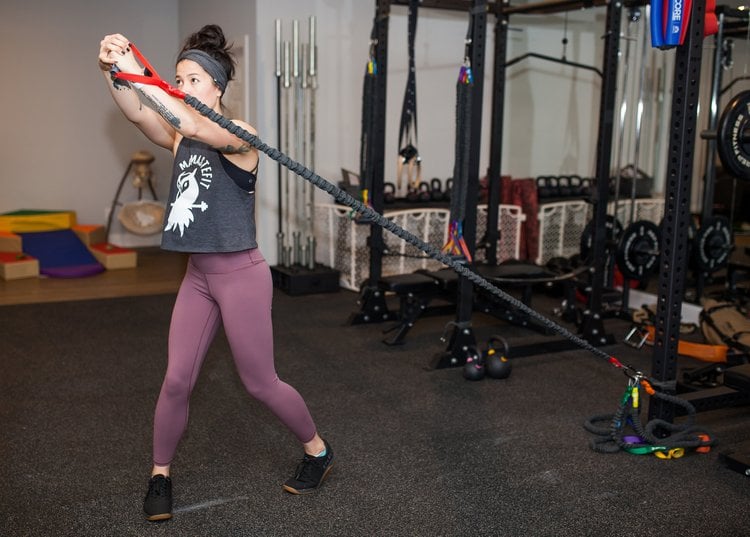
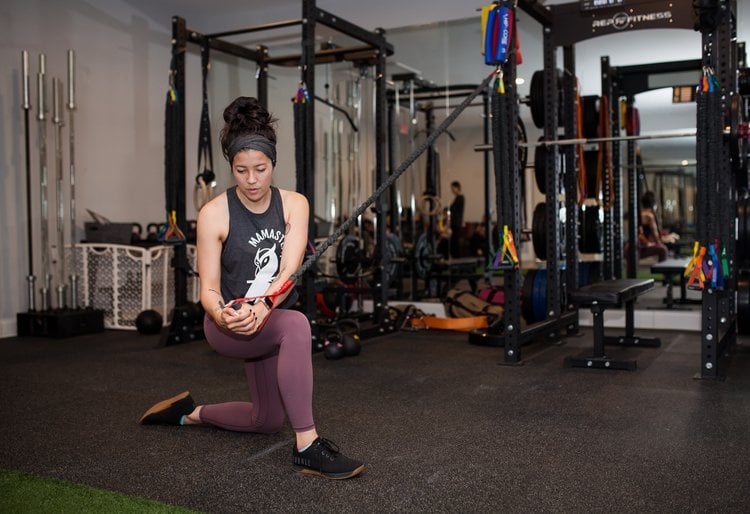


If you are not seeing improvement in your postpartum issues, it could be that you are just not challenging yourself enough. We will only be as strong as the demand we put on ourselves! Changing your setup, lifting weights or using resistance bands are a great ways to help improve your postpartum healing journey.
If you want more support, explore options to work with our pelvic floor physical therapists, either in-person or virtually in a 1:1 or group setting!
Fitness professional? Check out our newly released pre/postnatal fitness trainer certification course! This course is completely online and self-paced!