



Welcome to the MamasteFit Podcast Birth Story Fridays. This episode features American mom Elena, who shares her unique birth experiences in Italy, transitioning from an Italian hospital delivery after her first to a more empowering home birth with Italian midwives for her second. Elena details her preparation for birth, the unexpected challenges faced during her hospital birth, and the transformative journey to a community birth setting for her second child.
Read Episode Transcript
[00:00:00] Gina: Welcome to the MamasteFit Podcast. In this episode, we’re going to be listening to Elena share her birth stories where she gave birth in an Italian hospital, and then gave birth at home with some Italian midwives as an American living in Italy. In her story, she shares how she felt about her hospital birth experience and what helped motivate her to switch to a community birth setting instead for her second birth.
[00:01:48] Gina: Welcome to the MamasteFit podcast, Birth Story Friday. In this episode, we have Elena here who’s going to be sharing her hospital birth story and her home birth story living in a foreign country in Italy.
[00:01:58] Gina: So thanks so much for being here.
[00:02:01] Elena: Thank you guys. Thank you so much for having me.
[00:02:03] Gina: Absolutely. So tell us, how did you prepare for birth living in a foreign country?
[00:02:11] Elena: When I got pregnant, it was pretty unexpected. We were not… we didn’t even know that we could have kids initially. So it was a big shock.
[00:02:19] Elena: We got, I got pregnant after we got married. So I really didn’t know where to start. But a friend of mine who, she had just given birth to her first kid, sent me, y’all’s Instagram. And I started there looking at just all of the info that you guys put out there, and then I was in the States for a short stint, and I realized that you guys, there’s a MamasteFit in the town that my parents live in, and I was visiting my parents.
[00:02:49] Elena: So I started delving more into that and I was like, “Oh, that’s so cool.” And, my husband was obviously still out here. So I, actually first started with taking y’all’s pre/postnatal fitness trainer course in person, just because I’m an athletic trainer and I thought, “Oh, like this is something that I can use, but then also maybe this is something that I can use, not just personally, but in my job as well.” and I just took a lot from that course and, I really enjoyed learning from you guys.
[00:03:20] Elena: So then my husband and I decided to take the course. We did it virtually since he was, like, overseas and I was back in the States at the time. So that was the groundwork and we learned so much from the course.
[00:03:33] Elena: I think that where I went wrong is that I got very cocky and I was kind of like, “Okay, yeah, I learned the stuff. That’s all I need to do.” I didn’t, just being naive and being a first time mom, I wasn’t like, maybe I should like really start to practice more of these things and, even more like putting into like practice the mental aspect of preparing for birth. I think I focused really, like a lot on just the physical aspect, okay, let me keep, let me keep doing my programming and, prepping for birth that way.
[00:04:11] Elena: Mostly it was through your course and a few other people that I follow, like on Instagram and stuff like that. But I think that, in general, I wish I would have done more prepping for my first birth. It was just like, I was just naive,
[00:04:24] Gina: I feel like I was like that for my first, too. I was like, “Oh, it’s a natural thing. I got this.” And then I was like, “I don’t got this. I don’t got this!”
[00:04:32] Roxanne: This is, most people, this is like, people do this every day. Like, why do I need to take a course to tell me what to do and what to expect and also prepare.
[00:04:42] Roxanne: So you’re not alone in that aspect.
[00:04:44] Gina: So let’s get into your first birth story then.
[00:04:48] Elena: My first birth, I got back over to Italy around 25 weeks pregnant, and all of the care for, like OB care, is done off base. There’s no hospital or anything on base, so I had to choose one of the local hospitals.
[00:05:05] Elena: The doctors speak pretty good English, and it’s the midwives that, they have midwives, they don’t have any nurses, so it’s like the nurses are the, the midwives are the labor and delivery nurses. But they’re also like, not the, like the OB midwives that would work maybe like at a home birth or something like that. So some of them speak English, some of them don’t. So that’s a toss up.
[00:05:30] Elena: But I think 40 weeks exactly came around and, I started having those period cramps, but being your first pregnancy, I was like, yeah, my first pregnancy, I was like, “I don’t really know what this is.” And then it started to, it actually came on like pretty like textbook, like it slowly got stronger and closer together. But also just being a first time mom, I didn’t know like how intense they could get. So I was like, “I’m like four minutes apart and they’re like 50 seconds long. So I guess we should head to the hospital.” But like they weren’t, they were still like pretty manageable. So we showed up and I was only like one centimeter dilated. But they kept me cause they’re like, “Oh, it’s pretty consistent.” And in the hospital there, you can, your husband can only be with you if you get a private room. If not, like you can’t, your husband can’t be with you until you get into the delivery room. But luckily we were able to get a private room. So he was able to like chill with me. And I, my contractions kept getting stronger, but didn’t have any type of progress at all. And I had a really bad back labor.
[00:06:41] Elena: And, I remember just being like super, super discouraged because I would like ping the thing and be like, “Come on, like, have I progressed? What do you think’s going on?” and they would, a little lady would come out and she would take me and go check. And, they don’t speak any English, so they’re just like, “Oh, two,” or whatever. And I was stuck at two for, eleven hours. And I was just exhausted. And at that point, I was like, “Can I have an epidural?”
[00:07:10] Elena: And the key thing about epidurals in Italy is that they don’t do full epidurals. They only do the walking epidurals. So I was asking for that and they’re like, “We can’t give it to you until you’re three centimeters.” And so I like cried and waited and eventually some midwife, who I think she felt like she was like taking pity on me in a way, like she was trying to help me out, she like took me back to check and she did a sweep. But she didn’t tell me she was doing it or anything. Didn’t give me like a heads up, but she like did a sweep and she was like, “You’re at three, you can go.” And so we like went to the delivery room and I got the epidural, which I think it worked like on my left side, maybe for 45 minutes, but, it gave me enough time to relax for a little bit.
[00:07:58] Elena: And then right away, not right away, but like about an hour later, a midwife came in and she started putting something in my IV and my husband was like, “What’s going on?” And then she was like, “Oh, we’re giving her oxytocin.” But they like, didn’t tell me they were doing it or anything like that. It was very weird. I think it has a lot to do with the language barrier. They’re just like, “It’s too hard to try and communicate to them what we’re doing. We’re just going to do what we think is best.” Which is, I get it, but that’s still not right. So once they started me on oxytocin…
[00:08:36] Gina: Do they have any translator option in the hospital or is that not like a thing?
[00:08:40] Elena: So they do have one that you can request. But it’s like you have to get them there. The bigger hospital that people, some people deliver at, there’s a translator like on call. So I think you can ask for a translator.
[00:08:57] Gina: Okay.
[00:08:58] Elena: They’ll get there when they get there, if that makes sense. They’re not just, right down the hall and can run over.
[00:09:03] Gina: Yeah. They’re not, waiting in your room.
[00:09:07] Roxanne: Yeah.
[00:09:07] Gina: To translate.
[00:09:08] Elena: No.
[00:09:09] Gina: Okay.
[00:09:09] Elena: No, they had just started me and I was just, I think it had been, like, 14, 15 hours at this point. I was like, “Whatever.” I think I had just kind of given up, in a way, and I was just like, “Okay, like fine.”
[00:09:23] Elena: And I also felt a little bit better cause the epidural. So I was like, “Yeah, that’s okay.” And then of course, like that kind of kicked in and the contractions definitely got a lot stronger and I was not managing it well mentally at all. Like I was like high anxiety. I felt like I couldn’t get ahead of any of the contractions.
[00:09:42] Elena: Because I at that point I was like telling myself, I had already started telling myself, like, “I can’t do this.” And so I feel like that started way too early. And like my mental state was just not a good place. I was just freaking out, essentially.
[00:09:56] Elena: But eventually, I think within four or five hours, I’d progressed enough to push. I don’t think I was necessarily ready to push, but I was like, I told them I wanted to push because I just wanted it over. And so they let me push and I pushed for maybe about three hours. The thing is they did let me choose however I wanted to push. I pushed like squatting, I pushed on my hands and knees a little bit. I actually did try and start doing, like I really wanted to do the, like the open glottis pushing that I learned about from you guys and the ob that I had was very stern. She was like, “No don’t do that. Hold your breath.” And I was just like, I don’t, like, I just I didn’t have the guts to stand up for myself at that point. So I was just like “Okay. Yeah.”
[00:10:50] Elena: So we started going along, whatever, he wasn’t, he was taking a while to come out, get down there and come, stretch, through all of my, like, all the muscles and everything. And so they ended up doing an episiotomy. That was, like, another thing. They didn’t tell me, they just cut right away. And I remember, because before I told my husband, I was like, “I really don’t want an episiotomy, I really need you to help me with that.” And there was just no option, there was no time, they didn’t tell me, they just did it. And it like, they did it and he came out within ten minutes. Because there was no more resistance, essentially.
[00:11:29] Elena: He came out, they don’t do any type of, I think they might have waited a little bit to cut the cord. But, I think that is all the same as it is in the hospitals in the States. they take him, they put the goop on his eyes or whatever. They do give you, two hours of “golden hour” where they let you just, sit with your baby and they tell you, don’t use your phones, don’t do anything, just, be with your baby and try and breastfeed your baby.
[00:11:53] Elena: But yeah, that was, it was just, a whirlwind of me not being, like, me not being prepared mentally and then just, these interventions that I didn’t want to happen, but also felt like I wasn’t given a chance to say no, led to a negative experience. He was healthy. I was healthy. Like my recovery went fine. the episiotomy of course, took a while to heal, but, everything was okay, but I still like, was kind of like, I didn’t enjoy it. I was like, “I don’t really want to do this ever again.” And that, yeah, that lasted a long time.
[00:12:34] Gina: Yeah. I mean, the bare minimum is everyone’s alive.
[00:12:39] Roxanne: Yeah. There’s so much room for more.
[00:12:41] Gina: That’s the bare minimum requirement, or desire. Like everyone’s alive. And healthy is like a little bit above that, like alive and then healthy. There’s a whole lot of room to like, also feel good about your experience without taking away from keeping everybody safe too.
[00:12:57] Gina: And so I, I feel you. Your birth sounds very similar to mine where there was that moment of just, “I give up, just do whatever, I guess.” And not like a lot of opportunity to advocate for yourself, but also it’s really hard to be expected to advocate for yourself in such a vulnerable time.
[00:13:16] Roxanne: And then add in a language barrier, which makes it even harder to advocate for yourself, because you, you got to figure out how to say stuff in Italian, and you’re like, I don’t know.
[00:13:27] Gina: I’m having a contraction.
[00:13:28] Roxanne: I don’t even know what the word I’m thinking of is. What even is contraction?!
[00:13:33] Gina: I don’t know any Italian. So all I’m thinking is like Spanish in my head.
[00:13:36] Roxanne: I did not even think of that.
[00:13:39] Gina: Donde esta el biblioteca?
[00:13:40] Roxanne: Where’s the library?
[00:13:42] Gina: Oh, wrong language!
[00:13:43] Roxanne: It’s similar. I think they could have figured it out.
[00:13:46] Roxanne: So do they do like skin to skin? Like baby came out and they immediately put baby to skin. And then after that two hours is when they did all the stuff? Or did, as soon as baby comes out, they took him to the warmer, did all of the things and then gave baby to you?
[00:13:58] Elena: Yeah, they did that. They took them to the warmer and they did all that stuff. Which is interesting because I’ve talked to other moms who have given birth in the same hospital and they’re like, “No, they gave me the baby right away.”
[00:14:10] Elena: So I don’t know. I think sometimes it depends on the provider, or yeah, I guess it depends on the OB because some people were like, “My experience was great. They asked for permission for everything. I got my skin to skin. I got my delayed cord clamping,” all of that. And then there’s other people like, “They didn’t ask me for anything. It was the worst.”
[00:14:27] Roxanne: Yeah.
[00:14:28] Elena: But for me, no, they, didn’t do skin to skin.
[00:14:30] Gina: It sounds similar to an experience in the U S as well, where it’s very provider dependent. Like some hospitals, some providers, very patient oriented, “Hey, whatever you want,” asking for consent, and others is, “It’s whatever I want to do as the provider.”
[00:14:47] Roxanne: So sad.
[00:14:48] Elena: Yeah.
[00:14:49] Gina: So let’s go into your second birth then. So you got pregnant again. I don’t know if it was expected or unexpected. How did you prepare the second time differently?
[00:15:00] Elena: I probably spent the first three to four months in a little bit of denial. Because I was like, “I do not want to do this again over here, in Italy.”
[00:15:12] Elena: And I looked at the options of maybe going back to the States. But that was going to be just a long time for me and the baby to get back over to Italy afterwards. So probably after those four months, I was like, “Okay, I need to like… This is happening. I need to make sure that I take steps to be in control this time.”
[00:15:34] Elena: So I started like reading more books, and just like talking to other friends who had positive birth experiences, like people that I actually knew. And so through that, I was like, “Okay, maybe I should…” there’s one spouse over here who is a doula. She can’t technically work as a doula because of like the rules in Italy about spouses working and the certain visa they have, but she’ll still help moms out and she’ll do like, “donations,” but she can’t like fully practice. But I decided I was going to meet with her. And see about her helping with my birth.
[00:16:15] Elena: Unfortunately, the hospitals do not allow doulas in the hospital, or they don’t allow her in the hospital because you can only have one person present in the birth.
[00:16:24] Roxanne: Interesting.
[00:16:24] Elena: So she’s been to a lot, but like one time she was allowed in. So I was like, “Maybe she’ll be allowed in for my birth.” And I was like, you know chatting with her and everything, and she’s like, “It’s really not probably gonna look good, but I can totally support you and help you labor at home as long as possible.”
[00:16:39] Elena: And then she subtly brought up, she was like, “You could do a home birth.” And I, it’s so funny because right when I found out that I was pregnant, of course my husband was, he was like gone somewhere, and I like showed up to a friend’s house to return chairs and I was like shaking and I was like, “I’m pregnant and I don’t know what to do!” And she was, she also was like, “Have you ever considered a home birth?” And so the doula was like, “Just bring it up.” And I was like, “You know what? Maybe I’ll think about it.” And so they don’t have like American midwives here, but they have an Italian midwife. And it turns out that they actually have a birth center. And it’s In the same town as me. It’s eight minutes down the road.
[00:17:20] Elena: And so I was like, I talked to my husband, he was actually like, very open about it. I don’t know. I guess I thought he’d maybe be like, “Absolutely not.” But he was like, “Yeah, let’s like, let’s meet them.” So we met with the midwives and, they have, they don’t have doulas here, but she called herself like a midwife assistant, but she said it’s like a doula. And we just sat down and asked all the questions that we could think of that would be like pertinent. What do you do in an emergency? What do you do with this happens? What are your beliefs in this and this and this? And, every single answer, like they gave back to us was just like exactly what we wanted and needed to hear.
[00:18:01] Elena: And they wanted to hear about my experience and they validated all of the things, like, “That’s not what it should have happened. There were definitely ways that we could have helped you more.” I’m almost positive that my son was posterior. I had a lot of back pain and because I, I was stuck for so long and wasn’t dilating, the midwives were like, “Yeah, that was probably the case. There’s definitely positions and stuff that you could have done to help with that.”
[00:18:29] Elena: And so, just after that meeting with them, I just felt like so much peace. I almost cried in the meeting because I was just like, wow. I just, I felt heard. I felt like I was in control. And the same thing with my husband, cause he was like, they asked his opinion, they’re like, “What do you think?” And my husband was like, “I’m excited. Like I could actually be involved in this. I won’t be pushed to the side. Like I can actually play a role.” So we decided to go forward with the home birth.
[00:18:57] Elena: And I started going back and, looking back at the course, like the course materials that you guys gave, and looking more into okay, let me actually do the movements and let me actually look more into okay, like what are the things that I can be doing towards the end of my pregnancy? You know, just actually making sure that I’m doing the stuff that I said I was going to do in the first time.
[00:19:22] Elena: And then I also took the course, Pain Free Birth. And that is all about like more of the mental aspect of things, like not letting the fear of pain get in the way of your own experience and being like, okay, like I can have a good experience, and I have control over my mental state and where I go. so I focused a lot more on the mental aspect as well, the second time around.
[00:19:51] Gina: So let’s get into your birth story then. So now you are having a home birth. How was it different going into labor? And share your story!
[00:20:01] Elena: Yeah. So I guess since my first son, I, went into labor on my due date and then gave birth the next day. I was like, “Okay, that was my first kid. They normally say like your first kid, you go a little bit later.” So I was like,
“Maybe like I’ll come early this time.” And I started having… (Gina and Roxanne laugh to themselves) Yeah of course. And that’s..
[00:20:23] Roxanne: Oh no!
[00:20:24] Elena: Yeah, exactly. Exactly. And I was like, I think…
[00:20:28] Gina: I already see where this is going.
[00:20:30] Elena: Yep, and I was like, “Okay!” I started having contractions maybe almost like a day or two before I was 39 weeks pregnant. And so I was like, “Whoa, okay!” And but the thing is they would come on maybe around 4 or 5 p. m. And then they would fizzle out at 3 a. m. And they were like that consistently, for a week and a half or something like that. And some days it would start a little bit earlier. Some days they wouldn’t be as strong. And so every day I was like, “Oh my gosh. Okay. Today might be the day.” And, I was just like, living in this constant state of, is it gonna happen? Is it not gonna happen?
[00:21:10] Elena: And of course, after a week I started getting super frustrated. And just, is my body ever going to do this? Just getting really down on myself. The midwife was just like, “This is great practice. Hopefully this will maybe make your, maybe it’ll make your active labor shorter because like your body’s doing so much work right now.” And she just kept encouraging me. Like, “Your body is still preparing for this. This is still your body preparing for birth.”
[00:21:39] Elena: And so I think it was at 40 + 5, I started having contractions earlier in the day. But I was like, at that point I was just like, whatever, like it’s been going on for over a week now. I just didn’t give much thought to it, gaslighting myself a little bit. And then I think we went home and put my son down for his nap. And then like right before he woke up, I just went to go pee, and I like stood up and went to walk away. And I like slipped in a puddle of water, or a puddle of something. And I was like… I don’t remember anything. Like I didn’t feel a gush or anything, but there was like just a puddle on the ground. And I was like, I called my husband in cause I was like, “Either like I just completely missed the toilet, or maybe that’s my water?” And so like he was, I mean he ended up cleaning up. It was clear, it was most likely my water, but it was just such a weird thing cause it was like nothing… I didn’t, I don’t remember it happening. It was just there. But then I started getting like, “Okay, like maybe this is going to happen.”
[00:22:48] Elena: And then, then I got upset because the contractions were pretty good and then they went away for two hours. And I was like, “Great.
Again. Cool.” And then they started picking back up, I think, right when we were putting my son down, maybe around, six or seven, they started picking back up again and I started trying to, tried to get into a rhythm of my breaths already just so that I felt like I wasn’t, if they, once they came on track, I wasn’t getting overwhelmed by them. And, we just went upstairs. My parents were there, but luckily our house is three stories. So we’re on the very top story and there’s a third story they could stay in. And I tried to go to bed. I laid down for like maybe 40 minutes and I was like, “This is not happening.”
[00:23:35] Elena: So I went ahead and hopped in the shower and started timing them in the shower. And I was like, “Yeah, we should probably text the midwives.” And it, then it just came like super quick. Like it went from nothing super strong, to like very strong. Like we had, Dave texted, my husband texted the midwife and was like, ” It’s like this far apart for this many minutes,” she’s like, “Okay, like when you want, I’ll come.”
[00:24:00] Elena: And not even 15 minutes later, I was like, “You need to come.” Cause it was just really strong. And she got there. My husband was already filling up the pool. And the minute she got there, she was like, “Okay, like whenever you want to get in the pool, you can get the pool. This is going pretty quick.” And so I hopped in and it was like the best feeling ever. And I labored the rest of the time in the pool. Like my husband at one point was like, “Maybe… do you like want to get out?” And I was like, “No, I’ll try different positions in here. I’m not getting out of this pool.”
[00:24:35] Gina: Nope! I will not be getting out. No thank you.
[00:24:37] Elena: No. But it was such a different experience. Like, the midwives, they’re like, they don’t do any type of cervical check or anything like that. They’re just like, “We know by your look, like the noises that you make where you’re at.” so they like stayed at the, on the middle level with my mom. They were like, sipping coffee, talking to my mom, and they would just come up and check on me every once in a while.
[00:25:00] Elena: And so it was really special. Cause it was just like me and my husband the whole time. And it was, labor is still hard. It was still so hard, but at the same time, like it felt so much more manageable. And I didn’t, I wasn’t ever freaking out. Like I felt way more in control. All of a sudden I felt like I heard like my noises go from more of just like a, “Ah!” to like more of this, like grunting noise. And I was like, “Oh my gosh, what’s going on?” And then I realized like, “Oh, like maybe this is like my body pushing,” which I never experienced with my son. Like it was like my own body was like, “It’s time to go. Like it’s time for this baby to start going down.”
[00:25:38] Elena: I started pushing, but then the pushing took forever. And I remember getting so like frustrated with that. Cause I think I ended up pushing for two and a half hours with this baby. and, I remember telling the midwife, like she would come up and she’s like, “You’re doing everything okay. Let’s change positions,” and stuff like that. And she was like, “Your baby is coming.” And I was like, “No. No, my baby’s not coming. You’re lying to me.” And she would be like, “No, your baby’s coming.” I’m like, “No, you’re lying!” And then she would just look at me and say, “Okay.” And then she would just walk away. And now I’m like, what a brilliant thing. Why would you argue with a laboring woman? She would just say, “Okay!” And just leave.
[00:26:20] Elena: But, this whole time I was like, we were told, we found out we were having a girl. So we were told, so I was like, trying to remember to talk to her and make her a part of it and stuff like that. And eventually like the midwife was like, “Let me like, see if I can feel if the baby, if I can feel her head.” And so on one push, she was like, “I can feel her head.” And I was like, okay. Like I felt like way more energized. And I think we moved to a squatting position in the tub. And, this time I definitely felt the ring of fire where with my son, cause they did the episiotomy. I did not feel that. So that was a, that was an interesting experience. But it was so cool to be able to feel everything to, I don’t know, I felt like I missed out on something before, but to be able to have that whole experience.
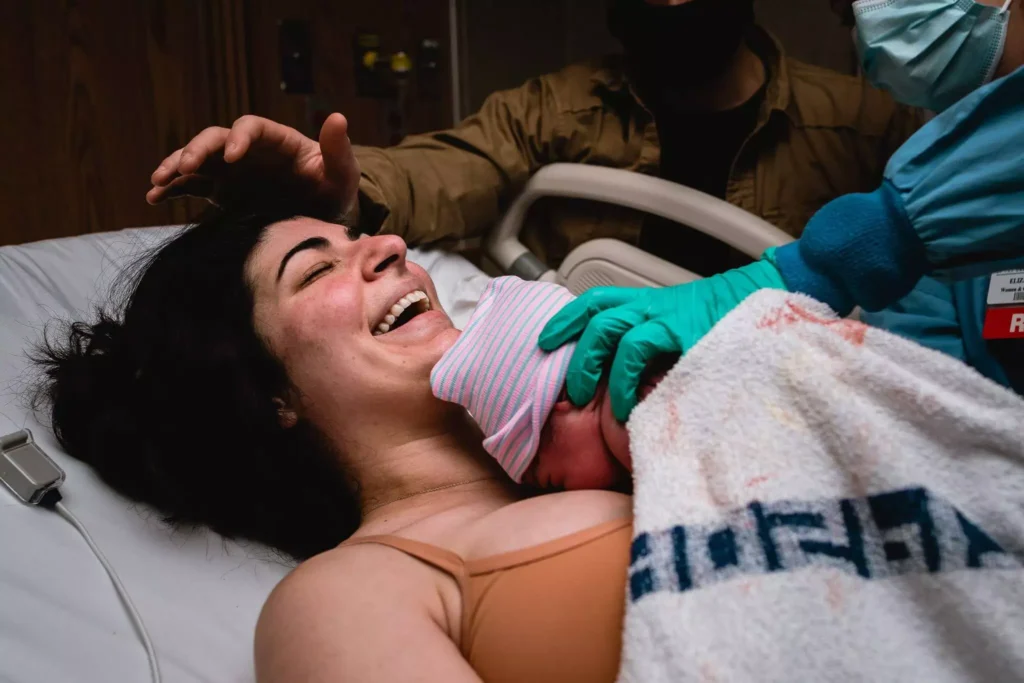
[00:27:08] Elena: And the baby came out easily. I was able to just pull my baby straight up to my chest. And like, it’s the craziest experience in the world. Cause like before you’re like, “There’s no way this is actually possible. There’s no way a baby can come out of there. There’s just no way.” And then you just have the baby on your chest and you’re like, “Oh my gosh” and it was just like this coolest thing. And I think like my placenta came out like 10, 15 minutes later, it came out super quick.
[00:27:35] Elena: And we went to get, I went to get up and go from the pool to the bed, and we handed the baby to my husband and the midwife was handing it to him and they both looked down and they’re like, “That’s a boy!” So for some reason, I guess our anatomy ultrasound was wrong. So we ended up having a little boy instead of a little girl.
[00:27:56] Gina: I was wondering why you said “My first son,” earlier. And I was like, “Oh, her first son. Oh, she must be having another boy,” and then you said girl, and I was like, “Oh, I must have just… then maybe she just… maybe she’s pregnant with another baby, I don’t know.”
[00:28:09] Roxanne: That’s so crazy because you don’t hear of the ultrasounds being wrong very often anymore.
[00:28:15] Elena: No.
[00:28:16] Roxanne: But it does still happen because I’ve had a few patients who they’re like, “Yeah, we thought we were having a girl…. That’s a penis.” They’re like, “I only own pink clothes.”
[00:28:29] Elena: Yeah.
[00:28:30] Roxanne: Like you had a boy at least the first time. So you had like boy clothes, but they’re like, “I literally have only pink frilly outfits for this child.” And I was like, we will find a onesie for him to go home in.
[00:28:41] Elena: Yeah.
[00:28:45] Roxanne: Cause like people, when you find out you’re having a girl, that’s what they get you. They’re like, “Oh my God, girl outfits are so cute! Let me get you all this pink.”
[00:28:53] Gina: Here’s your dinosaur onesie.
[00:28:55] Roxanne: Yeah. There’s not as cute boy stuff. I did find it really cute like old man pajama set, but that was it. But yes, back to your birth.
[00:29:03] Elena: No, you’re fine! But yeah, it ended up being a boy. It was a huge shock.
[00:29:09] Elena: I did end up tearing, but not anything super significantly. I think because, like, when he, when his head was coming out, his head was stuck there for a while. He was just chillin like, he took his time. It was just, but it was nothing crazy. It was very weird to be, like, at home, and they’re just, stitching you up off the side of your bed.
[00:29:30] Elena: But, overall, it was, a much different experience, but like much better and like even talking to my husband afterwards, he was like, “I could tell the difference just in the way that you handled yourself.” He was like, “You were just, you were so much more in control of yourself and of everything else that was going on.” He was like, “It was a much better experience for me because I could help you,” but also before he told me he felt helpless because he felt like he couldn’t help me because I was just so freaking out. And he was like, “This, like, it was you and me together and we got to do this, like, just us.” And he was like, for both of us, it was just a really, cool experience.
[00:30:07] Gina: That is really awesome. It sounds very, not to be like it’s making this about me, but it sounds similar to my experience. I had a hospital birth for my first, and then my second was a home birth. And my husband and my reflection on it was very he felt like he was watching a fight with our first birth where he’s like, “I couldn’t really do anything. I felt like I was like in high school, like trying to peek my head around to see what was happening in this fight.” And then for the home birth, he was like, “I felt like I was able to be a part of it,” and it was a much more positive experience for him as well.
[00:30:39] Gina: So do you have any advice for someone who may be trying to figure out whether or not they want to switch providers from like a hospital setting, which I think the majority of folks give birth in a hospital, to maybe an out of hospital or community birth setting? Do you have any tips to like help folks navigate that?
[00:30:56] Elena: I guess it goes down to like how you feel with your providers. Like I just didn’t feel like I was being heard or that, I feel in the hospital, they were, it was like, my pregnancy was like a condition. It was like something that was like happening to me, if that makes sense. But, with the others, with the providers that I was talking to and asking the questions, they were like, “This is you. You are in control, it’s you and your baby. This is about you, and how you want this experience to go.” so I guess it’s more about like, how do you feel when you’re with those providers asking them the questions that matter to you? Will they provide you, you know, what are your options for giving birth? What does it look like? Do they, have they done a lot of unmedicated births before, if that’s something that you want to do? What are their thoughts on, just how, before birth, after birth? What are their thoughts on epidurals, on…
[00:32:03] Gina: Just seeing if their views align with your desires.
[00:32:07] Elena: Yeah, exactly. You need to write down what you want out of your birth, and what your goals are, and what you want for you and your baby. And then you find that provider that aligns with those goals and those desires. And if they don’t, I think that there might, there’s gonna be a small part of you that’s like, “I don’t know,” and you should just probably listen to that voice, because, birth is one of the most, like, the biggest experiences of your life. And you don’t want to have that doubt, because it will like… that’s your gut, you know, telling you like maybe you should check other things. And I think that for me I was like, “I don’t want to be rude!” But like it’s not about them. It’s about you. So you have the right to look other places and know that you have options. Like you don’t just have to do a hospital, and even if you’re in the hospital you have options for how like you want to give birth. It’s not their choice.
[00:33:03] Gina: Thank you so much for coming on the podcast to share your two birth stories and also trusting us to support you throughout your pregnancies as well.
[00:33:11] Gina: We really appreciate you sharing everything with us.
[00:33:14] Roxanne: Yeah!
[00:33:15] Elena: Yeah! Thank you guys so much!
[00:35:07] Gina: Thanks so much for listening to Elena’s birth story. As you’re listening to her story, you probably understood how important it is to choose a provider that aligns with your birth values so that you can feel supported throughout your birth experience. Being in a specific country doesn’t mean that you’re going to have a specific birth experience, and being in a specific birth location also doesn’t mean that you’re going to have a specific experience as well, because you can absolutely still have a really empowering experience in a hospital setting in Italy, in whatever country that you live in. And so be sure to interview providers and be picky about who you choose to support your birth.
[00:35:42] Gina: If you enjoy this episode and you want more support from us throughout your pregnancy, check out our online prenatal fitness programs. Our online prenatal fitness programs are offered in two main formats. We have our app based program which is going to be a list of exercises with short demo videos. This is a great option for somebody that likes to work out at their own pace and prefers to work out in a gym setting because we do offer lifting modifications for each trimester within it. We also have our prenatal on demand program, which are full length workout videos that you can follow and work out with at the same time, if that is your preference for working out.
[00:36:12] Gina: Both programs can be started at any point throughout your pregnancy. The app based program syncs to your current week of pregnancy, while the on demand program syncs to your current trimester. So you can start it during your first trimester, you can also start it during your third trimester as well.
[00:36:26] Roxanne: And if you’re looking for a childbirth education course to help prepare for birth, check out our online childbirth education course where we discuss the science of labor and birth to take away some of the mystery to make it less scary and make it more manageable to deal with as you’re experiencing it.
[00:36:40] Roxanne: We also discuss birth options as well as what to expect when you arrive at your hospital, different interventions that they might ask about, so learning all of these options can be really helpful to have that conversation of which ones you’d actually want to utilize during your birth. And you can check out both the prenatal fitness and our childbirth education on our website at mamastefit.com, and you can bundle them together to get 15 percent off. And then with an additional code of STORY10, you can get 10 percent off, which basically makes it free.
[00:37:08] Gina: So thanks so much for listening. If you enjoyed the episode, be sure to like and subscribe to our channel. We release a new educational episode every Wednesday and birth stories on Fridays.
Prenatal Support Courses

Learn the science of pregnancy and birth to take the mystery of labor away! Understand why you are feeling what you feel, and learn strategies to confidently move through pregnancy and birth!
- 9h+ of Video
- Support Group
- Close Captioning

- 5 Workouts/Week
- Gym Workouts
- Self-Paced

Instructor
GINA
Workout on-demand with our prenatal fitness workout videos! Each workout is 30-40 minutes to follow along as you exercise at the same time!
- Birth Prep
- All Trimesters
- Mobility Work

Instructor
GINA
Find comfort and relief from pelvic girdle pain throughout your pregnancy and postpartum period! This program incorporates myofascial sling focused exercises to stabilize across the pelvic girdle joints.
- 3 Weeks
- On Demand Workout Videos to Follow