



1. Squats and Deadlifts
As the belly grows, our center of mass shifts forward. This creates more of a demand on our backside (hamstrings, glutes, back). Squats and deadlift-focused movements can help to strengthen the backside so that we can counter the shift forward in our center of mass. When incorporating squats and deadlifts, you don’t NEED to use a barbell! We can use kettlebells, dumbbells, bands, or even bodyweight movements, to strengthen the backside.
We like to include squats and deadlifts at least once a week in our prenatal strength and conditioning programming. Our usual rep range is 3 rounds of 8-12 reps per exercise. Explore different variations such as using a barbell or using a handheld weight.
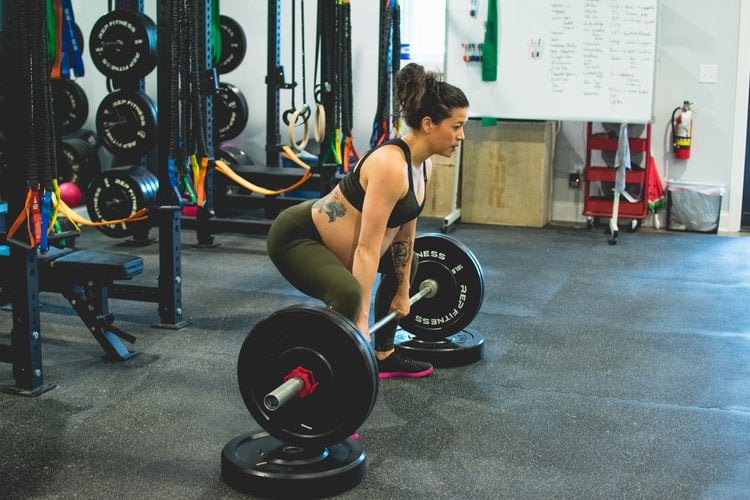

Bonus: squats can help open the top of the pelvis during birth, while deadlift-like movements can help open the bottom of the pelvis! Movements that focus on external rotation of the femur, or wide knees, and a posterior pelvic tilt, can help to open the inlet, or the top of the pelvis. Movements similar to the squat can help open the top of the pelvis, so ensuring this movement is achievable during pregnancy can support labor! Movements that focus more on hinge-type movement patterns, so pushing the hips to the wall behind you, can help to open the bottom of the pelvis more! Training these movement patterns during pregnancy can help us prepare for birth!
2. Myofascial Sling Exercises
The myofascial slings are lines of connection throughout our body that help to connect our upper and lower body, stabilize across the pelvic girdle, and can enhance core function and strength. We have four main slings: the anterior oblique sling, the posterior oblique sling, the lateral sling, and the deep longitudinal sling. These slings run diagonally and up and down on our body, some of which even interconnect with one another.
Incorporating these type of movements into your prenatal routine can help to maintain pelvic girdle comfort throughout pregnancy, and continue to maintain core strength.
When doing myofascial sling-focused exercises, we want to focus on co-contraction or co-activation of the opposite ends of the sling. For example, as we focus on the posterior oblique sling, we want both the lat and glute to be shortened and lengthened at the same time. In our programming, we usually program 2-3 rounds with 10 reps per side of the myofascial sling exercises.
The Anterior Oblique Sling: Pubic Symphysis Stabilizer
The anterior oblique sling runs from the same side chest/oblique to opposite adductor (inner thigh) crossing the pubic symphysis joint (front pelvic joint). Movements such as the pallof press variations (see video below) can help to strengthen this sling. With the pallof press, hold the band in the middle of the chest so that you feel that you are resisting a rotation towards the point of attachment. Then exhale to press the band away from your chest, increasing the resistance. We typically focus on incorporating anterior oblique sling-focused movements in our upper body strength days.
The Posterior Oblique Sling: SI Joint Stabilizer
The posterior oblique sling runs from the lat to opposite glute, crossing just above the SI joints on the back of the pelvis, but can help to stabilize this joint. Usually, if our clients have lower back pain, SI joint pain, or sciatic pain, incorporating these types of movements can help them find relief. The reverse lunge with a banded row is one of our favorite exercises to incorporate for the posterior oblique sling. You have the option to hold a weight in the free hand to make the movement more challenging!
In the reverse lunge with a banded row, hold the band in the opposite hand of the stationary foot. Inhale to step back into the lunge as you reach forward with the band. In this position, both the glute and lat are in a lengthened state. Then, exhale to stand up as you row the band back towards the torso. In this top position, both the glute and lat are in a shortened state.
We like to program posterior oblique sling-focused exercises during lower body workout days.
The Lateral and Deep Longitudinal Sling
The final two slings are the lateral sling and the deep longitudinal sling. These two slings interconnect with the previous two, making it easy to incorporate them into exercises. Both these slings run along the same side of the body.
The lateral sling wraps around the same side leg, from the adductor to glute med, and supports single-leg stability. Step-ups, lunges, or lateral band walks are all great ways to strengthen this sling.
The deep longitudinal sling runs from the neck down to the back of the heel on the same side of the body. Any sort of posterior chain strengthening exercises such as lunges, deadlifts, or squats will help to strengthen this sling, particularly where all the load is on one side.
The lateral step-up with banded row is an example of how we can incorporate the posterior oblique sling with the lateral and deep longitudinal sling in a single exercise!
3. Lateral and Diagonal Movements
We tend to favor forward and backward movements, as we usually walk in that direction and move our bodies in a forward motion. We need to also include movements that are lateral, diagonal, or rotational, to help balance the body! Most of our clients (and their partners) find that after doing most of the accessory work in our workouts, a lot of their lingering issues go away.
The lateral band walk and glute 2 routine are two examples of exercises that could help incorporate lateral and diagonal movements into your workout routine! We usually do about 30 seconds per direction, or 10-30 steps per direction for 3 rounds during lower-body days.
Exercising regularly throughout the week can help to enhance your comfort and strength throughout pregnancy. Incorporating these exercises could prepare you for birth and enhance your comfort throughout pregnancy! If you want more specific guidance on prenatal workouts, check out our prenatal strength program!
Our program syncs to your week of pregnancy so that you can begin it at any time! If you are 8 weeks, you’ll start at week 8 of our program; if you are 20 weeks, you’ll start at week 20 of our program. Our program offers trimester-specific modifications to help you navigate how to lift as your body changes.
If you want to learn more in-depth education on how to approach fitness throughout pregnancy and the postnatal period, check out our prenatal and postnatal fitness trainer certification course! We break down the WHY behind our recommendations and programming so that you can better navigate your own pregnancy or train clients.