
Welcome to the MamasteFit Podcast Birth Story Fridays! In this episode, Feige shares her 2 birth stories, detailing her transition from an unplanned C-section in her first birth to preparing for a VBAC in her second pregnancy. Despite meticulous preparation involving choosing a different provider, exercising, and maintaining a healthy diet, she faced an emergency C-section the day before her due date due to decreased fetal movement. Prompted by her husband and recalling advice from the podcast, she went to the hospital, a decision that ultimately saved her baby’s life. This episode emphasizes the importance of monitoring fetal movements, trusting maternal intuition, and the impact of supportive care teams.
Read Episode Transcript
Gina: Welcome to the MamasteFit Podcast. In this birth story, Feige is gonna be sharing her birth stories. Her first birth was an unplanned C-section, and so for her next pregnancy, she was preparing for a vaginal birth, and she made a lot of different decisions to help her prepare for this. She chose a different provider, she was exercising more throughout her pregnancy, she had a doula, she was eating well and overall felt really prepared and ready for a vaginal birth after C-section. However, the day before her due date, she noticed that her baby wasn’t moving quite as much. Her husband commented on how he didn’t notice, or he didn’t hear her say that the baby was moving as much, which was something she normally did. She also saw a reel by Roxanne, where Roxanne said, “Hey, if you don’t feel your baby move, go in. It doesn’t bother us as staff. We’d rather tell you that your baby is doing really well, as opposed to you not come in and something happened.” So after some prompting from her provider, she went in and it ended up saving her baby’s life. While she didn’t have a VBAC like she was preparing and planning for, she felt very empowered to have another C-section because it saved her baby’s life.
If there’s one thing that we really want to emphasize here at MamasteFit, it’s really important to monitor your baby’s movements throughout your pregnancy. After you hit 28 weeks, keeping track of how your baby is moving, either doing kick counts or monitoring their daily trends, is incredibly helpful because this is a sign to let us know that your baby is doing well. Count the Kicks is a great app that you can utilize to help you keep track of your baby’s movements. And honestly, this is something that can genuinely save your baby’s life if you notice a change in their movement.
If you notice that your baby is not moving as normal in the third trimester, we highly recommend going and seeing your provider. Don’t pause to take sugary drinks, don’t wait on it. Your baby’s movements are the way that they are communicating to you what their wellbeing is within the uterus. And so if at any point you notice a decreased fetal movement, we highly recommend going and seeing your provider. As a doula this is one of the things that I don’t mess around with at all. If any of my clients tell me that they notice a decrease in movement with their baby, I tell them that they need to go in and get checked out just in case. And so we would highly recommend that if you notice decreased movement to go and see your provider and get checked out. ‘Cause best case scenario it’s totally fine and you’ll just get sent home, and worst case scenario, you’re already at a facility that could help to save your baby’s life.
So thank you so much, Feige, for being here with us.
Feige: Thank you for having me. I was really excited to share it. It’s something I want to create awareness for and let other moms know, if it could help anybody else. So, thank you!
Gina: So let’s start with your first birth and kind of give the listeners like a quick synopsis of what happened and what was influencing you in your second pregnancy.
Feige: My older daughter is turning three next, like, very soon. So that’s, that’s how long ago it was. And I didn’t know much, like, how to prepare. I did take like a birthing class and I did try to work out a little bit during my pregnancy and I always felt like nauseous and tired right afterwards, so I never did it again. And I was very swollen, I gained a lot of weight, had a lot of food aversions. I basically only tolerated pizza and grilled cheese my whole pregnancy.
And then when I went into labor, basically my water broke, but then I just wasn’t really having contractions. And my provider obviously told me to come in right away, and they induced me right away. And I had a really wonderful doula who was really helping me my whole pregnancy, and she came and she tried to get me in different positions on the bed with the peanut ball, with everything. And my labor was just not progressing. It was just. My contractions weren’t peaking, we weren’t really getting anywhere, I wasn’t really dilating that much, and after many hours of this, they started talking about a C-section and they really, they kept upping the Pitocin. And I wanted an unmedicated birth and I ended up being like, on everything. I had an epidural, I had Pitocin, I was scratching myself so they gave me Benadryl, there went my unmedicated birth.
And then at one point her heart rate started like getting really high. So that’s when they just took me for a C-section. And then, as soon as they, as soon as she was born, they took her right away to check her blood sugar ’cause she was a really big baby. And it was very low, so they went away, fed her, and then they wheeled me to recovery. And I just kept hearing them, I just kept hearing her screaming ’cause they kept poking her and feeding her and then checking her blood sugar again.
So by the time I came home from all that, that, that’s a short synopsis, but it was many hours of, “What’s going on? I’m not understanding this.” All the birth prep videos or books that I read said you have contractions and they get gradually more closer together and more intense, and then you give birth. That’s what I thought! I didn’t know that there could be different scenarios or that your water could break and you could not have contraptions or that your baby’s not in the best position even if they’re head down. I didn’t know all that till afterward, and I had a lot of like birth trauma, and bad feelings about my birth and, “Could I have avoided a C-section?” And I was very sad that I missed that golden hour right after birth with my baby. I had struggled with breastfeeding afterward and I blamed a lot of it on the fact that she got taken away from me right away.
And, it took a long time and a lot of talking to professionals to heal from that and come back from that and be like, “Yeah, maybe there were things I could have done differently. There were things I could have prepared for differently.” Another thing about my daughter’s, my first daughter’s birth is that the doctor that I’ve been going to my whole pregnancy was not around at all for my delivery, never came to check on me postpartum. And I had a lot of negative feelings about that, a lot of resentment, like feeling like a little bit abandoned. I came to you for nine months and the four days that I was in the hospital, I didn’t here or see you once? That really bothered me. So that was my first birth.
Gina: That’s really hard. That’s really hard.
Feige: It wasn’t like a happy story, and I feel I did the best that I could to let that go and move forward. My daughter’s really cute, really beautiful, she’s talking a lot. She’s really excited about turning three! I managed to nurse her until she was two, until I got pregnant with this one, so we did get past all that.
And I did speak to someone and I was like, “What if they’d never induced me?” And then, the person that I was speaking to was a doula herself, and I go to her for acupuncture, and she was like, “You could have wound up with an infection. She could have had meconium,” like, I was also strep B positive. So I did need to go to the hospital, and that is what they would normally do in that case. In the end, she’s safe, I’m safe. We all came out of it. Like, to have not taken any action, that could have led to infection, that could have led to things getting more complicated. So in the end like that, that kind of helped me like, okay, it was meant to happen the way was meant to happen, and that’s what it is.
Gina: Yeah, totally understandable.
Feige: But it took, me time to get over it.
Gina: How did that impact your next pregnancy then, like with the preparation?
You’re having a lot of feelings about how the birth went, maybe even blaming yourself for maybe your preparation, or maybe, “I did something that caused this,” or maybe, “The people I chose to support me caused this.” How did you prepare differently with your second pregnancy?
Feige: I did everything different, from the beginning! First of all, the, doula that I had with me, she was my saving grace through my whole birth the first time, and she’s also someone I worked out with a lot ’cause she’s also a fitness trainer- think you guys would really bond! So she, she sent me a reel from you guys about scar mobilization when I was like, like a year and a half postpartum. And so then I started following your channel, and I love how you guys would say that, “birth doesn’t have to…” like you said on your channel exactly how I had approached my first birth, and how I didn’t want to repeat that, where you come in clueless, come in not knowing what’s going on, and you don’t feel like you’re the one making the decisions- and I knew I wanted that to be different. I wanted to come in and be like, there’s a lot about birth that you don’t know how it’s gonna go, and there’s a lot of variables that you cannot control, but you can be more educated, you can be more knowledgeable, you can take care of yourself better, you can be more prepared.
So I would say the first thing I did was find a better provider that I felt more connected to and that I felt would listen to me more and be there for me more.
And I switched practices- it’s really far from my house, they live in Long Island and I live in Brooklyn and it’s an hour’s drive on highway, but it was worth it for me. There are three doctors in the practice who all listened to me, were caring. I was really happy with them, very VBAC, supportive, very VBAC friendly. I spoke to them a lot about what I wanted and they always heard me out and they always got it, like, it was a very supportive feeling.
I was very inspired by you and Roxanne. I watched your whole pregnancy with Zoe, she’s adorable. And I was really inspired how you were working out, even with your kids, that was really inspiring for me. And the weekend that you had Zoe and MamasteFit went on sale, I bought your, full prenatal program to work out the first, second, and third trimesters, and I bought your VBAC course. I watched all of it. I tried to understand what could I have done differently my first birth? Maybe I could have waited a bit to be induced and just gotten the antibiotics right away. Or, even I would’ve just maybe been more like, communicated more with the providers, discussed my options better. Instead, I was like, “Okay.” The resident who did my triage was like, “Your water broke, so we’re gonna induce you,” and she didn’t say it very nicely, and I was just like, “Okay.” If I had been more confident and more aware and more understanding what my options were, I could have maybe discussed with them what my options were. And I did discuss that with the next doctors that I went to. And they were very like, “They should have asked you. They shouldn’t have just told you. It should have been a conversation.” So I knew I was with the right team right now.
And I also just, I focused a lot on taking care of myself. I worked out with the trainer at the gym once a week, and then the rest of the days of the week I did your program. I took a lot better care of myself with my diet. I was making like bone broth soups and eating a lot of whole foods, fruits and vegetables. And I gained half the amount of weight that I did with my first pregnancy, and I felt really strong. I think it was helpful to have very active toddler that I was chasing and sitting on the floor with. My first pregnancy, I…
Gina: That makes a big difference.
Feige: Yeah! I also, my first pregnancy, I was working a full day. I’m a special education teacher, and I was teaching like small resource room groups, and I’m also a certified reading specialist and I was working from 8:00 till 5:00, 8:00 till 4:00, 9:00 till 4:00 every day, and I would literally drive myself home and plop up on the couch. That was my first pregnancy.
When I got pregnant with her, this was a really hard decision, but I felt like in my heart I knew it was the right decision for me. I took a year off work and I got a lot of job offers because I had just finished a reading specialist certification course in a few schools. I was gonna, I went to interview to become the reading teacher and… and it was hard to say no because it was giving up a huge financial income. And also my job, something I worked really hard for. I just finished my certification, but I really knew that like my babies are only babies for very short, my health and me being a very present mother is a little bit higher priority right now. So I actually just quit my job and became a stay-at-home mom and spent my whole pregnancy with her, just focusing on taking care of myself and taking care of my daughter. And like I knew that I wanted to do it, it was just hard to do it, but I had to really listen to my inner voice and be like, “This is not forever. This is for now. I can go back to work in two years or three years. Like it’ll still be there, but my babies are only small right now, and my health is really important, and if I wanna VBAC, I’ve gotta do everything that I can to have it.” And I wouldn’t have the energy after working a full day to also work out and also be calm with my daughter when she came home from her daycare. Like I, I knew that’s what I needed and I’m really grateful my husband was very supportive, even though it was hard, like it was hard financially for us, but, we knew it was the right decision and I really was able to just…
Gina: I absolutely love that.
Feige: Yeah. I was able to really take care of myself better. Exercised, I walked, and just focused on much better nutrition. I was working with a nutritionist, eating a lot of, like I said, whole foods. I was making batches of bone broth and making like vegetable soups with the bone broth so that I was getting like protein and health benefits and I was adding like fresh ginger and turmeric into everything and I really felt good. oh, and it’s funny, like there’s a lot of like superstitions about how you carry. All my relatives were like, “You’re for sure having a boy this time!” Like I was just carrying so differently. My first, I was so swollen, and I was laughing, I’m like, “It’s really not!” It’s really just how I was taking care of myself.
Gina: You’re just doing things differently this time, yeah.
So it sounds like you had an amazingly supportive team. You chose a completely different practice and so you were going into your birth. With a team that truly believed in you?
Feige: Yeah. The only thing that was the same was my doula.
Gina: Oh, so you still had the same doula? ‘Cause she was amazing!
Feige: Yeah. She was the only person that I was like ble to trust during my first birth. Like I, none of the nurses or PAs that came in while I was in labor, like I, I felt any connection to, or felt really cared about me. And my doula like, kept me calm the whole time.
But this time around it was very different I was giving birth in a different hospital where the nurses there had incredible reputations and, I was much, much happier with the hospital that I was, that I was gonna give birth at now.
Gina: Let’s take a break from this week’s episode to hear about our podcast sponsor, Needed. Needed is a perinatal nutrition company that specializes in optimizing nourishment for the perinatal timeframe. It is a brand that Roxanne and I personally utilize during our pregnancies and now in the postpartum. You can check out Needed at thisisneeded.com and use our code MAMASTEPOD to get 20% off.
And one of our favorite products is their prenatal vitamin. With Needed’s prenatal vitamin, there’s a few different options depending on what trimester you’re in and your preferences. You can either do the powdered version, which was a personal favorite of mine in the first trimester because I could just put it in my smoothies, or I can put it in my oatmeal, and it made it much easier for me to continue to get my prenatal vitamin. And then once I made it to the second and third trimester, I opted for their capsule version. Needed also, just did a research study to take a look at how good their prenatal vitamins were, and in comparison to other leading brands their prenatal vitamin well outperformed it. And so you could trust that Needed, one is creating quality products that do what they say, and then two, Roxanne and I are only gonna recommend brands that we personally use and trust, and Needed is at the top of our list. So if you wanna check them out, you could check them out at thisisneeded.com and use our code MAMASTEPOD to get 20% off your order.
So let’s talk about the end of your pregnancy then, and when your plan really shifted. So you were doing all of this work to prepare for a VBAC- you had a supportive team, you had your amazing doula, you were exercising more, you were eating well, you felt overall more healthy and ready for a vaginal birth.
What shifted for you at the end of your pregnancy that helps you feel confident to choose a different path for your birth?
Feige: You can see this one over here, she was very active my whole third trimester. She’s always- every time I watch her do it now, I’m like, “That’s what saved your life,” she’ll move her hands and feet a lot. And I felt her all the time, like we would put my toddler to bed and then I would tell my husband, “This is what’s gonna be in a few months. We’re gonna put her to bed, and we’re gonna have the next one,” because I would sit down on the couch after bedtime and just feel her kicking me, a lot! I felt her a lot, every day.
And the week before I was due, there were a lot of like… all of a sudden things came up that were just not in my control. My doula, unfortunately, had a family emergency and had to leave the country to go to her mother-in-law. And she called me and she was like, so sad to tell me, and she was like, “I was just so like emotional about your birth,” but she wasn’t gonna be there. But she had prepared a replacement for me, and then I met with the replacement and we bonded right away, and she was also fantastic, and really special, and really supportive of how I wanted my birth to go. And I was so caught up on the VBAC. Like I was just really hoping for it, really trying for it. I was doing inversions every day, and just really hoping that it would happen.
And then my due date was on a Saturday, and the Thursday night before- and every day I was like, preparing in case I would go into labor, like I had my upstairs neighbor was gonna be my babysitter, she was gonna come down when I called her that I was in labor, whether it was the middle of the night or… and we had a hospital backpack to go and every night we were like cleaning up and straightening up, just in case I had to leave. That Thursday, we had a bar mitzvah in the family and I was really tired. I was like, “Okay, I’m not having any contractions so I’m probably not having the baby tonight or tomorrow morning.” We just came home and crashed. And my husband just like casually said to me, he’s like, “You know, you didn’t say anything about the baby moving today,” because I always would tell him. He’s like, “You didn’t mention anything.” And I didn’t even notice ’cause I was just so tired that day, but it got in my head that he said that, and, I had just recently- I watched your guys’ podcast the whole pregnancy, and what was incredible was that you always managed to air a video that was exactly what I was dealing with! It was like the week that I was getting my strep swab, that’s when I saw your podcast about microbiome and, I listened to the whole thing and I saw Roxanne talking about, what is GBS? And I like, literally you guys like, were my pregnancy support without knowing me, without hearing from me, and you always managed to talk about something that I was going through or that I was dealing with.
Gina: I don’t know how we do that! ‘Cause there’s so many people that say that, they’re like, “You just happened to release this one video at the perfect time for me,” and I’m like, “I don’t know how we’re all so in sync to you all, but we somehow are.”
Feige: I’m so grateful to you guys, you have no idea.
So I just watched a reel that Roxanne did, sort of like acting it out where there was a pregnant mom being like, “I don’t know if I should go in, I don’t wanna bother the nurses,” and Roxanne was always like, “Lack of fetal movement can be a sign of fetal distress, so don’t worry about bothering your nurses, we wanna make sure that you’re okay. We’d rather you come in.” And I had that in my head.
Gina: Absolutely.
Feige: So I went to bed that night. I felt odd a little bit, so I was like, “Okay, whatever.” I went to bed and I woke up myself around 2:00, 3:00 AM, and everything was in my head- the fact that my husband made that comment, Roxanne’s reel just kept playing over and over in my head, and I was like, “I don’t really feel her.” And usually if I woke up in the middle of the night, which I did my whole pregnancy all night, I feel her moving, and I don’t feel her. So I went to the kitchen and I made myself like a drink of apple juice and sat down. And my doula always told me with my first pregnancy, ’cause I was always anxious that I didn’t feel the baby, she was like, “Make yourself a sugary drink and then just sit still and relax on the couch and see if you start feeling movement then. So I did that, and like I wasn’t really feeling anything, and I think that I was nervous, but you also, in the middle of the night, don’t wanna start like waking everyone up and making a ruckus and driving to the emergency room. Like we’re never looking to do that, but I just couldn’t get that like nagging voice out of my head.
And I was like, “Do I wake up my husband? Do I not? Should I call the provider? Should I not?” And I just kept hearing her voice saying that lack of movement could be a sign of fetal distress. And I’m like, “You know what? I’m not gonna be able to let this go.” I woke up my husband and he made me like an even sugar, more sugary drink. He like literally took the apple juice and poured in teaspoons of sugar and mixed it and made me drink it. And I wasn’t really feeling her so we, right away, called. And I got the on-call, after hours at my OB’s office and it was a PA that I, or a doctor that I didn’t meet yet. And she came on the phone and she heard me out and she was like, “Go right now, get checked out. And possibly, where do you live? Possibly go to the nearest emergency room,” and that, that got to me. I was like, “Okay, it’s go time.” I called my babysitter on repeat until she woke up and came downstairs, and we got in the car. And thank God, I told her my husband’s actually, he’s a paramedic and when he’s not at work, he’s a volunteer EMS in our neighborhood, so he has lights and sirens on his car. So I told the doctor, I’m like, “I really would rather come to you guys and where my doctors are, and we can get there fast. My husband has lights and sirens on his car.” It could normally take an hour to get there during daytime traffic, but we got there in 25 minutes, a half hour.
It was 4, 4:30 in the morning, with lights and sirens, we got there really fast. And they right away put me on a fetal monitor, and right away we heard a heartbeat, thank God. But they were telling me, and I didn’t understand what they were saying, they were telling me that they told my doctor, and he was watching the heartbeat at home, but he’s not really “seeing” it really well. So I didn’t really understand what that meant. he later explained it to me.
Gina: So, baby’s heart rate should have some variability within them, so it’s a little bit faster, a little bit slower. And when there’s not a lot of change happening, it’s usually not a good sign, like our heart rate should have more variability within it as well. So more variability is good, means that baby’s doing well. If there’s, if it’s maintaining the same line, that’s not always a good sign.
Feige: So that’s what it was, he explained it to me afterward. He’s he wasn’t seeing enough like going up and down, and so they were starting to talk to me like, “Okay, like, you’re the day before your due date, so we’re not gonna send you home,” and they were trying to see, they knew that I really wanted a VBAC, I was very open about it, so they were kind of like, “Well, we can see…” basically we were all trying to- and this is where I had a totally different experience with them- it wasn’t like, “This is what’s happening,” it was like, “We should talk about an induction. We’ll see when your doctor gets here, we’ll ask him what he thinks. We might need to take you for a C-section, but, let’s see. We’ll check you, we’ll do a sonogram, we’ll see what’s happening more. And then we could decide and then we’ll wait for your doctor to come in.” They checked me and I was totally closed, so it was like, okay, an induction would then take a long, long time, it would take many hours. Like it could possibly take many hours, and would she be able to tolerate that?
And then they came in to do a sonogram, and after the sonogram technician left, there were like a few PAs and nurses that were in the room, kind of like checking on me and talking to me and seeing what’s going on. And my doula had shown up, because I called her and told her I was going to the hospital while I was still home, and she was like, “Do you want me to come?” And we were also in, I was also in touch with my original doula that was out of town, and she was like, “Let her come with you. Rely on her. She can be there for you. She can help you, even if just to hold your hand.” So she was really sweet. She came and they, I had a moment where, let’s say we had, I wanna say about four people in the room with me, like a PA, and a nurse, and my doula, and the first PA that had checked me, walked in with like forms and a tablet. And she’s like, “So I have the C-section papers here for you to sign,” and I was like, “What?” she’s like, “Oh my God, I didn’t tell you? I’m so sorry.” She says, “Yes, the ultrasound, you scored a four out of eight.” Now I understood what that meant because I’d actually been to an MFM a few times during this pregnancy and they had a scale that they like gave two points for four things, like the baby’s position, fluid, the respiratory rate, and the fetal movement. And each of those things got awarded two points, and I usually got an eight out of eight with all my, all the ultrasounds that I had with her, and so I understood four out of eight. She was like, “Yeah, they took two points off for lack of movement and two points off for her respiratory rate.” So then I was like, “Oh, okay.”
And then, everyone was like, “Yeah, so she’s not gonna really tolerate an induction, so…” And at that moment, I had two seconds to be like, “Okay, I’m letting go of my VBAC dream right now.” Your priorities suddenly change in a heartbeat, where I’ve been so… everyone who knew me and saw me, heard about my VBAC dream and my VBAC wish and like how hard I was working just for that. And I kept telling myself like, “Even if I have another C-section, like all this is not for nothing. I’ll have an easier recovery, I’ll feel better. But I really want the VBAC. I really want it.” In that moment, when I heard that okay, respiratory distress, like this is serious, I had to just, I can’t even explain it. It was more than just like… in one second all your priorities shift and I just wanted my baby to be okay, and be safe and… sorry, I’m getting choked up a bit. And I had to just be like…
Gina: It’s okay!
Feige: “Okay, the VBACs not gonna happen. I just hope she’s safe and she’s okay and that, if I have to have a C-section for her to be okay, then that’s what we’re doing.” And I was like, “Okay,” and I broke down crying in the room. And in that scary moment, it was also a really beautiful moment that I go back to in my head a lot, where I just felt so much compassion and support from all the people that were in the room with me. And the PA that was checking me, like they all were with me in that moment, in such a kind way, with such genuine, “We’re here with you.” And they gave me that moment to mourn my VBAC, and to be like terrified and to be… they gave me that moment.
And then the PA, she put her arm on me and she was like, “You can be so proud of yourself. You had such good intuition to come in and you did the best thing you can as a mom to save your baby. Like, the fact that you chose to get checked out and come in right now like, that was the best thing you can do as a mom.” And then my doctor walked in, and I just felt this, like, my team is here, my support is here. He was like, “They called me with your name and I was trying to see how I could send you home so we wouldn’t go for a C-section, but, we just couldn’t!” And, it was like, “All right, let’s go.” He came in, in his clothes, like straight into to see me, and he was like, “All right, I’m gonna go get changed and I’m gonna meet you in the OR! Let’s go right now!”
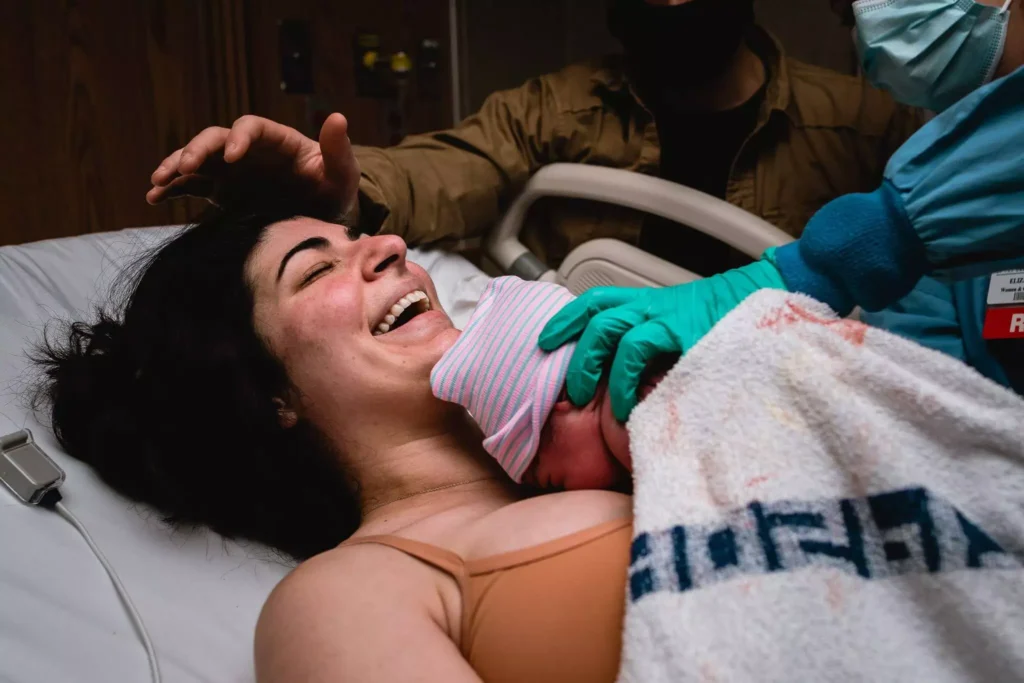
So that’s what happened. Right away, an anesthesiologist came, and they changed me, and they sent my husband to go get into scrubs, and that was that. We had a C-section. And right when they took her out, so at first she was okay, and they called for my husband, and they told my husband like, “You wanna come take pictures of her and then you can show mom the pictures?” And he went, and then all of a sudden I heard them saying, “Call back Peds!” She, apparently, after she was doing okay, she started to then desat, and her color turned really bad, and she was struggling to breathe. So my husband wouldn’t show me any pictures. I don’t think he took any, he told me, “You don’t wanna see her coloring.” He wouldn’t tell me, actually, he didn’t wanna scare me. But, then I was asking like, “Can I hold her? Can I see her?” even though I was being stitched up and I was on the table. They were like, someone came to talk to me, and they said, “So she’s not doing that well, so we’re gonna take her to the NICU,” and I asked, “But can I hold her first?” And they were like, “We really have to take her now. I’m sorry.” But they showed her to me for a second, like all swaddled up and wrapped up, and I couldn’t really see her before they walked out of the room.
And then when I was in a recovery, one of the doctors on the NICU came to talk to us. I learned a lot of new medical terms she had that weren’t new to my husband, but we’re all new to me, so he had to explain to me a few times what it meant. She had acidosis, which is, I was learning, the pH levels in her blood were not good, and it could be markers for infection. And then they told me, “It can affect the brain, so we’re gonna have her on an EG monitor right now for a bit. And it looks like marker, like it looks like there might be an infection, so we’re also gonna start round of antibiotics and we’re gonna do a lot of tests. So I’ll come back to you.”
And I was scared, but I also knew in my heart everything’s gonna be okay. She’s gonna be okay. This is my baby that I prayed for, that I waited for, that I… I just, I know she’s gonna be okay. And somehow, we’re very, very, very grateful, but after a couple hours on oxygen and IV, she really turned around. They were able to take her off everything, and she was doing great and she was able, she spent the whole time in the NICU while I was in the hospital, but I was able to take her home when I was discharged and she’s been really growing and blossoming ever since.
And I, it took me three months to write you guys an email, but I was like, “I need to thank Roxanne and Gina,” because if I hadn’t seen that reel, I don’t know if I would’ve actually… I was like, “Should I just wait till 9:00 AM and call the provider and go to the office?” Like, I don’t know if I would’ve known how important it is that I went in when I did.
And then I had to go for one week post-op follow up with my OB, and I was sitting in the waiting room and he came behind the front desk reception, my doctor, and he saw me so he was like, “Come in! Come in!” he didn’t even wait for the nurses to call me. He’s like, “Do you understand what happened to you? Do you know what happened to you?” He’s like, “We get calls all the time, people are like, ‘Oh, I don’t feel the baby move,’ and we tell everyone to come in. And a lot of times we send them right back home.” And he said, “A lot of times people talk about how they had an emergency C-section,” and he said there’s what I had with my first, where struggling to push out a 10 pound baby, and then you end up in a C-section, he’s like, “and then there’s an emergency.” So I learned the difference between an unplanned C-section and an emergency C-section, because with my first, it was unplanned with my second, it was an emergency. And I told him about the reel that I saw, and all these things. And so, we’re Hasidic Jews, and we have a philosophy called Hashgacha Pratit, which means, divine providence, everything happens for a reason, there’s no coincidence. God is guiding everything, down to a leaf falling. So the fact that before she was born, I saw that reel, my husband made that comment to me, the provider that got on the phone to answer a question made it sound urgent- all these things. Just me approaching this whole pregnancy with,” I wanna take charge more. I wanna be the one guiding my birth more. I don’t want other people telling me what to do,” all that led to this really, this really big miracle for me that we were able to save my baby and that she was okay. And we don’t wanna think about if I hadn’t gone in, or if I’d waited or, we’re not going down that right thinking that. But, I get very emotional and very grateful thinking, like all the things that led up to that.
So even though I was sad to not have my VBAC, and I needed another surgery, and surgery means a harder recovery, and I was in a lot of pain afterward physically, but I can look at my birth and just be so grateful and so thankful that, that all the events that led up right before just I, I was able to make that call and that she’s okay, and she’s safe and healthy. And, I don’t have the words to say what that means for me. I guess you could just, understand.
Gina: Yeah. I totally… You’re actually this, you’re actually the second person that has messaged us to say that they listened to that podcast episode ’cause we have a whole podcast that we did with Count the Kicks, which is an app that somebody can download to help track their baby’s movements. And then the reel that Roxanne did with Count the Kicks about, “Oh, I’m not really feeling my baby move, but I don’t wanna bother the nurses. I don’t wanna bother anybody.” And she’s really insistent on, “If you don’t feel movement…
Feige: I wanna give Roxanne such a big hug for sharing that reel!
Gina: “You need to go.” I know, I wish that she was here for this episode. She’s sad to miss it, ’cause she’s at midwifery clinic right now. But you’re the second person that has reached out to say that her efforts to create that podcast and to create that real has saved their baby’s life, which I think is incredible and completely- not to make this about us because your story is incredible- but it completely makes everything that we do with our free content and with our platform worth it, to know that we literally saved a baby’s life, and that is incredible. And I’m so grateful to be a part of your journey and of your story as well. And we get like emotional thinking about it too, because it is such an incredible thing to know that like we helped you with that to help you feel confident to know, “Hey, something’s off and we need to go in.”
And I’m so grateful that you had a team that supported you so wholeheartedly throughout your pregnancy, that when it came time to change your plan at the end, that you felt supported in it and that you still felt like you were the one that got to make that decision, which I’m hoping really changed this C-section experience for you in comparison to your first.
Feige: It did. And I told people, I said the way that I know this was all different- and you guys talk a lot about this- that it’s not necessarily about C-section or vaginal, it’s more about just coming to your birth empowered and making the decisions that’s right for you.
And if I could go back to my first birth, there’s so much that I would do different. And with my second- and obviously with all the variables that I had no control over staying the same with both- I would do everything the exact same, like I would make all the same choices. And that’s how I know that it was different. And also, my first birth left me with all these like negative feelings and birth trauma and upset. And my second, there was a lot of trauma of being very scared for my baby, but as far as the like, experience, I only have like feelings of like gratitude and pride. Pride in myself for how I handled it, pride that I chose the right team, and how they helped me through it. Both my doulas were incredible! My doctor was incredible. The nurses, the PAs, anyone who’s a part of it, the NICU staff, everyone just gave us so much respect and kindness, and support. … So for me, like not every, a C-section doesn’t have to be like a bad experience, it could be… I’m so grateful for modern technology that saved my baby.
But it really is about coming, listening to, like, what you guys say, that you as a mama, you should feel empowered, you should feel educated, you should understand what your choices are or what you could do, what your options are. And just making the decisions that’s right for you, for your baby. And sometimes we have to shift that, but as long as we’re listening to our, the voices that are in our head, and the intuitions that we’re having, and we can honor those and listen to those, then, it could be very positive. Even if it’s a scary, traumatic experience, it can still be a positive experience, in a way. So for me that, that’s how I felt, like looking back at both my children and how they came into the world and, and that whole experience.
And, I did push myself to actually reach out to you guys because I know how hard it is to put out content and to work on it and I wanted to… I know that you don’t always get feedback when you’re engaging with a…
Gina: Yeah.
Feige: People aren’t always interacting, so I was like, no, I need to let you guys know that you have watchers out there and viewers out there, and what you’re doing is so important and please keep it up and please know that you are, you guys literally saved my baby’s life.
And even, like, small stuff! Like I was really inspired to see how like you still work out with all your kids around you, ’cause I was always like, “I can’t do that. She’s not gonna let me,” and on the weekends I would roll out my mat, I roll out my laptop, and have a bunch of resistance bands, and I would just try to do the MamasteFit with my daughter together. And she sometimes cooperated, sometimes didn’t, but we still tried! And I don’t know about…
Gina: It’s about balance!
Feige: Yeah. And I’ll even say, even just, and I guess thank you for sharing your children and your life. There’s content like, for example my older daughter’s also like my little snuggle baby, I was worried about how she would transition to her younger sister. And I watched you like, let Sophie get in there a lot, and like also snuggle up, and so I took some cues from that, and I didn’t push her away from the baby so much. I tried to let them both in, I tried to give her a lot of loving, too, and, thank God, like she’s doing pretty well with her sister, relatively. And so you are also inspiring in a lot of little things and big things. So, thank you for sharing your channel with all of us.
Gina: I’m really grateful that you reached out to us as well, and that we were able to be such a, an important part of your journey. That’s the whole point of everything that we do here at MamasteFit is to help you and our other followers and listeners feel empowered on this journey to know that it doesn’t have to be this picture perfect way, that you can make decisions that maybe are different than other people, that are different from us, and that’s okay. And you should feel good about making those decisions. And yeah, it’s… motherhood’s messy, but it’s a wonderful journey and I’m glad that we got to be a part of your journey.
Feige: Thank you.
Gina: So thank you so much for coming on the podcast and sharing your story. I hope that we can continue to connect with one another over the years, and thank you for trusting us to be on this journey with you.
Feige: Thank you, guys.
And then you asked me what would be my message. So I would tell moms, listen to your voice, listen to…. first of all, follow MamasteFit, buy the workout programs! And count the kicks- it’s not nothing. It’s not nothing. It’s important. Do it. Listen to it, feel the baby. But also listen to your voices. Even me choosing to stay home this year, choosing to focus on my health, choosing to change providers, like all these like things that were steps that weren’t easy to make, but I knew that they were really important for me. And that would be my number one advice to moms out there, listen to what you know is important, even if it’s, even if it’s like contrary to what may be like even sometimes rational.
But, we, have a lot of strong intuition and, we honor ourselves the most by listening to it, I think. So that’s my message.
Gina: I love it. Thank you again for coming on the podcast and sharing your story with us and our listeners.
Feige: Oh, my pleasure. Thank you for having me.
Gina: Thank you so much for listening to Feige’s birth story.
Again, it’s really important if you’re not feeling your baby move to go and get seen. This is your baby’s first sign to let you know what their wellbeing is during pregnancy. You should never feel like going and being checked out is gonna be burdensome to anybody at the hospital or your birth location. So again, we highly recommend if your baby is not moving as normal to go and see your provider.
If you want more support throughout your pregnancy, check out our online prenatal fitness programs and our online childbirth education course. Even though Feige had a C-section, her efforts during pregnancy with exercising and moving her body and informing and educating herself still helped her to have an empowered birth experience and helped her postpartum recovery be easier even though she had a C-section. So if you do a lot of stuff during your pregnancy to prepare for your birth, it’s not wasted or not worth the doing if you don’t have the birth outcome that you were planning for, because this all can still help to empower your overall experience and help you in the postpartum.
You can check out our childbirth education courses and our prenatal fitness programs on our website at mamastefit.com and use code STORY10 to get 10% off any of our online offerings. And you can bundle them together to save an additional 15% off. This podcast is sponsored by Needed. Needed is a nutrition company that specializes in optimizing nourishment for the perinatal timeframe you can use our code MAMASTEPOD to get 20% off at thisisneeded.com.
Additional Resources
Blog: How to do Kick Counts
Prenatal Support Courses

Learn the science of pregnancy and birth to take the mystery of labor away! Understand why you are feeling what you feel, and learn strategies to confidently move through pregnancy and birth!
- 9h+ of Video
- Support Group
- Close Captioning

- 5 Workouts/Week
- Gym Workouts
- Self-Paced

Instructor
GINA
Workout on-demand with our prenatal fitness workout videos! Each workout is 30-40 minutes to follow along as you exercise at the same time!
- Birth Prep
- All Trimesters
- Mobility Work

Instructor
GINA
Find comfort and relief from pelvic girdle pain throughout your pregnancy and postpartum period! This program incorporates myofascial sling focused exercises to stabilize across the pelvic girdle joints.
- 3 Weeks
- On Demand Workout Videos to Follow