



Welcome to the MamasteFit Podcast Birth Story Fridays! Our beloved in house pelvic floor physical therapist, Hayley Kava, shares how her first birth experience inspired her career path. Her journey began with a hospital birth that she found to be less than positive, leading her to seek a more empowering experience the next time. Her second birth, also in a hospital, turned out to be a much more positive and fulfilling experience, but left a little to be desired when it came to immediate postpartum care. Finally, her third birth took an unexpected turn—an unplanned unassisted home birth after a precipitous labor! Despite having a midwife, the baby arrived before they could get there. Tune in to hear Hayley’s incredible birth stories and how they fueled her passion for helping others achieve empowering birth experiences.
Read Episode Transcript
[00:00:00] Gina: Welcome to the MamasteFit Podcast, Birth Story Friday. In this episode we have Hayley Kava here, who is our pelvic floor PT here in our gym in North Carolina, sharing her third birth story where she had a precipitous home birth with the same midwife that I used, but her midwife did not make it because she went so quick! So thanks so much for being here, Hayley.
[00:01:11] Gina: So we have Hayley Kava here, who is a pelvic floor physical therapist, and she’s going to be sharing her third birth story, which was a home birth. Previous two were in the hospital. So Hayley, how did you approach birth to begin with, like with your first baby?
[00:01:26] Hayley: Oh gosh. With my first….
[00:01:31] Hayley: So my first is, similarly to you, really my whole reason why I do this. So, I went into my first birth, my first pregnancy like, “I’m healthy, I’m fit, I’m a former division one athlete!” I could hop up and run a 10k tomorrow if I wanted. I could go lift and do whatever, and was working like 40, 50 hours a week as a outpatient, like just sports medicine PT. And so I was like, “Oh, no problem.” Pregnancy was pretty relatively easy, and then I was like, yeah, “I’ll just go to the hospital, and they’ll take care of me at the hospital, and then I’ll have a baby, and it’ll be great.” And it was not. Newsflash. And actually what really was interesting with my first was that my husband had gotten, really bad poison ivy. He was like clearing the brush out of the back of our house, as you do the week before a baby comes.
[00:02:37] Gina: Of course.
[00:02:38] Hayley: And he was covered head to toe in poison ivy. And then he didn’t know he was covered in poison ivy when he took all his clothes off. And so I must have been dealing with, or I thought I was dealing with the laundry, and I ended up getting, like a rash all over my belly, which, in hindsight now, maybe wasn’t poison ivy, I just assumed it was poison ivy because he had it so bad. But I’m wondering if it was maybe like PUPPP or some other pregnancy symptom, cause it was just like intense itching it was like so uncomfortable. And then I was getting some like rash on my arms.
[00:03:17] Hayley: And so that really triggered some of the interventions earlier, like before labor started, because I would go in and I’d tell them, “I’m so itchy,” and they’d be like, “Oh, you must be really uncomfortable. Do you wanna have this baby now?” And I was like 37 weeks or 38 weeks. And I was like, “Well, no.”
[00:03:39] Gina: Not immediately.
[00:03:42] Hayley: “Let’s hold off here.” And at my 37… my 40 week appointment… or no, 39. 39 week appointment or somewhere in there, I had a, they offered a cervical check, and while the OB was doing the cervical check, just opted to strip my membranes, which, wasn’t great, informed consent was preferred. And they were basically just, “Oh, we figure you’re uncomfortable. You’ve got all this itchy rash all over. You may as well get this show on the road,” Basically. And so that’s what kind of set the tone for that entire labor and birth, because I started to have cramps that night and went into early labor, and it was just a really long, long labor.
[00:04:31] Hayley: And I really probably wasn’t ready, my body. Well, it was because labor had started, but, anyway. So yeah. Long labor, lots of interventions, an epidural I didn’t want, just comments from providers about my birth plans, and those types of, all that sort of maybe typical things that happen in hospital. And I ended up pushing for a long time, got and epidural and, just then was like, baby was here, and then just the mental game shifted over for me. Like, “Whatever. Okay, he’s here, I’m fine, it’s okay.” And really blocked out a lot of the details, other details of things that had happened in his birth in terms of just those interactions between providers and me.
[00:05:26] Hayley: And so when I was recovering from his birth, I started to have a lot of anxiety, probably related to all these things that I had forgotten about had happened in his birth. And I was dealing with some pelvic floor issues. I saw a pelvic floor PT who diagnosed me with pelvic organ prolapse, which is a cystocele and basically was like, “Don’t run, don’t jump…”
[00:05:54] Gina: Don’t live.
[00:05:56] Hayley: And I was like, “What do you mean? What? Uh, no.” And it’s funny because, the reason I think that my prolapse became symptomatic, I was like four or five weeks postpartum and I joined like a mom’s running group in town and I was like, “I just need to do something.” I just started running like multiple miles a day, at four or five weeks postpartum.
[00:06:21] Gina: I think maybe that did it.
[00:06:22] Hayley: Yeah, Totally. 100%. Yeah. And so, that interaction with that pelvic floor PT was like, actually like having this history of being in sports medicine, and like I’ve seen people completely rupture their Achilles tendon, I’ve seen like people blow out their knees completely and like they can recover to a point where they are running, jumping, doing the things that they want to do. It doesn’t make sense that I have, sure, like maybe a fascial issue in my pelvis or pelvic floor muscle injury, but like I can fix this. This is not something that I can’t overcome.
[00:07:01] Hayley: And so I went to my first pelvic floor continuing education course to learn internal assessment and evaluation. And what was wild about that was that while you were talking about like perineal massage, I started having like flashbacks to my birth, of like things that had happened that I didn’t remember. Which was wild because they mentioned that at the beginning of the class, they’re like, “It can be triggering sometimes when we’re doing these assessments,” and I had no idea, I had totally compartmentalized all of that. Yeah, so then I started therapy because I was like, “Oh shoot, like I can’t be constantly triggered by every single patient that I see. I need to deal with all of
this.” And yeah, so started doing some different types of therapy to help process that. And what was really interesting is that there was things that both my husband and I remember differently. And so being able to put together both of our stories on that was really cool. I was able to then like process that without re traumatizing myself every time I talked about it.
[00:08:14] Hayley: So a big one was, I was struggling. I was having a lot of back pain, but they wanted to keep the baby on the monitor so I had to be in the bed. And so really struggling to be still in the bed, but, I had refused IV fluids, but I had a hep lock and the nurse was like, “You can’t get this epidural unless you get your fluid on board. It’s going to take a while.” And, yeah, so we get the IV going, the nurse leaves, and I look at my husband dead in the eyes, I honestly don’t remember saying this, and I go, “Dump my IV bag.” So he took the IV and emptied it and then hooked it back up so that it looked like it was empty, so that I can get the epidural faster, which is insane. Don’t do that. And then the complication of that was that the nurse came back pretty quickly and was like, “Oh, you must’ve been really dehydrated. That went really quickly.” And it was like, “Yeah, get me this epidural now.” But then once I got the epidural, I didn’t have enough fluid on board and my blood pressure kept tanking. So, everyone was gone, lights are off, everyone’s sleeping and I was trying to sleep and every time I’d start to fall asleep, I would have impending doom of like, “I’m dying right now,” because my blood pressure is dropping, and then the alarms would go off and they just came in and turned off the alarms. So then I just felt like, “I’m totally alone here. I’m dying and no one cares and this alarm probably should be telling them something.” Yeah, so that was my experience with an epidural and having those low blood pressure events, and also bizarrely like blocking all of that out until reprocessing it later, which again, is crazy that our brain can do that.
[00:10:20] Hayley: And so anyways, I, I knew with my second that I didn’t want an epidural, although maybe if I’d had appropriate like fluid, it might’ve been fine, but I just didn’t want that feeling of… I just didn’t want to experience that at all. I didn’t want the possibility of that happening. And I also didn’t want the potential of ever interacting with any of the providers that I’d ever seen in my entire pregnancy again. Because there was interactions with all sorts of different providers at that clinic, all throughout that entire pregnancy, and then also through labor, cause I was there for, I don’t know, probably close to 40 hours with my first labor. So I saw like a bunch of different OBs, a bunch of different nurses, and I just didn’t want to interact with any of them. And so with my second, I switched to a different clinic that used midwives and OBs, and it was like a bit more rural hospital that we have here in Sanford. They were great. I stuck with one provider the entire pregnancy, and had hired a doula with my second, and I had learned so much in those three years between my first birth and then on from there.
[00:11:47] Hayley: With my second, my water broke, I was 38 weeks and I rolled over in bed, we had had my son’s third birthday and we had a bounce house and I was like bouncing with him. And I felt great, honestly, like that whole pregnancy, I felt really great. And I had no, I was like set to work until 40 weeks. my husband had like a bunch of work things like coming up in those few weeks leading up, so we were like, okay, you know, we have more time and we’ve got lots of things going on. So bounce house, and I had, yeah, had been working full time as like a pelvic floor PT do integrating PRI and pelvic floor and overall feeling great hopping on the bounce house. Pelvic floor felt fine during, it was great. My prolapse had essentially recovered. I was asymptomatic and, and I turned over in bed that night after my son’s birthday party and yeah, I felt this like pop and just like fluid, and I knew it was my water because I knew it wasn’t pee, but there was still this “Am I sure? What is this?” And it’s funny, though, like the mental side of things was really big with the second one, just kind of processing through all the things from my first, and I was worried about someone being able to watch my son. And then my entire pregnancy had been telling my older son, “Hey, after your birthday, that’s when the baby’s coming.” Cause his due date was like a couple weeks after his birthday. And so we had his birthday party, and I think it was like my mom arrived, we had the birthday party, and so the baby also has been hearing all this the whole time was like, “All right, you had the birthday party. Mamie’s here. I can come now!”
[00:13:56] Hayley: And yeah, rolled over in bed and water broke. And, this was also COVID times, and so we weren’t sure if the doula was going to be able to come to the hospital with us. I think we knew I could have one support person, but it was like September 2020. It was still like, who knew?
[00:14:18] Gina: Yeah.
[00:14:19] Hayley: I never got to tour the hospital, and we didn’t really know what to expect there. And so the plan was for the doula to come over to the house and just labor at home as long as possible. And, I had gotten into the Gentle Birth app and just had different strategies and perspective this time. And then, yeah, we just didn’t go into labor after my water broke. And I had a bunch of notes to finish for like patients and then had to let my office know and get in touch with all my patients that were scheduled for the next couple weeks, which we’ll come back to, cause that was similar this time too. And so two in the morning or, one or two in the morning water breaks, I get up, I’m on my computer, like working. And then my husband’s like, “Oh shoot, this is your water breaking? I have to finish this. work thing, So we’re sitting at the table, both of us like trying to finish our work. And then once that work was done, I was like, “Okay, work’s done. Okay, labor can start now.” And it just didn’t start.
[00:15:28] Hayley: And so my, it was like, I think it was a weekend day, my husband and my mom and my son, we all went to the park and played and went and just enjoyed ourselves that whole day. And then it was like, “Okay, labor, like you can start now,” and it just didn’t. And so I, I, was like, “Okay, I need to start to do things to encourage labor to begin.” And so once my older son was in bed and he was, like, taken care of, I did a little bit of pumping, and I did a little bit of acupuncture on myself in a couple of labor spots. And then at, 9 p. m., labor picked up. By 11 p. m., I was having pretty regular contractions and that’s when the doula came over, and then needed a little bit more support, by 11:30, 12.
[00:16:28] Hayley: And then by 1:30, I was like, had this like lucid moment, cause I think I was probably in active labor at that point, lucid moment where I was like, “We got to go now or I’m not going to make it to the hospital.” And I wasn’t having any sense of pushing or anything like that yet, but I was like, there was just like this moment where I was like, “If I don’t go now, it’s not going to happen.” And so my doula was like, “Okay, let’s take three contractions to the car.” So we’ll walk, contraction, walk, contraction. And I was like, “Absolutely not. We’re going to the car in one.” And so I like raced across the house and I got to the kitchen and grabbed onto the counter and I squatted down during the contraction and then I could feel myself starting to push, I could feel the baby like come down into my pelvis and I was like, “Oh crap.” And I didn’t say anything to anyone, but it felt good to push. And we had a 30, 40 minute drive to the hospital. And so I didn’t say anything, and I was just like, “Okay, we got to get in the car now.” And our doula drove separately from us because, we weren’t sure if she’s going to be able to stay or not. And so we had her on speakerphone, and we get like a block away from our house. And I tell Bobby, I’m like, I have a contraction, I’m like, “I’m pushing.” And so he starts to pull over and I’m like, “No, that doesn’t mean that the baby’s coming out right now. I’m just letting you know.” And he’s like, “Don’t.”
[00:18:01] Gina: “Don’t do that!”
[00:18:03] Hayley: My doula was like, “If you want to push into it a little bit to relieve what you’re feeling, that’s fine.” And then the cue was, like, “Just go completely limp in between contractions.” And that was, like, magical, and then I could stay relatively calm on the way to the hospital.
[00:18:22] Hayley: And then, when we got to the hospital, I kept, we were walking from the car, kept like squatting down during contractions. And they were like, “No, we got to keep, you got to keep moving. Otherwise you’re going to have this in the parking lot.” And so thankfully we made it.
[00:18:36] Hayley: I had a funny piece from that birth: I like jumped up onto the table, I like got my kind of tights off cause I was still fully like wearing clothes, and Bobby’s in the hallway cause we had not pre registered. And there’s like this, in Zootopia where the guy’s like, the sloth types so slow. So Bobby’s in the hallway, my husband with the guy trying to get us registered. And I’m like screaming, like under control, just like really vocalizing loudly, and in the contraction, I was like, “Bobby, get in here! And Bobby was like, “Dude, I know you’re just trying to do your job, but if I miss the birth of my child, I’m gonna punch you.” And so he leaves, and he made it, baby was born and that was great.
[00:19:29] Hayley: And I would say what was important from that was yeah, relatively hands off, midwife caught the baby. we didn’t get like delayed cord clamping. They just clamped the cord right away and his cord was a little bit short. And then, we didn’t, I was GBS positive. I didn’t have time to have antibiotics before he was born when we made it to the hospital and my water had been broken for a while, so they were stressed about me having some sort of like infection or whatever, which is valid and fair. And so I kept getting like pretty intense management of the placenta being delivered, and it was just, “We’re going to give you Pitocin now, and we’re going to massage your fundus a lot,” and that was just really uncomfortable. And I understood, but I felt like there wasn’t like good informed consent on the Pitocin and the fundal massage, like in the moment. And so that was…. fine. But it was like, oh, okay, like everything was so great. And then we have this sort of like less care given to that, what is that, like third stage is pushing…
[00:20:54] Gina: It’s like the fourth stage, or no, it’s the third stage, which is placenta. Yeah. Sorry.
[00:20:58] Hayley: And so, yeah, great experience overall.
[00:21:03] Hayley: And so this time we had moved a bunch. So we lived in Minnesota, which is like like “birthy” central. There’s like tons of “birthy” people there, and the hospitals are really more open to lots of different options and have lots of doula programs. And, and so we lived there, and lots of more home birth. I like had gotten connected with a few home birth midwives up in Minnesota for work stuff. And, then we moved to Kansas City, yeah, when I got pregnant with our third baby. And so I knew I just like, again, wanted to have an even different experience this time. And so I worked with midwives for all my prenatal care, before we moved back to North Carolina with my third.
[00:21:55] Hayley: And I was really sick this time in my first trimester, which I hadn’t been with my other two labors. So I was like throwing up every day, multiple times a day, really had a hard time just like functioning, but I actually
did fairly consistently through my first trimester, did like the MamasteFit prenatal programming, which I felt fine when I was working out.
[00:22:21] Gina: But outside of that…
[00:22:22] Hayley: Yeah, like I’m going to just barf at all times, and then like when I get to the gym, I feel like I’m not going to throw up, which was like, good.
[00:22:29] Gina: Yes!
[00:22:29] Hayley: Great! And so then we moved back and actually even before that, as soon as I peed on the stick, I literally like emailed you, texted you and was like, “Get me Nancy’s contact,” who’s our midwife, “and let her know that I’m trying to contact her,” because I know in North Carolina, it is difficult to find a CNM who will, yeah, take you on, and there’s not a lot of them. And the most stressful part about that second labor was getting to the hospital. And so I was like, okay, if I can eliminate that stressor, then we’ll be, then it’ll be great.
[00:23:10] Hayley: And so I worked with a midwife in Kansas City, who was great. and then transferred care here. Did collaborative care with UNC and they’re fantastic. And, yeah, pregnancy wise, after that first trimester, everything felt really good. I feel like I probably was a little less active than typical, just with moving and restarting my practice and all that kind of stuff. But no, like no major issues.
[00:23:42] Hayley: And yeah, so when it came to this labor and this birth, really bizarrely, I had this premonition. I was like about to be 38 weeks. My husband and my son, my son plays hockey and they were going to Charleston for a hockey tournament. And I was like, “I don’t think I should go. I think I should stay home and you guys go.” And my husband was like, “Okay…?” And I was like, “Yeah, I think you guys should just go. I’m going to stay here.” And I had told my midwife earlier in my pregnancy, I’m like, “I think I’m going to accidentally have this baby with no one around.” And she’s like, “Well don’t do that.”
[00:24:27] Gina: Do the opposite of that.
[00:24:28] Hayley: Yeah. But it was like, just weird. Like just your weird intuition, intuitive feelings. And I didn’t feel like stressed out about it, but I was like, “I just need to be conscious of this feeling.”
[00:24:40] Hayley: And they were in Charleston, they had their hockey tournament, and they were staying over that night and planning to come home the next morning. And that whole day I like scrubbed the bathroom and I painted a wall, and re-caulked my shower that needed to be re-caulked. And as I’m doing this, I’m like, “Oh, this is probably like me really nesting. I’ve needed to do this. I haven’t had the chance to do this yet.” But I didn’t think anything too hard about it. But, that was like the first time our bedroom was like fully set up, and I had like little twinkle lights already set up, and like our birth affirmations were, like, I was just starting to get into like labor mode. I got in the like tub, even though I wasn’t sure I wanted to labor in the tub, just cause I’m such a big person, like I felt like I would never be able to like be fully submerged.
[00:25:40] Hayley: And so anyway, I have this like really nice day all by myself. And I like do some movement, and do my affirmations, and my hypnobirthing, or, my Gentle Birth stuff that night. And I go to sleep and I turn over in bed and my water breaks again, but no one’s home. My husband and kids are a couple hours away. And so I like text the midwife, “Hey, nothing happening yet. Just want to give you a heads up, water broke.” And then I text my husband like, “No rush. Don’t worry about it. Water broke, but just do what you guys are going to do and I’ll see when you get home. And so same thing as last time I have like charts to finish. I have like people to notify. And so I start doing that, like in the middle of the night thinking, “Okay, if labor starts tomorrow, then I’m good.” And then there was like a bunch of administrative things that like could have waited, but yeah, they were on like the back burner.
[00:26:53] Hayley: And no labor starts, the midwife comes over, confirms that it’s my water that’s broken, and she’s like, “Okay, just keep me in the loop.” And she had three or four other people that were in, I think she had three births within three days at that time. I don’t know if there was like a pressure shift or whatever. And so the kids, like the family gets home the next day around noon and I’m thinking, “Okay, now everybody’s home. Now labor’s gonna start.” So then at 3 or 4pm, nothing. My midwife comes back over and she’s like, “Okay, what’s, yeah, what are we, what’s the plan? What are we gonna do?” And so she had some, herbs, to try. I don’t know if we can talk about that.
[00:27:38] Gina: Yeah!
[00:27:39] Hayley: So we used, she had like black and blue cohosh, so I gave that a try. I was doing like stairs, I tried the Mile Circuit, and I was having like the occasional like cramp, but nothing major. I could just tell like it wasn’t, anything. And the water just like kept, I felt like I’m like, it’s replenishing. It’s continuously leaking. It’s clear, it’s not, no odor, no meconium. And, I thought “Oh, I thought when everyone came home, emotionally, then I’d be able to go
into labor.” and then that night I was like, “Oh, it’ll be once the kids are in bed, then labor will start.” And so Nancy was like, “Okay.” I was like, “You know what? I think I need to take this 24 hour pressure off of myself.” And so we did have to adjust our consent a little bit. So like our written consent with the midwife, saying that I consent to staying home despite having my water broken for 24 hours. And so I assumed the risk there of, okay, I am not showing any other signs of infection. Everything’s okay. And just from a liability standpoint, and I felt fine communicating that with her and she felt comfortable with that as well. And I was like, “I think as soon as I say it’s fine, it’s going to be that the labor will start, right?”
[00:29:15] Hayley: And then so I went to bed that night. I was like, “Okay, I’ll get a good night’s sleep. Or I’m going to wake up in the middle of the night and I’ll be in labor.” And I didn’t. So now we’re 24 hours, water’s broken. No signs of labor at all. And I wake up that morning and it’s raining, and, I’m like, “I’m going to go for a big walk.” We didn’t know the gender. We had no names picked out at all. I’m like, I’m going to just go for a big walk. I like went for a big walk with our dog and cried. And then I was like at peace with, okay, if we have to go to the hospital, that’s fine. I have, I know how to advocate for myself. I know that it’s going to be okay. The baby’s okay. I’m okay. And if the safest option at this point is to transfer to the hospital, I felt comfortable with the providers that I had dealt with in my pregnancy up at UNC. It’s not an emergency, so we would go there. And so I was like, I’m cool now with that. I think I needed to like, just let that out. And so then I get home from that big walk. I’m like going and doing the stairs. And I felt like anytime I would go walk the stairs, I’d have a little contraction at the top, and then I’d walk back downstairs and have a contraction at the bottom. So I was like, “Okay, I’m gonna do the stairs and maybe that will like… I don’t want to exhaust myself, but I feel like, okay, stairs are like, making something happen.” But still it was like nothing major.
[00:30:56] Hayley: And then my parents arrived. So my parents were planning on coming that day so that they could spend some time with us before 40 weeks. And so again, it was like, okay, now my parents are here so that my older kids are managed. Okay, now we’re going to… now it’s going to happen! Then I started having some more consistent contractions and I was using like the birth sling that you leant me, and it was awesome. I have some cool videos of me using that.
[00:31:29] Hayley: And in hindsight, I was definitely in active labor, but I was not vocalizing like I had with my previous labors. With my second, I was really loud the entire time, like just really vocal. In this labor, I was just a little less vocal, and so I think I thought it wasn’t as intense as it was, but when I like watch back some of those videos, I’m like, “Oh no…” like hip shifting. But my youngest was there, my older son was like playing at a friend’s house, and my parents were like hanging out in the kitchen. And I think that was part of it too, was like, I didn’t want to be too loud because there’s other people around and in our space.
[00:32:15] Hayley: And so the midwife’s plan was to come back to check back in on us at 1:30. And so it’s 11:30, 12:00 at this point. And I had texted, the other PT who works up here as well, Casey, who also does dry needling. And I was like, “Hey, maybe we could try some needling to see if that helps move things along.” So she’d come over with the needle because I didn’t have any at the house. And my mom took, so this is like 11:45, my mom takes my son, they go to the grocery store. Casey and I are sitting, and I’m sitting on the chair with the needles in, having contractions. And there’s a video of me with my eyes closed, having a contraction, talking to Casey just like this. I’m like focusing on the contraction and we’re having a conversation and then the contraction ends and I just keep having a conversation. So you would have thought, I was not that close to having a baby. So then she, I’m like, I had another one and I was like, “You know what? I think these needles need to come out because I need to like move.” And I said, I was like, “I think this next contraction is going to be really big.” And I stood up and it was like, not horrible, but it was like long. And it’s the video that I sent you where I like do this little like squat at the end of the contraction. And so Bobby, my husband was like, had his hips squeezes, but I wasn’t, didn’t have to be like super loud, it’s just like a low moan. And then Casey could tell that, “Okay, my job is done here.” And I, then I couldn’t really engage with Casey anymore, I couldn’t like talk with her anymore. And so she just like tiptoed out of the house. She’s like, “See you, guys!”
[00:34:04] Hayley: So again, the last video she took of that contraction was like 12:50. And I’d walk into the kitchen, have like a big contraction, Bobby does like a big hip squeeze, and then I’m like, “Okay, yeah. Like, now we’re in business.” And no one else was there. So it was like, my son was gone, both my parents were gone, my older son was gone, so it was just me and Bobby in the house, and it was like, Okay. Everyone’s gone. Now you can, do this.
[00:34:37] Hayley: So I like, walk over into the bedroom. The next contraction I’m very vocal, very loud. And my husband was like, “Oh, I recognize these noises. I recognize these sounds.” So then he calls the midwife and she’s on speakerphone and she’s on her way. Cause her plan was to be there at 1:30 and it’s one o’clock at this point. And so she’s just calmly talking us through, and I was like, “I need to push, the baby’s coming,” and she’s like, “That’s fine!” As, I don’t think our midwife has ever been, I don’t imagine her ever being, like, bothered by anything. She’s just very relaxed, which is perfect, and she was like, “If you need to push, then push!” And so then she’s talking to Bobby and she’s like, “Well, throw the chucks on the bed.” And I can feel the baby like coming down into my pelvis as I’m pushing and I have my left knee up on the bed and my right leg out to the side. So I’m in a bit of an asymmetrical position and yeah, making lots of noise. And the contractions then are like on top of each other. So there’s not a whole lot of break in between, and I felt fine with that. So there was like then variations in my tone where then I start like grunting a little bit and Bobby’s like, “Keep breathing,” I’m like, “No, that’s fine.”
[00:36:00] Gina: Like, be quiet!
[00:36:00] Hayley: I wanted to just be like, “It’s okay.” And so I could feel myself like just grading the pressure of okay, I need to add a little bit force. I need to help a little bit with this and create a little bit of force here, but I don’t want to go full, like full closed glottis, I want to ease this down. And I didn’t really feel stressed that no one was there. And, my husband had never done hip squeezes on me in labor before. It had only been our, like the doula last time. And like a strong, like my husband’s a big person, like those hip squeezes were like, insane. Like I told my husband, I was like, “Those hip squeezes, I had no pain.” Like I had intensity, and as soon as the hip squeeze would come on, like the pain of the contraction went away completely, which was like really cool.
[00:36:54] Gina: I always tell people like in the childbirth class, I’m like, these should feel good right now. During labor, they’re going to change your life.
[00:37:01] Hayley: And I told Bobby, I was like, they need to rent you out for these hip squeezes because like, this is insane.
[00:37:08] Gina: You could rent a TENS or you can rent Bobby.
[00:37:11] Hayley: Yeah. Or do the partner workout program.
[00:37:16] Hayley: And, and then there was a contraction where I was like, “I need you to like jiggle my butt.” It was like, hip squeezes felt good, and then I was like, “Jiggle!” He’s like, “What do you mean?” I’m like, “Jiggle my butt!” And he’s like, “Okay…” And then the midwife was like, asking what he could see, and blah blah blah. And I’m probably, my butt’s up in the air, I’m probably starting to poop a little bit and, whatever, it happens. And she was like, “Oh, if you can get a warm compress, you could add that to like her, like that perineal space.” And so he starts to walk away to go get that, but the contractions were so close together, I was like, “Absolutely not!”
[00:38:03] Gina: I don’t care.
[00:38:04] Hayley: I don’t care. Absolutely not. I need that, I need that pressure, I need that, hands on support.
[00:38:10] Hayley: And then, then the next contraction, the baby’s head was born. And baby’s heads when they’re born are typically facing back. So my husband who’s there, sees the baby’s face, right? And I think for someone who maybe hasn’t been that up close with the baby being born, it’s like a little intense. And I knew enough that like a baby doesn’t need to be born like all in one go, like their head can be born and then the rest of them can be born and it may be a few contractions. So I’m not particularly stressed out. Like it felt like relief. I had no, I had a little bit of intensity, but not ring of fire like it was with my second. And it was just like, “Oh, yeah, good, great.” And I think maybe not having Nancy there, just having her on the phone, also kept me present. Because I think otherwise I might have just fully surrendered and been like, “Take care of me.” But I didn’t have that option. And I just intuitively reached down and could feel like, okay, that’s the back of the baby’s head. Good, they’re facing the right, not the right way, but they’re facing a typical way.
[00:39:27] Hayley: And then I was like, okay, I can I like felt the baby’s neck and could feel a little bit of what I thought was cord. And I was like, “Okay, it’s fine. There’s nothing I can do, so it’s okay.” And, then on the next contraction, my body was intuitively pushing, and I switched from kneeling with my left knee on the bed and my right leg on the ground, to laying on my left side. So then I had, I was laying on my left side and had my hand on the baby’s head. And then, took my pinkies and just, had my pinkie and my thumb, between there and at the back of the baby’s neck. And so then on the next contraction, I didn’t pull, but I just guided and I could feel that the cord that I felt was, like, loose, like it wasn’t tightly around the baby’s neck. And then the rest of the baby was born. And sometimes they, you know, come quickly and so Bobby was there and he caught the baby and then just handed him straight back up to me. And then I just scooched back up on the bed and he was there.
[00:40:39] Hayley: And Bobby took a picture like immediately and sent it to my mom. And so this is 1:11. So for time recap, Casey left, took a video at 11:45. And then the baby’s born at 1:11. So less than, I don’t know, like math is hard…
[00:41:02] Gina: Hour and a half. Yeah.
[00:41:03] Hayley: So like less than 30 minutes because, or just over 30 minutes. So 12:45 to 1:11. So the picture Bobby took, I didn’t even know he took is like that, “Oh, crap,” like that moment where you’d come back into your body like, okay, we’re here now. All right. And, and texted to my, or text my mom, “The baby’s here,” or calls my mom and says like, “The baby’s here.” And my mom thought it was a joke. Because they had, my mom and them had left and I was sitting there peacefully on the chair getting acupuncture. And they were like, “Oh, this is going to be a while.”
[00:41:51] Gina: We’re going to need to rent Casey out, too.
[00:41:53] Hayley: Yeah, right? And, and so, I had hired a birth photographer and her plan was to come at 1:30 also because we figured, oh, like the show will, I’m in labor now, the show will start at 1:30 when everyone gets here. And, and so the midwife’s assistant was just a little bit ahead of the midwife. And so we’re like, okay, baby cries right away, baby in, my mind looks pretty good. I had this, again, like this sort of primal intuitive moment of suctioning the baby’s nose with my mouth, which I don’t know if I ever knew was a thing, but did. And yeah, and he was, looks fine to me, and so we just like cuddled up and the birth photographer is the first person to arrive. So she comes, Bobby enters the door and she comes in and she’s like, “Oh, where should I set up?” And then she looks at me and I’m like, “Oh, hi, the baby’s here.” And her face was just like, “Wait, what?” And so that was funny. so we have some funny pictures of that, of just, the shock.
[00:43:15] Hayley: And then, shortly after the midwife’s assistant arrived, she did a quick check of the baby. Everything looked good. And then the midwife arrived and same thing, but then they do all their, postpartum things. And so this, in this labor was my first birth where I didn’t tear at all. And that was like a hugely different experience And yeah, to just be home and to just then be in your space. And be like, “Oh, cool.” And so literally like probably 10 minutes after the baby’s born, like my mom and my youngest got back. And again, there’s some like really adorable pictures of my youngest, like walking in and his face being like, “What? There’s a baby here now!” And so that was really cool. And I think we had done a lot of like prep work with my oldest too, about like labor and birth and sounds I make, and what’s the placenta, and like blood and these things are all normal, but I think deep down, I just didn’t want them to be there or like maybe without knowing. And I think it’s crazy how the scenario was right where everyone’s gone and you’re like, everything feels right, and so then it just like flips like that. And yeah, it’s great.
[00:44:39] Gina: Yeah. Would you do it again?
[00:44:41] Hayley: I would do it again. But I’m, I feel like our family is good. I’m like, I like joke, I’m like…
[00:44:50] Gina: If you had an accidental baby, would you give birth at home again?
[00:44:52] Hayley: Oh, absolutely. Yeah, absolutely. And I think what was really, like eye opening this time was just like the level of care. And so like throughout the, I don’t know, it wasn’t 48 hours. It was like, 24, 36 hours, probably, of water breaking to baby born like the midwife had come to our house, like probably three or four times, checking out, checking all the things, all of the collaborative care we had, your appointments are an hour long, you get you just feel like really well supported. From like emotionally, they talk a lot about what are you eating, how are you sleeping, and so to have that level of care, is just, yeah, it’s not, you can’t compare it.
[00:45:48] Hayley: And it like really made me feel like, oh, like I wish, this was more accessible to people because I had, I literally had to email Nancy the day I found out I was pregnant, and even then was like, just barely, “I can fit you in,” and so to have to like really, make a plan for that. Versus I think a lot of people at 20, 30 weeks aren’t maybe happy with the care they’re getting and they’re like, “Oh, I want to consider a home birth.” but then by that point, especially around here, it’s there isn’t really many options. And it definitely made me open my eyes to oh wow, like this type of experience is something that I think people should be able to experience all the time. And not just… I think I heard a lot of, “Oh yeah, you had a, like a quote unquote, like proven pelvis. You’d given birth vaginally two times before, the second time unmedicated.” Almost this is the progression is like traumatic hospital birth, unmedicated hospital birth, less intervention, and then home birth. But I just felt like, no, I think people are going to have this on their first time. I think I could have had this experience the, the first time. And, so for people who are like, if you’re, it’s like that, fear of “Oh, what if something happens, I need to be at the hospital.” And it’s true I think that there’s validity there. But I think something that my midwife said that kind of reassured me, she’s like, “We’re not going to the hospital on a red flag.” She’s like, “We’re monitoring, we’re keeping tabs on things throughout. And that typically, we’re going to, because we know you so well, because we’ve been in connection with you so long, we’re going to be able to tell- and she’s been doing this for a long time- we’re going to be able to tell if something’s not right. And that puts a lot of like trust and faith in, in that, like that really midwifery, like with woman methodology of they’re, keeping tabs on you.
[00:48:09] Gina: That was something that I really liked about our midwife was she is very like open to the experience, like surrenders to it and trust the process, but she is also like very serious about it too. Like she’s not going to like mess around.
[00:48:22] Hayley: Yeah.
[00:48:22] Gina: Which is a big reason why I had chosen her as my midwife is I want someone who trusts that I can give birth at home safely and to support me in that, but is not home birth or bust. Like I’m not trying to do something that’s potentially unsafe for me and my baby and my experience with her, like personally, and then as a doula, like she transfers people if there is something abnormal about their labor or something abnormal about their pregnancy. And I appreciate that because I need someone that I can trust to not only help me navigate a normal labor and pregnancy, but also when things don’t go, are not going maybe the way that we need to.
[00:48:58] Hayley: Yeah. And I think a big piece of this labor too was being open to that when my waters have been broken for so long, and, and that she was on board. And if she had said, “We got to go, I think we should go,” no questions. We would have gone. But she said all signs were pointing to everything is okay. And, and then like even the conversations that I’d had with the midwives who I did collaborative care with, with UNC, they were like, they were really trusting of Nancy. Like they always had really positive things to say. They, there was not any discouragement of home birth, they were all always really positive. And that was also really helpful because I think, when those seeds of doubt start to go into your mind, like that’s rehearsing, right? We rehearse the worst case scenario, our brain doesn’t know that’s not real, right? And so we need to have plans, and we need to know what are our range of possibilities of things that can happen, but we don’t need to like be worried or stressed about those things all the time. And yeah, it was fantastic.
[00:50:27] Hayley: I will say like the biggest light bulb thing was like, the first pee and like the first poo postpartum this time, were totally fine, which was like, I think for me in the past, my past two were like so difficult and so alarming, even with my second having had it with my first, whereas I also couldn’t pee for a while after my first, cause I had the catheter and then had to be re catheterized. And so yeah, that all being like pretty regulated pretty quickly, or like immediately, I was like, “Oh dang. Yeah, I can do this!” and so just the knowledge that like, yeah, labor birth doesn’t have to be difficult. Yeah, it is wild.
[00:51:25] Gina: How has your birth changed your practice as a PT, if at all?
[00:51:29] Hayley: I think I’ve become a more vocal advocate for clients interviewing providers. I think I used to like, not get into it. I’d be like, “Okay, you’ve chosen your provider, cool, let’s focus on the things we can focus on.” But, I definitely, if my clients are feeling unsure or they have questions, I’ve been more like more vocal, helping them advocate. I would say, also, talking more about like the mental aspects of birth preparation, and how, also labor and birth isn’t formulaic and it doesn’t follow a clock or a timeline. So, “Oh, it takes one centimeter an hour,” or, “Oh, it’s your first, it’s going to be long.” There is no set rules for anyone. And, also, just like movement in general is, it doesn’t need to be formulaic, right? And so it’s good to have formulas of understanding early labor, early actively, in terms of movements that are helpful to facilitate that. And if we run into a situation where things are stalling for a while to have these tools, but also to lean into just like the fluidity and the ability to move intuitively when you feel supported, when you feel safe, like that happens so much easier.
[00:53:09] Hayley: And so I’d say that’s definitely shifted my practice for when I’m working with clients who are pregnant versus, yeah, oh, inlet movements, mid pelvis movements- which I think are so valuable and we want to make sure that we have access to all of those different movements in pregnancy, but to know that like labor is a different beast and that we need to be able to shift over into that, not thinking brain.
[00:53:35] Gina: There’s no like set, you must do these labor positions or else.
[00:53:39] Hayley: Yeah.
[00:53:40] Gina: There’s a little bit more like intuitiveness to it, which is hard to like trust. I think sometimes, especially when it’s like your first pregnancy.
[00:53:47] Hayley: Yeah. To be able to go into that, like lizard brain, if you will. I have a friend who has horses and her horse has had babies, like she’s bred her horse, and she’s been there when her horses had the babies. And, she, when she gave birth, she was like, “I’m channeling Ellie, I’m channeling my horse,” because watching a horse give birth, like it’s calm. It’s moving. It’s, it’s not stressed out. It is able to shift over into that. And so she used to always say, “I’m channeling my horse when I’m birthing.” Because I think as humans, we tend to, yeah, we like, we’ll overthink it or we’re thinking too hard, and so to be able to, have all this information in our brain, but also like just, lean into that, yeah, is big.
[00:54:40] Gina: Thank you so much, Hayley, for sharing all of your birth journey with us. For those of you that are listening that want to learn more from Hayley, you can find her on Instagram at Hayley Kava PT, and we’ll link all her stuff down below. You can work with her virtually with pelvic floor consults, or if you’re in person or near us, you can work with her in person and also with Casey. And so thank you again for sharing your story with us.
[00:55:02] Hayley: Thanks for having me!
[00:55:03] Gina: If you want to learn more from us, check out our online prenatal fitness programs and our online childbirth education course. Our prenatal fitness programs help to guide you throughout your pregnancy with movement, with different recommendations to help you create more space within your pelvis and also to support your baby’s position for birth. A lot of the movements that I utilize during my own labor and that Hayley even utilized during her labor are movements that we have incorporated within the prenatal fitness program as well. If you want more education on what type of movements help to create space in different parts of the pelvis, and to help you understand
Additional Resources
Prenatal Support Courses
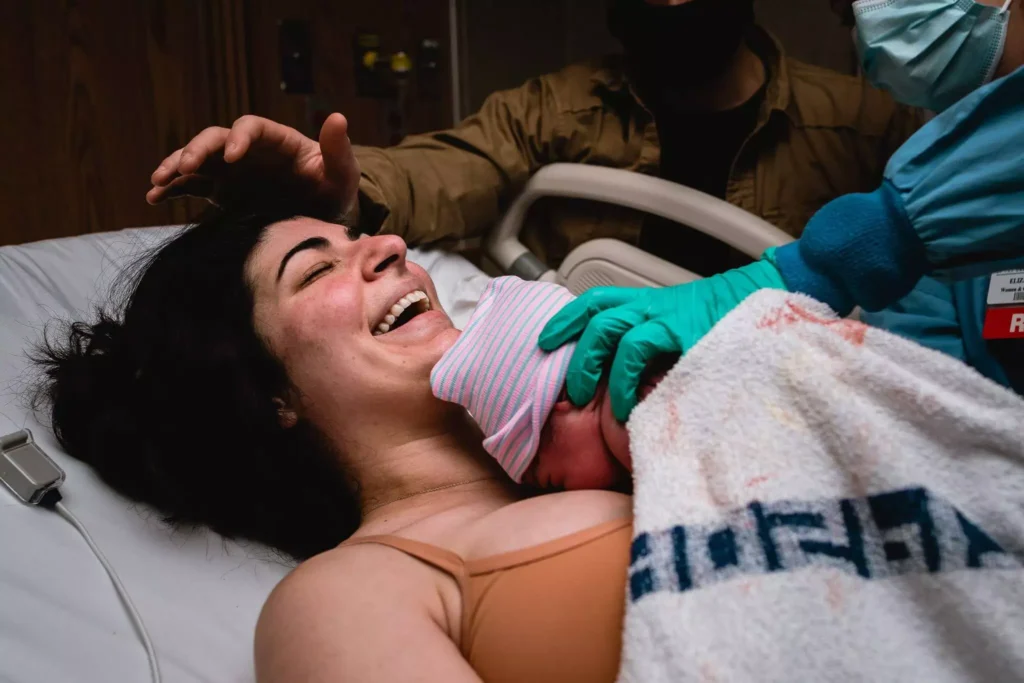

Learn the science of pregnancy and birth to take the mystery of labor away! Understand why you are feeling what you feel, and learn strategies to confidently move through pregnancy and birth!
- 9h+ of Video
- Support Group
- Close Captioning
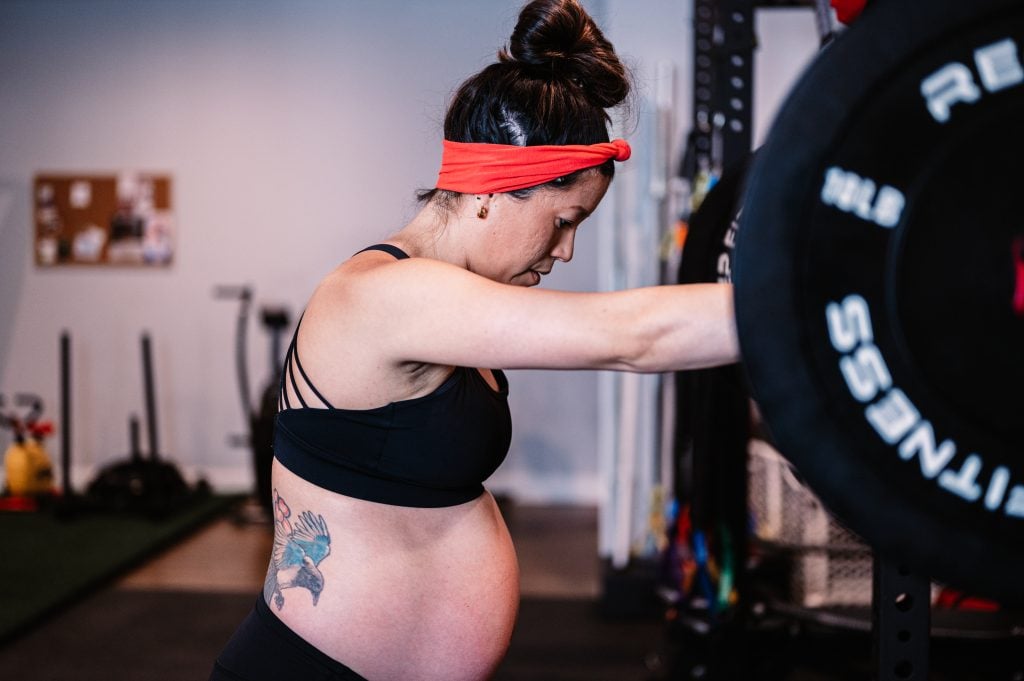

- 5 Workouts/Week
- Gym Workouts
- Self-Paced

Instructor
GINA
Workout on-demand with our prenatal fitness workout videos! Each workout is 30-40 minutes to follow along as you exercise at the same time!
- Birth Prep
- All Trimesters
- Mobility Work

Instructor
GINA
Find comfort and relief from pelvic girdle pain throughout your pregnancy and postpartum period! This program incorporates myofascial sling focused exercises to stabilize across the pelvic girdle joints.
- 3 Weeks
- On Demand Workout Videos to Follow