

Choosing the right labor position can help you feel more comfortable during contractions while creating space for your baby to move through the pelvis. But how do you know which are the best positions for labor at each stage? And how can you tell where your baby is in the pelvis without relying on cervical exams?
One of the most helpful things you can do during labor is pay attention to your body’s natural movement patterns. The way you instinctively move, shift your hips, position your legs, or respond to contractions can provide clues about where your baby may be within the pelvis and what types of positions might feel most supportive.
Understanding the relationship between your baby’s position, the shape of your pelvis, and your labor progress can help you make more informed decisions about movement during birth. Although cervical exams can provide valuable information, they are not the only tool available to help you understand what may be happening during labor.
In this guide, we will explore how the baby moves through the different levels of the pelvis, which labor positions may help create space at each level, and how your physical and emotional responses can provide clues about your labor timeline.
Table of Contents
Subscribe to our YouTube Channel for more weekly workouts and educational videos! We publish one new workout video and 2-3 educational videos a week on our channel.
 Video course · 9+ hours
Childbirth Education
Over nine hours of video on contractions, comfort measures, pushing, and recovery — so you walk into labor knowing what's happening and what your options are at each stage.
Learn more
 On-demand video · 24 workouts
Birth Prep Workout Program
Twenty-four workouts that open the pelvis for each stage of labor — strength, mobility, and positioning you can start at any fitness level, 15 to 30 minutes each.
Learn more
 Video course · 7 modules
Prepare Your Pelvic Floor For Birth
Seven modules on releasing the pelvic floor rather than only strengthening it — breathing drills, thoracic and pelvic mobility, and how to relax it during labor.
Learn more
Why Labor Positions Matter
During labor, your baby navigates through the pelvis before being born. The pelvis is not a single, uniform space. Instead, it has different levels, each with its own shape and dimensions. As your baby descends and rotates, different areas of the pelvis become important.
The goal of labor positioning is to help create space in the part of the pelvis where your baby needs it most.

For example, if your baby is still high in the pelvis, you may benefit from movements that encourage space at the pelvic inlet, which is the top of the pelvis. As your baby moves into the middle of the pelvis, positions that encourage movement and space through the mid-pelvis may become more useful. When your baby is lower and preparing to be born, positions that support the pelvic outlet and allow you to push comfortably may be more appropriate.
Your body often guides you toward movements that feel instinctively helpful. You might sway your hips, widen your stance, shift your weight from one leg to another, or bring your feet closer together. These movements may offer clues about where your baby is in the pelvis.
Rather than assuming there is one ideal labor position that works for everyone, it can be helpful to understand the different options and learn to respond to what your body is telling you.
Understanding Fetal Station and Cervical Exams
Before discussing specific labor positions, it helps to understand fetal station and how it relates to your baby’s movement through the pelvis.
Fetal station describes how high or low your baby is within the pelvis. As labor progresses, your baby generally descends through the pelvis, although the timing and pattern of descent vary from person to person.
A cervical exam can provide information about several aspects of labor, including:
Dilation: How open the cervix is.
Effacement: How thin the cervix has become.
Cervical position: Where the cervix is positioned.
Cervical consistency: How firm or soft the cervix feels.
Fetal station: How high or low the baby’s presenting part is in the pelvis.
These assessments provide a snapshot of what is happening at that moment. However, cervical exams can be uncomfortable or painful, and repeated examinations may increase the risk of infection, particularly after the membranes have ruptured.
Cervical exams are not inherently bad. They are a useful tool that your healthcare provider can use when the information is needed to guide your care. However, you may not need an exam every time you want to understand how labor is progressing.
Observing your contractions, physical sensations, and natural movement patterns can provide additional information to consider alongside your care team’s assessments.
It is important to remember that these external signs cannot tell you your exact cervical dilation or confirm your baby’s precise station. They are clues that may help guide your comfort measures and positioning choices, rather than a replacement for clinical assessment when it is needed.
The Three Main Levels of the Pelvis
To understand how labor positions can help, it is useful to divide the pelvis into three main levels.
1. The Pelvic Inlet: The Top of the Pelvis
The pelvic inlet is the opening at the top of the pelvis. When your baby is still high and has not fully engaged, creating space at this level may help support the baby’s movement into the pelvis.

2. The Mid-Pelvis: The Middle of the Pelvis
The mid-pelvis is the middle portion of the bony pelvis. As your baby descends and rotates through this area, different hip positions and weight shifts may help create space for the baby’s continued movement.
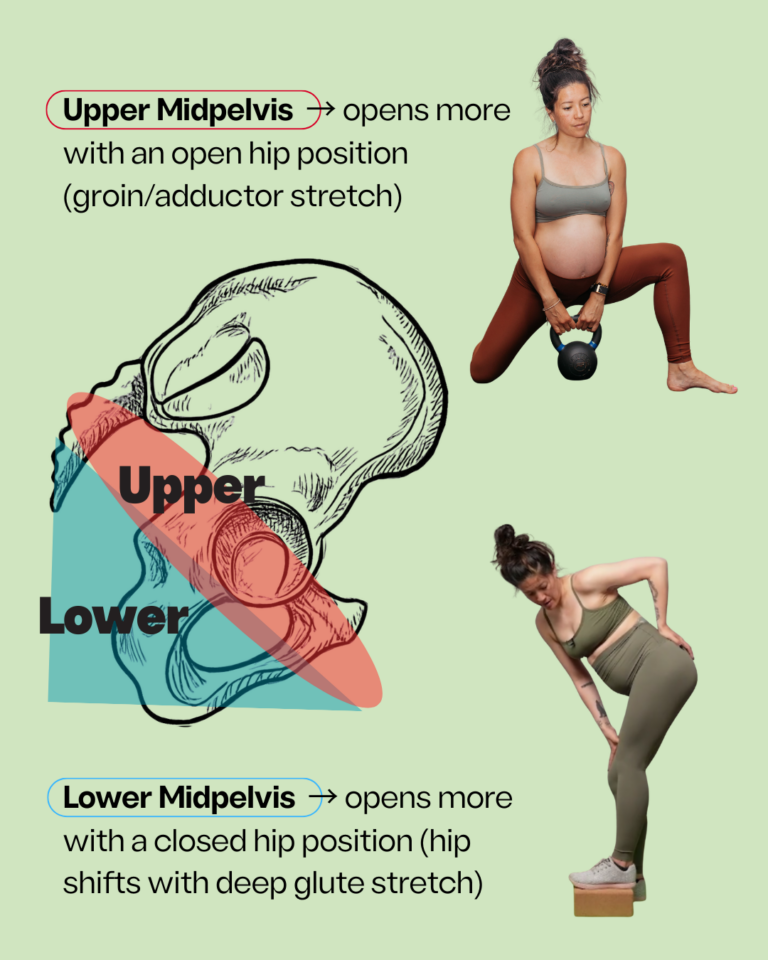
For practical positioning, it can be helpful to think about the mid-pelvis in two stages: an upper portion and a lower portion. The types of movements that feel useful may change as your baby moves lower.

3. The Pelvic Outlet: The Bottom of the Pelvis
The pelvic outlet is the bottom opening of the pelvis, where your baby exits during birth. As your baby reaches this level, the focus shifts toward finding a comfortable pushing position and allowing the tissues of the pelvic outlet to soften and accommodate birth.
The important thing to remember is that these pelvic levels describe where your baby is moving anatomically. They do not correspond perfectly to specific stages of labor. A person can be in a particular stage of labor while their baby is still navigating a different level of the pelvis.

Labor Positions for a Baby Who Is Still High in the Pelvis
When your baby is still high in the pelvis and working toward engagement, the goal is to create space at the pelvic inlet.
The pelvic inlet can be influenced by the position of your legs and the way you tilt your pelvis. Two movements that may be particularly useful are widening the legs with external rotation and moving the pelvis forward and backward.
Wide-Leg Positions With External Rotation
External rotation refers to turning the thighs outward. When you widen your stance and allow your legs to rotate outward, you change the shape and orientation of the pelvis in a way that may help create more side-to-side space at the pelvic inlet.
During contractions, you might instinctively stand with your feet farther apart, turn your toes outward, or move into a wide-legged position that feels more comfortable.
You do not necessarily need to exaggerate the movement. Sometimes, a subtle adjustment in your stance is enough to make a position feel better.
Possible positions to explore include:
Standing with your feet comfortably wider than hip-width apart.
Standing with your knees relaxed and your feet turned slightly outward.
Using a wide-legged stance while leaning forward onto a stable surface.
Moving your hips gently while maintaining a wide stance.
The goal is not to force your body into a specific position. Instead, pay attention to whether a wider stance and outward rotation feel helpful during contractions.

Anterior and Posterior Pelvic Tilts
Pelvic tilting is another movement that may be useful when your baby is still working toward engagement.
An anterior pelvic tilt involves tipping the pelvis forward, often creating a slight arch in the lower back. A posterior pelvic tilt involves tucking the pelvis underneath you.
These movements change the orientation of the pelvis. An anterior tilt can help create space toward the front of the pelvic inlet, while a posterior tilt changes the position of the sacral promontory and may create additional space toward the back of the inlet.
During labor, you may notice that you naturally alternate between arching your back and tucking your pelvis underneath. You might emphasize one direction more strongly, or the movement may be small and subtle.


For example, during a contraction, you could:
Stand with your feet comfortably apart.
Gently tuck your pelvis underneath you.
Return toward a neutral position or allow a small forward tilt.
Repeat whichever movement feels most comfortable.
Add gentle side-to-side weight shifts if they feel supportive.
You can also explore pelvic tilts while leaning forward onto a counter, a birth ball, or another stable surface.
One possible clue that your baby is still working toward engagement is a repeated preference for pronounced forward-and-backward pelvic movements, particularly tucking the pelvis underneath. This is not a definitive assessment of fetal station, but it can help you notice your body’s natural preferences.
Labor Positions for a Baby Moving Through the Upper Mid-Pelvis
Once your baby has engaged or is beginning to move through the middle of the pelvis, you may notice a shift in the movements that feel most comfortable.
Instead of emphasizing primarily forward-and-backward pelvic tilts, you may begin to sway your hips from side to side or shift your weight from one leg to the other.
For the upper portion of the mid-pelvis, positions that emphasize opening one hip at a time, often with a slight anterior pelvic tilt, may feel supportive.
One-Sided Open-Hip Positions
Open-hip positions generally involve allowing one hip to move into a more open position, with the leg moving outward or rotating externally as appropriate for your comfort.
These positions may create a sensation of stretching through the groin or inner thigh, where the adductor muscles are located.
You might naturally find yourself:
Widening one leg more than the other.
Shifting your weight from one foot to the opposite foot.
Swaying your hips from side to side.
Allowing one hip to open while the other leg supports your weight.
Maintaining a slight forward pelvic tilt as you move.

For example, you might stand with your feet apart and shift your weight toward your left leg before moving toward your right. You could allow the opposite hip to open slightly as you shift, adjusting your stance according to what feels comfortable.
You may also notice that your body prefers a more subtle version of this movement. A simple side-to-side sway without a dramatic change in hip rotation may be enough.
The key clue is often the shift from predominantly forward-and-backward movements to more pronounced side-to-side swaying during contractions.
This type of movement may suggest that your baby has engaged or is beginning to move through the mid-pelvis. However, every labor is different, and your movement patterns cannot establish your baby’s exact position.

Why Following Your Instincts Matters
Labor is not always a process in which you consciously choose a position and hold it for a set amount of time. Many people naturally move in response to the sensations of contractions.
You might sway during one contraction, lean forward during the next, and change your stance again when the intensity increases.
Rather than worrying about whether you are performing a movement correctly, notice what your body seems to be asking for.
If side-to-side swaying feels relieving, allow yourself to explore it. If a wide stance feels uncomfortable, you can bring your feet closer together or try another position.
Movement during labor should be responsive to your comfort, your baby’s progress, and any guidance from your birth team.
Labor Positions for a Baby Moving Through the Lower Mid-Pelvis
Closed-hip positions generally involve bringing the legs somewhat closer together and allowing one hip to move into a more internally rotated position.
Internal rotation refers to turning the thigh inward. As your baby moves lower, this type of hip positioning may help change the available space around the lower mid-pelvis and support the baby’s continued rotation.
You might notice that you naturally begin to:
Bring your feet closer together.
Shift your weight from one leg to the other.
Rise slightly onto your toes during a weight shift.
Make small, gentle squatting movements.
Alternate your weight between your feet while keeping your stance relatively narrow.

These movements can be much smaller than a traditional exercise squat. You may find yourself gently bending your knees, lifting your heels slightly, or moving from one foot to the other during a contraction.
The goal is not to force a deep squat or hold a challenging position. Instead, you can experiment with small weight shifts and gentle movements that feel comfortable and sustainable.
Signs Your Baby May Be Getting Lower
As your baby moves deeper into the pelvis, you may experience increased pressure or heaviness.
Some people notice:
More pressure in the vaginal area.
A sensation of heaviness toward the buttocks.
Increased pressure around the outer hips.
A stronger urge to change positions during contractions.
A natural preference for small squats or shifting weight between the legs.
These sensations may accompany your baby’s descent, but they do not reliably predict exactly when pushing will begin.
If you notice a strong urge to push, significant rectal pressure, or rapidly changing sensations, let your birth team know so they can help assess what is happening and guide you through the next steps.
Labor Positions for the Pelvic Outlet and Pushing
When your baby reaches the pelvic outlet, the focus shifts toward the final stage of descent and birth.
At this point, your baby’s head may become visible as birth approaches. Your body may also develop a strong urge to push.
Rather than trying to follow a complicated sequence of movements, the priority becomes finding a pushing position that feels comfortable, allows you to work with your contractions, and supports your baby’s birth.
Finding a Comfortable Pushing Position
There is no single pushing position that works best for every person or every birth.
Depending on your circumstances, comfort, mobility, and care team’s guidance, you might prefer a position that allows you to lean forward, rest on your side, kneel, squat with support, or use another supported posture.
The important consideration is how your body responds.
You may naturally move your hips, adjust the angle of your legs, or change your position as your baby descends. These adjustments can help you respond to pressure and find a position that feels manageable.
As you approach birth, your preferences may also change from one contraction to the next. You do not need to remain in one position simply because it felt good earlier in labor.
Your care team can help you find an appropriate position based on your baby’s progress, your comfort, and any medical considerations.
What If You Have an Epidural?
An epidural changes the experience of labor positioning because it can reduce sensation and limit your ability to move independently. However, there may still be ways to use positioning to support your baby’s movement through the pelvis.
Even with an epidural, you may notice that one side feels more comfortable than the other. Your care team can help you explore different supported positions in bed, depending on your mobility and the degree of sensation you retain.
Using a Peanut Ball During Epidural Labor
A peanut ball is an elongated, peanut-shaped exercise ball that can be placed between the legs while you are lying on your side or used in other supported positions in bed.
With assistance from your nurse or birth team, a peanut ball can help support your legs in different positions and encourage changes in hip alignment.
The best position may depend on where your baby is in the pelvis. For example, a position that encourages one type of hip opening may be useful at one point, while a different leg position may be preferred as your baby descends and rotates.
If you have an epidural and are unsure which position to try, your care team can help you consider your baby’s station and your available range of movement. A cervical exam may be useful when knowing the baby’s station would help guide positioning decisions.
You do not need to figure out every positioning choice on your own. Your nurse or provider can help you safely adjust your position and use a peanut ball when appropriate.
Understanding the Labor Timeline: Early Labor, Active Labor, Transition, and Pushing
In addition to paying attention to your baby’s movement through the pelvis, you can observe how your body and mind respond to contractions.
There are two related but distinct processes happening during labor:
Your baby’s journey through the pelvis: Your baby descends and rotates through the different pelvic levels.
Your labor progression: Your contractions change in strength and frequency, while your cervix dilates and effaces and your body prepares for birth.
These processes occur at the same time, but they do not always progress in a perfectly coordinated way.
For example, being in active labor does not automatically mean your baby has reached the middle of the pelvis. Similarly, being in early labor does not necessarily mean your baby is still high in the pelvis.
Understanding this distinction can help you avoid assuming that a particular contraction pattern always calls for a particular pelvic movement.
Early Labor
During early labor, contractions may be relatively spaced out, sometimes approximately five to ten minutes or more apart.
You may remain aware of your surroundings and feel able to talk, walk, or engage in normal activities between contractions. You might not need much physical or emotional support yet.
During a contraction, you may pause to breathe or adjust your position, but you can often return to your usual activities when it ends.
This can be a time to experiment gently with comfortable movements, rest when needed, eat and drink according to your care team’s guidance, and conserve energy for the work ahead.
The timing of contractions alone cannot establish exactly how dilated your cervix is or where your baby is in the pelvis.
Early Active Labor
As labor intensifies, you may begin to need more support during contractions.
You might need to stop talking, focus on your breathing, lean on a support person, or concentrate on the sensations in your body. However, between contractions, you may still return to conversation and remain engaged with your environment.
Contractions during this phase may be approximately three to eight minutes apart, although patterns vary considerably.
This can be a useful time to have your support person help you explore positions that feel relieving. You might lean forward, sway your hips, change your stance, or use another comfortable position as the contractions become more demanding.
Rather than trying to predict your baby’s exact position from the stage of labor, consider your movement preferences alongside your overall labor pattern.
Active Labor
During active labor, contractions may become stronger, longer, and more frequent, often occurring around two to three minutes apart.
You may need substantial support during contractions and become less interested in interacting with your surroundings between them. Instead, you may remain inwardly focused as you concentrate on each contraction.
Your support person may help by providing counterpressure, offering reassurance, assisting with position changes, or simply staying close and maintaining a calm environment.
As labor progresses, you may find that certain movements become more instinctive. You might sway, rock, shift your weight, or change positions without consciously thinking through each movement.
Allow yourself to respond to these preferences while remaining attentive to your comfort and any guidance from your care team.
Transition
Transition is commonly described as an intense period near the end of the first stage of labor, as the body prepares to move into pushing.
During this time, contractions may feel particularly demanding. You might experience a sense of panic, begin to doubt your ability to continue, or feel as though your confidence is disappearing.
These emotional responses can occur during intense labor, but they do not establish exactly how dilated you are or guarantee that pushing is imminent.
Support is especially important during this period. Your birth team can help you focus on one contraction at a time, provide reassurance, and guide you through changes in sensation and position.
If you feel overwhelmed, remember that you do not have to manage every contraction independently. Your support person and care team can help you navigate this stage.
Pushing and Birth
When you reach the pushing stage, your baby continues descending through the pelvic outlet and is eventually born.
The sensations of pressure and the urge to push may influence which positions feel most comfortable. Your care team can help you respond to these sensations and determine how best to proceed based on your circumstances.
After your baby is born, the placenta is delivered as the final stage of birth.
Although these stages provide a general framework for understanding labor, every birth follows its own timeline. The length of each stage and the sensations you experience can vary.
 Bundle · lifetime access
MamasteFit Bundles
Combine courses and programs for lifetime access and save up to 15% — grouped for birth preparation, the third trimester, or the whole pre and postnatal journey.
Learn more
On-demand video · 30 workouts
Core, Pelvic Floor & Pelvic Stability
Thirty follow-along workouts across beginner, novice, and advanced levels, ten per level — core and pelvic floor strength for pain relief in pregnancy or postpartum.
Learn more
 On-demand video · 128 workouts
Prenatal Workout On-Demand
Follow-along workouts from week 5 to week 41, four or five a week with guided warm-ups and cool-downs — over 128 sessions coached in real time alongside the video.
Learn more
How to Combine Your Baby's Position With Your Labor Progress
One of the most important concepts to understand is that your labor timeline and your baby’s movement through the pelvis are not the same thing.
Your labor timeline describes changes in contractions and cervical dilation and effacement. Your baby’s movement through the pelvis describes descent and rotation.
These processes influence one another, but they do not always align in a predictable pattern.
For example, you might be experiencing strong, frequent contractions while your baby is still working toward engagement. Alternatively, your baby may have descended significantly before you experience a strong urge to push.
This is why it can be helpful to pay attention to both your overall labor experience and your instinctive movement patterns.
Instead of assuming that a particular stage of labor requires a particular position, consider the following questions:
What movements feel most comfortable during contractions?
Am I naturally moving my pelvis forward and backward?
Do I feel drawn to swaying from side to side?
Do I prefer a wide stance, or do my feet naturally move closer together?
Am I experiencing increasing pressure or a strong urge to push?
Would additional support from my nurse, midwife, or provider help me understand what is happening?
These questions can help you communicate your needs and explore different comfort measures without feeling that you must identify your baby’s exact position on your own.
A Practical Guide to the Best Positions for Labor by Pelvic Level
The following table summarizes the general movement patterns discussed above.
| Area of the pelvis | Possible movement preferences | Positioning focus |
|---|---|---|
| Pelvic inlet | Forward-and-backward pelvic tilts; wide stance with external rotation | Create space at the top of the pelvis |
| Upper mid-pelvis | Side-to-side hip swaying; one-sided open-hip positions | Encourage movement and space through the upper middle pelvis |
| Lower mid-pelvis | Weight shifts with a narrower stance; internal rotation; small supported squats | Support continued rotation beneath the pubic bone |
| Pelvic outlet | Comfortable pushing positions and instinctive adjustments | Support the final descent and birth of the baby |
These are general patterns rather than rigid rules. You may use different movements at different times, and you do not need to force a position that feels uncomfortable.
Your baby’s position, your mobility, your contractions, and any medical considerations all influence which positions are appropriate for you.
How Your Birth Partner Can Help
A birth partner can play an important role in helping you move comfortably and respond to your body’s changing needs.
During labor, you may not want to explain what you need or make decisions about every position. Having someone who understands your preferences can help reduce the amount of thinking required when contractions become intense.
Your birth partner can help by:
Offering a steady surface to lean on while you stand or sway.
Providing physical support during gentle weight shifts.
Helping you change positions when you become uncomfortable.
Reminding you to relax between contractions when possible.
Communicating your needs to your nurse, midwife, or provider.
Supporting your choices without insisting that you use a particular position.
It can also be helpful to discuss labor positions before birth. You do not need to memorize every movement or plan exactly how you will respond to each contraction. Instead, become familiar with the general concepts and remain open to adjusting your approach.
If you have an epidural or other circumstances that limit movement, your birth partner can work with your care team to help you change positions safely.
When to Ask Your Care Team for Guidance
Your intuitive movements and physical sensations can provide useful clues, but they cannot confirm your baby’s station, cervical dilation, or overall well-being.
If you are unsure which position might be helpful, your nurse, midwife, or provider can assess the situation and help you decide what to try.
A cervical exam may be particularly useful when knowing the baby’s station would help guide positioning choices. You can discuss the potential benefits and limitations of an exam with your provider and decide whether it is appropriate for your circumstances.
Your care team’s guidance is especially important if you have an epidural, are experiencing an unusually strong urge to push, or have a medical condition that affects which positions are safe.
Always follow your birth team’s recommendations regarding movement, pushing, and any changes in your symptoms. Labor positioning should support your comfort and care, not replace clinical assessment when it is needed.
Final Thoughts: Trust Your Body While Staying Flexible
Choosing labor positions does not have to be about finding one perfect movement or following a strict sequence. It is about understanding how the pelvis changes as your baby descends and learning to respond to the movements and sensations that feel most helpful.
When your baby is high in the pelvis, you may naturally prefer wide-legged positions, external rotation, and forward-and-backward pelvic tilts. As your baby moves through the mid-pelvis, side-to-side swaying and one-sided hip positions may become more comfortable. As your baby moves lower, you may prefer a narrower stance, gentle weight shifts, or small squatting movements. When it is time to push, finding a comfortable and appropriate position becomes the priority.
At the same time, remember that your baby’s position and your labor timeline are separate processes. Contraction patterns, emotional responses, and instinctive movements can all provide clues, but none of them can tell you your exact cervical dilation or fetal station with certainty.
The most useful approach is to combine your body’s natural responses with support from your birth team. You can trust yourself to explore movements that feel comfortable while also asking for help when you need a clearer understanding of your labor progress.
With preparation, flexibility, and the right support, you can approach labor positioning with greater confidence and a better understanding of how movement may help you navigate the birth process. For additional support, you can explore our childbirth education course or fitness programs and use code YOUTUBE 10 for 10% off any of our online offerings!
Video course · 9+ hours
Childbirth Education
Over nine hours of video on contractions, comfort measures, pushing, and recovery — so you walk into labor knowing what's happening and what your options are at each stage.
Learn more
On-demand video · 24 workouts
Birth Prep Workout Program
Twenty-four workouts that open the pelvis for each stage of labor — strength, mobility, and positioning you can start at any fitness level, 15 to 30 minutes each.
Learn more
Video course · 7 modules
Prepare Your Pelvic Floor For Birth
Seven modules on releasing the pelvic floor rather than only strengthening it — breathing drills, thoracic and pelvic mobility, and how to relax it during labor.
Learn more