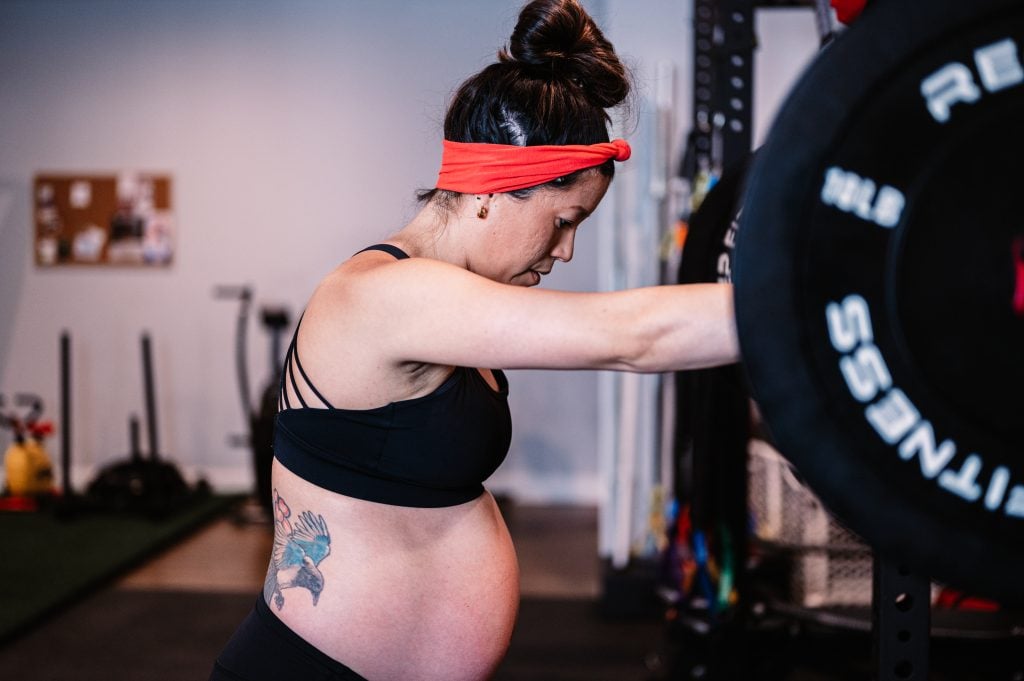
How to Workout with Your Kids: A Realistic Approach to Fitness for Moms
Fitness, Motherhood
As a perinatal fitness trainer, birth doula, and mom of four, one of the most common questions I get is: “How do you find time to work out with kids around?” The truth? You don’t find it—you create it, right in the middle of the beautiful chaos.
At MamasteFit, our philosophy is simple: your kids shouldn’t be an obstacle to your fitness. They can be right beside you, learning, exploring, and even mimicking your movements. And while it does require some expectation-management, it is absolutely possible to get an effective, thoughtful workout done with your baby or toddler nearby.
In this blog, I’ll walk you through exactly what that looks like—how I set up my space, how I adapt my programming, and how I stay focused (and safe!) while still being a fully present parent.
Subscribe to our YouTube Channelfor more weekly workouts and educational videos! We publish one new workout video and 2-3 educational videos a week on our channel.
Setting Up for Success: Expectation Management + Intentional Space
Before I start moving, I take two minutes to set up an environment that keeps my daughter happy and gives me enough flexibility to get through at least parts of the workout.
Here’s what I use:
Kid-sized workout gear (fun, safe, and lets them “copy” your movement)
Snacks—always essential
A simple puzzle or toy
iPad/screen time (guilt-free!) Screens can be a powerful tool when you need 15 minutes of focused movement.
A baby carrier—for the moments when she wants to be held but I’m not done moving
Having options gives your child something to cycle between, which buys you windows of time for effective exercise.
Warm-Up: Releasing Tension + Preparing the Pelvic Floor
My warm-ups always serve a purpose. Instead of random stretching, I focus on releasing tension patterns in my pelvic floor and creating mobility that supports the rest of my workout. Today’s warm-up includes:
1. All-Fours Hip Shift (Right Side)
I shift my weight left to stretch the right anterior pelvic floor, which tends to be more overactive for me. From that shifted position, I alternate between arching and rounding to mobilize both the pelvis and core.
2. Elevated Hip Shift (Left Side)
Placing my left knee on a yoga block shifts emphasis to the left posterior pelvic floor. Because humans naturally carry asymmetries—right side often more backward, left more forward—this targeted mobility helps restore balance.
3. Staggered Goblet Squats
Weight slightly into the left foot, kettlebell held in front to encourage front abdominal engagement. Bonus: kids love copying squats, especially if they have their own tiny kettlebell.
4. Staggered Stance Kettlebell Swings
Before adding dynamic movements, I always check where my daughter is. Swings are powerful and harder to stop mid-rep, so you may need to modify or swap out this movement depending on your child’s proximity.
In today’s program, cleans and rack-loaded squats were originally on my list, but I skipped both. Olympic lifts aren’t ideal with a child wandering around, and I don’t have my power rack in the filming studio.
Instead, I focus on accessory work that still delivers a full-body, pelvic-floor-supported session:
Accessory Block: Strength + Mobility With Purpose
1. Reverse Lunges (Side-Specific Setup)
Because each pelvic half behaves differently, I load each leg differently:
Left Leg: band around the inner thigh → activates inner thigh/hamstring more intentionally
Right Leg: band around the outside of the knee → helps fire the outer glute and keep knee aligned
This supports the natural asymmetry most people have rather than ignoring it.
2. Lateral Hip Shifts
Feet wider than hip-width, weight held opposite the working leg. This move does so much:
improves thoracic (rib cage) rotation
stretches one pelvic quadrant while strengthening the opposite
increases hip mobility
trains your body to shift weight effectively—important for core, gait, and pelvic floor function
3. Single-Leg Deadlifts (Loaded Differently on Each Side)
Left Leg:
Weight in the right hand → encourages internal rotation → helps “close” the left hip (useful because the left pelvis tends to sit more open)
Right Leg:
Weight in the right hand again → encourages external rotation → helps “open” the more closed right hip
These subtle shifts create profound improvements in pelvic balance and core function.
4. Alternating Seesaw Rows
A hinge + rotation combination that unlocks thoracic mobility while also building upper-body strength. If your rib cage is stiff or “stuck,” your pelvic movements will also be limited—so training rotation is key to a comfortable pelvic floor and functional movement patterns.
Working Out With Kids: What It Really Looks Like
Throughout the workout, my daughter wanders around the space, plays with toys, comes over for cuddles, and occasionally tries to run off set. And that’s normal. She’s familiar with the environment, knows what’s safe, and has enough options to stay engaged.
But I still monitor, parent, and adjust the flow as needed.
This is real motherhood—flexible, imperfect, and still incredibly rewarding.
Why Our Programming Isn’t Perfectly Symmetrical
Most fitness programs treat the body as if it’s evenly balanced. But humans aren’t symmetrical, especially during pregnancy and postpartum.
At MamasteFit, we design our approach around normal, common asymmetries, especially within:
pelvic positioning
rib cage mechanics
hip rotation
muscular activation patterns
By intentionally loading and mobilizing each side differently, we help you:
feel more comfortable throughout pregnancy
prepare your pelvis for birth
recover postpartum
reduce pelvic floor symptoms
move with less tension and more strength
Your body adapts quickly when you train it according to how it truly functions.
Motherhood-Friendly Workouts That Work in Real Life
Every MamasteFit program is broken into 3–4 smaller sections so that you can:
do the whole workout when time allows
OR complete it in smaller 10–15 minute chunks
Because movement doesn’t have to be an hour long to be meaningful. Ten minutes is still movement. Five minutes is still movement. Consistency beats perfection every single time.
Ready to Train With Us?
If you want structured, pelvic-floor-supportive workouts that embrace the chaos of motherhood—not fight against it—join us for our online fitness programs.
Use code YOUTUBE10 for 10% off any online program.
Motherhood is not a barrier to fitness. You deserve to feel strong, supported, and at home in your body—no matter how many little ones are running around your feet.
Learn the science of pregnancy and birth to take the mystery of labor away! Understand why you are feeling what you feel, and learn strategies to confidently move through pregnancy and birth!
Find comfort and relief from pelvic girdle pain throughout your pregnancy and postpartum period! This program incorporates myofascial sling focused exercises to stabilize across the pelvic girdle joints.