

In this article, we’ll explore three highly effective squat modifications that can help you regain pelvic strength and improve Pelvic Health. These modifications are gentle yet powerful, making them suitable for women looking to enhance their pelvic health without overexerting themselves.
Squats are a beneficial exercise for overall fitness and strength training. They engage multiple muscle groups, including the quadriceps, glutes, hamstrings, and calves, which help to build lower body strength and improve balance and coordination.
Squats are also a functional movement, which means they mimic movements we use in our daily lives, such as getting up from a chair or lifting heavy objects. BUT if you are experiencing pelvic floor dysfunction symptoms while squatting, should you STOP all squats??
No! Rather we can modify to a variation that better suits your pelvic floor needs. Let’s explore a few ways to modify the squat if you are experiencing leaking or pelvic heaviness.
Are you an expecting mother looking to prepare for childbirth? MamasteFit’s Childbirth Education Course can provide you with the knowledge and tools you need to feel confident and empowered during labor and delivery.
Our course covers everything from relaxation techniques and pain management to breastfeeding and newborn care.
Join our community of supportive mothers and experienced instructors today and take the first step towards a positive birth experience. Enroll now and give yourself and your baby the best possible start.
Improve Pelvic Health: 3 Effective Squat Modifications For Prolapse, Heaviness, And Leaking
Squats tend to be wide-legged, which loads more of the anterior pelvic floor. This could be an issue since this portion of the pelvic floor is not as supported as the posterior pelvic. So overloading this portion could cause some issues.
What can we do if we are having some issues with these types of movements??
Rebuild in a more supportive position!
How Can We Modify The Squads to Improve Pelvic Health?
How can we modify the squat to support our pelvic floor function?
- Decrease the width of your stance
- Add a block or ball squeeze to increase adductor activation which helps support the pelvic floor
- Add a box at the bottom for more support
1) Decrease Width of Stance
If you are experiencing leaking or pelvic heaviness with squats, the first step is to decrease the width of your stance. External rotation can overload the front half of the pelvic floor, which is not as supported structurally as the posterior portion.
In wide-legged squats, if we are experiencing leakage or pelvic floor issues, decreasing the width of your stance can take some of that pressure off the front half of the pelvic floor and hopefully alleviate your issues.
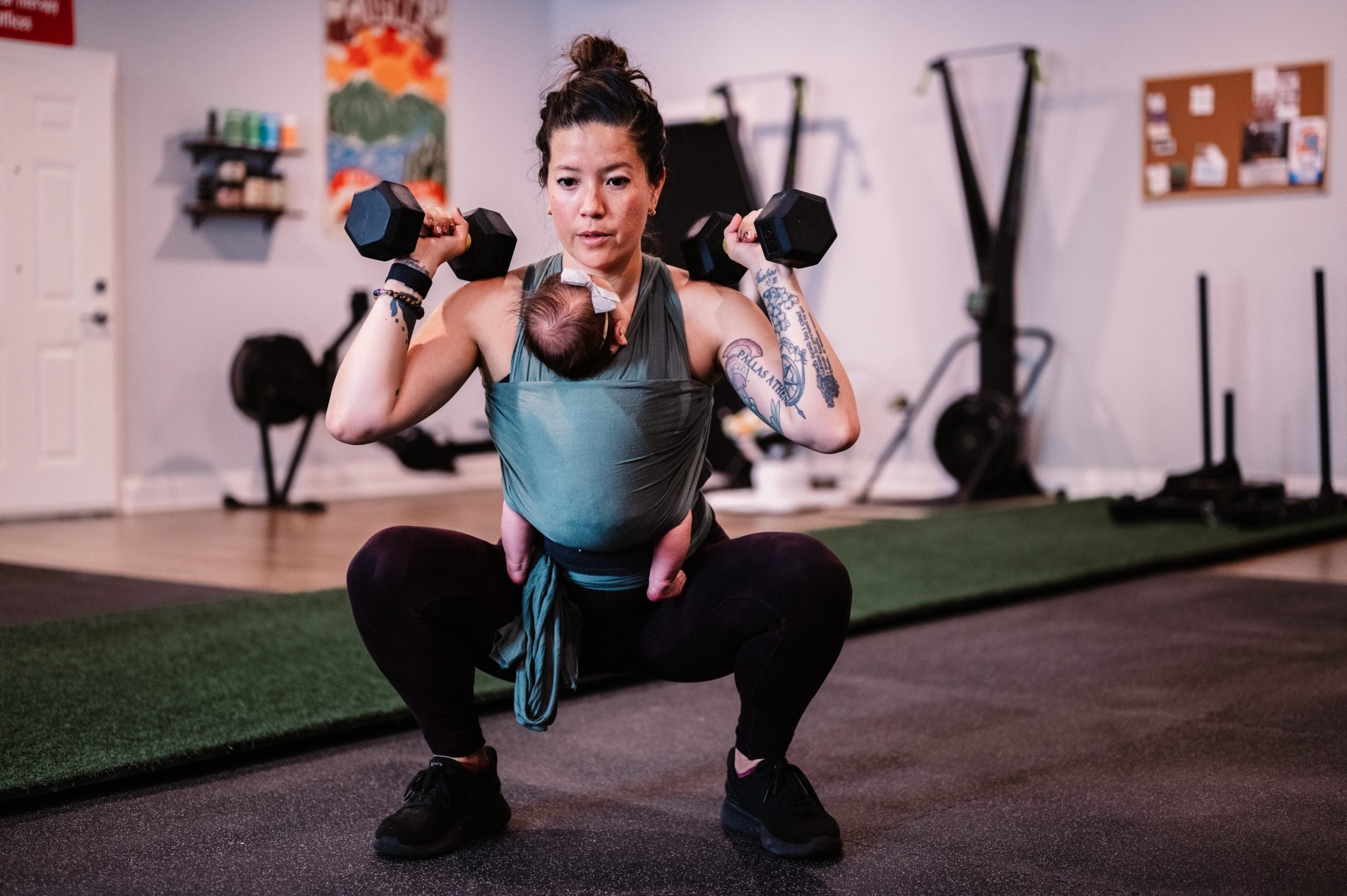
This shorter stance can more evenly load the pelvic floor as you build hip and glute musculature to support the pelvic floor during lifts. As you feel more comfortable, you can slowly begin to widen the stance if that is your preference for squats.
If you are postpartum and trying to figure out HOW to return to fitness after birth, join our postpartum fitness programs! We offer our programs in three main ways:
- 16-Week Postpartum Program in the Teambuildr app. Workouts are 45-75 minutes long to help you get back to big lifts, jumping, and running. We want you to be able to do WHATEVER it is you want to do physically.
- 12-Week Postpartum Mini Program in the Teambuildr app. Workouts are 15-20 minutes long to accommodate a busy schedule! Same programming design, but condensed to make t more manageable time-wise.
- Postpartum on-demand program are our full-length workout videos that you follow as you work out at the same time!
2) Increase Adductor Activation to Support the Pelvic Floor
The adductors, inner thighs, support the pelvic floor and help the pelvis rotate more internally. Internal rotation loads the posterior pelvic floor more. If the issue is that there is TOO much pressure on the anterior pelvic floor, the internal rotation could help to relieve some of that pressure.
We can increase adductor activation by squeezing a ball or block between our thighs or unilaterally loading it with a resistance band to pull the knee OUT.
The pelvic floor isn’t perfectly symmetrical, similar to the rest of our body, so we don’t always need to load things symmetrically! Unilaterally loading our body can support uneven tension in the pelvic floor that may be causing some of your pelvic floor related issues.
3) Decrease Range of Motion with Box Squats

Another modification if you are experiencing pelvic floor issues with squats is to decrease the range of motion.
Sometimes, we are just moving TOO much and we cannot stabilize well enough to stay pain-free and supported.
Decreasing the range of motion allows us to still strengthen the musculature, but in a way that is more supportive and within our current capabilities.
Over time, you can lower the box or remove it and see how it feels!