



Welcome to the MamasteFit Podcast. In this episode, we’re going to be talking all about what information do you need to know when it comes to birth. And so we’re going to introduce some key topics such as:
- what is a contraction,
- what is happening to your cervix when you have a contraction?
- What is your cervix, in case you don’t know what that is?
- We’re going to talk about what are the labor hormones that contribute towards birth,
- and then the labor timeline. So what to expect from first contraction until your baby and your placenta is born, because some of us forget that that also needs to be birthed in some capacity.
Read Episode Transcript
[00:01:21] Gina: Welcome to the MamasteFit Podcast. In this episode, we’re gonna be sharing with you the introduction to childbirth. So what information do you need to know to have a better understanding of what is even happening as you are preparing for birth? And so we’re going to talk about contractions. What’s even happening to your cervix. What is dilation and effacement, for example? A lot of us know dilation. Not all of us know what effacement is. Maybe we’ll talk about station. Where’s your baby even happening? What’s going on with your baby within the pelvis? And then we’re going to talk all things labor. So what hormones contribute towards labor and then what is even happening from your first contraction until your baby is born, plus that placenta, cause again, a lot of us forget that we also need to birth that. And so if you want to dive deeper into childbirth education with us, check out our online course, where we have way more information than what we can include in this hopefully somewhat short podcast episode. We’ll see how long we talk… But if you want to dive deeper with us, check out the online course and you can use code STORY10 to get 10 percent off, and then you can bundle it with our prenatal fitness and our pelvic floor prep to save an additional 15 percent as well.
[00:02:29] Gina: In the online course, we talk all about pregnancy and birth, anatomy and physiology. So what is actually happening within your body? What is the science of birth? We talk about some of the topics that we discuss in this podcast episode, but way more in depth. We talk about how to resolve issues during your labor, exercises that you could do during pregnancy to help prepare for birth. How does your pelvis open? What type of laboring positions help to facilitate that opening? Pelvic floor stuff. We also talk about labor comfort measures and ways to incorporate your birth partner into your birth preparation and in your labor, plus pushing and some postpartum information as well. So there’s a lot of stuff in there that was already probably too much to describe our online course, but check it out on our website and we’ll link it down in the notes below.
[00:03:12] Gina: So first thing, and probably the biggest thing that contributes towards our labor progress is a contraction. What is a uterine contraction? So our uterus is similar to other muscles within our body where it’s going to contract, where it shortens and tightens, and this tightening is helping to push your baby down into your pelvis. It’s helping to cause some change to your cervix to help it open or dilate and also get thinner or efface. And then uterine contractions are ultimately what’s going to help our labor progress towards pushing our baby out and then helping to push our placenta out.
[00:03:44] Gina: The way that you can tell that you’re having a labor contraction is the sensation that you feel during the contraction, and that that sensation should increase in intensity over time. And so with a uterine contraction, you can think about it like a charlie horse where it increases intensity, it peaks, and then releases and lets go. So if you’ve ever experienced a charlie horse in the middle of the night because you were slightly dehydrated, which I feel like all millennials are just in a state of constant dehydration from our youth.
[00:04:11] Roxanne: I don’t know if all of us are.
[00:04:13] Gina: Well, maybe we’re better now with our gigantic water bottles, which, are we like beverage goblins now? But if you are slightly dehydrated during pregnancy, you have probably had the luxury of experiencing a charlie horse in your calf in the middle of the night. And when you feel it, you feel it building and you’re like, “No, no, no, no!” and then it peaks and you’re like, “Ah!” And then it releases and lets go. I would not describe a uterine contraction as that same sensation, necessarily. Labor is not like charlie horses on repeat cause that would be horrible. But it is a similar wave like sensation where you feel it build, it peaks and then it releases, lets go. And so the intensity during that one minute of contraction is different at the beginning versus the peak, and then at the end. And so that’s how you can tell that it’s a labor contraction, is you have that wave like sensation.
[00:05:06] Gina: So Braxton Hicks, or a practice contraction, is different from a labor contraction because it doesn’t have that same wave like sensation. So the intensity during the practice contraction tends to be the same, where it’s a sudden tightening and then a sudden release, but no build or like change in intensity or sensation during it. In addition, Braxton Hicks tend to not be painful. They can be if you’re on the more dehydrated side. But typically they’re just like a little bit uncomfortable, but shouldn’t be super painful. But again, they can be if you’re like a little bit more dehydrated. Braxton Hicks and the practice contractions typically don’t cause any change to your cervix as well because it’s just kind of like tightening in the center and then releasing, letting go. While a labor contraction is pulling from the bottom to build into the top of the uterus and then pushing down, which is causing the cervix to change.
[00:05:57] Gina: And so the changes that are happening to your cervix are going to be that effacement, or thinning of the cervix, and then dilation, or the opening of the cervix. Now most of us are probably more familiar with dilation, which is how open the cervix is, and this is measured from a zero, sometimes known as closed, to 10 centimeters, also known as complete. And so the more open your cervix is, the higher that dilation number is going to be.
[00:06:22] Gina: So with effacement, we’re going to start at 0%, which is usually around 3 to 4 centimeters, which is what our cervix should be throughout most of our pregnancy. Towards the end of your pregnancy, your cervix may start to get a little bit thinner, and then ultimately during labor, it’s going to get super, super thin, like the thickness of a piece of paper, which will be like a hundred percent effaced. So 0% means the cervix is really thick, and 100% means it’s super, super thin. The thinner your cervix is, the more easily it is to manipulate and to dilate and open. So for a lot of us, we’re going to efface before we begin to dilate. So you might be like 70 to 80 percent effaced, but maybe only like one or two centimeters. But once we start to get higher in the effacement, you may find that dilation begins to happen a lot faster.
[00:07:05] Gina: And so you have to think about effacement as like half the effort that your cervix has to do to open to allow your baby to pass through. So effacement is at 0 to 100%. So think about that as half, or 50% of the effort. And then that dilation is that 0 to 10 centimeters. And so if you’re already like 90 percent effaced, you’re like halfway there, even if you’re only like one centimeter. So just all these mental tricks that you gotta play on yourself to feel good about your labor progress.
[00:07:30] Gina: Now, the main thing that contributes towards these labor contractions even happening are hormones within our body.
[00:07:37] Roxanne: And there are two main hormones that are involved with labor. There is oxytocin, which is our love hormone. This is what we release when we feel safe, supported, happy, when you orgasm, when you hold hands with someone that you love, when you hug them.
[00:07:49] Roxanne: All of these things are releasing in our body when we feel safe and supported, and it also makes us feel happy. So it’s releasing endorphins at the same time to like almost a natural pain relief. So oxytocin is a really great hormone. Oxytocin is what’s causing the uterine contractions.
[00:08:07] Roxanne: The other hormone involved is prostaglandins. Prostaglandins is just something that’s found in a lot of the tissues within our body. Another place that it’s commonly found is the lining of our stomach to prevent ulcers from forming. So the, acid within our stomach doesn’t erode our stomach lining. Prostaglandins are in charge of preventing ulcers from forming in your body. So, really helpful. Uh, but it’s also found in our cervix. So, prostaglandins is responsible for thinning out that cervix and making it softer and more effaced.
[00:08:36] Roxanne: So the two hormones, again, oxytocin and prostaglandins. And these work together in a positive feedback loop. So they contribute to each other increasing in the amount within our body. So which one starts labor? No one really knows. It’s probably very individualized on the person. And it’s also baby who is contributing oxytocin to also start labor as well. So it’s baby has a say and our personal bodies have a say. But we’ll just pretend that oxytocin is the initiator of labor.
[00:09:05] Roxanne: So oxytocin is released by our pituitary gland in our brain. This tells our body to have uterine contractions. The uterine contraction is going to cause baby in the amniotic sac to increase the amount of pressure that’s placed onto the cervix. That increased pressure on the cervix is going to release prostaglandins within our body. And then those prostaglandins then tell the brain as well to keep making more oxytocin. And then it just continues and continues until a baby is born.
[00:09:32] Roxanne: There are things that we can do to increase the amount of those hormones within our bodies, such as with oxytocin, again, feeling safe and supportive, having a very good team, setting the mood, as well as like dark, dim lights, soft music, things that are kind of helping you relax. The reason a dark, dim room is really helpful is because melatonin is another hormone that we release in our body to help us go to sleep at night, but it has a side benefit of making us more sensitive to oxytocin. So it allows you to be able to have like contractions a little bit easier. So having a dark room will stimulate the release of melatonin in your body to make you more receptive to oxytocin. So that’s how you can kind of help with that oxytocin, setting the mood, having your team there that makes you feel safe.
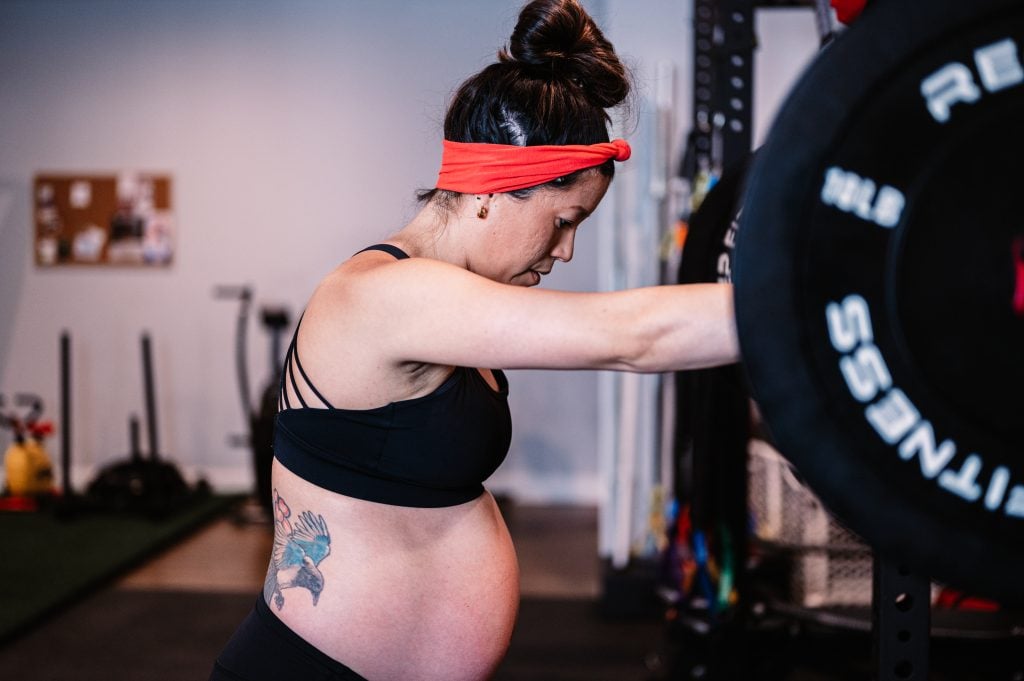
[00:10:17] Roxanne: And then with prostaglandins, there are things that we can kind of help with the release of prostaglandins. One is upright movement, because that’s going to allow the gravity to kind of help increase the amount of pressure that’s on the cervix. So doing prenatal fitness throughout your pregnancy can help you have the stamina to be able to be in an upright position longer than someone who maybe wasn’t able to work out as much.
[00:10:40] Gina: So working out during your pregnancy doesn’t make you better at labor. It’s more like what Roxanne says, it gives you the stamina to maintain those upright positions for a lot longer.
[00:10:48] Gina: And so if you’re interested in working out throughout your pregnancy, we have some programs for you as well. We have our prenatal fitness programs that we offer that we’ll link down below.
[00:10:57] Roxanne: And these, this is a program that both Gina and I have used during our pregnancies and obviously we cannot recommend it enough.
[00:11:03] Gina: Let’s take a break from this week’s episode to talk about our podcast sponsor, Needed. Needed is a nutrition company that focuses on the optimal nourishment for the perinatal time frame. It is the brand that Roxanne and I both use during our pregnancies and our postpartum and we highly recommend them to you.
[00:11:19] Roxanne: A prenatal vitamin is something that your provider is going to recommend to you, and pretty much everyone on the street, if they see that you’re pregnant, “Oh make sure you’re taking a prenatal vitamin!” So 97 percent of us are taking a prenatal vitamin, but still a majority of us are having some sort of nutrient depletion. Like, we’re not taking in the right amount of nutrients we need in just our diets, as well as in that prenatal vitamin. And that is why we really love Needed, because they’re really intentional about the research that they’re doing to create this prenatal vitamin with the right nutrients, the right dosages of those nutrients based on current research, and the nutrients are in a form that optimally absorbs into our bodies easier than other prenatal vitamins.
[00:11:58] Gina: During my current pregnancy, I’ve been taking Needed’s prenatal multivitamin capsules, but they have other options as well, such as their prenatal multivitamin powder, which was a favorite of mine in the first trimester when taking pills was really challenging. So I just included that in my smoothies. And then they have their prenatal essentials, which is similar to the prenatal multivitamin capsules, but it’s less pills. And so I really love that there’s multiple options that Needed offers, plus they have add on supplements that you can take to fill any sort of nutritional gaps that you have within your diet.
[00:12:27] Gina: If you’re interested in checking out Needed, they’re definitely a brand that we highly recommend, and you can use code MAMASTEPOD to get 20 percent off your first order at thisisneeded.com.
[00:12:35] Roxanne: So, things that we can kind of help release prostaglandins in our body is, one, your provider can do either a vaginal exam or a membrane stripping to release more of those prostaglandins. Any stimulation of the cervix will allow your body to release more prostaglandins. Prostaglandins is also found in semen, um, evening primrose oil is another thing that people use to help thin out the cervix, are things to kind of help either stimulate the release or kind of simulate. So there are prostaglandin, synthetic prostaglandin drugs that they can use for induction as well as Pitocin is that synthetic oxytocin. So that is going to allow uterine contractions to happen.
[00:13:12] Roxanne: There are things that can impede this labor feedback loop, but most of us, most of us during labor will be able to kind of, this feedback loop will start and sustain itself until a baby is born. And then this will adjust based off of where you are in the labor timeline. So usually the next thing is, well, how do I know when I’m in labor and what’s going to happen next once a contraction starts?
[00:13:35] Gina: So there are three stages to labor. The first stage is going to be like the labor stage. So this is where our cervix is dilating, where you’re having contractions and what you’re typically going to think of when you think of labor. Within that, there are like little phases as well that we’ll break down.
[00:13:51] Gina: The second stage of labor is going to be pushing, which is where you’re pushing your baby out. So it starts from when you begin pushing until your baby’s born.
[00:13:58] Gina: And then the third stage is your placenta that also needs to be born in some capacity. that some people forget exists. It’s an organ that you create yourself. It’s really cool.
[00:14:08] Gina: But the first stage of labor is that dilation. And so within it, we have some different phases or stages as well. So we have early labor, early active labor, which is kind of the transition between early to that active labor, which is the next stage. And then we finish that up with transition, which then brings us into pushing.
[00:14:27] Gina: So for early labor and early active labor, this is typically going to be where most of us start labor. Now, some of us will sleep through early labor, so you may wake up in active labor, or you may progress very quickly through early labor. But generally, most of us will spend most of our time in early labor. Generally. Again, generally. Don’t come for us if you have a fast, fast labor. In early labor, contractions are typically more than 10 minutes apart. They’re probably less than a minute (long), anywhere from like 30 seconds to a minute long. And you can like walk and talk and just exist normally through them. Like you were unaffected by the fact that you were having contractions, other than you might be really excited that you’re finally having these uterine contractions. So they’re building in intensity, they’re peaking and they’re releasing and let go, but you don’t need much support during them. You’re just kind of continuing about your day.
[00:15:20] Gina: So during early labor, if you’re tired, go to sleep. If you’re not tired because you had a full night of sleep and you woke up in early labor, eat some food, go move around, like, do your thing, and then when you’re fatigued, lay down to take a nap. But kind of just move through it based on how you feel. Don’t go for like a 10 mile walk, like, don’t completely dehydrate yourself, like, just think like a more relaxing day, like, if you’re in early labor to allow things to just kind of continue to progress.
[00:15:46] Gina: After early labor, we begin to enter this, like, transitional point where we’re kind of in between early and active labor. Which we just conveniently call Early Active Labor, because we’re not good at naming things, but we felt like that made sense. But this phase can be really confusing, because now your contractions, you’re starting to have more difficulty with them. You’re needing more support. You can’t quite walk and talk through them anymore. But in between contractions, you return to the space. So you’re present in the space that you’re in. So, you’re like, chatting with whoever and they’re telling a really funny joke and you’re like, “Ha, ha, I’m laughing at your joke!” And then you’re like, “Hang on, I have a contraction coming.” And then you focus on your contraction, your partner’s like squeezing your hips. And then the contractions over and you’re like, “Ha, ha, your joke was so funny!” And you’re kind of like returning to the space and you’re like mentally present in between contractions. So that’s a key thing to notice that you’re still in that early labor phase and contractions are probably anywhere from like four to ten minutes in spacing.
[00:16:47] Gina: And so what that means is every four minutes a new contraction starts. So you have a contraction for a minute, and then three minutes later another contraction starts. So you have a contraction for a minute and then three minutes later another contraction starts. So the spacing includes the one minute of contraction and plus the rest that you have. So if it’s 10 minutes in between contractions, every 10 minutes a new contraction starts, just so you have an idea of what that interval means.
[00:17:13] Roxanne: So active labor is generally where you’re needing support during those contractions and now you’re no longer present in that space. You’re almost in your own world. So it’s almost like when you go someplace and you see this person like, dancing to their own beat. They’re, like, all of the things that are happening around them, they are not aware that any of those things are happening. They’re in their own world. This is you in active labor. You are now in Labor Land, as some people call it. So you are rocking through the contractions with your support, and then you don’t really want to talk to anyone in between. Some people will try to even fall asleep in between. It’s like you’re this, like, sleepy drunk, in a way.
[00:17:52] Gina: A key thing for me to know that someone has transitioned into active labor is that for my doula clients, they’re no longer texting or calling me anymore. It’s their partner that is now the primary communicator. So during early labor, it’s usually my client who is like texting and updating me on what’s happening. Once they begin that transition into active labor, like it’s for whatever reason, being on your phone is like too mentally fatiguing and it’s like, I cannot like be on my phone. And for me, that’s how I know that I’m kind of starting to transition as well. Contractions are probably two to three minutes apart at this point. They’re lasting for a full minute. They’re a little bit more intense. And this would also be a good time to start thinking about heading to your birth location. if you are planning to give birth somewhere other than at your house.
[00:18:38] Roxanne: So after active labor is transition, and this is the other transitional phase between active labor and starting to push, which is the second stage of labor.
[00:18:46] Roxanne: During transition, your body is going to be releasing a ton of stress hormones, and this is a good thing because it’s amping you up to like, push a baby out of your body. But it’s also, those stress hormones are passing to your baby to amp them up, to live on the outside of the world. They have to learn to breathe on their own, do a lot of changes within their circulation system. They have to figure out how to eat and regulate their own temperature. There are a lot of things that are having to change in a short period of time for them that they need to be like amped up and ready to do.
[00:19:17] Roxanne: But depending on how you respond in stressful situations is likely how you respond in transition. Cause again, all of these stress hormones can feel very overwhelming for you during transition. There is a spectrum though. Some people are on the super calm, controlled, collected side where they’re a serene birther and they’re just like, “I am now pushing and I’m going to have my baby.” And I’m like, “Cool, we will do that.” and then you have the other spectrum of people that are just screaming and holding on for dear life, because it is very overwhelming. And then most of us are going to be in the middle where they’re very confused. They’re asking for help. Like they, if you ask them a question, they just say, I don’t know, like, I don’t know what I want to do. I just need something, like, this is never going to end.” If you don’t have an epidural, this is a very common time that people are like, well, labor is going to be forever, I need an epidural, like, I can’t do this anymore. So this is like a lot of self doubt, like, confidence. And this is when partners, it’s really helpful to like, you know, encourage them still, if they are very confused, as well as losing a little bit of that confidence in themselves, because transition is very overwhelming.
[00:20:30] Roxanne: But knowing that this is probably, unless you push for a very short period of time, transition is the shortest phase for most of us during labor. If you notice within yourself, you can be like, oh, I think I’m in transition. Especially if you’re like Gina and you’re at home and you don’t have the option of an epidural, but then you start thinking, well, how long would it take me to drive to the hospital and then ask for the epidural and then get it? Oh, that’s like, that’s too much. Also, I think I’m in transition at this point anyway, so I just need to stand up and have a baby. You might have this like thought process in your head. You might not. Uh, but usually you’re feeling this way and then all of a sudden you’re like, I think I’m pushing, because you’re about to have a baby and you’ve now transitioned into the second stage of labor.
[00:21:13] Gina: So the second stage of labor is the pushing phase. And so this is from kind of the end of transition where you may have like what is known as like a fetal ejection reflex, also known as like a Ferguson reflex, depending on how, who you talk to, like either of those phrases might be interchanged. Although the Ferguson reflex would technically be the correct term for it, where you just spontaneously push your baby out. Or you may reach a point where you’re 10 centimeters and baby’s pretty low in your pelvis and you’re kind of being directed or encouraged to start pushing if you don’t have the reflex to push. Not everybody has that sensation to start spontaneously pushing. Especially if you have an epidural, you may not feel that urge to push. This is usually more so if you’re like unmedicated, you may. Feel like a strong urge to push or you may begin to spontaneously bear down. Which I would kind of describe as like vomiting out of your vagina. Roxanne doesn’t love that description, but that’s how it feels for me. Um, but it’s just like, you cannot control how you are pushing. So you’re either going to spontaneously begin pushing, or you’re going to be coached to start pushing. And if you feel ready to push, you’ll push.
[00:22:18] Gina: With pushing, this can last like a few pushes to like three or four hours would typically be like the max timeframe that you’ll see. Some folks push a little bit longer. But usually it’s like, I would say like on average, probably like two and a half to three hours for like a first time birther. The main thing is like usually the first hour is just figuring it out. Especially if you have an epidural, it can be hard to like reconnect that mind to body connection to figure out how to push again.
[00:22:46] Gina: But usually how a push will go is your contraction will build, you’ll take a big inhale to begin to push down, so you’re increasing pressure down with that inhalation, and then you’ll either hold your breath or you’ll exhale and you’ll bear down and continue to push downwards with your breath to help push your baby out. So this is going to be a combination of like pressure from your diaphragm and pressure from the activation of like your core muscles kind of like pushing baby down, similar to as if you were squeezing like a tube of toothpaste from the top and from the sides to kind of shoot them out. And again, you’ll do that for about three or four pushes per contraction and then you’ll rest. And it is normal for contractions to begin to space out a little bit during pushing just to give your baby more time to recover. And so they can space out to be about like 5 minutes apart at this point.
[00:23:34] Gina: As you’re pushing, eventually you’ll begin to see your baby’s head begin to emerge a little bit. And you may be thinking, “Oh my god, there’s so much baby still in me and not very much head showing.” But usually once the head is born, then the body comes either within the same push or like the very next contraction, the body comes out very, very quickly. So it’s, it’s just that initial, like few inches that need to come out. And then it’s just like torpedoes from that point.
[00:24:00] Roxanne: Maybe not “torpedoes”….
[00:24:00] Gina: Maybe torpedoes is not a good word, but it’s, uh, it’s much, much quicker. Once like the ears of the baby come out, everything else usually comes much quicker after that.
[00:24:11] Gina: And so again, pushing can take like three to four hours. We go way more in depth with like pushing positions, pushing strategies and techniques in the online course. We also have like a pushing specific course and then tons of podcast episodes about pushing as well. Cause that’s like a really popular topic for us. Um, so that is a second stage of labor. It can last three to four hours. Usually you do three to four pushes per contraction, either just on your own, or someone could help guide you through them if you’re feeling a little bit more overwhelmed.
[00:24:40] Gina: After your baby has finally been born, we move into the third phase of labor, which is the placenta being born.
[00:24:46] Roxanne: Yes, so the placenta can take up to 30 minutes to be born, but on average, most people, it’ll be like less than five minutes that the placenta comes out. Some people might not even realize that the placenta comes out because it just like falls out and you’re too enthralled with your baby to even notice. Some people do have to like bear down a little bit for their placenta to come out.
[00:25:06] Roxanne: If after 30 minutes, the placenta still has not been born, especially in a hospital, they usually will want to go in and manually extract the placenta if they can’t get it to come out on with just like a little bit of gentle traction on the cord. And this is because where the placenta is located in your body on that uterus, it’s embedded into the uterine wall. And it starts to kind of detach a little bit, and the wound that is behind the placenta where all of the blood vessels were connected to that placenta is just slowly bleeding. And if that placenta is still in there, that uterus can’t fully clamp down to stop the blood flow from coming through that wound that’s on the uterus where the placenta was embedded. And this can just increase the amount of blood loss that you have. So after 30 minutes, if the placenta still has not fully detached, this is when they just want to like kind of go in there and scrape it the rest of the way off. It sounds as awful as it is, um, but it’s very rare that it actually happens for most people. Most people, it’s like within five minutes.
[00:26:08] Roxanne: In a hospital setting, they’re most likely gonna do an active management style. And this just means that they’re going to encourage the placenta to detach from the uterine wall and be born quicker by doing Pitocin either through your IV or a shot to get your uterus to contract a lot more so that it detaches that placenta from it, as well as gentle cord traction to again encourage the placenta to detach and be born quicker.
[00:26:34] Roxanne: If you’ve had no interventions and you have no risk factors for postpartum hemorrhage, so bleeding excessively after birth, you don’t need the active management if you don’t want and this could be a discussion that you have with your provider because there is another option of expected management or just waiting for the placenta to detach naturally. So this is where they’re looking for the signs of placental detachment without giving the Pitocin or doing that gentle cord traction. So the signs are a big gush of fluid just from the placenta detaching from the uterine wall and then the uterus clamping down, so that stops that gush of blood. The umbilical cord will lengthen as well as, which is my favorite one, is if you’re looking at the uterus in your belly, once the placenta detaches, it actually lifts up in your belly, and it’s like, that’s super cool to watch because your body is just amazing. But it’s because it lifts because it’s not being anchored down by that placenta any longer. And then shortly after, usually you’ll feel like there’s some heavy pressure and then the placenta will come out.
[00:27:30] Roxanne: After your placenta is born, you do have some options though, you can keep your placenta, you don’t have to have the hospital dispose of it if you don’t want to. Um, some people will plant it or you can encapsulate it, but the placenta, once it comes out, you have now entered the fourth stage, which is Postpartum.
[00:27:48] Gina: And it’s forever.
[00:27:50] Gina: So hopefully this episode was helpful for you to understand the introduction to the information that you might need to know for birth. Contractions are ultimately what is contributing towards that whole labor timeline. We have that wave like sensation where it peaks in intensity at the top for like 10 to 15 seconds, and then it lowers in intensity down.
[00:28:11] Gina: Contractions are typically going to last for about one minute, and when we make it to active labor, contractions are going to be about two to three minutes apart. And so that means every two or three minutes, a new contraction is starting, it lasts for one minute, and then another minute or two later, another contraction starts. So, the timing is how far apart the contractions are from one another, not necessarily how much spacing you have in between contractions.
[00:28:36] Gina: We have labor hormones that contribute towards the uterine contractions even happening, such as oxytocin, which is released from your brain, triggers your uterus to contract down, which then pushes your baby and the amniotic fluid sac down onto the cervix, which releases prostaglandins. And those prostaglandins triggers your brain to release more oxytocin, and we kind of continue in that labor feedback cycle, which helps propel you through the rest of the labor timeline. So we’re starting in that early labor, which you may sleep through or progress very quickly through. You’ll eventually make it to active labor, you’ll progress into pushing, and then ultimately your placenta does have to be born.
[00:29:11] Gina: But like we said, there’s a lot more information out there about birth that we include in our online childbirth education course. And so if you want to dive deeper into childbirth education, because this was only like a 30 ish minute long episode, just introducing these topics, because you might want to know, well, what happens if there’s an issue in my labor? How do I resolve that? What type of laboring position should I do to help create more space within my pelvis? How does my baby even move through my pelvis? Like, how does that whole process happen? Plus like what can I do during labor to help stay more comfortable or what birth options do I have? How do I plan for birth? So there’s a lot more when it comes to childbirth education and we break it all down for you in our online course.
[00:29:53] Gina: The online course is completely self paced. You have lifetime of the course access, so you can use it throughout this whole pregnancy, use it to review in future pregnancies, plus all updates. So we’re constantly refilming and updating information in our course. So you get access to all that new information as well.
Additional Resources
Learn more in our online childbirth education course! We break down these topics and much more to help prepare you for your birth!
If you’re local to us in Aberdeen NC, join our in-person childbirth education class offered every month!
Prenatal Support Courses


Learn the science of pregnancy and birth to take the mystery of labor away! Understand why you are feeling what you feel, and learn strategies to confidently move through pregnancy and birth!
- 9h+ of Video
- Support Group
- Close Captioning

- 5 Workouts/Week
- Gym Workouts
- Self-Paced

Instructor
GINA
Workout on-demand with our prenatal fitness workout videos! Each workout is 30-40 minutes to follow along as you exercise at the same time!
- Birth Prep
- All Trimesters
- Mobility Work

Instructor
GINA
Find comfort and relief from pelvic girdle pain throughout your pregnancy and postpartum period! This program incorporates myofascial sling focused exercises to stabilize across the pelvic girdle joints.
- 3 Weeks
- On Demand Workout Videos to Follow