If you’ve ever wondered, “Is my pelvis too small for birth?” or worried that your baby might be too big to fit through your pelvis, you’re not alone. This is a common concern among many expecting parents—especially if they’ve heard anecdotal stories or have had certain comments from care providers. But here’s the truth: in most cases, your pelvis is not too small, and your baby is not too big.
Let’s explore how pelvic mechanics really work, how your baby’s body adapts during birth, and—most importantly—what movements and exercises you can do during pregnancy to create more space in your pelvis and optimize your baby’s position for birth.
Subscribe to our YouTube Channel for more weekly workouts and educational videos! We publish one new workout video and 2-3 educational videos a week on our channel.
Why Your Baby Probably Isn’t Too Big for Your Pelvis
First, it’s important to understand that neither your pelvis nor your baby’s head is rigid. Your pelvis is made up of four joints, all of which increase in mobility during pregnancy thanks to the hormone relaxin. These joints include:
Pubic symphysis (front of the pelvis)
Two sacroiliac joints (on either side of the sacrum)
Sacrococcygeal joint (tailbone connection)
These joints allow your pelvis to shift and expand to accommodate your baby’s movement through the birth canal.
Your baby’s head isn’t a solid watermelon either—it has sutures and fontanelles that allow it to mold and change shape as it passes through the pelvis. Even babies with larger head sizes (like my own four babies, all with 99th percentile heads!) can fit through the pelvis if well aligned.
Yes, in rare cases such as insulin-managed gestational diabetes, your baby might be truly large (macrosomic), but this is still unlikely to prevent a vaginal birth. And keep in mind, ultrasounds can be off by as much as two pounds—so if they say your baby is 11 pounds, they might only be 9!
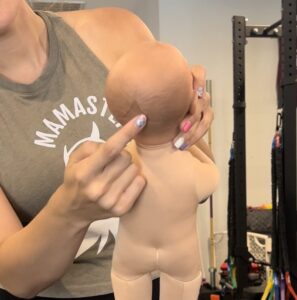
The Anatomy of the Pelvis—and How It Moves
Your pelvis is not a single, solid bone. It moves depending on how your hips and body are positioned. During pregnancy, the increased mobility of pelvic joints is beneficial in labor and birth.
On top of that, your pelvic floor—a group of muscles at the base of your pelvis—plays a huge role in your baby’s ability to pass through. Releasing tension in this area can make a significant difference in birth outcomes.
Movements That Create More Space in the Pelvis
Let’s dive into a few intentional movements and exercises that can help you:
1. Open Hip Positions
These positions help create space in the upper mid pelvis, which is where babies often struggle to engage or rotate.
Try this:
Move one leg out to the side in a kneeling lunge (the open hip).
Shift your weight into that leg, pulling your belly away from your thigh.
Keep your big toe grounded to avoid rolling the foot outward.
Feel the stretch through your groin and adductor.
This helps release tension in the front half of the pelvic floor and can encourage your baby to engage into the pelvis.
2. Rotational Lunges
These strengthen your body while mimicking open hip mechanics.
With one foot elevated and perpendicular to the other, rotate to face forward, step up, and then rotate back down.
These rotational lunges help your baby rotate and descend by increasing space in the pelvis.
3. Closed Hip Positions
Closed hip positions help improve mobility in the lower mid pelvis, which is key for the later stages of labor—especially when baby needs to rotate under the pubic bone.
Try the hip shift:
Stand with feet parallel, shift weight into one leg (e.g., the left).
Rotate your belly toward that thigh while keeping the thigh steady.
Feel the stretch in your back hip pocket—think about where your jeans’ pocket would be.
Keep weight in the big toe and slightly round your back.
This movement helps baby finish their final rotation and prepares the posterior pelvic floor for their exit.
4. Staggered Stance Romanian Deadlifts
This strengthening move is great for maintaining closed hip alignment while engaging your hamstrings:
Step one foot slightly back for balance.
Keep weight in the front foot and rotate belly toward the thigh as you hinge forward.
Add light weights for resistance and rotation for a deeper stretch and activation.
These exercises can be found in the MamasteFit Birth Prep Circuit and the book Training for Two, along with step-by-step instructions and visuals.
Trust Your Body—And Train It!
While you can’t control every aspect of your birth experience, you can build mobility and strength during pregnancy to improve your odds of a smoother birth. Focus on:
Open hip exercises to create space for engagement.
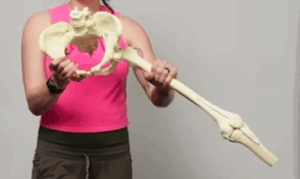
Closed hip positions to aid in descent and rotation.
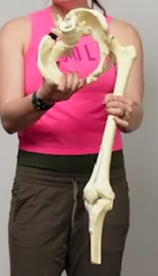
Strength training to build resilience and pelvic awareness.
These movements not only support your birth but will help immensely with postpartum recovery—regardless of how your baby is born.

Final Thought
Is your pelvis too small for birth? Probably not. With education, movement, and support, you can feel empowered in your pregnancy and confident in your birth journey.
Prenatal Support Courses
Learn the science of pregnancy and birth to take the mystery of labor away! Understand why you are feeling what you feel, and learn strategies to confidently move through pregnancy and birth!
- 9h+ of Video
- Support Group
- Close Captioning
- 5 Workouts/Week
- Gym Workouts
- Self-Paced
Instructor
GINA
Workout on-demand with our prenatal fitness workout videos! Each workout is 30-40 minutes to follow along as you exercise at the same time!
- Birth Prep
- All Trimesters
- Mobility Work
Instructor
GINA
Find comfort and relief from pelvic girdle pain throughout your pregnancy and postpartum period! This program incorporates myofascial sling focused exercises to stabilize across the pelvic girdle joints.
- 3 Weeks
- On Demand Workout Videos to Follow