



Welcome to the MamasteFit Podcast Birth Story Fridays! In this episode, Mikala shares her experience of a planned home birth that necessitated a hospital transfer due to her baby’s elevated heart rate. Mikala discusses her extensive preparation for an unmedicated home birth, her quick labor progression, and the challenging decision to transfer to a hospital. Despite the hospital transfer and some minor frictions, Mikala’s story emphasizes the importance of preparation, flexibility, and surrendering to the process of birth. The episode also highlights the significance of creating comprehensive birth plans, being well-informed, and having support systems like doulas. Tune in for insights on navigating unexpected birth experiences and maintaining a positive outlook!
Read Episode Transcript
Gina: Welcome to the MamasteFit Podcast, Birth Story Friday. In this episode, Mikala is be sharing her planned home birth story where she did need to transfer due to elevated heart rate of her baby. Her baby also had a very short NICU stay, but Mikala’s story highlights the importance of surrendering during the entire birthing experience, even when it does take these unexpected turns, and how important it is to prepare for your birth and for the unexpected.
Welcome to the MamasteFit Podcast, Birth Story Friday. In this episode, we have Mikala here who’s going to be sharing her planned home birth that turned into a hospital transfer. So thank you so much for being here, Mikala.
Mikala: Thank you for having me. I’ve been really excited to, tell you my story.
Gina: I’m excited to hear this story! We don’t have very many home birth to hospital transfers, which I think is a really important story to also tell so that folks can understand that sometimes we don’t end up giving birth in the place that we plan, but it can still be a good experience.
So let’s talk about how you were preparing for birth. What were you doing during your pregnancy? How did you choose to have a home birth?
Mikala: So I started preparing probably a year before we even tried because, we actually got engaged and I said, “You know what? It would be funny if at our wedding we were pregnant and announced it to everybody.” So I started.
Gina: Oh my gosh.
Mikala: Yeah.
Gina: Is that what happened?
Mikala: It happened, yeah! I was 14 weeks at my wedding and we pulled off the surprise.
Gina: That’s awesome.
Mikala: But I was very, I’ve always been into nutrition. Like I did CrossFit for years, so, working out, eating around my cycle, foods that supported me, and then when I got pregnant, continuing that. Working out about the same, obviously like less intensity. I looked at a lot of y’all’s videos and looked at your programs online, and listened to so many podcasts, your podcast, and then Pop That Mumma, I actually purchased her birth course, and did that while I was pregnant. And before I had gotten pregnant, I always knew I wanted a home birth, I’ve always leaned on the natural side of things. So luckily my friend is a doula who’s had two at home births with a midwife that is local, who is actually 70 years old and she has been doing it, like she’s the OG midwife, everybody knows her.
Gina: Oh man, that’s amazing. Grandma midwife. I love it.
Mikala: Yes!
Yeah, so we were really lucky to have her. So I was under her care my entire pregnancy, I never saw nobody else, so that was a really amazing experience. I just really wanted to be in the comfort of my own home, and I wanted to be stripped of my ego, like how we all talk about those who do unmedicated births, like I wanted to get there, I wanted to feel it all and go through that with my baby because they’re going through a trauma too, so it’s like, we’re going to go through this together.
Gina: That’s what I was telling myself in my last birth. I was like, “We’re doing this together! You’re feeling all these contractions too!”
Mikala: You’re right, yeah! That was the mindset that I had. And I’m really stubborn, so it’s like when I have like my mindset to do something, it’s, “I’m going to do it.” And then a lot of people around you are like, “You shouldn’t be doing that.” Like it’s, it’s very rare, like you don’t meet a lot of people that either want to do unmedicated or have a baby at home.
Gina: It’s, I think it’s really uncommon for the first baby, especially, to want to give birth at home. Did you have any sort of like transfer plan or care established with the hospital that you ended up transferring to at all, like, prenatally?
Mikala: No. I did, write up birth plans, thank God, in case of a hospital transfer. Like I did one for like vaginal and C-section just in case. I did not pack a hospital bag and I told myself I should, but I was like, “Ehhhhh….” We live like three minutes from the hospital, like we could walk. But luckily my midwife actually has a really good connection with Baptist even though she operates illegally, I would say, because she’s like cash based, but she’s just been around for so long everybody knows her. So she was able to call the hospital and we had a room set up as soon as we got there. It was not as smooth as it should have been when we got there, but we had a room set up.
Gina: Yeah, so you guys had a plan. You just, you didn’t have a relationship already established with them.
Alright, so let’s get into your birth story. So how was the very end of your pregnancy? And then let’s just jump straight into labor.
Mikala: Yeah. So, the end of my pregnancy, it was painful. Her foot was jammed in my ribs, so like I did a lot of stretches, but my favorite one that you do is with the yoga block, the cat and cow.
Gina: Oh yeah, that one’s nice.
Mikala: Yeah, I did that so much.
I was 38 weeks when I went into labor. My morning started off normal. It was actually funny, I actually watched a workshop video on having labor unmedicated. And then I worked out that morning, like nothing crazy, like a 15 minute workout. And I could start to feel like some cramping, a little bit. And then I went to the bathroom and I wiped and I’d seen some like pink mucus, and I was like, “Okay,” I was like, “I haven’t seen that yet.” And I went downstairs and told my husband and I was like, “It’s probably nothing. I could, it could be two more weeks, but, I am feeling like some pain in my lower back, which I don’t normally feel.”
So I go about my day and I’m thinking like, “Okay, I need to go to the grocery store, like just in case anything… like I just need to start getting the house together.” And then things started picking up. I go to the bathroom again, it’s like red blood, and I was like, “Okay, so something’s going on.” And so I decided to call my doula since she’s my friend, she like lives really close, and I told her about what was going on. And then I told my husband, I was like, “Go get me some food. I need to try to eat,” because by then I’m like having contractions. And it was so funny, I thought I was going to go to the store. I’m like, “Okay, I’m not going to the store.” Like my contractions probably started out four minutes apart right then, no lie, like as soon as my husband brings me my food, I’m like, “I can’t even eat it.” I take a couple bites, I’m like (shaking head).
So I’m just laying in my bed, like in child’s pose, just, trying to time the contractions. But that got old really fast, because I was like, they’re just coming too close together. Like, already, I was already like having a focus on them. So they came very strong and intense in the beginning. So I try to take a bath, and I texted, I get up with my midwife, and she suggests a bath. So I take a bath. They ain’t slowing down! So my doula comes and, she gets there first. My husband sets up the pool, sets up the living room, and I’m just on the birth ball. And at that point I can talk in between contractions. I’m just floored by how fast everything’s going. I’m just like, “What? This is crazy!”
So probably not long after that, I would say not even an hour, they really start picking up, and I’m like, “I want to get into the pool,” and so I get into the pool. So our midwife’s not even here yet, but my doula is in contact with her, she’s like, “This seems like it’s really picking up…” So I get into the pool, and my husband’s like just pouring water on my back, I’m trying to get my whole body under this water because I’m just like, it’s just so intense!
And, so the midwives show up and they’re just like, they’re also surprised by like how close- because by then my contractions were like two to three minutes apart, probably closer to two. And this is all within, I would say, less than three hours from the start because my, I’d say my labor started around 11:00 AM. So I end up getting out of the tub, and I get on the floor, and I start shaking, like looking like I’m going through transition, like I start throwing up. And we’re, like, like my midwife’s like, “Okay, she’s about to have this baby, like warm the house up, get the towel, like it’s about to happen.” And I opted, I didn’t want to do any cervical checks, like I really just wanted to go with the flow because I didn’t want to be discouraged at all. But at this point I’m like, “Yeah, maybe you should check.”
So she checks, I’m five centimeters. I was like, “Wow, like this intense, at five centimeters?” And so they go with the doppler check the baby’s heart rate and it’s almost at 200. And so she’s like, “Okay, like you need to drink some coconut water.” I’m drinking as much as I can, I walk around the house- and I’m also bleeding. I’m just like in a bralette, like no underwear or anything on, and I’m just like bleeding all over the house as well. So she checks again, and her heart rate was not coming down. So that’s when she called it and was like, “Okay, we need to go to the hospital,” but not in a panic or anything, luckily. I don’t think I had time to panic because I was just I had to be so focused on these contractions because they were just so intense. But I would love for you to ask me questions so I can like, think back.
Gina: So when your midwife decided, or recommended, that it was time to transfer, because baby’s heart rate was pretty elevated, how did you feel? How did you feel in that moment? Do you remember?
Mikala: I felt defeated because I was just like, “What? This can’t…” I was just like, “this cannot be happening.” Yeah, I already felt beat up before because of just how fast and intense everything was going. I remember being on the floor thinking, “How am I going to do this? Like, how am I going to do this?” And then for that to happen, I was like… So I stayed more calm than… I shocked myself with how calm I stayed, of not freaking out about her health. Like I was not like, “Oh my God!” I think because I was just, just having to be in the moment with the contractions really helped distract me. But it was a huge blow.
Gina: I could totally see how that is just like, “Gosh, like I’ve been preparing this whole pregnancy to give birth here, and now we have to transfer?” And that whole transfer process can be very like turbulent as well. So how was it when you arrived at the hospital? So they were expecting you, because previously you said that your midwife had communicated with them. Like, how did you feel like you were treated when you arrived at the hospital?
Mikala: I come in, I’m loud during labor- this is my first baby but now I know I’m a loud person during labor! So I’m coming in, I am walking, making noises through my contractions. Like I’m not, I never felt like, at this point, I ever got a true break anymore. It was never, I couldn’t talk anymore.
So we go to check in, and, see, they didn’t… there were like some miscommunications. Like they thought I was going to have to go to triage, and no, like they have a room ready for us. And the lady up front was not very nice. She was asking me my social security number and I managed to get it out, and she was like, “Oh, that’s not enough numbers,” and I was like, “….Bitch, it’s enough numbers.” Like, I know my social security!
Gina: I’m going through a little bit of stuff right now.
Mikala: Oh yeah. And then she told me to calm down and I was like, “Girl, you’re telling me to calm down right now? Like I’m fighting for my life!”
But we finally get back, and we just go back to a room. There’s a fluid shortage, because everything going on in western North Carolina, and I think that’s really what I needed was fluids.
Gina: Yeah.
Mikala: They really struggled to get an IV in me, which really upset my husband. But I don’t have great veins, so I understand, I get it. So after they finally got the IV in me, I got a half a bag of fluids, my doula said that’s the only time she’d seen her heart rate go back to normal.
And so I asked, while I was in bed with the IV, I was like, “Can I get the gas? Let me get like some kind of relief.” I’m at the hospital, I’m not even in my environment anymore, let me have some gas. So they give me the gas mask and I’m inhaling, like nothing’s happening, right? But it turned out the gas was not even on, so I was just…
Gina: That would be why it’s not working.
Mikala: Yeah. I was just like huffing air, but in the middle of me huffing that air, my water must have been bulging and it broke and just like it was, that feeling was so crazy. I was like, “Wow.” Just a huge gush of water, like I felt the pop, that was really amazing. That was really amazing to feel! But yeah, they found out it wasn’t on, they couldn’t figure out how to get it turned on, and I was just like, “Okay, whatever.”
Gina: I’ll just inhale air, I guess.
Mikala: Yeah. And they unhooked me after that half a bag is gone. I get in the shower. I’m trying to squat in my contractions, and you know how this is, how intense it is, like when you’re squatting during a contraction.
Gina: Yeah.
Mikala: So I’m in the shower. It’s like I can’t, I honestly couldn’t breathe, it was like, because I just didn’t get any breaks. Like it was just so intense. Like even, you would think moving from home to the hospital, and all these different interactions, my contractions would slow down. But no, they just never did.
So I’m in the shower and I got over that. I was like, this is just nothing. Nothing was really helping me cope. I was just having to go through it. And they checked me again and I was nine centimeters.
Gina: That was why, that was probably why nothing was helping you cope.
Mikala: Yeah. I was like, yeah, I think after my water broke, like I definitely really started dilating. So at nine centimeters, I’d already in my head was like thinking, I need to probably ask for help. And, my poor husband is watching all this, he has been watching me for, probably at this point, it’s been like 11 hours. And he was just having to watch me go through all this. And, I finally said, at nine centimeters- because at that point I was wanting to push, but obviously, you want to, I’m like, “I want to push, like I want to get this baby out now.” “No, Mikala, you can’t push yet.” And finally, after being, I probably truly was probably 10 centimeters by the time I asked, but I was like, “Give me an epidural.” I was like, “I can’t.” I couldn’t breathe, like I was, I just couldn’t breathe anymore, I was almost at the point of having a panic attack. That was, that felt like a blow, too. Like where I was like, “I can’t do this anymore.”
So they brought in the anesthesiologist and that was really hard to get epidural that far into labor, but they gave it to me and then I finally got some relief and I could talk. And my husband was so relieved. He was like, “Oh my God, she’s back. She can talk to us.” And so after that, I had the epidural for maybe an hour, and then they were like, “Okay, it’s time to push.”
Gina: How long at this point had you been in the hospital? So you were at home for about three hours, so 11 to 2-ish.
Mikala: I want to say it might have been longer at home. Honestly, I really don’t think we got to the hospital till five o’clock.
Gina: Okay.
Mikala: I want to say it was about almost five o’clock. I was in the hospital, like from when she was born, I’d say 5:00, and she was born at 12:19 AM.
Gina: So not too long. All right.
Mikala: Yeah.
Gina: So you got your epidural, you were, “normal,” quote unquote, for an hour. And then you started pushing. How was pushing?
Mikala: Yeah. It took, it took an hour and a half. I’m really thankful I practiced my down breathing. They really complimented me, they were like, “We’ve never seen somebody push like this!” But the problem was my perineum, they were like, “Your perineum is like still.” It was so, like, I could hear it. It, her head, like they were trying to stretch me out and then it would snap back like a rubber band, like a loud noise. It was awful.
But pushing the epidural did what it was supposed to do. I was able to move, thank God, because that’s what I was afraid of. I’ve always been afraid to have epidurals because I don’t want to not be able to move, that’s scary! So I was able to get on all fours and push. The midwives and nurses there were really amazing. Like they really let me take my time, like getting into different positions, to prevent me from like tearing. And, so it, but it was an hour and a half. It took an hour and a half to get her out. Her head was stuck there for a good minute. She had bruising on her head from it. So looking back, I’m like, “I need to do more stretching to relax my pelvic floor,” because I think that was a problem.
Gina: So your baby, hour and a half of pushing- which is actually not bad for first time- she was born.
Mikala: I’m happy to hear that.
Gina: Yeah, no, it was actually very impressive. So she was born and then what happened?
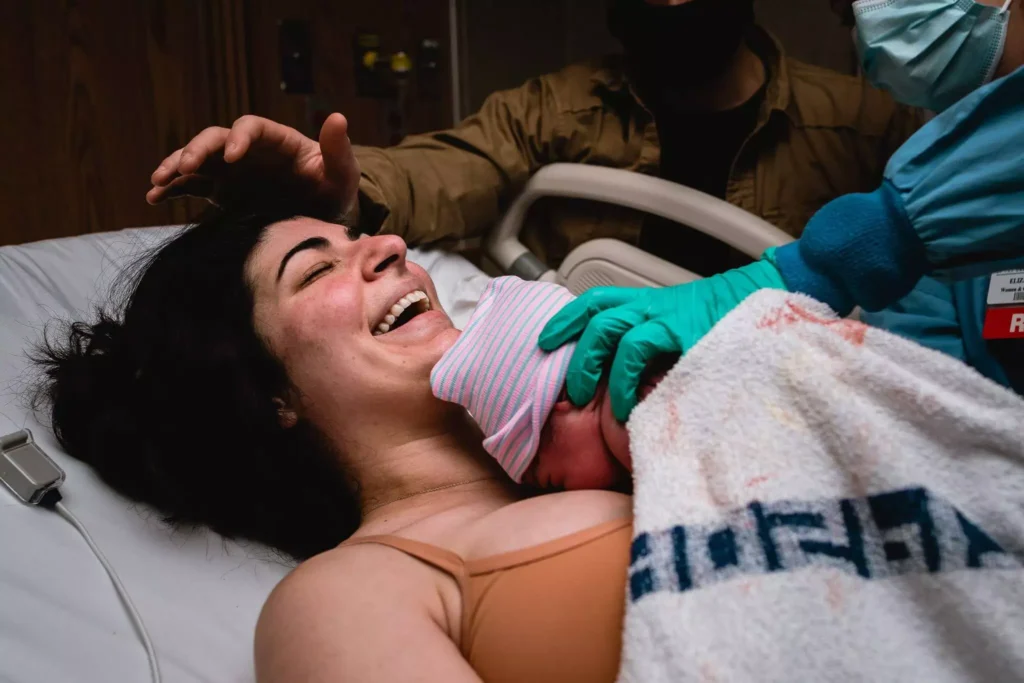
Mikala: So I got my husband to catch her. I was like, “If I’m going to get anything, you have to catch her. I want you to be the one.” Like, I wanted it to be me or himthat were the first ones to touch her. That was so important to me. And I was like, “You gotta catch her when she comes out.” And so he did. And what was so funny is he got, he didn’t, because we didn’t know her gender, we waited. So he runs to the bathroom after he hands her off to the nurse, because the vernix, he was like, “It was so sticky,” and I was like, “Oh, my.” But I didn’t even notice. So I bring her up, right here. She’s not crying. She never cried. Like I’m guessing she looked like floppy, but her eyes were just open and she was just, she looked, like, alert. Like she was just like, “Wow, okay, I’m here.”
Gina: It’s like, “What was that?”
Mikala: Yeah, like, it was really stressful for her.
Then they were going to cut the cord, they were going to cut it right away. And I was like, I was heartbroken at that, because I knew they had to take her, but I was like, “Can we give her a second? Let’s see.” Obviously we’re in the hospital, I don’t want for them to have to resuscitate my baby, but I was just like, “Can we just give it a second?” And, they were like, “No.” So they cut the cord and they took her across the room and started getting fluids out of her. She still didn’t cry once they got the fluids out of her, but we saw, like my husband was right there by her, and we watched her turn, I watched her from across the room, watched her turn pink. So I was like, “Thank God.” Like she’s obviously getting some air. And I didn’t even, I forgot to even mention the moment I found out she was a girl! Because, I had to look down twice just to to confirm, “Oh my gosh, she’s a girl.” And that was the most… that was so amazing, to be able to wait and find out. And that was a gift for sure.
But so they decided to take her back to the NICU. They wrapped her up and then gave her to me for 30 seconds and then took her. And that was really traumatic. Like I was looking forward to that, obviously, golden hour. She would’ve never, hopefully, would never had to leave my side if like we were at home and it worked out. But my husband was with her the whole time. I was like, “Don’t take your eyes off that baby,” because I had, like I said, I had my birth plan, and they really, for the most part, respected it. I got a little pushback at the end before we left, but, they listened, luckily, and my husband was there just in case they didn’t.
Gina: How soon after you gave birth did you get to go see her again, or were you guys reunited with each other?
Mikala: So, they wanted me to walk, which, I felt like I could walk right after, honestly, because I never felt, because I could always feel my legs and move. So I was probably down where I delivered her for, it felt like almost an hour. And I also sat up, when I sat up, I had the worst headache of my life. And I’m pretty sure I was like, “Is this the epidural headache that I’ve heard about? Because I feel like it might be.” Because every time I sat up, like, it was the worst headache. We finally got outta that room and they took me up to the private room- I don’t even know what to call it right now. And I kept asking, I’m like, “When can I go up there?” and then finally they were like, “Okay, we can wheel you up there to the NICU.” And so we got up there, my doula came with me, and we went up there, and I was able to sit in the chair in there and they handed her to me. And they just had her hooked up for monitoring her, they did have a tube giving her oxygen, but it wasn’t even on her nose all the way. And I was like, “Okay….”
So I was able to sit with her in there until they finally checked her out. Because like I said, that took a long time to check her out of the NICU. But before that, they were trying to give her antibiotics because they were worried about infection because the high heart rate. And I was like, “You’re going to have to give me,” I’m like, “you’re going to have to give me a really good reason. Like, you have to find an infection if you’re going to, if we’re going to give her antibiotics.” And luckily, like I didn’t have to make that decision to tell them “No,” ’cause they came back and were like, “Okay, she doesn’t need the antibiotics.” And I’m like, “Okay. Thank God.” I just felt like I had to make so many tough decisions that day, unexpectedly. It’s, it was just really important…
Gina: To have some power at some point during the experience.
Mikala: Yeah. And I knew being in the hospital it was going to be… that’s why I was like, that’s why I wanted, one of the reasons why I wanted to be at home. Because I knew I wouldn’t be made to feel uncomfortable for my choices at home. But luckily they were like, “Okay, she doesn’t need it,” so I didn’t, we didn’t have to have that conversation anymore.
And so we were able to go down, once they finished checking her out, we went back to the room. We were at the hospital for a total of 24 hours because we did leave, because I did sign for us to leave early. They made me sign that paper that it was against there the recommendation, but, since she was doing okay, I was like, “I just want to go home. Like I don’t want to be here anymore.”
Gina: And you still have care with your midwife where she was going to come to your home and be able to check on you all.
Mikala: Yes.
Gina: And do all that stuff as well. So it wasn’t like you were just going to have no medical care at all, like, your midwife was still going to provide the same care that she would have postpartum.
Mikala: Absolutely. That was definitely the worry in the hospital. Like one of the midwives actually knew Amy, my midwife, and called her and was like, “They’re being difficult and trying to leave,” and she was like, “I promise you, like, they’re taken care of,” and Amy was at my house the next day weighing her. And I pumped, and I actually pumped in the hospital and had colostrum like in a syringe, because she did latch in the hospital, but it’s crazy looking back and it’s like I forget, but I did syringe feed her with my finger the first couple days before my milk came in, and latched her because, I wanted to make sure she was getting…
Gina: Yeah.
Mikala: …getting colostrum.
Gina: That’s usually something that I recommend for any of my doula clients whose babies go to the NICU, like very shortly after birth is to start pumping because normally baby would come and would latch pretty soon after delivery to start with that milk. And so if baby gets taken away, then we still need to try to get our milk supply going, and so pumping can be really helpful at those times where you’re separated momentarily. So I’m glad that you had somebody that helped guide you through the pumping process while you were navigating that brief separation.
Mikala: Yeah, because it was, I actually asked, because in the hospital they, after I had her, they asked me if I wanted like synthetic oxytocin and I was like, “No,” to help stop the bleeding, and I was like, “No, I’d rather just pump or nurse her,” and so that’s how I end up pumping. But it’s funny in the NICU, like they don’t let you, feed with the syringe in there, because they were asking me about giving her formula and I was like, “Absolutely not.” They checked her sugar and her sugar was fine. So I was like, “No, I don’t want to give her any formula when I can give her colostrum.” But I thought that was funny. It’s like, “Why are you going to, why am I going to have synthetic oxytocin when I can just do this?”
Gina: Absolutely.
Mikala: That’s why it’s so important, and I tell, even though I’m a first time mom, it was just so important for me to be informed and like podcasts like y’all’s podcast it like it offers so much information on even breastfeeding, like the breastfeeding podcast, I listened to that and learned so much. And that’s just, knowledge is power, especially being in those situations where there is a power struggle with doctors.
Gina: Absolutely. So in reflection of your birth, so you were planning a home birth, and we didn’t get to end up giving birth at home. We had a transfer because there was something going on with baby. You, it appears, that you felt very confident that was a good decision at that point- it was still a hard decision to make. Transferred to the hospital, it sounded like the midwives and the nurses were great. Maybe a little bit of friction with the woman that you checked in with and a little bit of friction with navigating elements of your birth plan and then NICU.
Reflecting on your birth experience, what were some really key things that helped you to still have a positive outlook on your birth, and what were some things that you would prepare differently for?
Mikala: So what really helped me even though it was hard at first, like coming home and seeing- it was really hard to come home and see like the birth set up and not go the way I wanted- but the mindset of surrendering, being a mom, like you have to surrender and go with the flow. And that’s the mindset like I’ve been holding onto, and that’s what it was. And I told myself when I was pregnant, if it doesn’t go this way, it’s like I have to surrender to whatever happens. That’s helped me a lot and it taught me lessons, and it gives me an experience to share with others. Because somebody who had been planning for so long and trying to do everything I can, I was healthy my whole pregnancy and no issues there, but it’s like it could still not go the way you planned it.
But the things I would do differently was probably, next pregnancy, at the end of my pregnancy, I’ll probably get a bag of fluids. I would go to an IV bar. I’ll probably go to an IV bar and get a bag of fluids, and I would love to plan for another home birth, but I would love to have fluids available.
Gina: I think they have some mobile IV bars now that’ll come to your house and give you a bag of fluids with like vitamins and stuff in it.
Mikala: Yeah, I think that would be amazing! Because I am nervous because it’s such a, it’s still such a mystery, even my midwife with how long she’s done this, she’s like, “I don’t, I don’t know.” I mean it definitely seems like it was a fluid issue, but for her just to be so stressed out the whole time. And, amazingly, how my contractions were so fast, like they were just back to back so quickly. Like being a first time mom, I was expecting to be in labor for over a day, like hearing your last birth story, I’m like, you were like trying to get your contractions to pick up! And I’m like, but it’s crazy, it’s like I would, love to…. it’s like a catch 22, I would’ve loved to have a long, early labor almost. But it’s, either way it’s hard. But next time, I’m just going to have to do the same thing and surrender, but I definitely will try to be more hydrated if that was an issue, but I guess we’ll see.
Gina: Absolutely. I’m excited to have you come back on the podcast in two to three years, or however long, I don’t know what your guys’ plan is for spacing children, to share your next birth story where you hopefully have the birthday you were planning at home.
But surrender is such an important aspect of preparing for birth, navigating our births, and then I think just continuing into motherhood as well. Like babies get a say in all of the things that we do, and so surrender is such an important thing. So I’m really glad that you like fully embrace that in your own birth experience, even if it wasn’t what you were expecting, and that there were still moments that you were able to hold onto your power and to be able to make decisions for you and for your baby, even if it was unexpected for you.
And so, yeah, so do you have any last advice for our listeners that are maybe planning a home birth and a little worried about needing a transfer? Or just maybe they’re a first time mom and they’re trying to figure out like what they want to do, do you have any advice for our listeners?
Mikala: I would say definitely have some hospital birth plans written up, just in case. And have a hospital bag just so you’re not scrambling! I didn’t even have a hairbrush, like y’all should have seen me. It was bad. And just, and definitely hire a doula, because my doula saved me during labor. And she was a great support to my husband as well, because they go through a lot seeing us in pain. Even though it’s a positive pain, it’s still really hard on them.
But I would say go with the flow and and whatever’s going to happen is going to happen. Like you just, you just never know. Listening to birth stories definitely helped me too, because you just hear so many different sides, because everybody’s labor’s so different. So it’s like, a box of chocolates, you don’t know what you’re going to get, like when you go into labor.
Gina: Thank you so much Mikala, for coming on the podcast and sharing your birth story and trusting us to support you during your pregnancy.
Mikala: Yes, thank you so much! Thanks for having me.
Gina: Thank you for listening to Mikala’s Birth story. It’s important to acknowledge that birth is about surrendering to the process. We cannot guarantee exactly how our births will go, but it is still important that we prepare for our birth, even if it can be unexpected and things that we were not planning can happen.
If we understand what our different options are during our birth, whether we’re giving birth at home, whether you’re planning to give birth at a hospital, whether you’re planning to give birth at home and potentially needing a transfer during your pregnancy, it’s important to understand what our different options are and our preferences for those different options.
Different things that we can do to learn what our options are is to, one, take a child with education course. Your birth location may offer a course, you can also take an independent childbirth education course like the MamasteFit Childbirth Education Course, so you can understand what are the different options that are available at your birth location, what are the risks and benefits of these different options, and then figure out what your preferences are with those options.
We also don’t want to plan in isolation. So take your birth plan, figure out what your preferences are, and then talk to your provider about it. Whether you’re giving birth in a community birth setting, or a hospital-based birth setting, we still want to incorporate and involve our providers in this conversation as well. So bringing your birth plan to your prenatal appointments, “Hey, this is what I’m wanting. What are you thinking? Are there other options that are available that I didn’t realize? In what situations would you recommend this over this?” and involve them in that birth planning process. You still get the ultimate say in what happens, but it’s important that we utilize the resources that we have, which include our medical providers.
And then the last thing with our providers is choosing a provider that we trust to help us navigate our birth experience. And so we are not going to be the experts on birth as a whole, birth and pregnancy as a whole, because we are not the medical provider. We are going to be an expert on our own experience and on ourselves. And so it’s important that we choose a provider that we trust to be that expert for us to help guide us to make decisions based on what is going on during our birth, but still respects the fact that we have the ultimate say that we are an autonomous person that gets to make the final decision. And so choosing the provider to support your birth experience that best aligns with your values and with your preferences is going to be incredibly important to helping you navigate your birth and to have a positive experience.
And we’ll link our podcast episodes in the show notes where we talk about community birth and choosing a provider in that setting, how to choose a provider in general, in addition to our conversations with OBGYNs and midwives about finding a provider that best aligns with your values and your preferences.
So thanks so much for listening to Birth Story Friday with MamasteFit. If you want more support from us during your pregnancy, check out our online prenatal fitness programs and our online childbirth education course. Our online prenatal fitness programs are designed to help you move confidently throughout your pregnancy so that you can be comfortable, because pain is not a requirement of pregnancy. You can feel strong during your pregnancy while you are preparing for birth. Our prenatal fitness programs incorporate exercises that create more space within your pelvis to ensure that these movement patterns are available to you when labor begins, it helps to release tension within your pelvic floor, in addition to help support your baby’s positions as you prepare for birth. Our childbirth education course is going to teach you the science of birth, in addition to help you understand what are your options when it comes to birth, and help you figure out what your preferences are with those various birth options.
You can check out all of our courses on our website at mamastefit.com and use code STORY10 to get 10% off any of our online offerings, and you can bundle childbirth education and prenatal fitness together to save an additional 15% off.
Additional Resources
Prenatal Support Courses

Learn the science of pregnancy and birth to take the mystery of labor away! Understand why you are feeling what you feel, and learn strategies to confidently move through pregnancy and birth!
- 9h+ of Video
- Support Group
- Close Captioning
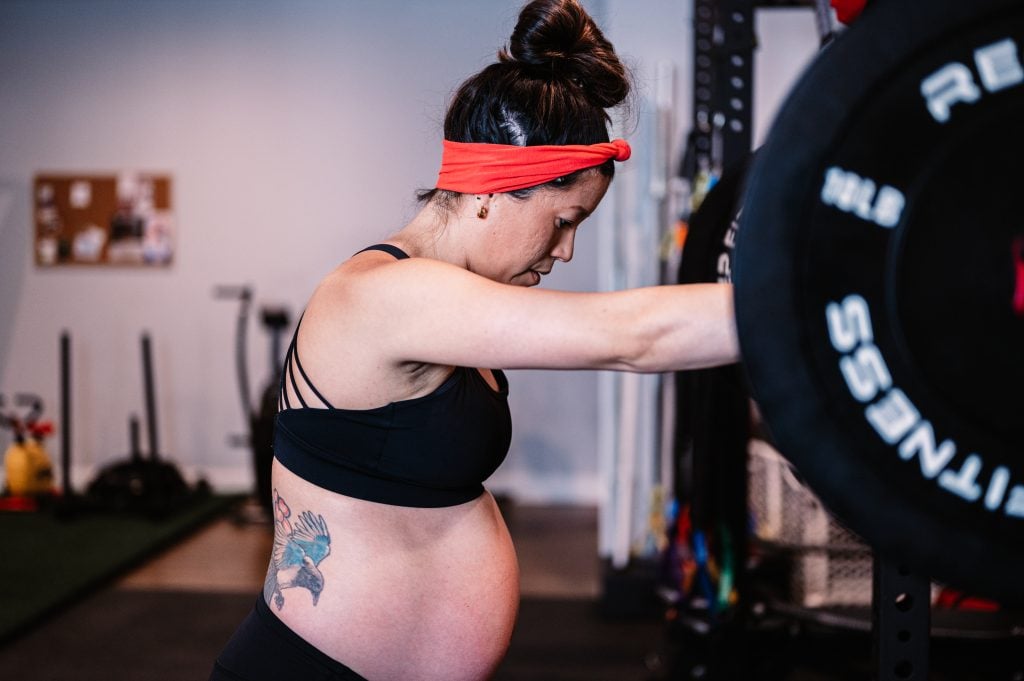

- 5 Workouts/Week
- Gym Workouts
- Self-Paced

Instructor
GINA
Workout on-demand with our prenatal fitness workout videos! Each workout is 30-40 minutes to follow along as you exercise at the same time!
- Birth Prep
- All Trimesters
- Mobility Work

Instructor
GINA
Find comfort and relief from pelvic girdle pain throughout your pregnancy and postpartum period! This program incorporates myofascial sling focused exercises to stabilize across the pelvic girdle joints.
- 3 Weeks
- On Demand Workout Videos to Follow