Mom Posture Mobility Exercises: It’s Not Hamstring Stretches!
Postnatal, Postpartum
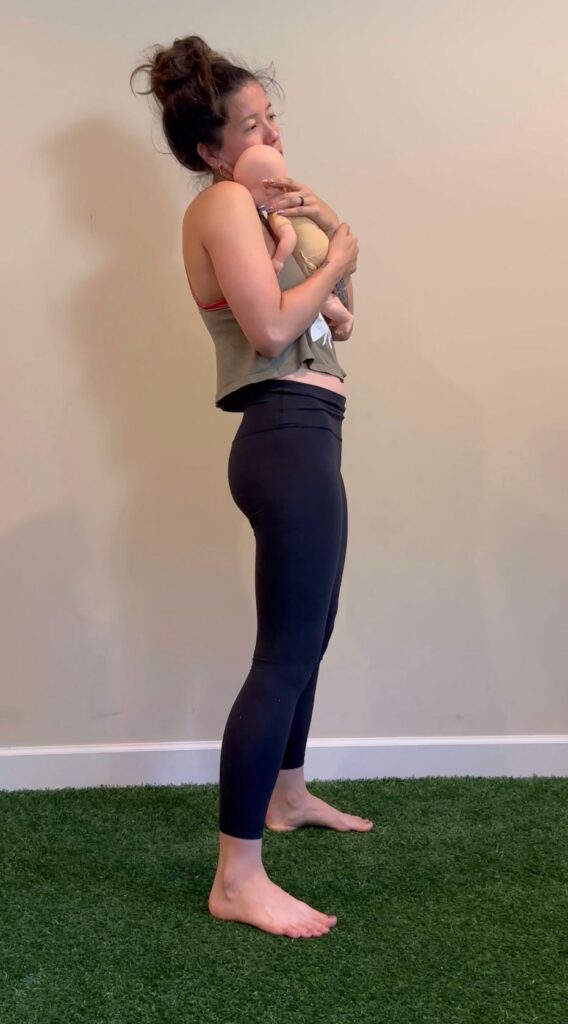
If you're a mom, you likely have done the mom sway while holding your baby (and while just existing in line even without your baby... lol). And this posture is commonly believed to be a posterior pelvic tilt (butt tucking underneath or pelvis rotating backward).
If you’re a mom, you likely have done the mom sway while holding your baby (and while just existing in line even without your baby… lol). And this posture is commonly believed to be a posterior pelvic tilt (butt tucking underneath or pelvis rotating backward).
In a posterior pelvic tilt, the hamstrings pull the pelvis backward to tuck the butt underneath. This position is commonly associated with a sway back, where the rib cage shifts backward (see image). This sway back helps to bring your weight more midline, making it easier to balance. If you are ALWAYS in this position, it can cause discomfort–as the leading cause of lower back pain tends to be LACK of movement.
Since the hamstrings pull the pelvis into this position, you may be told to do hamstring stretches to release the tension in the hamstrings–but you may find that even doing hamstring stretches does not seem to bring any relief.
But, what if I told you that this posture may not actually be a posterior pelvic tilt? So, all of those hamstring stretches are probably NOT helping you find relief if this posture is causing you some issues.
In this blog, we are going to discuss how you may actually be in an anterior pelvic tilt with a sway back, or you may have an anterior pelvic tilt that has lost its way!
Our postnatal strength and conditioning program helps you navigate your return to fitness after the birth of your baby! Start with a rehabilitation program, then progress towards lifting weights. Feel stronger and lift heavier than ever before!
Our c-section recovery fitness program supports your healing after a cesarean birth with strength and conditioning programming. Reconnect with your core and pelvic floor! Includes access to our scar mobilization course.
Our postpartum fitness programs help you navigate your return to fitness after the birth of your baby! This version of our postpartum return to foundations program is delivered with on-demand videos!
An anterior pelvic tilt is when the pelvis rotates forward, and results in an arch in the low back. This position is commonly associated with a rib thrust, or the rib cage tilting upwards. This results in your rib cage and pelvis opening up like an alligator mouth or opening up like a pair of scissors.
But, sometimes you can have an anterior pelvic tilt with a SWAY BACK position of the rib cage–and this is what makes it confusing! The sway back, again, is commonly associated with a posterior pelvic tilt. But, you can ALSO have it with an anterior pelvic tilt that is disguised as a posterior pelvic tilt–so this is where the recommendation for hamstring stretches can still persist even when the pelvic position is not that posterior position.
If you have an anterior pelvic tilt in this mom sway, and you are experiencing discomfort–we may want to focus on releasing the muscles that are pulling the pelvis into this position: the lats and the front side of thighs (hip flexors and quads).
Let’s break down several exercises you can incorporate into your daily routine to help improve your mobility–and more importantly, decrease discomfort in motherhood!
1) Hip Flexor Release
The first exercise you can incorporate into your mobility routine is the half kneeling hip flexor stretch with side body opener. The hip flexors pull the pelvis forward into this anterior position. If you release tension of the hip flexors, it can make it easier for the pelvis to rotate backward to increase mobility.
Start in a half-kneeling position:
Tuck the butt under and push the hips forward; you will feel more of a stretch in the front side of the pelvis and thigh.
Reach overhead with the same arm as the down knee, to feel a side body stretch.
Hold here for 30-60 seconds, and then switch sides.
Next up is the quad release stretch. The quadricep muscle is along the front side of the thigh, and helps to pull the hip into flexion and the pelvis forward. You can do this standing or from a half kneeling position. If you are doing the half kneeling position, place something under your down knee for additional comfort.
Starting in your half kneeling position:
Reach back to grab the foot with the same side or opposite hand. Each option provides a different sensation.
Tuck the butt under as you pull the foot towards your buttocks.
Shift the hips slightly forward.
Keep the rib cage DOWN as you maintain this position for 30-60 seconds.
Switch sides.
After the quad release, you can move into a hip-shifted all fours pelvic tilt. Sometimes the LACK of movement is what contributes to lower back pain or discomfort. Adding in pelvic tilts to increase movement, especially in this hip shifted position, can help to release tension.
Grab a yoga block, and place it under one knee in an table top position:
Shift your weight over the block, so you feel more of a stretch in the elevated hip.
Drop the belly to the floor to arch in the back.
Then round in the back.
Repeat 10 times per side.
Watch this YouTube video for more of a breakdown of how to do this exercise.
3) Forward Leaning Lat Release
And finally, we have the lat release! In this exercise, you are releasing tension in the back muscles. The lats pull the pelvis upward from the back, bringing it into that anterior tilt to arch in the back. This is one of my favorite lat release exercises!
Starting by pressing your hands into a wall:
Hinge your hips back to form an L with the wall.
Then step your feet perpendicular to your hands.
Press harder into the lengthened side hand to increase the intensity of the stretch.
Hold for 30-60 seconds, then switch sides.
Watch this YouTube video for more of a breakdown of how to do this exercise.
When choosing mobility exercises, we need to consider what is ACTUALLY too tight–and you may need to take a look at what position your pelvis is currently sitting in. For many of us, we favor more of an anterior pelvic tilt during pregnancy, so it makes sense that this posture continues into the postpartum period. If you favor more of an anterior pelvic tilt, or arched back, focus more on releasing common areas of tension (lats, hip flexors, quads) to make it easier to find MORE movement. The best way to find relief from discomfort is to MOVE more.