



Welcome to the MamasteFit Podcast! In this episode, Gina and Roxanne discuss the importance and functionality of the pelvic floor during pregnancy, birth, and postpartum recovery. They explain what the pelvic floor is, common misconceptions around it, and exercises to support it. The episode covers breathing techniques for managing intra-abdominal pressure, movements for preparing the pelvic floor for birth, and postpartum recovery tips. Gina and Roxanne also share insights on pushing positions and techniques to protect the pelvic floor during labor and highlight various resources and products to assist in these stages.
Read Episode Transcript
Welcome to the MamasteFit Podcast. If you’re wondering what is your pelvic floor and what you should be doing during your pregnancy to help prepare for birth, this is the episode that we are going to talk about it. We’re going to discuss what is your pelvic floor, what exercises could you be doing during your pregnancy to help prepare for birth, and then also a little bit about what you could do in the early postpartum to help support healing in the pelvic floor.
[00:01:13] Gina: Welcome to the MamasteFit Podcast. We’re gonna be talking all about pelvic floor and birth prep, because that’s a hot topic when it comes to birth preparation. How do I prepare? How do I protect? What do I do with my pelvic floor? If you’re like me, you didn’t know that you had a pelvic floor until you were pregnant. And you were like, “What do you mean there’s a sling of
musculature down there?” Because somebody had asked me like, “What are you doing to prepare your pelvic floor for birth?” And I was like…
[00:01:41] Roxanne: “What is a pelvic floor?”
[00:01:42] Gina: “What? What is a pelvic floor?” And I was, I think I was like 27, 26 years old when I was pregnant with my first, and I had no idea that there was a sling of musculature down there that I should be thinking about.
[00:01:55] Gina: And then it becomes a hyper focus and you’re like, “Everything is pelvic floor!”
[00:01:59] Roxanne: “You need to strengthen your pelvic floor, it needs to be strong, do all the kegels!”
[00:02:03] Gina: “You have to push your baby out!”
[00:02:04] Roxanne: “Your pelvic floor is going to push the baby out!”
[00:02:07] Gina: So there’s a lot of misconceptions with the pelvic floor as well, because there is this really big hyper focus with the pelvic floor musculature. And so we’re going to be talking all about what is the pelvic floor because in case you don’t know what it is, we’re going to explain it to you. If you do know what it is, after we’ve told you, or because you already know because you were ahead of me in your health class, we’re going to discuss what we can be doing during pregnancy to help support the pelvic floor because it’s not kegels, but also it’s not NO activation of the pelvic floor either. Like there is some balance that we’re looking for, like we do want a strong pelvic floor, but we need to define what that means. It’s not tight equals strong, like you can have a really tight pelvic floor, which still is a weak pelvic floor as well. So we’re going to discuss different movements that you can do during pregnancy. And then also, how can we support healing the pelvic floor in that early postpartum phase? Because after you give birth, for me, I felt like I got hit by a truck. My whole body was in a…
[00:03:04] Roxanne: Postpartum’s rough.
[00:03:05] Gina: It’s really rough. The first week postpartum, I’m like, “I would rather go into labor again than deal with this.”
[00:03:10] Roxanne: So bad.
[00:03:11] Gina: You might be wondering, “Well, what’s going on with my pelvic floor now? A lot of stuff just happened to me.” So we’re going to discuss something that you can do in the early postpartum to help support that.
[00:03:20] Gina: So first, let’s start with what is the pelvic floor? The pelvic floor is a sling of musculature at the bottom of your pelvis that does a bunch of different functions for us. So the most common thing that you might know that the pelvic floor does is it helps keep urine and feces and gas, it keeps things in, and then it can release and let things out. So it has sphincter control.
[00:03:40] Gina: It also is going to help with sump pumps, so lymphatic drainage. It helps kind of push all that lymph throughout your body because there’s no pump for that. I learned that in one of our recent podcast episodes. It is just your muscles that pump it up and down, so your pelvic floor plays a big role in that.
[00:03:57] Gina: It’s going to help to provide support for your pelvic organs. As females, we have three pelvic organs that we are supporting, which is going to be your bladder, your uterus, and your rectum. And so it’s helping to provide support to those organs. It as a sexual function, so it could help with orgasm, plays a big role during childbirth. And so, I mean, that’s a big deal with both avenues.
[00:04:17] Gina: And the last thing is going to help to support stability. So, the pelvic floor is the base of our core canister, which is how we stabilize our spine. And so we have our diaphragm on the top, which is like the roof of our house. We have our transverse abdominus, which is like our corset abs, or like the abs that kind of wrap around providing support all around. On the backside, we have the multifidi, which helps to provide a little bit of stability along the spine, and then we have the pelvic floor on the bottom. Some people will also include the internal obliques as a part of the deep core stabilization system, so it just kind of depends on what you’re reading, but the pelvic floor is the base of that. It’s providing that support at the very bottom of our core to help stabilize our spine. And with stabilization, it also, it plays a big role in pressure management within our abdominal cavity and our thoracic cavity. And so pressure management means is how much pressure are we building or decreasing within our abdominal cavity, which then translates to an increase or decrease in pressure in the thoracic cavity, which is how we suck air in and push air out.
[00:05:16] Gina: So we’re not like actually sucking air in, it’s actually just decreasing pressure that then is pulling the air in, and then we increase pressure within our lungs, which then pulls the air out. And so, it’s kind of a weird thing to think about, but the pelvic floor kind of helps to support our ability to breathe as well.
[00:05:34] Roxanne: And when we have a mismanagement of this like intra abdominal pressure, this is what leads to dysfunctions such as a hernia. So a hernia where it’s like your internal organs are starting to push through that abdominal muscle somehow, whether or not that’s during pregnancy because there’s like the weakening of that linea alba, which is the tissue down the center of the abdomen has started to now separate during pregnancy, so now it’s weaker, and then you’re adding additional pressure because of this like mismanagement that’s leading to maybe those bowels or those intestines now pushing through that linea alba. Similarly with prolapse, where this mismanagement of pressure could lead to pelvic organ prolapse because our pelvic floor is just not as strong as some of our other muscles, and this could lead to weakening of those pelvic floor muscles leading to our pelvic organs now pushing through the musculature of our vagina. So learning how to manage pressure outside of pregnancy is beneficial but also especially during pregnancy and that postpartum so that we can hopefully decrease the risk of dysfunction.
[00:06:37] Roxanne: And this could also decrease risks of hemorrhoids as well which is another symptom of dysfunction of again that mismanagement of pressure. So if you are outside of pregnancy or even before pregnancy and you have hemorrhoids and you have had like chronic hemorrhoid issues this could be due to a mismanagement of pressure, which I had prior to kids. Like I would have a lot of issues with hemorrhoids just like throughout college, in my early years of 20s, and I was just like, “Well, this is just my life. This is just like I got lucky. I’m dealing with hemorrhoids!” And then I went through pregnancy, still had them like every now and then during pregnancy surprisingly, but then I, in by postpartum developed rectocele, which is like my rectum is protruding through my vaginal wall, so it could be due to my mismanagement of pressure that just increased my risk of developing that, because most of my pressure was going towards the posterior portion of my pelvic floor, leading to a (weakening). So now I am focusing on learning that management of pressure to decrease hopefully other things. But it’s very important that a lot of people focus on this pelvic floor portion during just pregnancy and postpartum, but this could benefit people at all times.
[00:07:48] Gina: At any time. Because we all have pelvic floors.
[00:07:50] Roxanne: Yeah.
[00:07:50] Gina: Men and women both have pelvic floors.
[00:07:51] Roxanne: You can develop a hernia outside of pregnancy. You can get hemorrhoids outside of pregnancy and prolapse outside of pregnancy. So, it increases your risk because obviously you have a baby putting a lot more
pressure on all those organs during pregnancy and postpartum, but even outside. That was my little soapbox. Continue, Gina.
[00:08:07] Gina: So let’s start with pressure management then, because I think the ability to manage pressure is really important for our pelvic floor function, also for how we approach exercise during pregnancy and how we can, again, optimize that pelvic floor ability to do things, and it can help to decrease the symptoms that you’re having during pregnancy and the postpartum. So it’s not necessarily like pressure management, this is going to support birth specifically, because there are some aspects of it that can be beneficial for pushing. But let’s talk about what pressure management even looks like because this is a big thing that again can help to decrease pelvic floor symptoms and issues that you may be having to support your exercise during your pregnancy, your recovery postpartum, and then can really help support pushing during birth.
[00:08:50] Gina: So the first thing with pressure management is, it’s how we are breathing in changing pressure within our thoracic to our abdominal cavity. And so the abdominal cavity is everything that’s below the respiratory diaphragm. So that diaphragm is a sheet of muscle at the bottom of your ribcage that moves up and down, which helps to change the pressure within your lungs. The pelvic floor is the bottom diaphragm of our core canister, and so those two are kind of moving together in kind of this like piston type motion to either increase or decrease pressure within the abdominal cavity, which is creating this opposite type of pressure within the thoracic cavity.
[00:09:28] Gina: So when we inhale, the diaphragm and pelvic floor move down, which is going to increase pressure within our abdominal cavity. So you may feel more pressure out into the abs, into the back, more pressure down into the pelvic floor. But this is going to decrease pressure within our thoracic cavity, which then pulls air in to our lungs. When we exhale, the pelvic floor lifts up, which is kind of pushing that diaphragm back upwards, which is going to decrease pressure within our abdominal cavity, increase pressure within our thoracic, which then pulls the air out of our lungs as we exhale. So that piston type motion of our diaphragm and pelvic floor is changing the pressure within that abdominal cavity. And depending on what kind of activity you’re doing, how much pressure we increase or decrease will depend on the demand that we have.
[00:10:17] Gina: So we’re not always taking our deepest breaths or our strongest exhale. If I’m just sitting here, I’m not going to be doing super deep breaths. If I am lifting heavier weight, then I’m going to have a much stronger inhalation and exhalation to meet the demand that I’m doing.
[00:10:33] Gina: So with the inhale, the ribcage is expanding outwards, which is moving that diaphragm down. It’s flattening it. And you’re going to feel this increase in pressure, kind of 360 around the abdominals into the back. Preferably, you’re feeling more of an increase in pressure into your backside because the muscles are a little bit denser back there, so there’s more resistance to help with that increase in pressure as opposed to pushing everything forward into our belly.
[00:11:01] Gina: During pregnancy, the abdominal wall gets thinner. And so if we’re pushing more and more pressure into this thinner wall, it may not give the same type of resistance that breathing into our back does. And it could contribute towards a worsening diastasis, potentially those hernias. So when we inhale, we’re thinking ribcage expand, and we’re breathing into our backside. So we’re kind of pushing air into a place that has a little bit more density to it. And you may also feel some expansion into the pelvic floor.
[00:11:29] Gina: So, inhales are expanding outwards. And with this outward expansion, this is eccentric. So, it’s lengthening, it’s stretching, it’s a state of tension. And so, sometimes I’ll see folks say, “Inhales equal relax, exhales equal contract,” and that’s not necessarily true, because an inhale is the eccentric loading of our tissue. So, I’m generating power so that I can recoil back in with my exhale to pull everything up and in. So inhales are not relaxed, inhales are a state of tension. So if you think about when you take a big sigh, where you’re like, (sigh), it’s the exhale that’s the relax.
[00:12:09] Gina: So the inhale of the sigh is this stretching, this kind of filling up, but you want it to stay in that position, that’s not a relaxed position. But then when you exhale and let go, you can stay in that relaxed position for a longer period of time.
[00:12:25] Gina: And so that’s how I like to explain the difference between inhales versus the exhales is inhales again, not relaxation. It is eccentric loading, power generation. It’s stretching. So if I’m stretching a muscle, I’m not going to be like, “Wow, I’m so relaxed in this hamstring stretch.” No, I’m like, “I can’t wait to get out of it.” The opposite of inhalation is going to be that exhale. And this is where we have the upward movement of the pelvic floor, kind of the abdominals coming back in. And so we have this increased muscular force. So we exhale, and if I wanted to contract or activate with the exhalation, because I’m like picking something up, for example, I’m going to exhale, my pelvic floor is going to lift up, my abdominal wall is kind of coming in, and it’s pushing the diaphragm back to its starting position, which is again, increasing pressure within my thoracic cavity, which is pushing the air out, or pulling the air out of my lungs.
[00:13:20] Gina: And so one aspect is we can exhale to contract or to activate, increases muscular activation, to counter increases of pressure with exertion, or I can exhale and just relax. So if I’m just sitting here, like I am right now, I’m not inhaling, (heavy breathing sounds) I’m just breathing. I am exhaling and just releasing and letting go. So it’s a very gentle breath for me right now. If I’m lifting, then it might be more of that like (audible breath) type noise where I am. Really activating within my pelvic floor to counter that pressure.
[00:13:52] Gina: And so that’s one way that we can do pressure management is essentially think inhales are down, exhales are up. And if we exhale and we lift up, this is going to help kind of prevent a lot of those pelvic floor type issues related to pressure mismanagement, which would be, I’m inhaling up and then exhaling and bearing down. And the reason why exhaling and pushing down would not be ideal is because when we exhale with exertion, we have muscular activation. And so now we have this pressure that’s being pushed down, and then we add on muscular activation and then push down onto a pelvic floor that is potentially not at its prime, like during pregnancy. It’s a little overworked. And then we’ve got Baby, fluid, there’s a lot of stuff going on. The way we stabilize is different during pregnancy. And so when we exhale and we then push down with our exhalations, it could potentially be putting too much pressure on the pelvic floor, contributing towards those issues.
[00:14:50] Gina: Let’s take a break from this week’s episode to hear about our podcast sponsor, Needed. Needed is a nutrition company that specializes in optimizing nourishment for the perinatal time frame. This is a brand that Rox and I have both utilized throughout our pregnancies, postpartum, preconception- so we really trust and love this brand and we would only recommend them to you if we did.
[00:15:08] Gina: One of my favorite products from Needed that I utilize almost every day, especially after my workouts, is their collagen protein. Our protein needs during pregnancy and the postpartum are much higher than they are outside of pregnancy, so it’s really important that we’re increasing our protein intake and this can sometimes be hard to do with just whole foods. While it is great to get a lot of our nutrition from whole foods, adding in a collagen supplement can be super helpful. We’re really big fans of Needed’s Collagen because it dissolves super easily into our drinks or to our food so it doesn’t leave any clumps that we normally get with other collagen proteins. It also doesn’t add flavor to anything. So it’s super easy to add to like my oatmeal or to like my juice in the morning or even to my coffee. And so it makes it really easy for me to increase my protein intake throughout the day to meet the demands of growing this baby.
[00:15:53] Gina: You can check out needed at thisisneeded.com and use our code MAMASTEPOD to get 20 percent off.
[00:15:58] Gina: And so that is what pressure management is. It’s how we are breathing and moving our pelvic floor with that breath to manage the pressure within the abdominal cavity. So we’re not putting too much pressure downwards. And so essentially think inhales, everything moves down, exhales, everything lifts up. And then we’re going to match how much pressure we have to the effort that we’re doing. So if I’m just sitting here, there’s not a whole lot of movement happening. If I’m standing and moving, there’s going to be more effort happening, but the pelvic floor is moving. So if I inhale, the pelvic floor moves down, I exhale, the pelvic floor lifts up. And so we’re not thinking, “I’m clenching my pelvic floor as I do things,” or “I’m only kegeling,” which is that quick, or even long holds of a pelvic floor activation, where it’s just tight, tight, tight, tight, tight.
[00:16:47] Gina: Because sometimes that’s what you get told to do when you’re preparing for birth, is to do tons of kegels. “Do 500 kegels a day, every stoplight you’re at, do this kegel,” with the thought of, if you do a lot of kegels and pelvic floor activations, this is going to make your pelvic floor strong, and if we have a strong pelvic floor, it can help us push our baby out. But, one, your pelvic floor does not push your baby out. It’s at the bottom of the canister. It’s your diaphragm and your uterus that are pushing the baby out from the top. And so, your pelvic floor really just needs to let go and move out of the way. And so, when we say that, then someone’s rebuttal is, “Oh, well, we want the pelvic floor to be strong for the postpartum to help you recover after birth.” Again, a Kegel is only the shortening portion of our pelvic floor’s range of motion. And so if we think about like my bicep has the ability to lengthen and stretch, and then also shorten and contract to pull my hand towards my shoulder. And so when I’m doing Kegels, all I’m doing is these little bicep pops where I’m just like tight. But the moment that I had to lengthen my arm to grab something and try to pull it through its range of motion, if I’ve only been training this really small range of motion, my arm is going to be pretty weak when I try to do something else. Or, I’m going to have a really hard time lengthening my arm and straighten it because the muscles are so tight that it’s making it really difficult to find that length.
[00:18:11] Gina: And so rather than only focusing on tight, we want to think, can I inhale to lengthen and stretch within my pelvic floor? And then can I exhale to lift my pelvic floor and pull it up and in? So we want to be thinking about that full range of motion with our pelvic floor work, not just the tightening, because really tight does not equal strong, and really loose does not necessarily equal weak either. We want to have, strength is defined by how well a muscle can move something over a longer range of motion. So, we want our
pelvic floor to lengthen, and then we want our pelvic floor to be able to shorten and tighten for optimizing function.
[00:18:52] Gina: So, yes, we do need some contraction and shortening of the pelvic floor muscle to support its function during pregnancy and the postpartum, but we also equally need that ability to lengthen and stretch the pelvic floor.
[00:19:06] Gina: And so doing a bunch of kegels to prepare for birth is not what I would recommend at all. You could have that pelvic floor activation as a part of your breathing cycle to help with that pressure management, but not just the tightening.
[00:19:19] Gina: So what exercises can you do to help you prepare for birth then?
[00:19:23] Gina: Another misconception when it comes to preparing the pelvic floor for birth is all of the movements involve tons of wide leg positions. So deep squats, butterfly pose, even like a half lunge with a really open hip position. And those movements are all really great to helping stretch and lengthen the front half of the pelvic floor, but they don’t stretch the entire pelvic floor.
[00:19:45] Gina: The pelvic floor attaches to the pelvic bones, and different types of hip movements help to create different types of movement and changes the diameter of the pelvis. And so when we have more of those wider leg positions, so more of those like deep squats and butterfly poses, more of the front half of the pelvic floor is being stretched.
[00:20:04] Gina: And so during pregnancy, a lot of us tend to favor more of that external hip rotation and more open hip positions because it’s more comfortable during pregnancy. And so for a lot of us, the anterior portion, or front half of our pelvic floor, tends to be a little bit more lengthened compared to the back half.
[00:20:21] Gina: And so when we’re preparing for birth, it is helpful to still include those wide leg positions, but we also want to include more of that internal hip rotation or closed hip positions. And one of my favorite exercises to find more of that closed hip position to stretch more of that posterior, or back half of our pelvic floor, that tends to be a little bit tighter for a lot of us, especially during pregnancy, are hip shifted movements.
[00:20:43] Gina: And you can do hip shifts with all sorts of different positionings. You can do a side lying, on your back, you can do it in all fours, or
even standing. But what we’re looking for is one knee is a little bit further back than the other, so we’re kind of driving one hip crease back and driving the opposite knee forward, so we’re finding this little bit of like shift and rotation within the hips. And for those of you that are listening or even watching the YouTube video, and you’re trying to figure out what does that look like? I’m going to link a few different examples of hip shifts down in the notes below. And so we’ll link what an all fours hip shift looks like and a standing hip shift looks like with a breakdown as well. And this is something that we incorporate into my book, Training for Two, as well as how to do all of these different hip shifts, because it’s so important for pelvic floor function and for that birth preparation.
[00:21:34] Gina: And so with the hip shift, it’s stretching more of one side, posterior pelvic floor. So right around where the sacrum attaches to the different musculature. And so if you’re having like tailbone pains or having constipation, maybe issues with hemorrhoids, sometimes it’s because the back half of the pelvic floor is really tight where the anus is, and so releasing tension in that part of the pelvic floor can help to relieve a lot of discomforts that you may have during pregnancy. But also help to improve how well that sacrum can move during birth.
[00:22:04] Roxanne: So as a nurse, a labor nurse, when I’m doing some internal feedback when someone’s pushing, I can feel the different parts of the pelvic floor.
[00:22:11] Roxanne: Do I know the nuances of a pelvic floor PT of the exact like muscle strengths and like what is tight and what is not tight and what can move and what cannot move? No. That’s not my expertise.
[00:22:23] Gina: I mean, you got more hands on experience than I do.
[00:22:25] Roxanne: A pelvic floor PT can definitely be able to tell you way more nuance of the actual pelvic floor.
[00:22:30] Roxanne: But I can feel a difference, when I’m, like, assessing someone or helping them give feedback on different points in their pelvic floor area, like their vagina, that feel differently and maybe don’t move as easily away as baby is coming down. So there are even like nurses who, when they’re pushing, and sometimes I will do this where like when they’re pushing, you can feel like these bands within the vagina and they could be like tension points within the pelvic floor, but usually we’re like talking to the patients, being like, “Hey, this is what I’m feeling when you’re pushing, you’re doing great, like baby’s coming down.” But within your vagina, I feel these like tight bands within your vagina. If I put gentle pressure on them, especially if they have an
epidural, they’re not going to feel it but we still should tell them before we just do something to their body, when they’re unmedicated, they know they can feel these bands when I press them, when I’m like helping them push. But with an epidural, I’ll be like, “Hey, I feel this band, you can’t feel it, but usually this would be a little tender. If I put some gentle pressure on it, usually these bands will melt away.” And that’s due to, there’s just like some tension within those muscles that I’m feeling and it’s sometimes, most of the time, it’s one sided. And if I do a little bit of pressure, it does melt away and then baby will drop sometimes in the pelvis just from melting away those bands. Some bands don’t move at all, no matter what I do. And some bands will. And when they’re, when they are there sometimes and they do not move, they do have a higher percentage of having lacerations in those areas when they do, if they do deliver vaginally.
[00:24:20] Roxanne: So that’s interesting to know and feel. But I do know when they’re pushing on their back, if they are flat on the bed, there is less space in the posterior portion of their pelvis, and you can feel how much space is around babies. And if the baby is in, that OA position, optimal position or whatever, there is less space behind the baby when someone is laying flat down on a bed, rather than if I move them, either if they want to lay on their back, I move them down to where there’s that hole in the bed, you know what I’m talking about? So there’s room for that sacrum to move. Or if they’re even side lying. I don’t normally push with a lot of people in hands and knees where I’m giving internal feedback, so I don’t know exactly what it feels like there, but there is more space posteriorly in side lying and then when they’re in that hole a little bit than when they’re just flat on their back. So, that sacrum can’t move to make more space in that posterior portion if they’re flat on their back.
[00:25:22] Gina: Yeah, which is a big reason why it’s usually recommended to not push flat on your back, unless it’s just the most comfortable position for you and it’s the position you need.
[00:25:30] Roxanne: Sometimes it’s the only place you could release and relax.
[00:25:33] Gina: Because that’s another big aspect of it. So with those tension points within the pelvic floor, you could also do your own internal massage as well with the pelvic floor. During pregnancy, obviously if you’re not sure if you should, if you have any sort of, complication where you can’t have intercourse…
[00:25:51] Roxanne: Don’t put your fingers in your vagina.
[00:25:52] Gina: Then probably don’t do internal pelvic floor massage either. But if you were a low risk pregnancy and there’s no complications really going on.
[00:26:00] Roxanne: If you can have sex, you can put your fingers in your vagina.
[00:26:02] Gina: Yeah, so that’s an easy way to know. Can you have sex?
[00:26:06] Roxanne: If you can have penetrative sex, you can put your fingers in your vagina.
[00:26:10] Gina: So you can use your fingers if you can reach. I have a smaller belly and sometimes I…
[00:26:14] Roxanne: If you can reach around your bowling ball!
[00:26:17] Gina: Sometimes I have a hard time getting down there. But pelvic wands are really awesome. And so Intimate Rose has a pelvic wand. TheraWand has a pelvic wand. There’s so many different ones out there.
[00:26:27] Roxanne: Frida Mom has a pelvic wand.
[00:26:28] Gina: Some of them have vibrating things with them too. But essentially you can insert it and then just kind of gently massage. It’s almost like using a lacrosse ball.
[00:26:39] Roxanne: Like trigger points.
[00:26:40] Gina: Yeah.
[00:26:40] Roxanne: You can find like trigger points within your pelvic floor.
[00:26:42] Gina: So towards the end of my pregnancies, I’ll do that, especially to the posterior pelvic floor, more so on the left side for me. And if I’ve, especially if I’m feeling like really symptomatic with SI joint pain or tailbone pain, when I go in and, manually release that tissue and that muscle, I feel so much better afterwards, too.
[00:26:58] Gina: And so that’s something that you could implement during pregnancy to help with birth preparation, as well as doing some internal massage and feedback.
[00:27:05] Roxanne: And it could help with that pelvic girdle pain, because even me, I was, how many weeks was I when I was having terrible SPD pain?
And I had just a million trigger points in my pelvic floor that my pelvic floor PT released for me because like I wasn’t going near that.
[00:27:21] Gina: Yeah.
[00:27:22] Roxanne: It was too painful. I didn’t want to touch it. And she released it all and my SPD pain was gone.
[00:27:27] Gina: Yeah. And so again, a tight pelvic floor doesn’t equal strong. It could also be a problematic pelvic floor. And so you can also work with a pelvic floor physical therapist during pregnancy too. If you’re like, “I don’t really know what’s going on down there. I didn’t know I even had a pelvic floor!” like me, you can work with a pelvic floor physical therapist during pregnancy. Not all of them will do internal work with you during pregnancy, so it’s kind of, up to them on what they’re gonna do. Sometimes, they want clearance from your OB. So it can vary from PT.
[00:27:55] Roxanne: Might have to sign a waiver.
[00:27:56] Gina: Yeah. But, they can also do internal work with you, or just explain how to do it yourself. “Okay, this is how you insert the wand, and this is kind of like the pressure that you’re looking for,” so they can kind of guide you through that as well, if you’re feeling “I don’t know if I want to do anything down there,” like that can also be a really great option.
[00:28:15] Gina: So now when it comes to pushing, because this is kind of the other point of pelvic floor that a lot of folks are really thinking about, is, “How do I protect my pelvic floor while I’m pushing? I don’t want it to fall out while my baby comes out with it, too.”
[00:28:29] Roxanne: It’s just holding on to the pelvic floor!
[00:28:32] Gina: I mean, hopefully they’re just pulling their placenta out with them.
[00:28:35] Roxanne: Well…Hmmm…
[00:28:37] Gina: Maybe not.
[00:28:37] Roxanne: Leave the placenta behind..
[00:28:39] Gina: Leave the placenta by itself.
[00:28:41] Gina: With the pelvic floor, we really just want it to kind of release and let go to allow baby to pass through. Now we want some tone to it or some, tension to it to help with baby’s head positioning during labor because it’ll help baby kind of tuck their chin and so that’s important, but again, we want a pelvic floor that moves well. And so when we’re pushing the most important thing is being in a position that you can relax in. And that is gonna help your pelvic floor release as well. And so I’m not a big advocate for, “You can never push on your back. How dare you?” Like, because, not everyone finds upright positions are restorative for them.
[00:29:22] Gina: So for me personally, I have a very strong, overwhelming fetal ejection reflex, where my body is vomiting out of its vagina to get this baby out. And it is overwhelming. I’m hanging on for dear life and I could not stand and relax and push. It’s just, there’s too much sensation going on. And so for me, I find either being in the water Is a place I can relax and push or being on the bed, just like holding on for dear life, like in a side lying, slash on my back, slash whatever is going on position. And so I find the more restorative and supine positions to be most comfortable for me because it allows me to relax the most. Other people will find that upright positions feel best for them.
[00:30:08] Gina: And so the best pushing position is the one that you choose, but we can be mindful on, can the sacrum move? So ideally we’re not super flat on our back. We’re either in the cutout portion of the bed, kind of like Roxanne was saying, or maybe like slightly tilted, so there’s a little bit of movement for that sacrum. So we don’t necessarily want to be flat on our back, but I’m also not going to be like, how dare you push on your back?!
[00:30:31] Roxanne: There are ways though, where you can lay back and be relaxed and supported and still not be on your sacrum and not be flat on your back.
[00:30:41] Gina: Yeah.
[00:30:41] Roxanne: Elevate the head of your bed, add some pillows behind you so that you’re not flat and working against gravity. So I understand the thought process, but also, do you, Boo.
[00:30:53] Gina: Yeah, just whatever allows you to relax is going to be the best position. But I’ll even do, I take a pillow and I just kind of cram it underneath one side of the body, and that just like slightly tilts you.
[00:31:04] Roxanne: Gina slowly raised the head of the bed as I was pushing.
[00:31:09] Gina: So there are ways to create this space. But it’s most important, I think, to find a position that you can relax in, and whatever that looks like for you. And if you’re pushing for a long time, you’ll be changing positions, too. It’s not going to be like, I can only push in this one position the whole time. You’re going to change positions every 20 to 30 minutes just because baby’s kind of wiggling and rocking through.
[00:31:29] Gina: Another way that we can kind of help protect the pelvic floor when we are pushing is we can think about how we are breathing as we push. And this is another thing where it’s really going to depend on you. You may find that holding your breath and bearing down feels best. It feels like it’s one less thing to think about. But, you may also find that exhaling as you push feels better too. When we exhale, this is known as open glottis pushing. And when the throat is open, we tend to have a more relaxed jaw, and when our jaw is relaxed, our pelvic floor tends to be more relaxed. And so if you’ve ever been in a stressful situation and you just feel like your shoulder is lifting and your jaw clenching, your pelvic floor is also doing the same thing.
[00:32:09] Roxanne: And you can feel it.
[00:32:11] Gina: Yeah, you can kind of feel it like lift up and just like clench. And so a good way to help protect the pelvic floor when we’re pushing is to exhale as we push. Again, if you do hold your breath, because it feels best for you, it’ll be okay. You will be fine, you will recover, your pelvic floor has a great capacity to heal. But when we exhale, the pelvic floor tends to be more relaxed.
[00:32:34] Gina: There’s two things that I usually find, quote unquote, “wrong” with gentle pushing or like open glottis pushing. One, the exhale is too weak. So it’s you’re just kind of blowing air out. Now, if you have a really strong fetal ejection reflex…
[00:32:49] Roxanne: Just hold on.
[00:32:51] Gina: …you’re just holding on and you’re just, your body is doing it all for you.
[00:32:53] Roxanne: You’re going along for the ride.
[00:32:54] Gina: If you have an epidural, you will probably not have a very strong fetal ejection reflex. I’ve seen very few people have a pushing reflex with an epidural, unless they were progressing super fast and their epidural quite
hadn’t kicked in yet. Normally we’re kind of guiding them through, “Okay, you have a contraction, let’s push now.”
[00:33:13] Gina: So when we exhale, we want to think a strong exhale. So if you think about blowing up a balloon, like how much effort and strength that takes, or like a really long, like (audible exhale) type motion or the noise, that is going to generate that pressure down to push baby.
[00:33:29] Gina: The second issue that I normally see is it’s not long enough. So it’s (quick exhale), and I’m like, “That was really… I really like how you exhaled there. That was a really good effort. Let’s make it a little bit longer just to like really hold baby down. So it’s six to eight.” “That was really good. Let’s make it a little bit stronger.”
[00:33:50] Gina: The problem with gentle pushing though is it takes some finesse. Like you have to kind of get it because it’s really hard to teach somebody in the moment and it’s really easy to just say, “Just hold your breath and just push.” Cause it’s really common to coach holding your breath and pushing because it’s one less step. Like if somebody’s pushing, which is usually the first time that they’ve done it, or one of the few times in their lives they pushed baby out, it’s a lot. It’s one less step to just hold your breath and bear down and push. When you exhale, you also have to think about blowing the air out in a certain way to help kind of generate that downward pressure.
[00:34:24] Roxanne: It’s harder to coach in the moment.
[00:34:26] Gina: It is. And so a good way to practice is when you poop.
[00:34:29] Roxanne: Yeah.
[00:34:29] Gina: During pregnancy. When you’re pooping, push your poops out with your open glottis pushing, so you’ll be sitting on your toilet, doing whatever position feels good for you, usually seated.
[00:34:40] Roxanne: I mean, hopefully seated.
[00:34:41] Gina: But, you know, your knees might be more in, knees might be more neutral.
[00:34:44] Roxanne: Squatty potty.
[00:34:45] Gina: Yeah, you’re squatty potty-ing, and we’re gonna think big inhale, diaphragm’s pushing down.
[00:34:50] Roxanne: That’s the key.
[00:34:50] Gina: The key, yes. The diaphragm starts, the inhale starts the push.
[00:34:55] Roxanne: People forget that. People forget that part though.
[00:34:57] Gina: So inhale, diaphragm moves down, we feel that increase in pressure. That might already start a little bit of a poop trickling at that point. And then we’re going to exhale and continue to bear down.
[00:35:09] Gina: This is different than when we’re exercising or other times of pressure management. We’re going to exhale and continue to bear down as we kind of push our poop out. And it’s going to be that strong, long exhale. So, (long, audible exhale) as you push your poop baby out. So that’s a good way to practice.
[00:35:29] Roxanne: That is a good way to practice. But no, with the inhale, I saw this, there was a trend somewhere on TikTok where people let all of your air out, and then try to scream.
[00:35:40] Gina: (Weak scream sound & laughter) That was hard.
[00:35:46] Roxanne: So you like, like your vocal cords are similar to your pelvic floor. They look very similar. So like your power of being able to scream comes from that diaphragm, which is also the power for your pushes. So if you can’t scream, that just shows you how, little power you have when you’re pushing.
[00:36:09] Gina: I need you to try it now.
[00:36:10] Roxanne: Because that is the start, that’s where you build the power, because a lot of people will be like, (small gasp) and then they push, and then, again, and I’m like, “No, you gotta let it out, reset, and go again.” But, (attempts scream)
[00:36:27] Roxanne: It’s hard!
[00:36:35] Gina: I hope you all are trying this right now as you’re driving in your cars, exhale completely, and then try to scream.
[00:36:45] Gina: So the diaphragm plays a big role in pushing and helping to strengthen our pushes as well. So we inhale, it pushes down. It kind of works with the top of the uterus, known as the fundus, to kind of push baby down, but
we’re pushing from the top. And then we add on the exhale with the bearing down to push baby out.
[00:37:03] Gina: Now, again, if the exhale portion is like too much, if that extra step is just like making it confusing for you, it’s okay to hold your breath and bear down. What we want to think about if you are holding your breath is we’re relaxing in the face. So we’re not like clenching in the jaw and like gritting our face and like purple pushing to where the, the eyes are like bloodshot.
[00:37:25] Roxanne: Oh yeah, if your blood vessels in your eyes are bursting or blood vessels in your face are bursting, you are pushing in your face. You’re doing such a good job pushing in your face, let’s direct it down.
[00:37:38] Gina: Yeah, so you can still hold your breath and relax in the jaw. And which will result in relaxing of the pelvic floor. So if you do find the exhaling while you push is too much, one too many steps, hold your breath, but relax in the face. We want to think the pushes are down in the vagina, not in the face. We’re not pushing babies out of our mouth.
[00:37:59] Gina: So that’s how you can protect your pelvic floor during birth, is we want to think about relaxing the jaw, exhaling if you can, and then know that the pelvic floor has a great capacity to heal.
[00:38:10] Gina: And so in the postpartum, some things that we can do to help support, help for healing is, one, some sort of gentle compression can be super helpful. This is where the Bao Bei bloomers are my favorite postpartum. There’s a few different options that you can get with insurance too, though. Mama Strut is covered by insurance, but something with some perineal support and some gentle compression can help with that initial healing. Sometimes some ice packs can feel really good. I would say, after 24 to 48 hours, ice may not be as beneficial. If it’s helping you with pain relief, then I’m not going to tell you to not use it, but usually within the first 24 hours, you don’t need any more ice at that point. You do things like heat, like heating pads and stuff can feel really good.
[00:38:52] Gina: But we can start to reinitiate that breathing again, because during pregnancy, you know, breathing and pressure management was how we were moving our pelvic floor to help optimize its function. During labor how your breathing was moving the pelvic floor to help support pushing. And then postpartum, again, we can reintegrate that breathing to help with the recovery after birth as well. So inhaling to feel that pelvic floor move down Exhaling to gently lift it up.
[00:39:16] Gina: And we have a whole free early postpartum recovery course that you can join. We’ll link it down in the notes below. That is just breathing, mobility, and super gentle core exercises. It’s a very non structured program So it’s just do a little bit of breathing here, a little bit of mobility there to help, and that can all really help to help your pelvic floor recover in the postpartum. Because if we get kind of stuck in positions, this is where we can start to feel some of that pelvic floor tension and heaviness and discomfort. So if you want to learn more early postpartum recovery exercises, definitely join that free course. It’s like a four week course. It’s really low, low commitment. You don’t have to do, you don’t have to do it every day. But it’s just some gentle movements to help move that pelvic floor to help it heal. And it comes with videos and stuff, too.
[00:39:59] Gina: So hopefully you found this episode helpful on what you can do to help support your pelvic floor for birth preparation, to move it during your birth, to help you recover postpartum. The pelvic floor was something that I didn’t even know I had for a long time, which is kind of embarrassing to say now as like a perinatal fitness expert or whatever.
[00:40:16] Roxanne: You don’t know what you don’t know.
[00:40:17] Gina: You don’t know what you don’t know. I had no idea.
[00:40:19] Roxanne: But now you guys know.
[00:40:20] Gina: But now you know, so you’ll be smarter than me.
[00:40:23] Gina: With the pelvic floor, we want to learn how to move it through its full range of motion. So inhale to move it down and stretch, exhales to lift it up, but also exhale to relax it. Cause again, if we think about that deep sigh, the exhale is the relaxation portion.
[00:40:38] Gina: As we are preparing for birth, we don’t want to do kegels, which is just the shortening portion of our pelvic floor. We want to learn how to move it through its full range of motion. So that’s inhales to move down, exhales to contract, and we can pair that with the type of exercises that we are doing as well.
[00:40:53] Gina: And so while we want to incorporate some of those deep squats and butterfly poses for more of that external hip rotation and open hip position to stretch more of the anterior portion of the pelvic floor, we also want to incorporate the opposite with internal hip rotation and closed hip positions,
especially with movements like hip shifts to help release tension in the posterior pelvic floor.
[00:41:12] Gina: And we have an entire course dedicated to pelvic floor birth preparation as well, that includes mobility flows, but also education on why thoracic mobility really impacts pelvic mobility and the pelvic floor function as well. So if you want to dive even deeper into the specific exercises that you can do, definitely join that course.
[00:41:29] Gina: When it comes to birth, the biggest thing that most of us are thinking about when it comes to the pelvic floor is pushing. What can I do to protect my pelvic floor as I push? The key thing is to find a position that you feel like you can relax into. If it’s on your back, it’s okay, but trying to do some things to just bring you a little bit off that sacrum can be beneficial, either moving to the cutout portion of the bed, maybe just sliding a pillow underneath one side. And so the position that you feel most relaxed in is going to be the best position for you to push in.
[00:41:57] Gina: And then we can think about how we are breathing, either exhaling to let air out, which can really help to relax the pelvic floor and let it move out of the way as baby navigates through. Or, if you find holding your breath makes more sense for you, we want to still think relax in the face. So we’re not clenching in our jaw or pushing in our face, we’re still thinking push down. Really helpful ways to practice pushing is on the toilet when we’re pooping.
[00:42:20] Gina: And in the early postpartum to help us recover, we want to learn how to move that pelvic floor again. So inhales to move it down, exhales to lift it up, and we can do this with different breathing drills, different mobility exercises, and also gentle core movements as well.
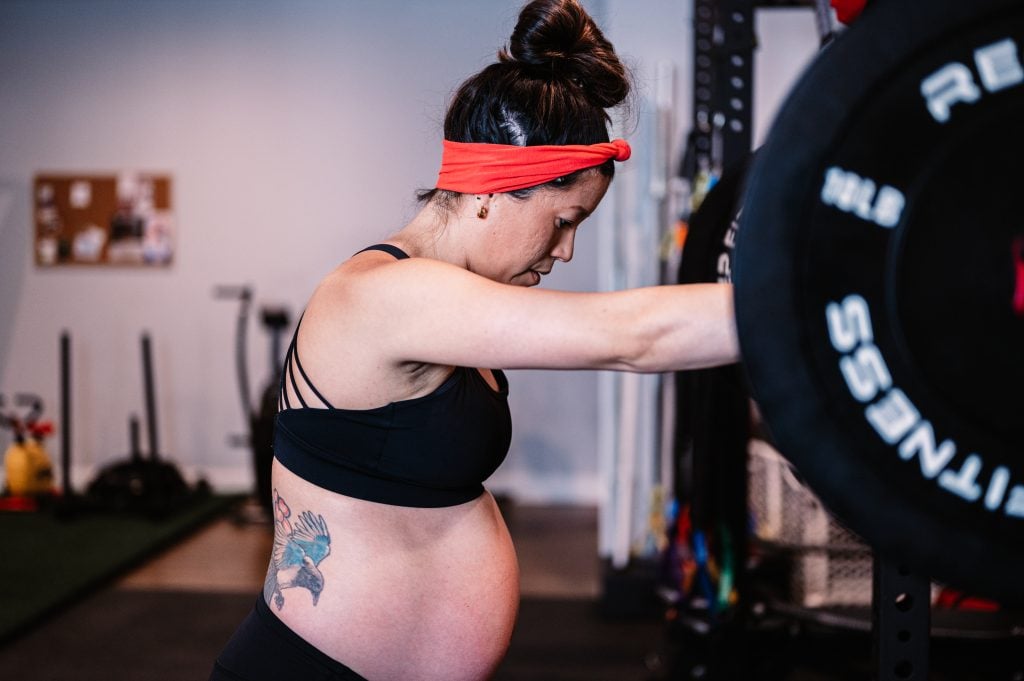
[00:42:34] Gina: If you want more support throughout your pregnancy, we offer a lot of support with our prenatal fitness programs. Our prenatal fitness programs incorporate a lot of birth preparation exercises in addition to pallet for prep as well. Our prenatal fitness programs are offered in two main formats. We have our app based program, which is going to be self paced workouts. This is a great option for somebody that likes to work out at a gym setting. The prenatal strength program is going to sync to your current week of pregnancy and offer different modifications based on what we have found made the most sense for our clients as they progress throughout their pregnancy, because we do also train in person training clients as well.
[00:43:06] Gina: For our other option we have our on demand program which are going to be full length workout videos that you can work out with and
follow at the same time. We offer this as trimester by trimester in addition to our birth prep standalone program as well. So if you already have a workout program that you love, but you want birth prep specific exercises and workouts, we do have a standalone program that is just our birth prep workout program as well.
[00:43:28] Gina: You can check out all of our prenatal fitness programs on our website. They incorporate strength training workouts, birth preparation workouts, pelvic stability, and those pelvic floor exercises across all of the programs, because we want to help you feel strong and confident as you move your body throughout your pregnancy. And you can check out all of our fitness programs on our website at mamastefit.com, and you can use code STORY10 to get 10 percent off any of our online offerings.
[00:43:50] Gina: This podcast is sponsored by Needed, which is a nutrition company specializing in optimizing nourishment in the perinatal timeframe. You can use our code MAMASTEPOD to get 20 percent off your first order or first month of subscription.
Additional Resources
Hip Shift Videos mentioned in this episode:
Prenatal Support Courses


Learn the science of pregnancy and birth to take the mystery of labor away! Understand why you are feeling what you feel, and learn strategies to confidently move through pregnancy and birth!
- 9h+ of Video
- Support Group
- Close Captioning

- 5 Workouts/Week
- Gym Workouts
- Self-Paced

Instructor
GINA
Workout on-demand with our prenatal fitness workout videos! Each workout is 30-40 minutes to follow along as you exercise at the same time!
- Birth Prep
- All Trimesters
- Mobility Work

Instructor
GINA
Find comfort and relief from pelvic girdle pain throughout your pregnancy and postpartum period! This program incorporates myofascial sling focused exercises to stabilize across the pelvic girdle joints.
- 3 Weeks
- On Demand Workout Videos to Follow