When most people think about pelvic floor health, they think about two things: Kegels and deep squats.
But the pelvic floor is far more complex than simply squeezing or stretching it. In fact, relying on only a few common pelvic floor stretches and movements can actually leave parts of your pelvic floor overworked, undertrained, or imbalanced.
To truly improve pelvic floor function, we need to understand how the pelvic floor works, how it connects to the hips and spine, and how different movements target different areas of it.
In this guide, we’ll break down:
What the pelvic floor actually is
Why “just doing Kegels” isn’t enough
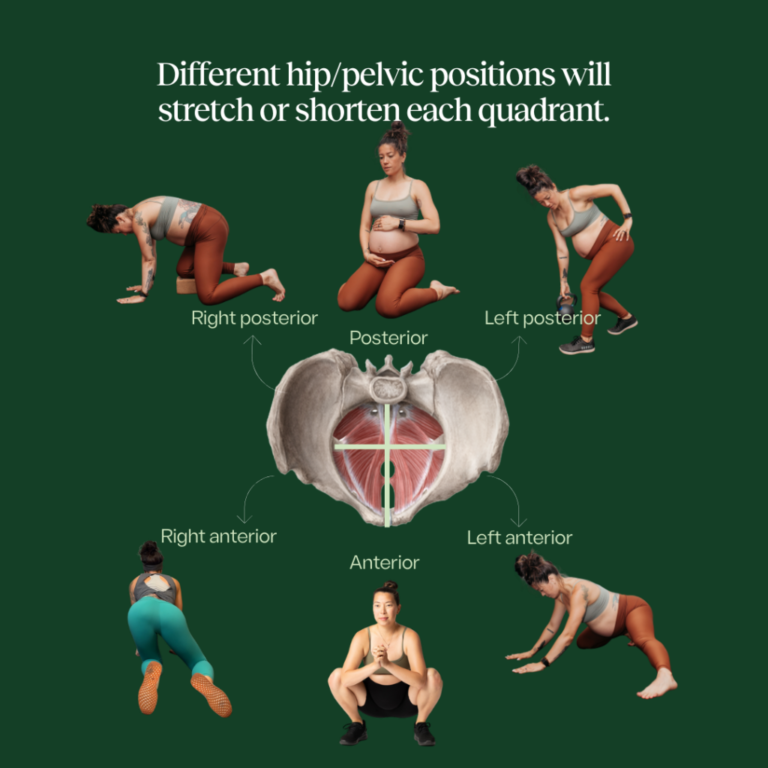
How the pelvic floor has four quadrants
Mobility exercises to release tension
Strength exercises to build balance and support
Let’s dive in.
Subscribe to our YouTube Channelfor more weekly workouts and educational videos! We publish one new workout video and 2-3 educational videos a week on our channel.
Understanding the Pelvic Floor
Your pelvic floor sits at the bottom of your pelvis, forming part of your core canister along with your diaphragm, abdominal muscles, and deep back muscles.
Rather than being a single muscle, the pelvic floor is actually a sling of muscles that attach to the pelvic bones. Because these muscles connect to the hips and pelvis, their tension changes depending on hip position and spinal posture.
This is an important concept.
There is no single exercise that stretches the entire pelvic floor.
There is also no single exercise that strengthens all of it.
Different hip orientations and spinal positions place different amounts of tension on different parts of the pelvic floor.
The Pelvic Floor Has Four Quadrants
A helpful way to understand pelvic floor function is to imagine it divided into four quadrants:
Right anterior (front right)
Left anterior (front left)
Right posterior (back right)
Left posterior (back left)
These quadrants respond differently to various hip positions.
For example:
Front (anterior) pelvic floor
Targeted with wide hip positions
Associated with external hip rotation
Encouraged by spinal extension
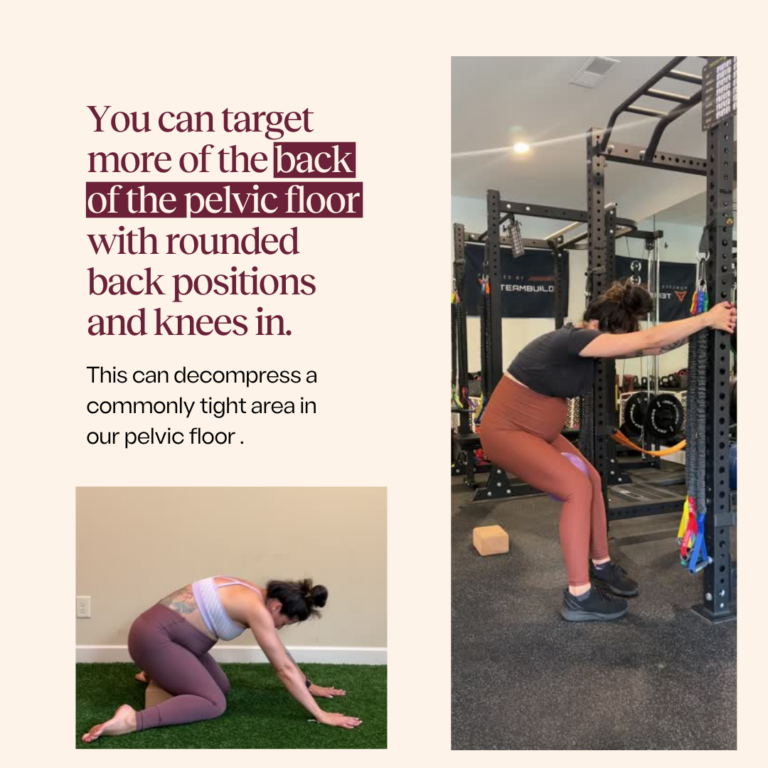
Back (posterior) pelvic floor
Targeted with closed hip positions
Associated with internal hip rotation
Encouraged by spinal rounding
Understanding these patterns helps us use movement intentionally to release tension where it exists and strengthen areas that need support.
To strengthen the posterior pelvic floor, we focus on muscles that promote open hip positions, including:
Glutes
Quads
Helpful exercises include:
Fire hydrants
Lateral band walks
Standing banded abductions
You can also use upright squat or lunge patterns, which naturally recruit the glutes.
A useful technique is ipsilateral loading (holding weight on the same side as the working leg). This encourages external rotation, which supports posterior pelvic floor strength.
Strengthening the Front Half of the Pelvic Floor
For the anterior pelvic floor, we want movements that emphasize:
Internal hip rotation
Inner thigh engagement
Hamstring activation
Exercises include:
Adductor Side Plank (Copenhagen Plank)
Place your top leg on an elevated surface and press through the inner thigh to lift your body.
This activates the adductors, which help support the front pelvic floor.
Hinge-Based Exercises
Examples include:
Single-leg Romanian deadlifts
Hip hinge variations
Holding a weight in the opposite hand of the working leg biases internal rotation, helping strengthen the anterior pelvic floor.
Creating Balance in the Pelvic Floor
Most people have natural asymmetries.
For example, many individuals experience:
Right front pelvic floor overactivity
Left back pelvic floor tension
This is influenced by common posture patterns and organ positioning within the body.
By combining:
Mobility work
Strength training
Asymmetrical movements
we can create a more balanced pelvic floor that supports better movement, reduced pain, and improved function.
When to Seek Additional Support
If you’re struggling with pelvic floor symptoms such as:
Persistent pain
Urinary urgency
Constipation
SI joint discomfort
working with a pelvic floor physical therapist can be extremely helpful.
Professionals trained in movement-based approaches can assess your posture, identify asymmetries, and guide you through targeted exercises.
Final Thoughts
Pelvic floor health is about balance, not just strength or stretching.
Rather than relying on a handful of exercises like Kegels, deep squats, or butterfly pose, a well-rounded approach should include:
Multiple hip positions
Rotation and weight shifts
Targeted strengthening
Intentional breathing patterns
When you train the pelvic floor through a variety of movements and positions, you support the entire core system and improve the way your body moves every day.
Learn the science of pregnancy and birth to take the mystery of labor away! Understand why you are feeling what you feel, and learn strategies to confidently move through pregnancy and birth!
Find comfort and relief from pelvic girdle pain throughout your pregnancy and postpartum period! This program incorporates myofascial sling focused exercises to stabilize across the pelvic girdle joints.
A tight or overactive pelvic floor — especially the back half — often shows up as tailbone pain, constipation, SI joint discomfort, or lower back pain. You may also notice persistent pelvic pain or urinary urgency. If these symptoms sound familiar, working with a pelvic floor physical therapist can help you identify where the tension lives and guide you through targeted exercises.
Can stretching help your pelvic floor?
Yes — but there is no single stretch that lengthens the entire pelvic floor! Your pelvic floor has four quadrants, and different hip positions target different areas: wide positions with external rotation stretch the front half, while closed positions with internal rotation reach the back half. The most effective approach pairs pelvic floor stretches with strengthening work, so you build balance rather than just flexibility.
Is TMJ related to the pelvic floor?
They are connected! The jaw and the pelvic floor develop from connected structures when we are an embryo, which means tension or relaxation at one end can influence the other. If you have jaw tension issues like TMJ, you may tend to hold tension in your pelvic floor too — so releasing your jaw may help release your pelvic floor. We break down this technique in 3 ways to relax your pelvic floor without focusing on your pelvic floor.