



Is your pelvis too small for a vaginal birth? If you’re wondering how do I know if my pelvis is too small, there are quite a few factors to consider before making the bold statement that your pelvis is not adequate for a vaginal delivery.
We get messages frequently on our social media from followers stating that their provider told them that their pelvis was too small for vaginal birth during a pelvic exam. It is important to understand that pelvic assessments during a pelvic exam are not accurate assessments in how birth will go for someone. If your provider makes a statement that your pelvis it too small for birth, it tends to affect our confidence going into birth and can even affect our trust in our provider and chosen birth team!
In most situations, your pelvis is NOT too small, and your baby is NOT too large for birth. Let’s explore the WHY so you can feel confident that you and your baby can work together during your birth!
Before we continue… learn more about how to create space in your pelvis in our childbirth education course! We break down the science of birth, including pelvic anatomy and mechanics!
Learn the labor positions that create more space in your pelvis and WHEN to do those positions!
The best part? This course is completely online and self-paced! And you maintain lifetime access to the course. So, use it for this pregnancy and for future ones!
Learn the science of pregnancy and birth to take the mystery of labor away! Understand why you are feeling what you feel, and learn strategies to confidently move through pregnancy and birth!
- 9 hours of on-demand video
- Lifetime Access of E-Course
- Watch on Mobile Device
How Do I Know if My Pelvis Is Too Small? Factors to Consider
Before we can say that your pelvis is too small (and it is likely it is not too small) we need to consider a few things:
- How was your pelvis assessed? Were you lying flat on your back with your knees wide? Was it a static position, or was your pelvis assessed in various positions? Likely, you were flat on your back, knees wide, in a static position.
- Your pelvis is dynamic and has the ability to change shape and diameter with movement. This is more so during pregnancy.
- Your baby’s skull is dynamic and has the ability to change shape and diameter based on pressure in the pelvis and vaginal canal.
You and your baby work together to facilitate the labor process!
If you want to learn more about labor biomechanics, and how you can create space in your pelvis for your baby, check out our childbirth education courses and labor biomechanics course!
This course includes our 90-minute labor biomechanics webinar recording plus our 24-page labor biomechanics quick reference guide.
- 90-min webinar
- 24-Page E-Book
- Upcoming Live Webinar & Q&A
- Watch on Mobile Device
1. How was your pelvis assessed?
The first consideration is how was your pelvis even assessed? Likely, you were flat on your back with your knees wide in a static position.
This type of assessment does not take into consideration that the pelvis is changes shape and your baby’s position, skull, and head position can influence their presentation and size.

In summary, unless you were put into various positions that changed the shape and diameter of each pelvic level (inlet, upper and lower midpelvis, and outlet), then it likely was not an accurate assessment of your pelvic size and capability.
And even if you were put in various positions, this assessment still does not account for your baby’s ability to influence their presentation and size during labor.
Now, there is something to knowing which pelvic levels are easier for you to open and which ones may be more challenging as a predictor of how labor may go for you. This is more of an assessment that a physical therapist may be able to make depending on their skill, or something you can determine by understanding each pelvic level and your own mobility.
In our prenatal fitness programs, we incorporate pelvic opening workouts specific to each pelvic level. This could be a way for you to better explore which movements feel more accessible and which ones may need some more focus as you prepare for your birth.
2. The pelvis can change shape and diameter with movement.
Now that we have determined that a static assessment of your pelvis is not an accurate representation of how well it can open during labor, let’s explore how the pelvis can change shape to create space for baby during birth!
The pelvis has three main levels that each open in a different way. There is no one movement that will open the entire pelvis!
The pelvic levels are:
- Inlet, the top of the pelvis. Opens more with a front to back tilting of the pelvis and external rotation in the femurs, or wide knees.
- Midpelvis, the middle of the pelvis. This has two sub-levels upper and lower, that open more with asymmetrical movements.
- Outlet, the bottom of the pelvis. Opens more with internal rotation of the femurs, or knees in, and the sacrum moves out of the way.
Each pelvic level opens more with different movement patterns! If you were assessed on your back, with your knees wide, this would potentially be opening the inlet of the pelvis more side to side but closes the pelvic outlet.
This means that your pelvic outlet appears smaller than usual due to it being in a closed position for a pelvic assessment. Another reason why a static on your back assessment was probably not helpful nor accurate.
Movement is HUGE for opening the pelvis! In our preparation for birth, ensuring that we have the movement capability to open each level of the pelvis and find different laboring positions is important!
Our prenatal fitness programs incorporate exercises that focus on various planes of motion so that you can stay strong and comfortable throughout your pregnancy, but also prepare for birth and moving into different labor positions!
3. Your baby's skull can change shape to fit through the pelvis!
Another factor to consider on if your pelvis is “adequate” for vaginal birth is that your baby also can adjust their position (of their body and head) and their skull can mold and change shape too!
It is not only your pelvis that accommodates for birth! Your baby plays a huge role too!
Your baby’s skull has sutures on the front and back that allow the skull bones to fold over one another as the baby descends through the pelvis.
Sometimes if you push for a long time, your baby may have a cone head at birth, which is normal and will go down in a few hours, days, or short weeks.
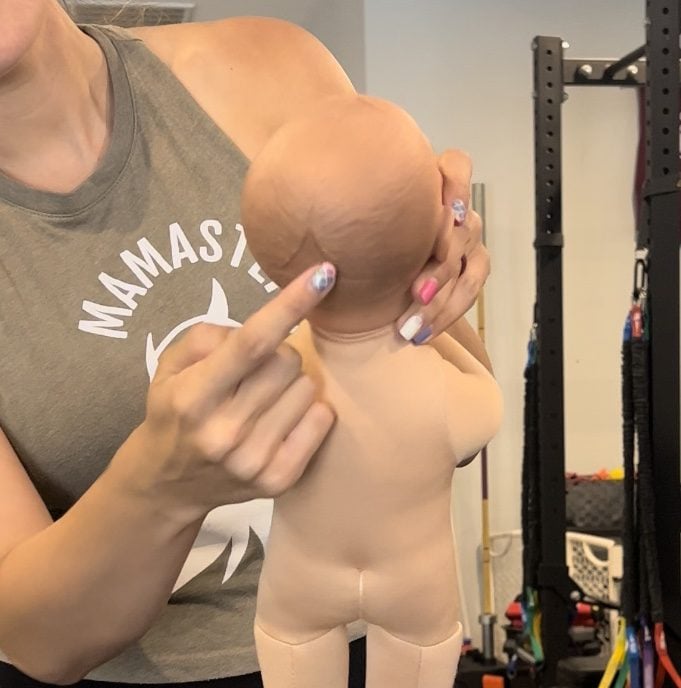
In addition to the skull bones being able to literally change shape to accommodate for the pelvis, your baby’s position, both of their body and their head, can influence how large or small they present!
If your baby tucks their chin to their chest, they present smaller than if they are looking forward or extending in their head!
In addition, your baby’s head alignment to each pelvic level matters too! Think of it like a square peg with a square hole: they are meant to fit, but if the square peg is not aligned, it may appear that it does not fit. But once we rotate the square peg, it will easily slide into the square hole. Same concept! Baby needs to align to the pelvic level, so they fit more easily, as well.
Your pelvis is NOT too small! Your pelvis and baby work together in a dynamic way during birth!
In summary, your pelvis is probably not too small because your pelvic assessment was probably not an accurate representation of your pelvis’s ability to open and change shape.
Your pelvis is dynamic! Movement can help increase pelvic diameters, and each pelvic level opens with different movement patterns.
In addition, your baby can literally change the shape of their skull and present as a different size depending on their head position and their alignment to the pelvic levels!
Labor is an interplay between you and your baby! There is a lot more than static positions!
Don’t miss out on this incredible opportunity to learn how to optimize your pelvic biomechanics and achieve a smoother, more comfortable labor… and MUCH MORE! Join our childbirth education course today!
Prepare For Your Birth: Our Courses


Learn the science of pregnancy and birth to take the mystery of labor away! Understand why you are feeling what you feel, and learn strategies to confidently move through pregnancy and birth!
- 9h+ of Video
- Support Group
- Close Captioning

- 5 Workouts/Week
- Gym Workouts
- Self-Paced

Instructor
GINA
Workout on-demand with our prenatal fitness workout videos! Each workout is 30-40 minutes to follow along as you exercise at the same time!
- Birth Prep
- All Trimesters
- Mobility Work

Instructor
GINA
Find comfort and relief from pelvic girdle pain throughout your pregnancy and postpartum period! This program incorporates myofascial sling focused exercises to stabilize across the pelvic girdle joints.
- 3 Weeks
- On Demand Workout Videos to Follow