



Table of Contents
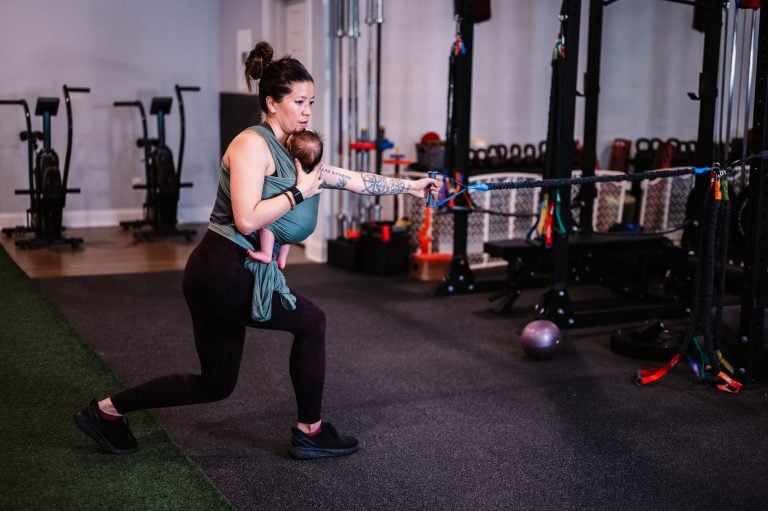
Welcome to the MamasteFit Blog! If you’re looking to rebuild strength and stability after childbirth, this postpartum leg workout is designed with you in mind. Today, we’re diving into a lower-body workout inspired by part A of Workout #17 from our Postpartum On-Demand Program. This session includes 3 rounds of dumbbell box squats, lateral step-ups with crossover step-downs, and pelvic floor-focused exercises with a mini band. In this detailed guide, we break down each movement to help you reconnect with your body, restore pelvic floor function, and regain single-leg stability—all at your own pace.
Subscribe to our YouTube Channel for more weekly workouts and educational videos! We publish one new workout video and 2-3 educational videos a week on our channel.
What You’ll Need
Before you start, gather these simple pieces of equipment:
Light to medium weights: Use dumbbells to add resistance to your squats.
A sturdy box or elevated surface: This will serve as your target for squats and step-ups.
A mini band: Ideal for engaging your glutes during the standing hip shift.
Optional support: A wall or chair can provide extra balance when needed.
These tools help modify each exercise to match your current strength level and allow you to progress over time.
The Postpartum Leg Workout
1. Dumbbell Box Squats
Purpose:
Build lower-body strength while keeping your movements controlled to protect your pelvic floor.
How to Do It:
Setup: Stand in front of a box or elevated surface holding your dumbbells at shoulder level.
Movement: Inhale and lower your body until you gently touch the box. Keep your weight in your feet to avoid “sitting back” onto the box. Continue for 30 seconds.
Key Cue: Exhale while lifting up and engaging your pelvic floor.
Modification Tip: If you feel pelvic heaviness, adjust the box height, reduce the weight, or simply focus on your breathing rhythm.


2. Lateral Step-Up and Crossover Step-Down
Purpose:
Enhance single-leg stability and activate your hip muscles through dynamic movement.
How to Do It:
Setup: Position yourself beside the box or step-up surface.
Movement: Step up onto the box with the food closest to the box. For a crossover, have your trailing leg step down and then move behind your body. If you’re new to this, try a simpler lateral step-up—just stepping up and down without the crossover movement. Continue for 30 seconds, then switch sides.
Key Cue: Keep your movement controlled and focus on your balance.
Switch Sides: Repeat the same steps on the opposite side to maintain muscle balance and coordination.


3. Pelvic Floor Release and Standing Hip Shift (with Mini Band)
Purpose:
Improve glute activation and hip stability while offering a gentle pelvic release.
How to Do It:
Setup: Place the mini band just above your knees.
Movement: Shift your weight to one leg while stepping the other leg back. Press the knee of your trailing leg out, engaging your glutes. Hold for 30 seconds and then move into the fire hydrants before switching to the other side.
Key Cue: Think about rotating your belly toward your thigh to maximize the stretch and activation.
Variation: If the mini band feels too intense, perform the movement without it until you build strength.


4. Standing Fire Hydrant
Purpose:
Focus on isolated glute activation, supporting overall hip stability.
How to Do It:
Setup: Stand firmly with support if necessary (using a wall or chair).
Movement: With weight on your supporting leg, lift the other leg out to the side and then slowly bring it back in. Continue for 30 seconds.
Key Cue: Maintain a steady balance throughout and ensure your knee remains aligned with your ankle.
Tip: If balance is a challenge, use support until you feel more confident.


 App program · 16 weeks
Postpartum Return to Fitness
Sixteen weeks of rebuilding, four strength sessions a week, with a vaginal or cesarean recovery track and follow-along videos for the first six weeks.
Learn more
App program · 16 weeks
Postpartum Return to Fitness
Sixteen weeks of rebuilding, four strength sessions a week, with a vaginal or cesarean recovery track and follow-along videos for the first six weeks.
Learn more
 Video course · 3+ hours
C-Section Scar Mobilization
Over three hours of video on scar mobilization technique and movement for recovery, plus a live webinar every other month you can attend or watch back.
Learn more
Video course · 3+ hours
C-Section Scar Mobilization
Over three hours of video on scar mobilization technique and movement for recovery, plus a live webinar every other month you can attend or watch back.
Learn more
 App program · 16 weeks
After C-Section Recovery Workout
Sixteen weeks of cesarean-specific rebuilding with scar mobilization included — developed with physical therapist and two-time c-section mom Casey.
Learn more
App program · 16 weeks
After C-Section Recovery Workout
Sixteen weeks of cesarean-specific rebuilding with scar mobilization included — developed with physical therapist and two-time c-section mom Casey.
Learn more
Putting It All Together
For today’s workout (labeled as Part A), perform 3 rounds of this sequence:
Box Squats: Begin with the dumbbell box squats. Focus on controlled movement—inhale as you lower down, exhale as you engage your pelvic floor to rise.
Step-Ups: Move to lateral step-ups with a crossover step-down, maintaining stability and focus on hip rotation. If this movement is too much, focus only on lateral step-ups and step-downs.
Pelvic Floor Release with Mini Band: Integrate the standing hip shift to engage your glutes, adding a mini band for an extra challenge.
Fire Hydrants: Conclude with the standing fire hydrants to fine-tune your hip stability and balance.
Remember, the quality of each movement matters more than the quantity. Feel free to take breaks, use modifications, and most importantly, celebrate every step of your progress.
Final Thoughts
Postpartum recovery is a journey, and each workout is a step towards reclaiming your strength and confidence. By following this carefully designed routine, you’re not only working on physical fitness but also honoring your body’s incredible ability to heal and transform.
If you liked this workout, checkout our 6-part Postpartum Core Workout Series! For more detailed workouts and guidance on your postpartum fitness journey, explore MamasteFit’s online programs and use code YOUTUBE10 for a discount on our online offerings, including prenatal programs, postpartum recovery, and educational courses.
Stay active, be kind to yourself, and enjoy every moment of your transformation!
 App program
Train for a Marathon After Baby
Progressive run workouts and strength training from 5K to the marathon finish — long runs, tempo work, easy miles, and a weekly pelvic stability session.
Learn more
App program
Train for a Marathon After Baby
Progressive run workouts and strength training from 5K to the marathon finish — long runs, tempo work, easy miles, and a weekly pelvic stability session.
Learn more
 App program · 64 days
Postpartum Return to Running
Sixty-four training days, four sessions a week, with plyometrics and running programming beginning at week seven — a structured way back to your first run.
Learn more
Membership · ongoing
Beyond Postpartum Strength Training
An ongoing subscription with a new training cycle every 6 to 10 weeks — strength endurance, max strength, then power, with deload weeks and running add-ons.
Learn more
App program · 64 days
Postpartum Return to Running
Sixty-four training days, four sessions a week, with plyometrics and running programming beginning at week seven — a structured way back to your first run.
Learn more
Membership · ongoing
Beyond Postpartum Strength Training
An ongoing subscription with a new training cycle every 6 to 10 weeks — strength endurance, max strength, then power, with deload weeks and running add-ons.
Learn more